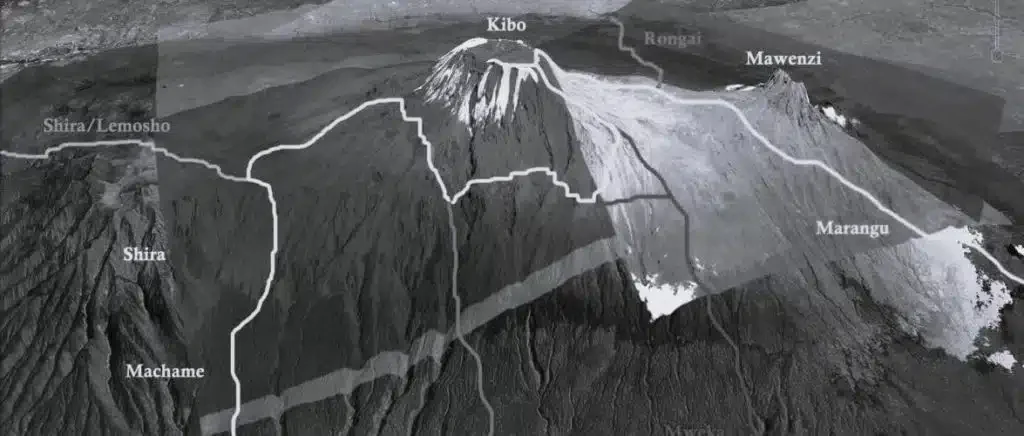
Shira Route Kilimanjaro: Itinerary, Difficulty & Cost

Choose the Right Kilimanjaro Route

The right route makes all the difference on Kilimanjaro.We help you plan your climb based on:

Plan Your Kilimanjaro Climb

Choosing the right route is key to your success.
Explore these guides to prepare properly:

OUR CATEGORIES

Shira Route Kilimanjaro: Remote Western Trail with Open Views

Climbing Kilimanjaro via the Shira Route offers one of the most scenic and remote experiences on the mountain, but it also comes with a serious altitude challenge.
 
Unlike most Kilimanjaro routes that begin lower in the rainforest, the Shira Route starts high on the western side of the mountain, around the Shira Plateau. This gives climbers wide-open views from the beginning, but it also means your body has less time to adjust during the first stage of the trek.
 
The Shira Route is best suited for experienced trekkers, climbers who have already spent time at altitude, or travelers who want a quieter trail with dramatic scenery. For most first-time climbers, the Lemosho Route is often a better choice because it starts lower and allows a more gradual acclimatization profile.
 
Before choosing this route, it is important to understand the itinerary, altitude profile, difficulty, cost, and how it compares with other Kilimanjaro routes.

Quick Answer: Is the Shira Route Good for Kilimanjaro?

The Shira Route is a scenic and quiet Kilimanjaro route that starts on the western side of the mountain and crosses the Shira Plateau before joining the southern circuit toward Barranco, Barafu, and Uhuru Peak.
 
It is a beautiful route, but it is not the best choice for everyone. The main challenge is the high starting altitude, which gives your body less time to adjust compared with routes that begin lower, such as Lemosho.
 
The Shira Route is best for experienced hikers, climbers who have already acclimatized, or trekkers who want remote scenery and fewer crowds. First-time climbers should compare it carefully with Lemosho before booking.

Why Choose the Shira Route?

The Shira Route is one of the quieter trails on Mount Kilimanjaro. It approaches the mountain from the west and gives climbers open views across the Shira Plateau early in the trek.
 
The route is known for:
  • Remote western approach
  • Wide-open plateau scenery
  • Fewer crowds than Machame or Marangu
  • Dramatic views of Kibo and volcanic landscapes
  • Access to famous landmarks such as Lava Tower and Barranco Wall
However, the Shira Route also has a major drawback: it starts high. This can make acclimatization more difficult, especially for climbers arriving from low altitude. Because of this, the route is better suited to trekkers with previous altitude experience or those who are already well acclimatized before the climb.
 
For many first-time climbers, the Lemosho Route offers a better balance of scenery, remoteness, and acclimatization.
Lava Tower on the Shira Route of Mount Kilimanjaro with a trekker standing near the volcanic rock formation.
Lava Tower is one of the most important acclimatization points on the Shira Route before descending toward Barranco Camp.

Table of Contents

Shira Route Overview

Feature Shira Route Details
Route duration Usually 7 days
Starting point Western Kilimanjaro / Shira Plateau area
Highest point Uhuru Peak, 5,895 m / 19,341 ft
Difficulty Challenging because of the high starting altitude
Scenery Open plateau views, volcanic landscapes, Lava Tower, Barranco Wall, and southern circuit scenery
Best for Experienced trekkers, altitude-prepared climbers, and travelers who want a quieter western approach
Main drawback Less gradual acclimatization than Lemosho because the route starts high

Shira Route Days and Elevation Profile

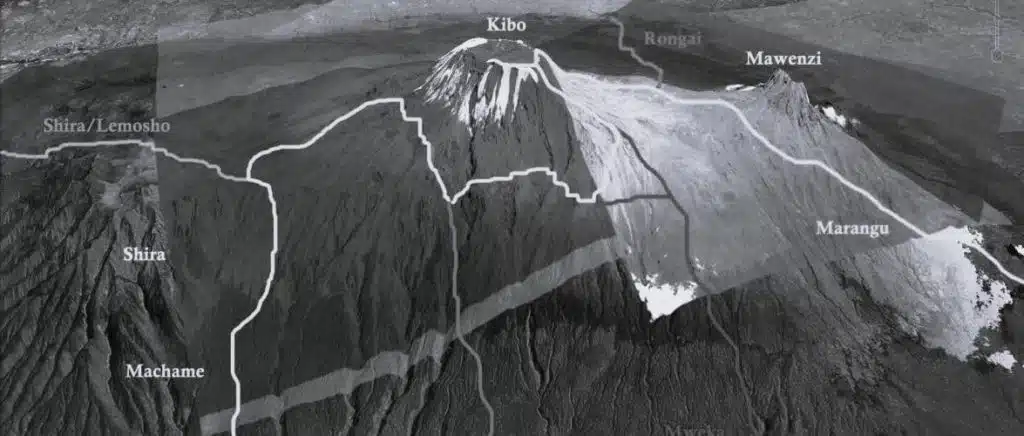
Shira Route map on Mount Kilimanjaro showing trail path from Shira Plateau to Uhuru Peak via Barranco and Barafu Camps
Begins at high altitude on the Shira Plateau and joins the Lemosho-Machame trail to the summit.

Shira Route Days and Elevation Profile

The Shira Route begins high on the western side of Kilimanjaro and crosses the Shira Plateau before joining the same southern circuit used by parts of the Lemosho and Machame routes.
 
This route usually follows a 7-day itinerary, passing through Shira 1 Camp, Shira 2 Camp, Lava Tower, Barranco Camp, Karanga Camp, Barafu Camp, Uhuru Peak, and Mweka Gate.
 
Because the route starts at a higher elevation than most Kilimanjaro routes, acclimatization must be taken seriously from the first day.

7-Day Shira Route Itinerary

Day 1: Shira Gate to Shira 1 Camp

Altitude: 3,600 m – 3,610 m
Hike Time: 1–2 hours
 
Your adventure begins high on the Shira Plateau  unlike most routes that start in the rainforest. This short first day helps your body begin adjusting to altitude while you enjoy wide, open views of the mountain and surrounding plains.

Day 2: Shira 1 to Shira 2 Camp

Altitude: 3,610 m – 3,850 m
Hike Time: 4–5 hours
 
A steady and gradual trek across alpine terrain. The landscape becomes more rugged and exposed, with fewer plants and more volcanic rock formations. This is an important day for building rhythm and pacing.

Day 3: Shira 2 to Barranco Camp (via Lava Tower)

Altitude: 3,850 m → 4,640 m → 3,960 m
Hike Time: 6–7 hours
 
One of the most important days for acclimatization. You climb up to Lava Tower (4,640 m), where many trekkers begin to feel the effects of altitude, before descending to Barranco Camp.
This “climb high, sleep low” strategy helps your body adapt and improves your chances of reaching the summit.
 
Read more about Kilimanjaro acclimatization if you want to understand how “climb high, sleep low” helps your body adjust.

Day 4: Barranco Camp to Karanga Camp

Altitude: 3,960 m → 4,035 m
Hike Time: 4–5 hours
 
Start the day by climbing the famous Barranco Wall — a steep but non-technical scramble that offers incredible views. After reaching the top, the trail continues through valleys and ridges toward Karanga Camp.

Day 5: Karanga Camp to Barafu Camp

Altitude: 4,035 m → 4,673 m
Hike Time: 3–4 hours
 
A shorter trekking day as you make your way to Barafu Camp, the base camp for your summit attempt. After lunch, you’ll rest, hydrate, and prepare your gear before an early night.

Day 6: Summit Day – Barafu Camp to Uhuru Peak to Mweka Camp

Altitude: 4,673 m → 5,895 m → 3,100 m
Hike Time: 12–14 hours
The most challenging and rewarding day of your climb. You’ll begin your ascent around midnight, trekking in cold, dark conditions toward Stella Point, then continue to Uhuru Peak , the highest point in Africa.After celebrating at the summit, you descend back to Barafu for a short rest, then continue down to Mweka Camp.
 
Understand what to expect in our Kilimanjaro summit day guide 

Day 7: Mweka Camp to Mweka Gate

Altitude: 3,100 m → 1,640 m
Hike Time: 3–4 hours
 
Your final descent takes you through lush rainforest terrain. At the gate, you’ll receive your summit certificate marking the end of your Kilimanjaro adventure.

Shira Route Difficulty and Acclimatization

The Shira Route is considered a challenging Kilimanjaro route mainly because it starts high on the mountain. Beginning around the Shira Plateau means climbers gain altitude quickly at the start of the trek, which gives the body less time to adjust.

The walking itself is not technical. You do not need ropes or climbing equipment, but you should be comfortable with multi-day trekking, long walking hours, and changing mountain conditions.

The hardest parts of the Shira Route are:
  • High starting altitude
  • Long trekking days after joining the southern circuit
  • Lava Tower acclimatization day
  • Barranco Wall section
  • Summit night from Barafu Camp
  • Long descent after reaching Uhuru Peak
This route is better for climbers who already have hiking experience or who have spent time at altitude before the trek. If you are a first-time climber and altitude is a major concern, compare Shira carefully with the Lemosho Route, which starts lower and offers a more gradual beginning.

Shira Route Cost

The Shira Route usually costs more than shorter Kilimanjaro routes because it is commonly done over 7 days and requires full mountain crew support, park fees, camping equipment, meals, transport, and safety logistics.
 
The final price depends on the number of climbers, service level, inclusions, guide and porter support, airport transfers, accommodation before and after the climb, and whether the climb is private or group-based.
 
Shira is not usually chosen as the cheapest Kilimanjaro option. It is chosen for scenery, remoteness, and the western approach. If price is your main concern, remember that the cheapest climb is not always the safest or best value, especially on a route where altitude management matters from the beginning.
 
For a full breakdown of park fees, crew costs, inclusions, exclusions, and extra expenses, read our main guide to Kilimanjaro climb cost.
View of Kibo Peak from Karanga Camp on the Shira Route with rocky alpine terrain in the foreground.
From Karanga Camp, the Shira Route offers dramatic views of Kibo before climbers continue toward Barafu and the summit.

Best Time to Climb the Shira Route

The best time to climb the Shira Route is during Kilimanjaro’s drier trekking seasons, when trail conditions are more stable and mountain views are clearer.

The best months are usually:
  • January to early March
  • June to October

January to early March can offer warmer conditions and fewer climbers. June to October is one of the most popular trekking periods because of drier weather and clearer skies.

The rainier periods, especially March to May and parts of November, can make the trail wetter, colder, and less comfortable. Since Shira starts high and crosses exposed terrain early, weather conditions can feel harsher than on lower forest-start routes.

For a full seasonal breakdown, read our best time to climb Kilimanjaro guide.

Shira Route Pros and Cons

Pros Cons
Quiet western approach with fewer climbers High starting altitude can make acclimatization harder
Beautiful open views across the Shira Plateau Not ideal for many first-time climbers
Joins the scenic southern circuit toward Barranco and Barafu Less gradual beginning than Lemosho
Passes famous landmarks such as Lava Tower and Barranco Wall Requires serious attention to pacing and altitude symptoms

What Makes the Shira Route Unique?

The Shira Route is unique because it begins high on the western side of Kilimanjaro and gives climbers immediate access to the open landscapes of the Shira Plateau.
 
Unlike routes that begin in dense rainforest, Shira starts with wide views, exposed terrain, and a strong sense of remoteness from the first day. It later joins the southern circuit, meaning climbers still experience major Kilimanjaro highlights such as Lava Tower, Barranco Wall, Barafu Camp, Stella Point, and Uhuru Peak.
 
The route’s biggest strength is scenery. Its biggest weakness is the high starting altitude

Is the Shira Route Right for You?

The Shira Route may be right for you if you want a quieter western approach, wide-open scenery, and a route that feels more remote at the beginning.

Choose the Shira Route if you:
  • Have previous high-altitude trekking experience
  • Want fewer crowds than Machame or Marangu
  • Prefer open plateau views and volcanic scenery
  • Are comfortable with a high starting altitude
  • Want to join the scenic southern circuit toward Barranco and Barafu
You may be better suited to another route if you are a first-time climber, worried about altitude, or want a more gradual start. In that case, the Lemosho Route is often a stronger choice because it starts lower while still offering excellent scenery.
Sweeping view of Mount Kilimanjaro’s Kibo Peak from Karanga Camp on the Shira Route, with rocky alpine terrain under a bright morning sky | Kili Quests
From Karanga Camp, Shira Route trekkers enjoy this dramatic view of Kibo — a reminder of the summit that awaits beyond Barafu Camp.

Shira Route vs Lemosho Route

The Shira and Lemosho routes both approach Kilimanjaro from the west and later join the southern circuit. The main difference is the starting altitude.
 
The Shira Route starts higher on the Shira Plateau, which gives climbers open views quickly but makes the first stage more demanding for acclimatization. The Lemosho Route starts lower and allows a more gradual beginning through forest and moorland zones.
 
For most first-time climbers, Lemosho is usually the better option because it offers similar scenery with a stronger acclimatization profile. Shira is better suited to trekkers who already have altitude experience or who specifically want the high western plateau start.

Frequently Asked Questions About the Shira Route

Where does the Shira Route start on Kilimanjaro?

The Shira Route starts on the western side of Mount Kilimanjaro near the Shira Plateau. Unlike routes that begin lower in the rainforest, Shira starts at a higher elevation, which gives climbers open views early but makes acclimatization more challenging.

Why is the Shira Route considered difficult?

The Shira Route is considered difficult mainly because of its high starting altitude. Climbers begin the trek already high on the mountain, which gives the body less time to adjust compared with routes that start lower.
 
The walking is not technical, but the altitude profile makes pacing and acclimatization very important.

How many days does the Shira Route take?

The Shira Route is usually completed in 7 days. This gives climbers time to cross the Shira Plateau, pass Lava Tower, continue through Barranco and Karanga, summit from Barafu Camp, and descend through Mweka Gate.

Is the Shira Route good for beginners?

The Shira Route is not usually the best choice for beginners because it starts high and can make acclimatization harder. Beginners are often better suited to routes with a more gradual start, such as Lemosho.
 
Shira can still be a good option for trekkers who already have hiking experience or have spent time at altitude before the climb.

Is Shira better than Lemosho?

For most first-time climbers, Lemosho is usually better than Shira because it starts lower and gives the body more time to adjust. Shira is quieter and scenic, but the high starting altitude makes it more demanding from the beginning.
 
The better route depends on your experience, fitness, altitude background, and comfort with a high start.

Climb the Shira Route With Kili Quests

The Shira Route is a beautiful but demanding Kilimanjaro trail. Its remote western approach and open plateau views make it memorable, but the high starting altitude means the route must be planned carefully.
 
At Kili Quests, we help you choose the right Kilimanjaro route based on your experience, fitness, travel dates, and acclimatization needs. If Shira is the right fit, our local mountain team will guide you with careful pacing, safety checks, proper support, and a clear summit strategy.
 
If you are unsure whether Shira or Lemosho is better for you, contact our team for honest route advice before booking.

Related Articles

Umbwe Route Kilimanjaro: Itinerary & Difficulty

Plan Your Umbwe Route Climb

The Umbwe Route is steep, direct, and built for experienced climbers.
Get expert advice and a personalized plan for your climb.

Kilimanjaro Planning Guides

Make the right decision before your climb:
Compare all Kilimanjaro routes

OUR CATEGORIES

Umbwe Route Kilimanjaro: Itinerary & Difficulty

The Umbwe Route is the steepest and most direct trail on Mount Kilimanjaro. It climbs quickly from the southern rainforest toward Barranco Camp before joining the southern circuit route to Barafu, Stella Point, and Uhuru Peak.
 
This route is quiet, scenic, and adventurous, but it is also one of the hardest ways to climb Kilimanjaro. The fast elevation gain gives your body less time to adjust, which makes acclimatization the biggest challenge on Umbwe.
 
For that reason, the Umbwe Route is best for experienced trekkers who are already comfortable with steep terrain, long hiking days, and high-altitude conditions. Most first-time climbers are better served by longer routes such as Machame Route Kilimanjaro, Lemosho Route Kilimanjaro, or the Northern Circuit.
 
Still comparing your options? Read our full Kilimanjaro routes comparison guide before choosing Umbwe.

Quick Answer: Is the Umbwe Route Good for Kilimanjaro?

The Umbwe Route is good only for experienced trekkers who want a steep, quiet, and direct climb on Kilimanjaro. It is not the best route for beginners because it gains altitude quickly and gives the body less time to acclimatize.
 
Umbwe is best for climbers who already have strong fitness, hiking experience, and confidence at altitude. If your main goal is better acclimatization and a more comfortable summit profile, routes such as Lemosho, Machame, or the Northern Circuit are usually better choices.
A climber stands on snow-covered terrain near Stella Point on Mount Kilimanjaro, holding a cup and trekking pole while overlooking the crater rim.
A trekker pauses to take in the spectacular view near Stella Point, where Kilimanjaro’s crater rim opens up into a vast, icy alpine landscape.

Table of Contents

Why the Umbwe Route Is Unique

The Umbwe Route is the most direct path up Kilimanjaro, ascending quickly through the southern slopes before joining the southern circuit near Barranco Camp.Unlike longer routes, Umbwe prioritizes speed over gradual acclimatization. This creates a more intense trekking experience, with fewer crowds and a strong sense of wilderness.However, the fast ascent makes it one of the riskiest routes in terms of altitude adaptation.

Umbwe Route Overview

Feature Details
Route duration Usually 6 days
Approximate distance About 53 km / 33 miles
Starting point Umbwe Gate
Finish point Mweka Gate
Highest point Uhuru Peak, 5,895 m / 19,341 ft
Difficulty Very challenging
Acclimatization profile Poorer than longer routes because of fast elevation gain
Best for Experienced trekkers who want a steep, quiet, direct route
Not ideal for Beginners, nervous hikers, or climbers who need more acclimatization time
Not sure if Umbwe is the right choice? Compare all options in our complete Kilimanjaro routes guide to find the best route for your experience level.

Umbwe Route Days and Elevation Profile
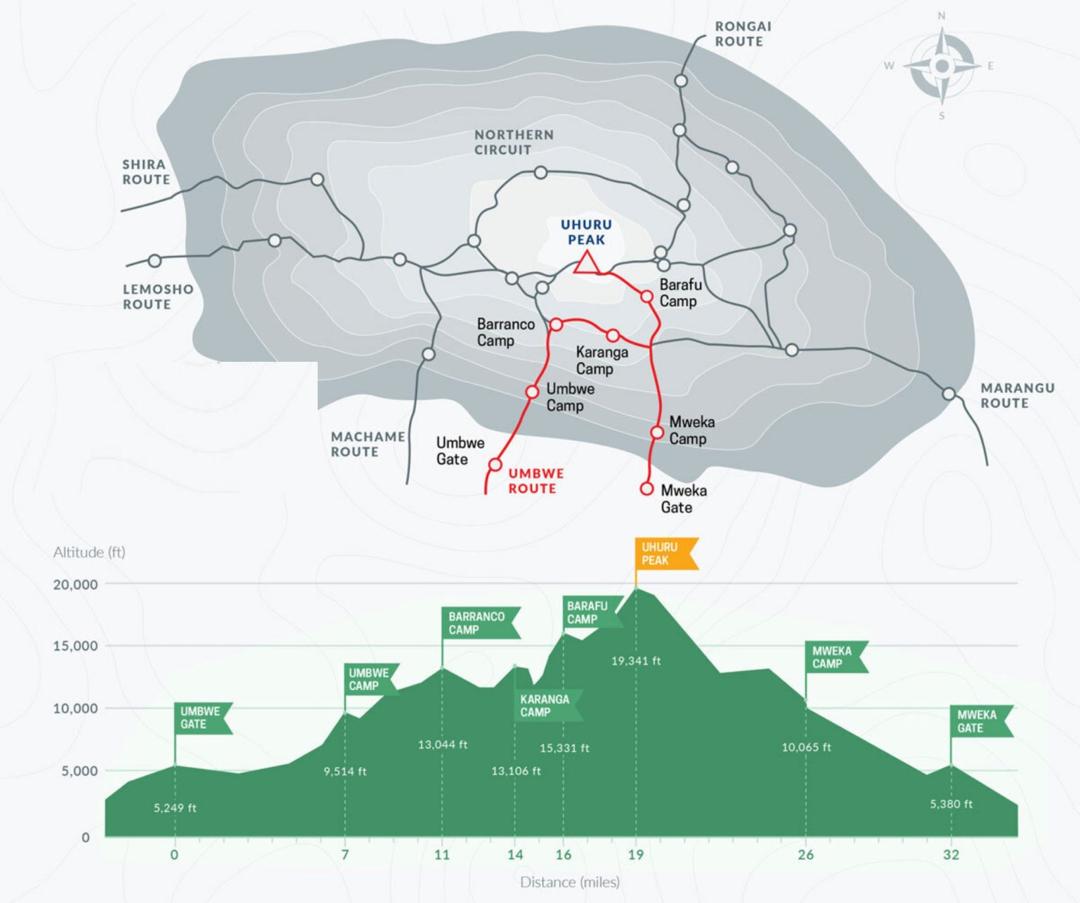
Umbwe Route map on Mount Kilimanjaro showing trail path, elevation chart, and key camps to Uhuru Peak
Kilimanjaro’s steepest and most direct route, ascending via Barranco and Karanga Camps.

Umbwe Route Camps and Elevation Gain

The Umbwe Route gains altitude quickly in the first two days, which is why it is considered one of the hardest Kilimanjaro routes for acclimatization. The climb starts at Umbwe Gate, passes through Umbwe Cave Camp, then joins the southern circuit near Barranco Camp before continuing toward Barafu and the summit.

Day Route Section Sleeping Altitude Acclimatization Note
Day 1 Umbwe Gate to Umbwe Cave Camp 2,850 m / 9,350 ft Steep first day through rainforest with fast elevation gain.
Day 2 Umbwe Cave Camp to Barranco Camp 3,900 m / 12,795 ft Big altitude jump; this is where acclimatization becomes serious.
Day 3 Barranco Camp to Karanga Camp 3,995 m / 13,106 ft Shorter altitude gain; useful recovery and adaptation day.
Day 4 Karanga Camp to Barafu Camp 4,650 m / 15,255 ft High-altitude base camp before summit night.
Day 5 Barafu Camp to Uhuru Peak, then down to Mweka Camp 3,100 m / 10,170 ft Longest and hardest day; summit push followed by major descent.
Day 6 Mweka Camp to Mweka Gate Exit at 1,640 m / 5,380 ft Final forest descent and certificate collection.

6-Day Umbwe Route Itinerary

The 6-day Umbwe itinerary is the standard version of this route, but it is also one of the most demanding ways to climb Kilimanjaro. The trail gains altitude quickly in the first two days before joining the southern circuit near Barranco Camp.
 
Because the route is steep and short, slow pacing and honest altitude monitoring are very important from the beginning.

Day 1: Umbwe Gate to Umbwe Cave Camp

The climb begins at Umbwe Gate, where your team completes park registration before entering the rainforest. The trail starts steeply and climbs through dense forest along a narrow ridge. This first day is more demanding than the opening day on many other Kilimanjaro routes because there are fewer flat sections.
 
The forest can be humid, muddy, and slippery after rain, so steady pacing is important. You will sleep at Umbwe Cave Camp, surrounded by thick vegetation and a quiet mountain atmosphere.
  • Altitude: 1,800 m to 2,850 m
  • Hiking time: 5–6 hours
  • Zone: Rainforest
  • Camp: Umbwe Cave Camp

Day 2: Umbwe Cave to Barranco Camp

Day 2 continues steeply as the trail leaves the rainforest and enters the moorland zone. The views begin to open as you climb higher, but the altitude gain is serious. This is one of the key reasons Umbwe is considered a difficult route.
 
By the time you reach Barranco Camp, the Umbwe Route joins the southern circuit used by routes such as Machame and Lemosho. From here, the trail becomes more familiar, but the early altitude gain has already made acclimatization more demanding.
  • Altitude: 2,850 m to 3,900 m
  • Hiking time: 5–6 hours
  • Zone: Moorland
  • Camp: Barranco Camp
This is where altitude can start to affect some climbers. Read our Altitude Sickness on Kilimanjaro guide so you understand common symptoms and warning signs before choosing a fast route like Umbwe.

Day 3: Barranco Camp to Karanga Camp

Day 3 begins with the Barranco Wall, one of the most famous features on Kilimanjaro’s southern circuit. The wall looks intimidating from camp, but most climbers manage it safely with slow movement and guide support.
 
After the Barranco Wall, the trail crosses ridges and valleys before descending into Karanga Valley and climbing again to Karanga Camp. This day is important because it gives your body a little more time to adjust before moving higher.
  • Altitude: 3,900 m to 3,995 m
  • Hiking time: 4–5 hours
  • Highlight: Barranco Wall
  • Camp: Karanga Camp

Day 4: Karanga Camp to Barafu Camp

Day 4 is shorter, but it takes you to Barafu Camp, the base camp for summit night. The landscape becomes drier, colder, and more exposed as you enter the alpine desert zone.
 
After reaching Barafu, climbers rest, eat early, prepare warm summit gear, and try to sleep before the midnight summit attempt. This is not the day to rush. Saving energy for summit night is more important than arriving fast.
  • Altitude: 3,995 m to 4,650 m
  • Hiking time: 3–4 hours
  • Zone: Alpine desert
  • Camp: Barafu Camp

Day 5: Barafu Camp to Uhuru Peak, then down to Mweka Camp

Summit day is the hardest part of the Umbwe Route. The climb usually begins around midnight in cold, thin air. Climbers move slowly toward Stella Point before continuing along the crater rim to Uhuru Peak, the highest point in Africa.
 
After reaching the summit, you descend back toward Barafu Camp for a short rest before continuing down to Mweka Camp. This is a long and exhausting day, so mental strength, warm clothing, slow pacing, and guide support are very important.
  • Altitude: 4,650 m to 5,895 m, then down to 3,100 m
  • Hiking time: 12–14 hours total
  • Summit: Uhuru Peak
  • Camp: Mweka Camp
If you are worried about summit night, read our How Hard Is Mount Kilimanjaro? guide for a realistic look at altitude, fitness, cold conditions, and mental preparation.

Day 6: Mweka Camp to Mweka Gate

The final day is a descent through the rainforest to Mweka Gate. The trail can be wet and slippery, especially after rain, so trekking poles are still useful even though you are going downhill.
 
After signing out at the gate, successful climbers receive their Kilimanjaro certificate before returning to Moshi or Arusha.
  • Altitude: 3,100 m to 1,640 m
  • Hiking time: 3–4 hours
  • Zone: Rainforest
  • Finish: Mweka Gate

Umbwe Route Difficulty and Acclimatization

The Umbwe Route is one of the most difficult Kilimanjaro routes because it climbs steeply and gains altitude quickly in the first two days. The challenge is not technical climbing. You do not need ropes, ice axes, or mountaineering experience. The real challenge is the combination of steep terrain, physical effort, and limited acclimatization time.
 
On longer routes, your body has more time to adjust gradually as you move higher. Umbwe gives you less of that buffer. This makes pacing, hydration, rest, and guide supervision especially important.
The route becomes more manageable after it joins the southern circuit near Barranco Camp, but by then you have already gained altitude quickly. That is why Umbwe is usually recommended for experienced trekkers rather than first-time Kilimanjaro climbers.
 
If you are still learning how altitude affects the body, read our Kilimanjaro altitude sickness guide before choosing this route. You should also understand the basic principles of Kilimanjaro acclimatization so you know why longer routes often provide a safer summit profile.

Safety on the Umbwe Route

Because the Umbwe Route gains altitude quickly, safety depends on slow pacing, daily health checks, hydration, and honest communication with your guide. Climbers should not ignore symptoms such as headache, nausea, dizziness, loss of appetite, or unusual fatigue.

A good Umbwe climb should include experienced guides, proper mountain equipment, emergency oxygen, pulse oximeter checks, and a clear descent plan if altitude symptoms become serious.

The biggest mistake on Umbwe is treating it like a short shortcut to the summit. It is not. The route is shorter, but the altitude challenge is higher because your body has less time to adjust.

Umbwe Route Cost

The Umbwe Route is often priced as a shorter Kilimanjaro climb because it is commonly completed in 6 days. However, the final cost still depends on the level of service, guide and crew support, park fees, camping equipment, safety equipment, transfers, meals, and group size.
 
Do not choose Umbwe only because it may cost less than longer routes. A shorter route can reduce the number of mountain days, but it can also reduce acclimatization time. For many climbers, paying for an extra day on a better-acclimatized route is a smarter decision.
 
For a full breakdown of park fees, crew support, tips, inclusions, and extra expenses, read our complete Kilimanjaro climb cost guide.
Climbers posing at Barafu Camp on the Lemosho Route before summit night on Mount Kilimanjaro
A cheerful moment at Barafu Camp, the final staging point on the steep and scenic Umbwe Route before the summit climb begins.

Best Time to Climb the Umbwe Route

The best time to climb the Umbwe Route is during Kilimanjaro’s drier seasons: January to early March and June to October.
 
Because Umbwe is steep from the first day, dry trail conditions are important. Rain can make the rainforest and ridge sections slippery, muddy, and more tiring.
 
Avoid the long rainy season from mid-March to May if possible. November can also bring short rains, especially on the lower mountain.
 
For a full month-by-month breakdown, read our complete best time to climb Kilimanjaro guide.
 

Is the Umbwe Route Right for You?

The Umbwe Route may be right for you if you are an experienced trekker, comfortable with steep trails, and confident hiking for several days at high altitude.

Choose Umbwe if you want a quiet, direct, and physically demanding Kilimanjaro route. It can be rewarding for strong climbers who understand the altitude challenge and do not want a crowded trail.

Avoid Umbwe if you are a beginner, unsure about your fitness, or want the best acclimatization profile. In that case, routes like Lemosho, Machame, or the Northern Circuit are usually better choices.

Who Should Avoid the Umbwe Route?

The Umbwe Route is not the right choice for everyone. You should avoid Umbwe if you are a first-time trekker, unsure about your fitness, nervous about steep trails, or worried about altitude sickness.

You should also avoid Umbwe if your main goal is the best possible acclimatization profile. In that case, a longer route such as Lemosho, Machame, or the Northern Circuit is usually a smarter choice.

Umbwe can be rewarding, but it is not the route to choose only because it is short. A shorter Kilimanjaro climb is not always easier. On Umbwe, the shorter schedule often makes the climb harder because your body has less time to adapt.
Umbwe Is Best For Umbwe Is Not Best For
Experienced trekkers First-time hikers
Climbers who want a steep challenge Climbers worried about altitude sickness
People who prefer quieter trails Travelers who want the easiest route
Fit climbers with previous altitude experience Climbers who need more acclimatization time

Umbwe Route Pros and Cons

The Umbwe Route is powerful for the right climber, but it is not a safe “shortcut” for everyone. Use this quick comparison before deciding whether it fits your experience level and altitude confidence.

Pros of the Umbwe Route Cons of the Umbwe Route
Very quiet compared to busier Kilimanjaro routes One of the hardest routes because of the steep ascent
Direct and adventurous trail from the southern side Less time for acclimatization, especially on the 6-day itinerary
Scenic rainforest and ridge sections in the early days Not recommended for most beginners or nervous hikers
Fewer crowds before joining the southern circuit near Barranco Higher altitude challenge than longer routes like Lemosho or Northern Circuit
Strong sense of achievement for experienced trekkers Can feel rushed if chosen only because it is short
View of Mawenzi Peak rising above the clouds as seen from Stella Point on Mount Kilimanjaro
Nearing Stella Point on the Umbwe Route — a snowy, high-altitude section with sweeping views of Mawenzi and the expansive volcanic landscape below.

What to Pack for the Umbwe Route

Packing for the Umbwe Route should focus on steep terrain, changing weather, and cold summit conditions. The early days can be humid in the rainforest, while the higher camps become dry, cold, and exposed.
 
You should bring strong hiking boots, trekking poles, layered clothing, rain protection, warm gloves, a headlamp, a sleeping bag rated for cold conditions, and enough personal items for six or seven days on the mountain.
 
Because Umbwe is steep from the first day, trekking poles are especially useful for balance, knee support, and reducing fatigue during descents. For a full item-by-item checklist, read our complete Kilimanjaro packing list before your climb.

Umbwe vs Machame and Umbwe vs Lemosho

Umbwe Route vs Machame Route

The Umbwe Route and Machame Route both approach Kilimanjaro from the southern side and eventually join the southern circuit, but they offer very different climbing experiences.
 
Umbwe is steeper, quieter, and more direct. It feels more remote in the early days and is better suited to experienced trekkers looking for a serious challenge.
Machame is more popular and usually offers a better acclimatization profile, especially on the 7-day version. It is still challenging, but it gives climbers a more balanced route with strong scenery, better pacing, and more gradual altitude adjustment.
 
For most climbers, Machame Route Kilimanjaro is the better choice. Umbwe is better only if you specifically want a steeper, quieter, and more demanding trail.

Umbwe Route vs Lemosho Route

Umbwe and Lemosho are almost opposite choices. Umbwe is short, steep, and direct. Lemosho is longer, more gradual, and better for acclimatization.
 
The Lemosho Route Kilimanjaro is usually a better choice for first-time climbers who want beautiful scenery and a stronger summit profile. It allows more time for the body to adjust and offers a more varied approach across the western side of Kilimanjaro.
 
Umbwe is better for experienced trekkers who want a tougher challenge and fewer crowds. Lemosho is better for climbers who want scenery, acclimatization, and a more comfortable route to the summit.

Frequently Asked Questions About the Umbwe Route

How difficult is the Umbwe Route on Kilimanjaro?

The Umbwe Route is considered the most challenging route on Mount Kilimanjaro. Its steep terrain and rapid altitude gain provide little time for acclimatization, making it best suited for experienced climbers.

Why is the Umbwe Route considered the toughest Kilimanjaro route?

The Umbwe Route follows a steep and direct path up the southern slopes of the mountain. Because climbers gain altitude quickly, the risk of altitude sickness is higher compared to longer routes like the Lemosho Route or Northern Circuit Route.

How many days does the Umbwe Route take?

Most climbers complete the Umbwe Route in 6 days, making it one of the shorter routes on Mount Kilimanjaro.

Is the Umbwe Route dangerous?

The Umbwe Route is not dangerous when managed properly by experienced guides, but it has a higher altitude challenge than longer Kilimanjaro routes. The main risk is not the trail itself. The bigger concern is rapid elevation gain and limited acclimatization time.

Is 6 days enough for the Umbwe Route?

Six days is the standard Umbwe itinerary, but it is not ideal for every climber. Because the route gains altitude quickly, a 7-day Umbwe itinerary gives more time for acclimatization and is usually a smarter choice for climbers who want a safer pace.

Which is better, Umbwe or Machame?

Machame is better for most climbers because it offers a more balanced route, better acclimatization, and strong scenery. Umbwe is better only for experienced trekkers who specifically want a steeper, quieter, and more demanding climb.

Which is better, Umbwe or Lemosho?

Lemosho is better for most first-time climbers because it is longer, more scenic, and better for acclimatization. Umbwe is shorter, steeper, and more intense, making it better for experienced climbers looking for a serious challenge.

Plan Your Umbwe Route Climb with Kili Quests

The Umbwe Route is not the easiest way to climb Kilimanjaro, but for the right climber, it can be one of the most rewarding. It is steep, quiet, direct, and physically demanding, so it needs honest planning and experienced mountain support.
 
At Kili Quests, we help you choose the right route based on your fitness, trekking experience, travel dates, and acclimatization needs. If Umbwe is not the safest fit, we will tell you clearly and recommend a better route.
 
Contact us today to plan your Kilimanjaro climb with experienced local guides.

Related Articles

How to Train for Kilimanjaro: 6-Week Fitness Plan-Kili Quests

Train Smart for Kilimanjaro

Not sure if your fitness level is enough for the climb?At Kili Quests, we help you:

Preparing for Kilimanjaro the Right Way

Training is only part  your route, timing, and acclimatization matter. Explore these guides:

OUR CATEGORIES

How to Train for Kilimanjaro: 6-Week Fitness Plan

Kilimanjaro Is Not Technical , But It Is Demanding

Climbing Mount Kilimanjaro does not require ropes, climbing equipment, or mountaineering experience. But that does not mean it is easy. The real challenge is walking for several days at altitude while your body deals with fatigue, thinner air, changing weather, and long summit hours.
 
Most trekking days involve steady walking for 5 to 8 hours. Summit night can take much longer and often becomes the hardest part of the climb. By then, your legs are tired, your sleep may be lighter, and the altitude makes every step feel slower.
 
Training prepares your body for this reality. It helps you build endurance, leg strength, balance, backpack comfort, and recovery ability. The goal is not to become fast. The goal is to move steadily, recover overnight, and repeat the effort for several days.
 
If this is your first high-altitude trek, read Climbing Kilimanjaro for Beginners and How Hard Is Kilimanjaro? before choosing your route.

Quick Answer: How Should You Train for Kilimanjaro?

You should train for Kilimanjaro by building hiking endurance, leg strength, cardio fitness, stair or hill capacity, backpack comfort, and recovery. Most climbers should train for at least 6 to 8 weeks before the climb. If you are starting from a low fitness level, give yourself more time.
Your training should include:
  • Walking or hiking 4 to 5 days per week
  • One longer hike each weekend
  • Hill, stair, or incline treadmill training 1 to 2 times per week
  • Leg and core strength training 2 times per week
  • Practice with hiking boots and a daypack
  • Gradual backpack weight up to about 6 to 8 kg
  • Rest days to avoid injury and arrive fresh
Kilimanjaro training is not about speed. It is about steady movement, long hours on your feet, and the ability to keep going day after day.
Smiling hiker walking on a trail with trekking gear, building stamina for Kilimanjaro | Kili Quests
With the right training, every step becomes part of your success story.

Table of Contents

What You’re Really Training For

Most people think Kilimanjaro training is about getting “fit.” In reality, it’s about preparing your body for a very specific type of effort.You are not training for speed.
You are training to:
  • Move steadily for long hours
  • Recover overnight and repeat the effort
  • Stay balanced on uneven terrain
  • Keep going when your energy drops
This is why fast runners sometimes struggle, while slower, consistent hikers succeed.Kilimanjaro rewards patience and rhythm  not intensity.
 
Many climbers are surprised by how demanding it is , see our How Hard Is Kilimanjaro? Difficulty Explained.

6-Week Kilimanjaro Training Plan Overview

Week Cardio / Walking Strength Training Hiking Practice Rest
Week 1 3 easy walks, 30–45 minutes 2 light sessions 1 longer walk, 60–90 minutes 1–2 rest days
Week 2 3 walks, 45–60 minutes 2 sessions 1 hike, 1.5–2 hours 1–2 rest days
Week 3 3 walks with hills, stairs, or incline 2 sessions 1 hike, 2–3 hours 1 rest day
Week 4 3–4 sessions with incline or stairs 2 sessions 1 hike, 3–4 hours 1 rest day
Week 5 3 sessions with backpack practice 2 lighter sessions 1 hike, 4–5 hours 1 rest day
Week 6 2–3 moderate sessions 1 light session 1 long hike, then taper 2 rest days

The First Two Weeks: Building a Foundation That Lasts

The beginning of your training should feel almost too easy.That’s intentional.
 
Your goal in the first two weeks is to create consistency. Your body needs to get used to regular movement before it can handle intensity.
 
Go for walks several times a week. Keep a steady pace. You should finish your sessions feeling like you could continue if needed.At the same time, start light strength training. Focus on simple movements like squats, lunges, and planks.
 
These exercises support your joints and improve stability, which is more important than raw strength on the mountain.If you push too hard too early, you risk burnout or injury. If you build slowly, your body adapts naturally.
 
Your training should match your itinerary  see our How Long It Takes to Climb Kilimanjaro.
 

Weeks Three and Four: When Your Body Starts Adapting

By this stage, something changes.Your body is no longer adjusting  it’s improving.
Walks that once felt difficult become manageable. This is where you begin to increase the challenge.
  • Start adding hills to your routes.
  • Use stairs whenever possible.

Extend the duration of your hikes so your body learns to stay active for longer periods.This is also the phase where strength becomes more important.Not for climbing up  but for coming down.

Descending puts significant strain on your legs. Without preparation, this is where fatigue builds quickly. Training your legs to handle that impact will make a big difference during your trek.

Weeks Five and Six: Training for the Reality of the Mountain

Now your training becomes specific.You are no longer just exercising  you are preparing for Kilimanjaro itself.
 
Begin hiking with a backpack. Add weight gradually until you are carrying around 6 to 8 kilograms. This changes your posture, your balance, and how your body uses energy.More importantly, start doing back-to-back hikes.
For example:
  • A long hike on Saturday
  • Another long hike on Sunday
This is one of the most valuable things you can do.Kilimanjaro is not about one difficult day. It’s about showing up again the next morning and continuing, even when your body is tired.That second day teaches your body exactly what the mountain will demand.

Best Strength Exercises for Kilimanjaro Training

Exercise Sets Reps Why It Helps
Squats 3 10–15 Builds leg strength for uphill trekking.
Lunges 3 8–12 each leg Helps with balance and uneven terrain.
Step-ups 3 10 each leg Closely matches uphill hiking movement.
Calf raises 3 15–20 Supports long uphill walking.
Plank 3 30–60 seconds Strengthens your core for balance and backpack comfort.

Cardio Training for Kilimanjaro

Cardio training helps your body handle long trekking days without burning out too early. You do not need to train like a runner, and you do not need high-intensity workouts every day. For Kilimanjaro, steady endurance is more useful than speed.
Good cardio options include:
  • Brisk walking
  • Long hikes
  • Incline treadmill walking
  • Stair climbing
  • Cycling
  • Swimming
  • Slow jogging if you already run comfortably
The key is consistency. Your cardio sessions should build your ability to move for long periods at a controlled pace. Kilimanjaro is climbed slowly, so your training should prepare you for steady effort, not short bursts of speed.

Hiking Practice: The Most Important Kilimanjaro Training

Hiking is the best training for Kilimanjaro because it prepares your body for the exact movement you will repeat on the mountain. Gym workouts help, but they do not fully prepare your feet, knees, balance, joints, and mental patience the way hiking does.
Hiking practice helps you build:
  • Foot comfort
  • Knee and ankle strength
  • Balance on uneven terrain
  • Pacing control
  • Backpack comfort
  • Confidence on long walking days
  • Mental patience when tired

Try to include one longer hike each week. As your training improves, add hills, stairs, uneven trails, or a backpack to make the practice more realistic.

How to Train for Kilimanjaro Without Mountains

You can still prepare well for Kilimanjaro even if you do not live near mountains. The goal is to copy the effort of uphill walking, long time on your feet, and repeated movement over several days.
Use these training options:
  • Stair climbing
  • Incline treadmill walking
  • Step-ups
  • Long city walks
  • Parking garage stairs
  • Walking with a loaded backpack
  • Back-to-back long walks on weekends
If you live in a flat area, stairs and incline treadmill sessions are especially useful. They help your legs adapt to uphill movement and prepare your body for slow, steady climbing.

What to Do in the Final Week Before Kilimanjaro

In the final week before Kilimanjaro, reduce your training intensity. This is not the time to test your limits or start hard new workouts. The goal is to arrive rested, healthy, and ready to climb.
During the final week:
  • Do light walks
  • Stretch gently
  • Sleep well
  • Hydrate regularly
  • Check your gear
  • Avoid heavy leg workouts
  • Avoid long, exhausting hikes
  • Do not try new boots or new training routines

Arriving tired is a mistake. Your final week should help your body recover so you begin the climb fresh.

Kilimanjaro Training Mistakes to Avoid

Many climbers make training harder than it needs to be by focusing on the wrong things. Kilimanjaro rewards consistency, not extreme workouts.

Training Too Hard Too Early

Pushing too hard in the first weeks can cause injury, soreness, and burnout. Build slowly so your body has time to adapt.

Only Running and Not Hiking

Running can help cardio fitness, but it does not fully prepare your feet, knees, backpack comfort, balance, or downhill muscles. Hiking should be part of your training.

Ignoring Descending

Going downhill can be hard on your knees and thighs. Practice descents, step-downs, and controlled walking so your legs are ready for the way down.

Not Testing Boots and Backpack

Do not bring new boots or an untested backpack to Kilimanjaro. Train with the gear you plan to use so you can fix problems before the climb.

Training Without Rest

More training is not always better. Your body improves during recovery. Take rest days so you do not arrive exhausted.

Arriving Tired

Do not destroy yourself in the final week. Reduce intensity, sleep well, hydrate, and arrive fresh.

Altitude Will Be the Hardest Part — No Matter Your Fitness

No training plan can fully prepare you for altitude.You can be very fit and still feel its effects.What training does is give you a stronger base. When altitude slows you down, your body is still capable of continuing.It also helps you control your breathing and maintain a steady pace  both of which are essential at high elevation.
 
 To understand how altitude affects your body, read our Altitude Sickness Guide.
Smiling climber at Uhuru Peak holding a flag or sign after a successful Kilimanjaro ascent | Kili Quests
The reward of every step — with the right training, Kilimanjaro is within reach.

Training With Your Gear Is Part of Preparation

Many climbers make the mistake of bringing new gear to Kilimanjaro without testing it.This creates unnecessary problems.Your boots should already feel comfortable before you arrive. Your backpack should fit properly. Your clothing layers should be familiar.
During training:
  • Wear your actual hiking boots
  • Use your backpack
  • Practice with trekking poles
  • Test your layering system in different conditions

This removes uncertainty and helps you focus on the climb itself.

 Use our Kilimanjaro Packing List to make sure you’re fully prepared.

Recovery Is What Allows You to Improve

Training is only effective if your body has time to recover.Without rest, your body doesn’t adapt  it simply becomes tired.
Make sure you:
  • Sleep at least 7–8 hours per night
  • Take at least one full rest day each week
  • Stretch regularly after workouts
If you feel constantly exhausted, reduce your intensity. Arriving tired is one of the worst ways to start your climb.
 
Choosing the right season also impacts your performance , read our Best Time to Climb Kilimanjaro.

The Real Goal of Training

The goal is not to arrive as the strongest person on the mountain.
The goal is to arrive:
  • Comfortable walking for hours
  • Confident in your pace
  • Mentally prepared for long days
Kilimanjaro is a slow journey. Success comes from consistency, not speed.One step at a time  repeated over days  is what takes you to the summit.

Frequently Asked Questions About Training for Kilimanjaro

How fit do you need to be to climb Mount Kilimanjaro?

You don’t need to be an athlete to climb Kilimanjaro, but you do need a solid level of endurance.The key requirement is not speed or strength  it’s your ability to walk for multiple hours a day, for several days in a row, while carrying a daypack and dealing with altitude. Most trekking days involve steady movement at a slow pace, often on uneven or steep terrain.A good benchmark is this:
  • If you can comfortably complete a 5–6 hour hike and still feel capable the next day, you are on the right track.
Fitness doesn’t eliminate the challenge, but it gives your body the ability to cope with fatigue, recover overnight, and maintain a steady pace  all of which are critical for summit success.

How long should you train before climbing Kilimanjaro?

For most people, 6 to 8 weeks of structured training is enough to prepare for Kilimanjaro  provided that training is consistent.What matters is not just the duration, but progression. Your training should gradually increase:
  • Time spent on your feet
  • Exposure to hills or elevation
  • Ability to recover between sessions

If you already have a good fitness base, you may need less time. If you are starting from a low activity level, giving yourself more time will significantly improve your experience on the mountain.The goal is simple: arrive feeling prepared, not rushed.

Can beginners climb Mount Kilimanjaro?

Yes , and in fact, many successful climbers are beginners.Kilimanjaro is one of the few high-altitude mountains in the world that is accessible to people without technical climbing experience. However, that does not mean it is easy.Beginners who succeed usually do three things well:
  • They follow a structured training plan
  • They choose the right route and itinerary
  • They take acclimatization seriously

With the right preparation and guidance, first-time trekkers regularly reach Uhuru Peak.

What type of exercise is best for Kilimanjaro training?

The most effective training is hiking, because it closely matches the demands of the mountain.However, hiking alone is not enough. A well-rounded training approach should include:
  • Endurance work (long walks, hikes, or cycling)
  • Strength training (especially legs and core)
  • Incline training (hills or stairs)
  • Time-on-feet training (long-duration movement, not intensity)

The goal is to prepare your body for sustained effort not short bursts of performance.If you train in a way that reflects how you will move on the mountain, your body adapts much more effectively.

Should you train with a backpack before climbing Kilimanjaro?

Yes , and it is one of the most important parts of your preparation.On the mountain, you will carry a daypack with water, layers, snacks, and personal items. Even a moderate weight of 6–8 kg changes how your body moves.Training with a backpack helps your body adapt by:
  • Strengthening your shoulders and back
  • Improving balance and posture
  • Teaching your body how to manage energy under load
Climbers who skip this step often feel discomfort early in the trek, even if they are otherwise fit.

Plan Your Kilimanjaro Climb the Right Way

Training gets your body ready, but reaching the summit also depends on the route, pace, acclimatization schedule, guide team, and safety support. The smartest plan combines physical preparation with a realistic itinerary.
 
At Kili Quests, we help climbers choose routes and schedules that match their fitness level, travel dates, and altitude concerns. Our local guides support you with steady pacing, daily health checks, proper acclimatization planning, good mountain meals, and safe summit preparation.
 
If you are preparing for Kilimanjaro, we can help you choose the right route and climb plan before you arrive in Tanzania.
 
Contact Kili Quests today to plan your Kilimanjaro climb with experienced local guides.

Related Articles

Wildlife on Mount Kilimanjaro: Animals & Plants Guide

Experience Kilimanjaro’s Ecosystems

Every step on the mountain reveals a new environment.

Plan Your Kilimanjaro Climb

The right route and timing help you experience every zone fully.

OUR CATEGORIES

Wildlife on Mount Kilimanjaro: Animals, Plants and Ecological Zones

Mount Kilimanjaro is not only Africa’s highest mountain. It is also one of the most ecologically diverse places in East Africa, with changing landscapes, plants, birds, and animals from the lower slopes to the summit.
 
As you climb higher, the environment changes quickly. The warm cultivated foothills give way to rainforest, then moorland, alpine desert, and finally the cold arctic summit zone. Each zone has its own wildlife, plant life, temperature, rainfall pattern, and trekking conditions.
 
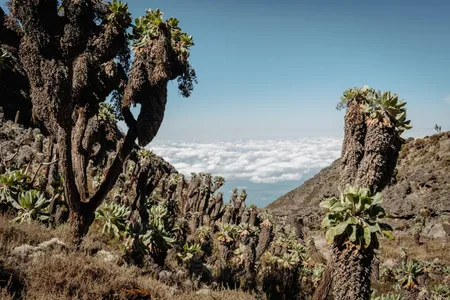
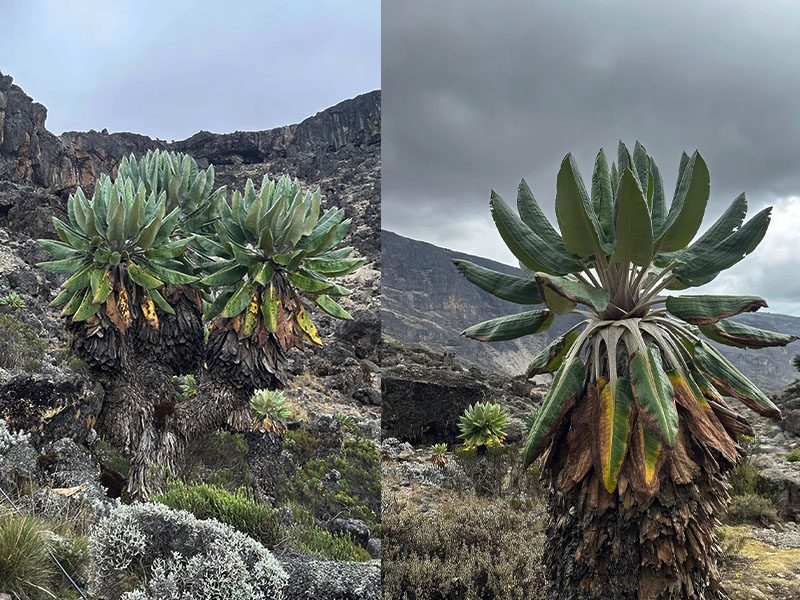
Most animals on Kilimanjaro are found in the lower rainforest and moorland zones, where there is more vegetation, water, and shelter. Higher up the mountain, wildlife becomes rare, but the plants become more unusual. Giant groundsels, lobelias, everlasting flowers, lichens, and hardy alpine plants show how life adapts to altitude, cold nights, and strong sunlight.
 
In this guide, you will learn what animals and plants live on Mount Kilimanjaro, which ecological zones you pass through, where wildlife sightings are most likely, and what climbers can realistically expect to see during a trek.
 
For a broader mountain introduction, read Mount Kilimanjaro overview.

Quick Answer: What Wildlife Can You See on Mount Kilimanjaro?

Most wildlife on Mount Kilimanjaro is found in the lower rainforest and moorland zones. Climbers may see black-and-white colobus monkeys, blue monkeys, bushbucks, duikers, birds, insects, and unique plants such as giant groundsels, giant lobelias, and Impatiens kilimanjari.
 
Wildlife sightings become less common as you climb higher because the mountain becomes colder, drier, and more exposed. The rainforest has the richest biodiversity, while the alpine desert and summit zones have very little animal life.
 
The most memorable natural features on Kilimanjaro are often the plants and ecological zones rather than large animals. Trekkers should expect changing landscapes, rare flowers, giant alpine plants, birdlife, and occasional monkey sightings rather than a safari-style wildlife experience.
Ecological Zone Elevation Range What You May See
Cultivation Zone 800–1,800 m Farms, banana trees, coffee plants, villages, birds, insects, and local Chagga landscapes.
Rainforest Zone 1,800–2,800 m Colobus monkeys, blue monkeys, birds, mosses, ferns, camphor trees, fig trees, and Impatiens kilimanjari.
Moorland Zone 2,800–4,000 m Giant lobelias, giant groundsels, shrubs, grasses, sunbirds, ravens, and wide mountain views.
Alpine Desert Zone 4,000–5,000 m Sparse grasses, lichens, hardy alpine plants, white-necked ravens, dry ground, cold nights, and strong sunlight.
Arctic Summit Zone 5,000–5,895 m Ice, glaciers, volcanic rock, thin air, almost no plants, and very limited wildlife.
Giant groundsels in the alpine desert zone of Mount Kilimanjaro | Kili Quests
Surreal and beautiful — giant groundsels thrive in Kilimanjaro’s alpine desert.

Table of Contents

Mount Kilimanjaro Ecological Zones Overview

Kilimanjaro is divided into five main ecological zones, each shaped by elevation, temperature, and moisture levels. These zones are not just labels , they define what you see, feel, and experience during your climb.

Cultivation Zone (800–1,800 m)

At the base of the mountain, life is shaped by human activity. This zone is home to farms, villages, and fertile volcanic soil that supports agriculture.Banana trees, coffee plants, maize, and beans dominate the landscape, reflecting the deep connection between local communities and the mountain. The Chagga people, who have lived here for generations, rely on this land for their livelihoods.Wildlife here is limited compared to higher zones, but you will see birds, insects, and domesticated animals.
 
This zone matters because it represents the cultural foundation of Kilimanjaro , where your journey begins not just physically, but socially.

Rainforest Zone (1,800–2,800 m)

As you gain altitude, the landscape changes dramatically. The air becomes humid, the temperature drops slightly, and dense forest begins to surround you.The rainforest is the richest ecological zone on Kilimanjaro. Tall trees such as camphor and fig create a thick canopy, while moss, ferns, and epiphytes cover branches and trunks. This layered vegetation traps moisture, creating ideal conditions for life.
This is where most wildlife is found. You may see black-and-white colobus monkeys moving through the trees, hear birds calling overhead, or spot small antelopes hidden in the undergrowth.Guides often point out unique plants like Impatiens kilimanjari, a flower found only on Kilimanjaro.
 
Wildlife sightings are best during the right season see our best time to climb Kilimanjaro guide.
 
This zone is important not just for biodiversity, but also for acclimatization. The gradual start helps your body adjust before higher altitudes.
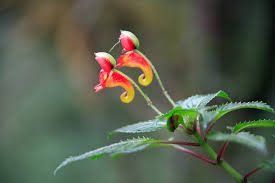
Impatien kilimanjarica flower blooming on Mount Kilimanjaro | Kili Quests
Impatiens kilimanjarica -Delicate beauty — this bright flower grows only on Kilimanjaro.
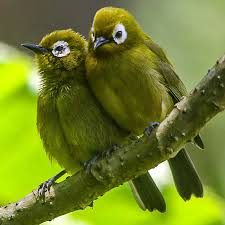
Kilimanjaro White-eye bird perched on a branch in the mountain forest | Kili Quests
A rare gem of the mountain — the Kilimanjaro White-eye is found nowhere else on Earth.

Moorland Zone (2,800–4,000 m)

As the forest fades, the landscape opens into a wide, dramatic environment known as the moorland. Trees disappear, replaced by shrubs, grasses, and some of the most unusual plants on the mountain.
Here you will find giant lobelias and groundsels , plants that have adapted to extreme temperature changes. During the day, they store heat, and at night, they protect themselves from freezing conditions.
The environment feels quieter and more exposed, with fewer animals but more striking views. Birds like sunbirds and ravens are still present, and small mammals may be seen occasionally.
 
Nights become colder here , see our Kilimanjaro night temperature guide.
 
This zone is where many climbers begin to truly feel the altitude, making it both physically and visually significant.
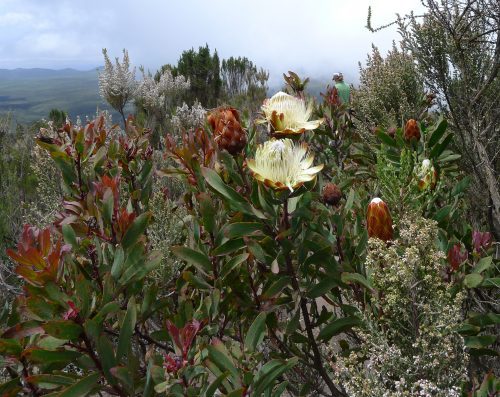
Protea kilimandscharica flowering shrub in the heath zone of Mount Kilimanjaro | Kili Quests
Protea kilimandscharica is a hardy flowering shrub found in Kilimanjaro’s high-altitude Moorland zone showcasing nature’s resilience and beauty.
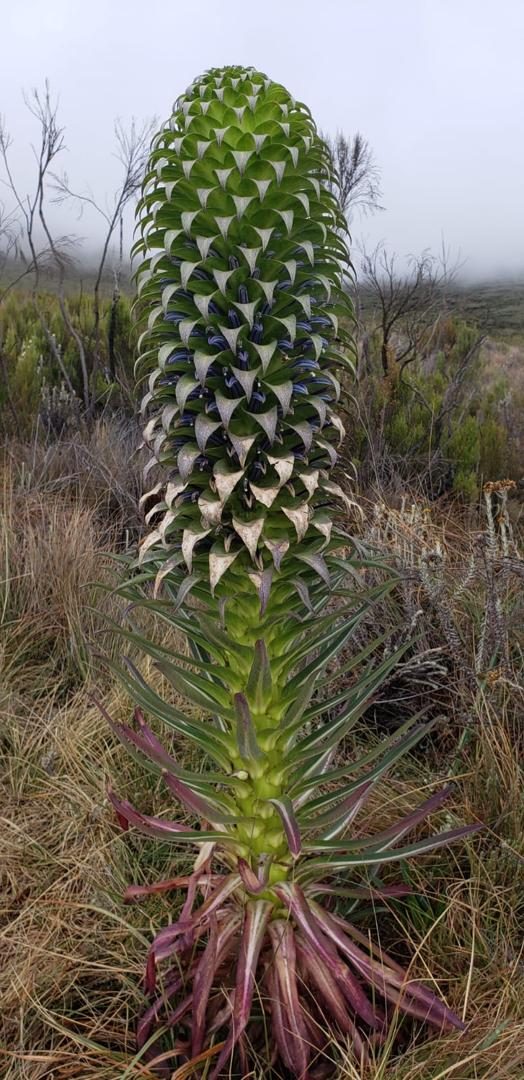
Lobelia deckenii growing in the moorland zone of Mount Kilimanjaro | Kili Quests
Lobelia deckenii is a giant rosette plant adapted to Kilimanjaro’s moorland, storing water to survive freezing temperatures and harsh winds.

Alpine Desert Zone (4,000–5,000 m)

Above the moorland, the environment becomes harsh and minimal. The alpine desert is cold, dry, and windy, with intense sunlight during the day and freezing temperatures at night.
Vegetation is sparse. Only small grasses, lichens, and hardy alpine plants survive here. Wildlife is rare, though you may still see white-necked ravens flying above or near camps.
The lack of life is not a sign of emptiness , it is a reflection of how extreme conditions shape survival.
This zone challenges both the environment and the climber, making preparation essential.
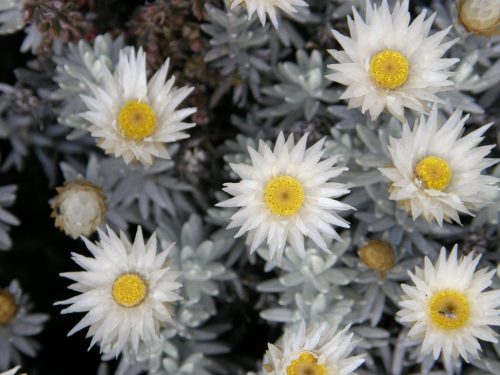
Everlasting flower, blooming near Kilimanjaro’s summit | Kili Quests
Timeless beauty — the Everlasting flower blooms near the summit, undisturbed by frost and wind.
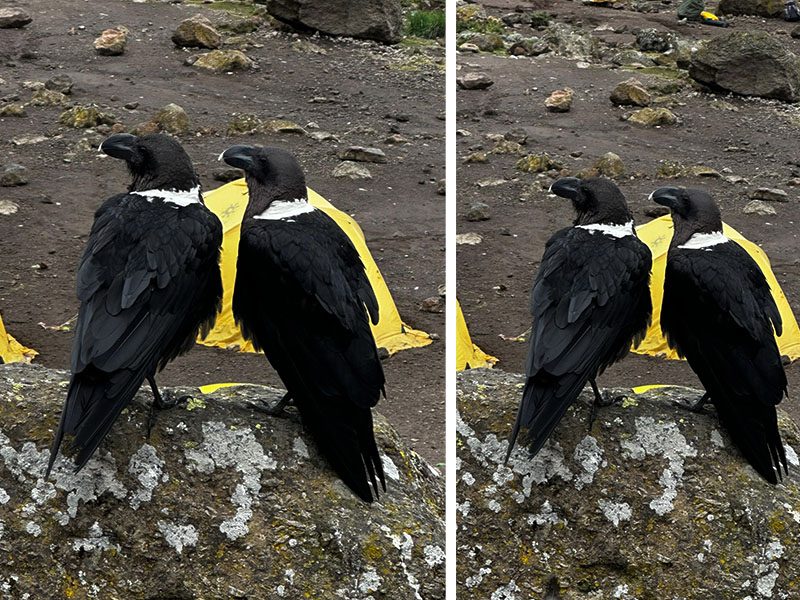
White-necked Raven gliding above the slopes of Mount Kilimanjaro | Kili Quests
A clever companion — White-necked Ravens often soar alongside trekkers in the high zones.

Arctic Summit Zone (5,000–5,895 m)

At the highest point, life almost disappears entirely. The summit zone is defined by glaciers, ice, and thin air.There are no plants, and only rare microorganisms may survive in sheltered areas. Occasionally, a bird may pass through, but this environment is largely lifeless.Reaching this zone feels otherworldly  a complete contrast to the lush rainforest below.This final stage represents the extreme end of Kilimanjaro’s ecological range.

Why Kilimanjaro Has So Many Ecosystems

Kilimanjaro’s diversity is driven by altitude.As you climb, temperature drops by roughly 6°C for every 1,000 meters. Rainfall is highest in the forest zone and decreases as you ascend. These changes create completely different environments within a short distance.This is what makes Kilimanjaro unique , few places in the world allow you to experience so many ecosystems in a single trek.
 
Your route determines how you experience these zones , explore our Kilimanjaro routes guide.
Animal or Bird Where It May Be Seen What to Know
Black-and-white colobus monkey Rainforest zone One of the most memorable animals climbers may see in the forest, often moving through the trees.
Blue monkey Rainforest zone Common in forested areas and usually seen or heard during the lower sections of the climb.
Bushbuck Forest and lower mountain areas A shy antelope species that is more difficult to spot because it stays hidden in vegetation.
Duiker Forest and moorland edges Small antelope that may be seen briefly, especially in quieter areas.
White-necked raven Moorland, alpine desert, and high camps One of the most commonly seen birds in the higher zones of Kilimanjaro.
Sunbirds Forest and moorland zones Small colorful birds often seen near flowering plants.
Kilimanjaro white-eye Montane forest areas A notable bird associated with Kilimanjaro and nearby highland habitats.

Rare and Endemic Species on Kilimanjaro

Some plants and animals found on Kilimanjaro exist nowhere else:
  • Dendrosenecio kilimanjari (giant groundsel)
  • Lobelia deckenii
  • Impatiens kilimanjari
  • Kilimanjaro white-eye bird
These species have adapted to survive extreme conditions, making them an important part of the mountain’s identity.
Plant Zone Why It Matters
Impatiens kilimanjari Rainforest zone A delicate flower strongly associated with Kilimanjaro’s forest environment.
Giant groundsel Moorland and alpine zones One of Kilimanjaro’s most unusual plants, adapted to cold nights and strong sunlight.
Lobelia deckenii Moorland zone A giant rosette plant that stores water and survives freezing mountain conditions.
Protea kilimandscharica Heath and moorland zones A hardy flowering shrub that adds color to higher slopes.
Everlasting flowers Alpine zones Small tough flowers that survive in cold, dry, exposed conditions.
Camphor trees Rainforest zone Important forest trees that help create the dense, moist lower mountain environment.
Podocarpus trees Rainforest zone Tall evergreen trees found in Kilimanjaro’s montane forest.
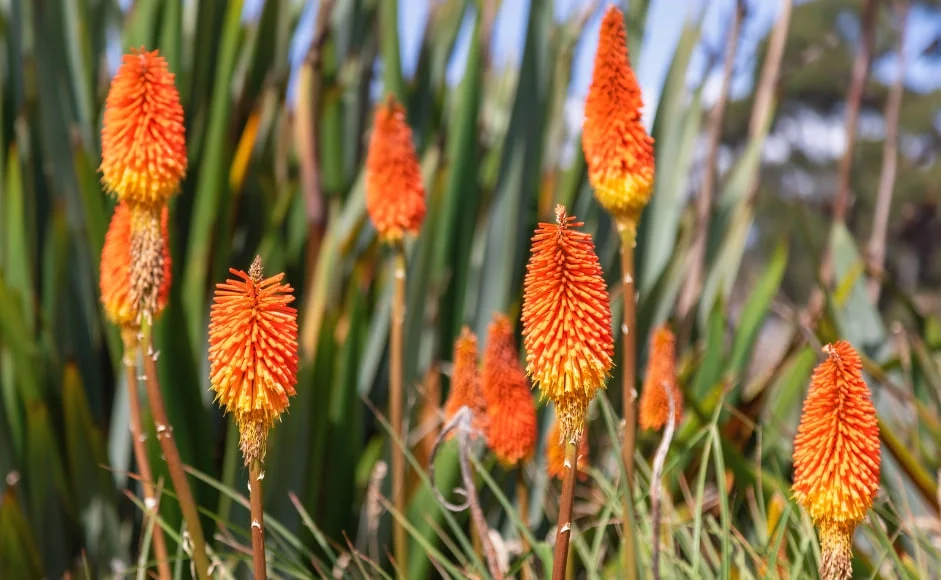
Kniphofia thomsonii, the Red Hot Poker flower, growing on Mount Kilimanjaro | Kili Quests
A burst of fire in the mist — Red Hot Poker adds striking color to Kilimanjaro’s slopes.
Camphor wood tree (Ocotea usambarensis) in the lower montane rainforest of Mount Kilimanjaro | Kili Quests
Towering with a quiet scent — camphor wood trees stand tall in Kilimanjaro’s misty rainforest.

Conservation and Climate Concerns on Kilimanjaro

Kilimanjaro’s ecosystems are sensitive because they change quickly with altitude, rainfall, temperature, and human pressure. The mountain’s glaciers have been shrinking, and changing weather patterns can affect vegetation, water sources, and the survival range of some plant species.
 
The rainforest zone is especially important because it helps capture moisture, supports biodiversity, and protects the lower mountain environment. Damage to trails, littering, careless camping, and disturbing plants or animals all weaken the mountain experience for future climbers.
 
Responsible trekking matters because every climber passes through fragile environments. Staying on trails, respecting wildlife, avoiding litter, and choosing responsible operators helps protect Kilimanjaro’s natural zones.
Various wildflowers growing across the natural zones of Mount Kilimanjaro | Kili Quests
From forest to summit, Kilimanjaro’s slopes are home to countless wildflowers — each adding color to the journey.
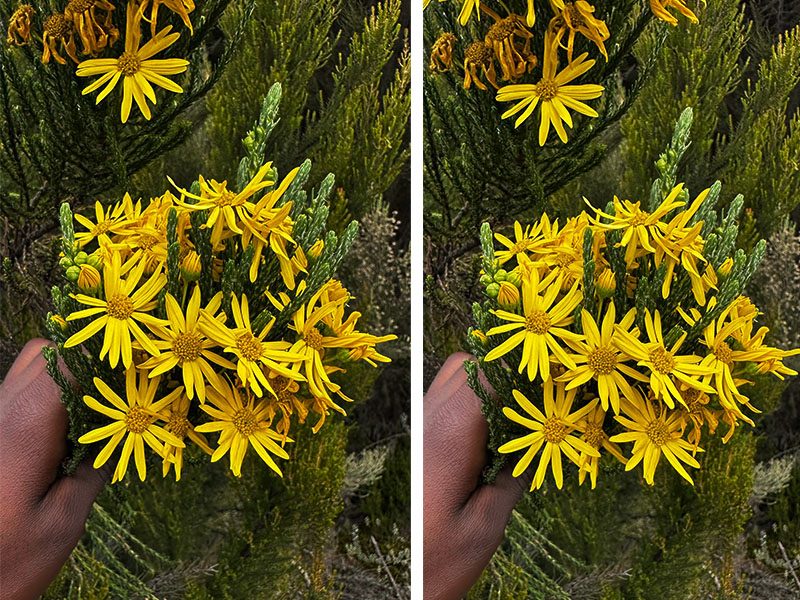
Wild daisy flower growing in the heath zone of Mount Kilimanjaro | Kili Quests
Simple and radiant — wild daisies bring charm to Kilimanjaro’s open slopes.

Best Kilimanjaro Routes for Wildlife and Plant Life

Some Kilimanjaro routes give better chances to experience the mountain’s ecological diversity than others. Wildlife sightings are never guaranteed, but routes with longer forest sections, quieter trails, and gradual movement through the zones often give a richer nature experience.
 
The Lemosho Route is one of the best options for scenery and ecological variety because it starts on the western side of the mountain and passes through beautiful forest before reaching the higher zones.
 
The Machame Route also offers strong landscape variety, with rainforest, moorland, alpine desert, and dramatic views as the climb progresses.
 
The Marangu Route passes through lush forest in the early section and can be good for seeing monkeys and forest plants, especially near the lower trail.
 
The Northern Circuit Route gives one of the most complete mountain experiences because it takes more time and crosses quieter areas of Kilimanjaro.
 
If wildlife, scenery, and ecological change matter to you, compare the main trail options in our Kilimanjaro routes guide before choosing your climb.

Tips for Wildlife and Plant Spotting

  • Be quiet in the rainforest for better sightings
  • Use binoculars in the moorland
  • Ask your guide — local knowledge is key
  • Avoid touching plants or disturbing animals
Your experience improves when you slow down and observe.
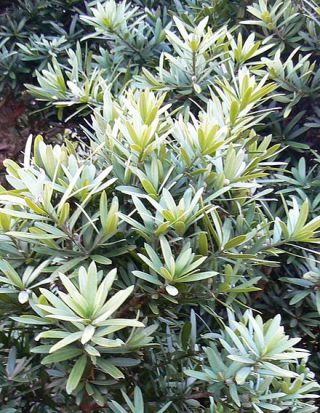
Tall Podocarpus tree in the lush montane forest of Mount Kilimanjaro | Kili Quests
Ancient and evergreen — Podocarpus trees guard the quiet paths of Kilimanjaro’s rainforest.
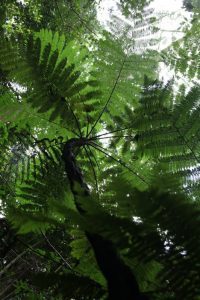
Cyathea tree fern unfolding in the lush rainforest of Mount Kilimanjaro | Kili Quests
Prehistoric elegance — tree ferns like Cyathea thrive in Kilimanjaro’s misty lower forests.

Frequently Asked Questions About Wildlife on Mount Kilimanjaro

What animals live on Mount Kilimanjaro?

Animals that live on Mount Kilimanjaro include black-and-white colobus monkeys, blue monkeys, bushbucks, duikers, small mammals, insects, and many bird species. Most wildlife is found in the rainforest and lower mountain zones.

Can you see animals while climbing Kilimanjaro?

Yes, climbers can sometimes see animals while climbing Kilimanjaro, especially during the early days of the trek in the rainforest zone. Monkey sightings are among the most common, while larger animals are less frequently seen.

Which Kilimanjaro zone has the most wildlife?

The rainforest zone has the most wildlife on Mount Kilimanjaro. It has more moisture, trees, food, and shelter than the higher zones, making it the richest area for animals, birds, insects, and plant life.

What plants are unique on Mount Kilimanjaro?

Unique and notable plants on Mount Kilimanjaro include Impatiens kilimanjari, giant groundsels, Lobelia deckenii, Protea kilimandscharica, everlasting flowers, and high-altitude shrubs adapted to cold nights and strong sunlight.

Are there animals near the summit of Kilimanjaro?

Very few animals live near the summit of Kilimanjaro because the environment is extremely cold, dry, windy, and low in oxygen. Birds such as white-necked ravens may sometimes be seen in higher areas, but animal life is very limited near the summit.

Is Kilimanjaro wildlife dangerous for climbers?

Kilimanjaro wildlife is usually not dangerous for climbers on the main trekking routes. Most animals avoid people, and sightings are usually brief. Trekkers should still respect wildlife, keep distance, and follow guide instructions

Experience Kilimanjaro Beyond the Summit

Mount Kilimanjaro is more than a summit goal. It is a journey through rainforest, moorland, alpine desert, rare plants, birdlife, and some of the most dramatic ecological changes in East Africa.
 
At Kili Quests, we help climbers experience the mountain fully, not just reach the top. Our local guides explain the landscapes, plants, wildlife, routes, and mountain conditions that make Kilimanjaro such a unique trek.
 
Contact us to plan a Kilimanjaro climb with experienced local guides who help you understand the mountain from forest to summit.

Related Articles

Gilman’s Point Kilimanjaro: Name, History & Location

Reach the Summit

Climb to Gilman’s Point and continue to Uhuru Peak with expert local guides.

Plan Your Climb

Prepare for your Kilimanjaro adventure:

OUR CATEGORIES

Why Is It Called Gilman’s Point? The Story Behind the Name | Kili Quests

Climbers taking the Marangu Route or Rongai Route to the top of Mount Kilimanjaro reach an important milestone before Uhuru Peak: Gilman’s Point. Located on the rim of Kibo crater, Gilman’s Point is one of Kilimanjaro’s recognized summit markers and a major achievement during the final summit push.
 
But why is it called Gilman’s Point, and who was Gilman?
 
In this article, Kili Quests explains the story behind the name, where Gilman’s Point is located, why it matters, and how it differs from Uhuru Peak and Stella Point.
 
To understand the mountain’s volcanic structure, read our guide to Kilimanjaro’s volcanic cones: Kibo, Mawenzi, and Shira.
 

Quick Answer: Why Is It Called Gilman’s Point?

Gilman’s Point is named after Clement Gillman, a British geographer, civil engineer, and surveyor connected with early mapping and geographic study in East Africa. The summit marker on Mount Kilimanjaro is widely spelled Gilman’s Point, although the historical surname is often written as Gillman with two “l” letters.
 
On Kilimanjaro, Gilman’s Point marks a recognized crater-rim summit point reached most commonly by climbers using the Marangu Route or Rongai Route. It is a major achievement, but it is not the highest point on the mountain. The true summit of Kilimanjaro is Uhuru Peak.
Gilman’s Point summit sign on Mount Kilimanjaro crater rim
Gilman’s Point marks one of Kilimanjaro’s recognized summit points on the rim of Kibo crater.

Table of Contents

Where Is Gilman’s Point on Kilimanjaro?

Gilman’s Point lies on the eastern rim of Kilimanjaro’s Kibo crater. It is the first major crater-rim marker reached by many climbers ascending via the Marangu Route or Rongai Route.
 
Reaching Gilman’s Point is a huge accomplishment because it means you have reached the crater rim after the steep overnight summit climb. From here, climbers who still have enough energy and safe conditions can continue toward Uhuru Peak, the highest point on Mount Kilimanjaro.
 
The walk from Gilman’s Point to Uhuru Peak usually takes around 1.5 to 2 hours, depending on pace, weather, trail conditions, and how well your body is handling the altitude.
 
These routes approach the summit differently, so if you are still choosing your trail, compare them in our Kilimanjaro Routes Guide.

Who Was Gilman?

Gilman’s Point is named after Clement Gillman, a British geographer, civil engineer, and surveyor who carried out mapping and survey work in East Africa during the early 20th century.
 
His work helped document the physical geography, routes, and terrain of the region, including areas around Mount Kilimanjaro. Although he was not the first person to climb Kilimanjaro, his name became connected with one of the mountain’s important crater-rim landmarks.
 
One detail often confuses climbers: the place is commonly spelled Gilman’s Point, while the historical surname is often written Gillman. For the Kilimanjaro location, use Gilman’s Point.
 
For more Kilimanjaro history, read the story of Hans Meyer and the first Kilimanjaro ascent in 1889.
 
Historical names on Kilimanjaro can be confusing because many landmarks were recorded during the colonial mapping period, and spellings were not always used consistently across maps, guidebooks, and local references.
Portrait of Clement Gillman British geographer and surveyor
Clement Gillman was connected with early mapping and geographic study in East Africa.

Why Does Gilman’s Point Matter?

Gilman’s Point matters because it is one of Kilimanjaro’s recognized crater-rim summit points. For climbers on the Marangu or Rongai Route, reaching this point means they have completed the steepest and most exhausting part of summit night.
 
Gilman’s Point is not a separate mountain peak. It is a named point on the crater rim of Kibo, Kilimanjaro’s highest volcanic cone.
 
For many climbers, Gilman’s Point represents:
  • The first major crater-rim milestone before Uhuru Peak
  • A major psychological victory after hours of climbing in darkness
  • A recognized Kilimanjaro summit point
  • A place where climbers may receive a summit certificate
  • A decision point before continuing toward Uhuru Peak
This is also where guides carefully assess each climber’s condition. If someone is too exhausted, showing altitude symptoms, or moving too slowly, stopping at Gilman’s Point may be the safer decision.

Gilman’s Point vs. Uhuru Peak

Feature Gilman’s Point Uhuru Peak
Elevation 5,681 m / 18,638 ft 5,895 m / 19,341 ft
Location Eastern rim of Kibo crater Highest point on Kilimanjaro
Common routes Marangu Route and Rongai Route Final goal for most Kilimanjaro routes
Meaning Recognized crater-rim summit point True highest summit of Mount Kilimanjaro
Certificate Summit certificate usually awarded Full summit certificate awarded
Time from Gilman’s Point Starting point on the crater rim Usually 1.5 to 2 hours farther

Gilman’s Point vs Stella Point

Gilman’s Point and Stella Point are both important crater-rim landmarks on Mount Kilimanjaro, but they are reached from different summit approaches.
 
Gilman’s Point is most commonly reached by climbers using the Marangu Route or Rongai Route. Stella Point is more commonly reached by climbers coming from routes such as Machame, Lemosho, and Umbwe.
 
Both points are major achievements, but neither is the highest point on Kilimanjaro. Uhuru Peak remains the true summit of the mountain.
 
To understand the other major crater-rim landmark, read our guide to Stella Point on Kilimanjaro.
Snow-covered crater rim view from Gilman’s Point on Mount Kilimanjaro
From Gilman’s Point, climbers continue along Kilimanjaro’s crater rim toward Uhuru Peak.

Did You Know?

The final push to Gilman’s Point is often done at night. Summit attempts usually begin around midnight so climbers can reach the crater rim near sunrise.

This section is one of the toughest parts of the Marangu Route because climbers move slowly through cold temperatures, thin air, and loose volcanic scree.

At sunrise, Gilman’s Point can offer dramatic views across the crater rim, the clouds below, and the distant landscape toward Kenya. It is one of three famous summit markers on Kilimanjaro, along with Stella Point and Uhuru Peak.

If you want to understand why summit night feels so demanding, read How Hard Is Kilimanjaro?

Frequently Asked Questions About Gilman’s Point

What is Gilman’s Point on Mount Kilimanjaro?

Gilman’s Point is one of Mount Kilimanjaro’s recognized summit markers. It is located on the eastern rim of Kibo crater at about 5,681 meters, or 18,638 feet. Climbers who reach this point have reached the crater rim and are close to the final summit route toward Uhuru Peak.

Is Gilman’s Point the summit of Mount Kilimanjaro?

Gilman’s Point is a recognized crater-rim summit point, but it is not the highest point on Mount Kilimanjaro. The true summit is Uhuru Peak, which stands at 5,895 meters, or 19,341 feet. From Gilman’s Point, it usually takes 1.5 to 2 hours to reach Uhuru Peak.

Which Kilimanjaro routes reach Gilman’s Point?

Gilman’s Point is most commonly reached by climbers using the Marangu Route and Rongai Route. These routes approach the crater rim from the eastern side before climbers continue toward Uhuru Peak.

How difficult is the climb to Gilman’s Point?

The climb to Gilman’s Point is difficult because it usually happens during summit night in cold, dark, high-altitude conditions. Climbers ascend steep volcanic scree from Kibo Hut while dealing with fatigue, thin air, and freezing temperatures.

Do you get a summit certificate at Gilman’s Point?

Yes. Climbers who reach Gilman’s Point usually receive an official Kilimanjaro summit certificate. However, Uhuru Peak is the highest point on the mountain and is considered the main summit goal for most climbers.

Reaching Gilman’s Point: What It Means for Your Summit

Reaching Gilman’s PoGilman’s Point may not be the highest point on Kilimanjaro, but it is still a powerful achievement. After hours of climbing through darkness, cold, and thin air, reaching the crater rim is a major physical and emotional milestone.

For some climbers, Gilman’s Point is the safest stopping point. For others, it becomes the final push before continuing along the crater rim toward Uhuru Peak. Either way, standing at Gilman’s Point means you have reached one of Kilimanjaro’s most important historic summit landmarks.

To understand the meaning of Kilimanjaro’s highest summit, read how Uhuru Peak got its name after Tanzania’s independence.

Plan Your Kilimanjaro Climb with Kili Quests

If you are planning to climb via the Marangu Route or Rongai Route, Gilman’s Point will be one of the most important landmarks on your summit journey.
 
With Kili Quests, you climb with experienced local guides who understand the route, the altitude, the summit pace, and the stories behind Kilimanjaro’s famous landmarks.
 
Contact us today to start planning your Kilimanjaro climb.

Related Articles

Climbing Kilimanjaro for Beginners: First-Time Trek Guide

Start Your First Kilimanjaro Climb

Not sure if you’re ready to climb Kilimanjaro?
At Kili Quests, we help first-time trekkers:

Preparing for Your First Kilimanjaro Climb

Beginners can climb Kilimanjaro — route, timing, and acclimatization matter. Explore these guides:

OUR CATEGORIES

Climbing Kilimanjaro for Beginners: First-Time Trek Guide

Climbing Mount Kilimanjaro is a bucket-list adventure, but for many first-time trekkers, it also raises serious questions. How hard is it? Do you need climbing experience? Can beginners really reach the summit?
 
The good news is that Kilimanjaro is one of the most accessible high-altitude mountains in the world because the standard routes do not require ropes, ice axes, or technical mountaineering skills. But that does not mean the climb is easy.
 
Success depends on preparation, pacing, route choice, altitude awareness, and the support team guiding you up the mountain.
 
If you are new to trekking, this guide explains what beginners should expect before climbing Kilimanjaro, including difficulty, routes, training, packing, altitude, safety, and summit preparation.
 
For a full preparation plan, see our Kilimanjaro training guide.

Quick Answer: Can Beginners Climb Kilimanjaro?

Yes, beginners can climb Mount Kilimanjaro, and many first-time trekkers reach the summit every year. You do not need technical climbing experience, but you do need proper preparation, good fitness, a realistic route choice, and enough days on the mountain for acclimatization.
 
The biggest challenge for beginners is not climbing skill. It is altitude, endurance, cold weather, and summit night fatigue. Choosing a longer route, walking slowly, training before the trek, and climbing with experienced guides gives first-time climbers a much better chance of success.
Climbers walking through Kilimanjaro’s rainforest trail with excitement | Kili Quests
First-time climbers begin their Kilimanjaro journey through the rainforest trail.

Table of Contents

Is Kilimanjaro Suitable for Beginners?

Yes, Kilimanjaro is suitable for beginners, but only if you respect the challenge. It is often called a “walkable mountain” because the standard trekking routes do not require ropes, technical climbing, or previous mountaineering experience.
 
However, Kilimanjaro is still a serious high-altitude trek. Beginners must be ready to walk for several hours a day, sleep at altitude, handle changing weather, and follow a slow pace for multiple days.
 
Many first-time climbers succeed because they choose the right route, train before the climb, listen to their guides, and give their bodies enough time to adjust to altitude.
 
For a deeper look at the challenge, read How Hard Is It to Climb Kilimanjaro?

What Makes Kilimanjaro Difficult for Beginners?

Kilimanjaro is not difficult because of technical climbing. It is difficult because of altitude, long walking days, cold conditions, and the mental challenge of summit night.
 
Most beginners struggle with:
  1. Walking for several days in a row
  2. Sleeping at higher elevations
  3. Cold temperatures near the summit
  4. Loss of appetite at altitude
  5. Headaches or fatigue from altitude
  6. The long overnight summit push
  7. Staying patient with the slow “pole pole” pace
This is why beginners should not choose the shortest route just because it is cheaper or faster. A longer itinerary gives your body more time to acclimatize and gives you a better overall summit profile.

How Long Does It Take to Climb Kilimanjaro?

Most Kilimanjaro routes take between 6 and 9 days. For beginners, the number of days matters because a longer route gives your body more time to adjust to altitude.

Shorter routes may look attractive because they cost less and take fewer days, but they can be harder on the body. Beginners usually do better with routes that allow gradual acclimatization.
 
Route Typical Duration Beginner Notes
Marangu Route 5 to 6 days Hut accommodation, but the ascent can feel faster for beginners.
Machame Route 6 to 7 days Popular route with better acclimatization when done in 7 days.
Lemosho Route 7 to 8 days Scenic route with a strong acclimatization profile for first-time climbers.
Northern Circuit Route 8 to 9 days Longest route with the most gradual acclimatization profile.
For most beginners, we recommend choosing at least 7 days on the mountain when possible. The extra time helps with acclimatization, comfort, and confidence.

Which Kilimanjaro Route Is Best for First-Time Climbers?

The best Kilimanjaro routes for beginners are usually the routes that offer better acclimatization, steady pacing, and enough time on the mountain. The goal is not to choose the easiest-looking route. The goal is to choose the route that gives your body the best chance to adapt.
 
For many first-time climbers, the strongest options are:
  1. Lemosho Route: scenic, gradual, and excellent for acclimatization
  2. Machame Route: popular, scenic, and strong when done in 7 days
  3. Northern Circuit Route: longer, quieter, and very good for acclimatization
  4. Marangu Route: hut-based, but faster and less forgiving if rushed
Beginners should be careful with very short itineraries. Saving one day can increase the physical pressure and reduce acclimatization time.
 
For a full route-by-route breakdown, read Kilimanjaro Routes Comparison: Which Route Is Best?

Do Beginners Need Climbing Experience or Special Gear?

No technical climbing experience is required for the standard Kilimanjaro routes. You do not need ropes, ice axes, crampons, or mountaineering skills.
 
You do need proper trekking gear. Kilimanjaro has several climate zones, so beginners must be prepared for rainforest conditions, cold nights, wind, rain, and freezing summit temperatures.
 
Essential beginner gear includes:
  1. Waterproof hiking boots
  2. Warm base layers
  3. Insulating jacket
  4. Waterproof rain jacket and trousers
  5. Trekking poles
  6. Warm gloves and hat
  7. Sleeping bag rated for cold conditions
  8. Daypack for water, snacks, rain gear, and personal items
For the full list, use our Kilimanjaro packing list.

How Fit Do Beginners Need to Be for Kilimanjaro?

You do not need to be an athlete to climb Kilimanjaro, but you must be able to walk for several hours a day for multiple days in a row.
 
A good beginner fitness target is being comfortable with:
  1. Hiking for 5 to 7 hours in a day
  2. Walking uphill at a slow, steady pace
  3. Carrying a small daypack
  4. Recovering overnight and trekking again the next day
  5. Staying mentally patient when the pace feels slow
Many beginners worry too much about speed. Kilimanjaro is not a race. Endurance, consistency, and patience matter more than intensity.
 
For a full preparation plan, read our Kilimanjaro training guide.

What Should Beginners Know About Altitude Sickness?

Altitude sickness is one of the biggest reasons climbers turn back on Kilimanjaro. It can affect beginners and experienced hikers alike because fitness does not guarantee altitude adaptation.
 
Beginners can reduce altitude risk by:
  1. Choosing a longer route
  2. Walking slowly from the first day
  3. Drinking enough water
  4. Eating regularly, even when appetite drops
  5. Listening to guide instructions
  6. Reporting symptoms early
  7. Avoiding alcohol before the climb
  8. Considering altitude medication after medical advice
The safest mindset is simple: do not rush the mountain. Slow pacing gives your body a better chance to adjust.
 
For a deeper guide, read Altitude Sickness on Kilimanjaro: Symptoms & Prevention.
Kilimanjaro guide assisting climber with health check on trail | Kili Quests
Guides support climbers with pacing, health checks, and altitude awareness throughout the trek.

What Does a Typical Day on Kilimanjaro Look Like?

Most days on Kilimanjaro follow a steady rhythm. You wake up early, have breakfast, pack your daypack, and begin trekking with your guide. Porters move ahead to prepare the next camp while you walk at a slow, steady pace.
 
A normal trekking day usually includes:
  1. Morning tea and breakfast
  2. Health check and route briefing
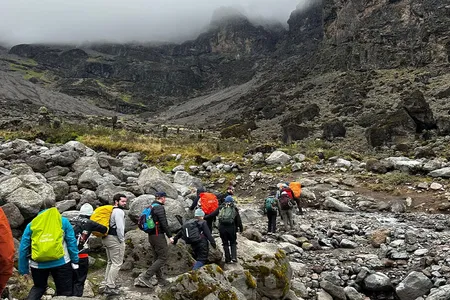
  3. 4 to 7 hours of trekking
  4. Short breaks for snacks, water, and photos
  5. Arrival at camp in the afternoon
  6. Rest, dinner, and evening briefing
Summit day is different. It usually starts before midnight and can take 12 to 15 hours round-trip, depending on the route, pace, and conditions. This is often the hardest part of the climb for beginners because it combines altitude, cold, darkness, and fatigue.
Trekker walking at high altitude toward Kilimanjaro’s summit | Kili Quests
Step by step, beginners gain confidence as they climb into Kilimanjaro’s higher zones.

Do Beginners Have to Carry Their Own Gear?

No. On a guided Kilimanjaro climb, porters carry your main duffel bag between camps. You only carry a daypack with the items you need during the day.
 
Your daypack should usually include:
  1. Water
  2. Snacks
  3. Rain jacket
  4. Warm layer
  5. Sunscreen
  6. Sunglasses
  7. Camera or phone
  8. Personal medication
  9. Small first aid items
Your main duffel should stay within the operator’s allowed weight limit. Pack carefully and avoid bringing unnecessary items.
 
For available equipment options, see our Kilimanjaro gear rental guide.

What Happens If a Beginner Cannot Reach the Summit?

Your safety is more important than the summit. If you cannot continue because of altitude sickness, exhaustion, injury, or another health concern, your guide will help you descend safely.

Turning around does not mean the climb was a failure. Many climbers who do not reach Uhuru Peak still complete a major personal challenge, experience Kilimanjaro’s landscapes, and learn what it takes to climb at high altitude.
 
A responsible guide team will never force a climber to continue when it is unsafe. The goal is always a safe climb, a safe descent, and a positive mountain experience.

How Should Beginners Prepare Before Booking Kilimanjaro?

Beginners should prepare before booking by choosing the right route, understanding the difficulty, checking the best season, and making sure they have enough time to train.
 
Before booking, think about:
  1. How many days you can spend on the mountain
  2. Whether you prefer a scenic route, quieter trail, or hut accommodation
  3. Your current fitness level
  4. How much time you have to train
  5. Your travel dates and weather conditions
  6. Your budget
  7. The experience and safety standards of the operator
A good Kilimanjaro operator should explain the route clearly, help you understand what is included, check your gear, brief you before the climb, and guide you at a safe pace on the mountain.
 
For planning costs, read Kilimanjaro Climb Cost. For weather and season advice, read Best Time to Climb Kilimanjaro.

Common Beginner Mistakes to Avoid on Kilimanjaro

Many first-time climbers struggle not because Kilimanjaro is technical, but because they make poor planning decisions before the climb begins.
 
Avoid these beginner mistakes:
  1. Choosing the shortest route only to save money or time
  2. Underestimating altitude sickness
  3. Training only for fitness but not hiking endurance
  4. Wearing new boots for the first time on the mountain
  5. Packing too much unnecessary gear
  6. Walking too fast during the first few days
  7. Ignoring early symptoms like headache, nausea, or unusual fatigue
  8. Choosing an operator without checking safety standards and crew support
The best beginner strategy is simple: choose enough days, train consistently, pack properly, walk slowly, and listen to your guides.
Three happy trekkers posing in front of the Barafu Camp sign on Kilimanjaro’s Northern Circuit Route, flexing muscles before summit day | Kili Quests
A light moment at Barafu Camp before the final summit push to Uhuru Peak.

Frequently Asked Questions About Climbing Kilimanjaro for Beginners

Can beginners really climb Mount Kilimanjaro?

Yes, beginners can climb Mount Kilimanjaro. The standard routes are trekking routes, not technical climbing routes, so you do not need ropes or mountaineering experience. However, beginners still need training, proper gear, a good route choice, and enough time for acclimatization.

Is Kilimanjaro hard for beginners?

Yes, Kilimanjaro is challenging for beginners because of altitude, long walking days, cold weather, and summit night fatigue. The climb is not technical, but it requires endurance, patience, and mental strength.

What is the best Kilimanjaro route for beginners?

Lemosho, Machame 7-day, and Northern Circuit are strong choices for beginners because they offer better acclimatization profiles. Marangu can suit climbers who prefer hut accommodation, but the ascent is faster and needs careful pacing.

How long should beginners take to climb Kilimanjaro?

Most beginners should choose at least 7 days if possible. Longer routes give the body more time to adapt to altitude and usually provide a better overall climb experience.

Do I need climbing experience for Kilimanjaro?

No technical climbing experience is required. You should, however, be comfortable hiking for several hours a day and walking uphill at a slow, steady pace.

What is the hardest part of Kilimanjaro for beginners?

For most beginners, the hardest part is summit night. It is long, cold, dark, and physically demanding because it happens at high altitude after several days of trekking.
How much does it cost to climb

Your First Kilimanjaro Climb Starts Here

Thousands of first-time climbers attempt Kilimanjaro every year. The ones who do best are not always the strongest or fastest. They are the ones who prepare properly, choose the right route, walk slowly, and climb with a team that understands altitude and safety.
 
At Kili Quests, we help beginners plan Kilimanjaro climbs with honest route advice, experienced local guides, proper safety support, and clear preparation guidance before the trek begins.
 
If this will be your first high-altitude climb, contact us today and we will help you choose the right route, number of days, and preparation plan for your Kilimanjaro adventure.

Related Articles

Chagga Culture: History & Traditions of Kilimanjaro

Experience Kilimanjaro Beyond the Summit

Experience the culture behind Kilimanjaro with local guides, village visits, coffee tours, waterfalls, caves, and Chagga stories that bring the mountain to life.

Related Kilimanjaro Culture Guides

OUR CATEGORIES

Chagga Culture: History & Traditions of Kilimanjaro

Mount Kilimanjaro is more than Africa’s highest mountain. It is also the homeland of the Chagga people, one of Tanzania’s best-known ethnic groups.
 
For generations, Chagga communities have lived around Kilimanjaro’s fertile southern and eastern slopes, especially near Moshi, Marangu, Machame, Rombo, Hai, and surrounding villages. Their culture is closely connected to farming, family land, banana and coffee cultivation, local language, traditional ceremonies, caves, food, and mountain life.
 
If you are climbing Kilimanjaro or visiting the Moshi area, learning about Chagga culture gives you a deeper understanding of the people, history, and local life around the mountain.
 
For the famous local guide story, read about Yohani Kinyala Lauwo and Kilimanjaro’s first recorded ascent.

Quick Answer: Who Are the Chagga People?

The Chagga people are a Bantu-speaking ethnic group from the Kilimanjaro Region of northern Tanzania. They live mainly around the slopes and foothills of Mount Kilimanjaro, especially near Moshi, Marangu, Machame, Rombo, Hai, and nearby villages.
 
Chagga culture is known for banana and coffee farming, Kichagga language, traditional food, banana beer, family land, local ceremonies, caves, strong community identity, and a deep connection to Mount Kilimanjaro.

Where Do the Chagga People Live?

The Chagga people live mainly around the slopes and foothills of Mount Kilimanjaro in northern Tanzania. Important Chagga areas include Moshi, Marangu, Machame, Rombo, Hai, Siha, Old Moshi, and nearby villages.
 
These communities are closely connected to Kilimanjaro’s fertile volcanic soil, water sources, banana farms, coffee farms, and mountain tourism.
Chagga Culture Element What It Means
Location Chagga communities live around Mount Kilimanjaro’s slopes and foothills, especially near Moshi, Marangu, Machame, Rombo, Hai, and Siha.
Language The traditional language is Kichagga, with different dialects depending on the area. Swahili is also widely spoken.
Farming Bananas, coffee, beans, maize, yams, and vegetables are important crops grown on Kilimanjaro’s fertile slopes.
Food Traditional foods include machalari, kiburu, and mbege, the well-known Chagga banana beer.
Traditions Family unity, land respect, ancestral roots, ceremonies, Masale plant symbolism, and local leadership are important cultural elements.
Tourism Visitors can experience Chagga culture through coffee tours, waterfalls, cave visits, local food, banana beer, and village walks.

Table of Contents

Map of Mount Kilimanjaro highlighting areas inhabited by the Chagga people, including villages on southern and eastern slopes | Kili Quests
The Chagga people have lived on the fertile slopes of Kilimanjaro for generations, forming vibrant communities across the mountain’s southern and eastern sides.

Who Are the Chagga People?

The Chagga people are a Bantu-speaking ethnic group native to the Kilimanjaro Region of northern Tanzania. They are strongly connected to Mount Kilimanjaro’s southern and eastern slopes, where many Chagga families have lived, farmed, and built communities for generations.
 
Chagga people traditionally speak Kichagga, although the language has different dialects depending on the area, such as Marangu, Machame, Rombo, and other parts of Kilimanjaro. Today, most Chagga people also speak Swahili, and many people involved in tourism speak English.
 
Chagga identity is closely tied to land, farming, family, education, business, hospitality, and the mountain itself. Their history helps explain why Kilimanjaro is not only a climbing destination, but also a living cultural landscape.

Chagga Language and Identity

The traditional language of the Chagga people is Kichagga, but it is not exactly the same everywhere. Different areas around Kilimanjaro have their own dialects, including Marangu, Machame, Rombo, and other local variations.
 
Today, Swahili is the main everyday language across Tanzania, and many Chagga people also speak English, especially those working in tourism, education, and business.
 
Even with modern changes, Kichagga remains important for family identity, local stories, greetings, songs, place names, and cultural memory.
Chagga people performing a traditional dance during the 1990s in Kilimanjaro region | Kili Quests
Cultural pride in motion — this 1990s Chagga dance reflects deep-rooted heritage passed through generations.
Members of the Chagga tribe near Mount Kilimanjaro in traditional attire
Skill passed through generations — Chagga spear makers keep ancestral craftsmanship alive with precision and pride

Traditional Life on the Slopes of Kilimanjaro

Traditional Chagga life has always been closely connected to the land. Many families lived in homesteads surrounded by banana groves, coffee trees, small gardens, and livestock areas.
 
The mountain’s volcanic soil and reliable water sources helped support productive farming systems. Families used the land carefully for food, shade, animal keeping, and household needs.
 
Important parts of traditional Chagga life include:
  • Banana farming for food and local drinks
  • Coffee farming as an important cash crop
  • Livestock keeping, especially cows and goats
  • Family land and inheritance
  • Local ceremonies and clan relationships
  • Respect for elders and ancestral roots
This connection between land, family, and farming remains one of the strongest parts of Chagga identity.

Chagga Farming: Bananas, Coffee, and Mountain Soil

Farming is one of the foundations of Chagga culture. The fertile volcanic slopes of Mount Kilimanjaro support bananas, coffee, maize, beans, yams, vegetables, and other crops.

Bananas are especially important. They are used for daily meals, traditional dishes, livestock feed, and local drinks. Around many Chagga homes, banana plants are more than crops; they are part of the household landscape.
 
Coffee also became a major part of Chagga life, especially during and after the colonial period. It helped many families earn income and became one of the most important crops around Kilimanjaro.
 
This farming system shows how closely Chagga culture is connected to the mountain environment. Kilimanjaro provides fertile soil, water, and a highland climate that has shaped local life for generations.
Chagga people performing a traditional dance during a harvest ceremony in the Kilimanjaro region | Kili Quests
A dance of gratitude — Chagga communities celebrate the harvest with rhythm, song, and ancestral joy.
Historic Chagga house at Mangi Meli’s boma site in Old Moshi, Kilimanjaro region | Kili Quests
Mangi Meli’s boma — a cultural landmark honoring Chagga leadership and tradition.

Chagga Food and Banana Beer

Food is an important part of Chagga culture. Many traditional dishes are based on bananas, beans, yams, meat, milk, and local vegetables.
 
Common Chagga foods and drinks include:
  • Machalari , a banana and beef stew often served during family meals or special occasions
  • Kiburu , a traditional dish made with bananas, yam roots, soda ash, salt, and cooking oil
  • Mbege , traditional banana beer made from fermented bananas and millet
Mbege is one of the best-known traditional Chagga drinks. It is often connected to ceremonies, community gatherings, and cultural celebrations.
 
Visitors who join a Chagga village or cultural tour may have the chance to taste traditional food, learn how banana beer is made, or visit local farms where the ingredients are grown.
Large Colocasia yam plant with broad green leaves, grown near Mount Kilimanjaro. Known for its edible yam roots and similarity to taro plants.
This is a Colocasia plant, commonly grown by the Chagga people for its yam roots, which are used in traditional dishes like Kiburu. It belongs to the same plant family as taro, and they look very similar. However, the key difference is that taro plants often show a faded purple color in the leaf veins and produce taro roots, not yams.

Chagga Beliefs, Traditions, and the Masale Plant

Chagga culture includes deep respect for family, elders, land, ancestors, and community harmony. While many Chagga people today are Christian, traditional beliefs and ceremonies still carry meaning in some families, especially during weddings, funerals, reconciliation, harvest gatherings, and family rituals.
 
One important plant in Chagga tradition is Masale, known botanically as Dracaena fragrans. This plant has been used as a traditional land boundary marker and is respected as a symbol of peace, protection, and ancestral connection.
 
In some traditions, Masale is used during rituals together with items such as:
  • Mbege, traditional banana beer
  • Milk
  • Meat
  • Animal blood
  • Other symbolic offerings
Masale can also be used in reconciliation. A folded Masale leaf may be carried by someone seeking forgiveness, or by an elder speaking on their behalf. This act shows humility, respect, and the desire to restore peace.
 
These traditions show how Chagga culture values family unity, land respect, spiritual balance, and community harmony.

Chagga Caves and Local History

Chagga caves are an important part of local history around Kilimanjaro. In some areas, caves and underground spaces were used for protection during conflict, cattle raids, and periods of insecurity.

These caves could protect families, livestock, and food during dangerous times. Today, they are part of cultural tourism around Kilimanjaro, especially near places such as Marangu and Old Moshi.

Visiting Chagga caves with a local guide helps travelers understand that Kilimanjaro’s history is not only about climbing. It is also about survival, community defense, family history, and life on the mountain’s slopes.
Masale plant (Dracaena fragrans) used in Chagga rituals and traditional land boundary marking in Kilimanjaro region | Kili Quests
Masale, or Dracaena fragrans, plays a sacred role in Chagga traditions — symbolizing peace, boundaries, and ancestral respect.

Traditional Chagga ceremonies serve

 important social and spiritual purposes:
  • Restoring Family Unity – Ceremonies cannot be held if family members are in conflict. Disputes must be resolved first, promoting peace and togetherness.
  • Encouraging Mutual Support – Ritual gatherings provide a space for relatives to share problems, offer solutions, and strengthen community bonds.
  • Spiritual Diagnosis and Guidance – Through ritual practice, the community seeks to identify ancestral displeasure or spiritual imbalance, and correct it through offerings and realignment.
  • Preventing Land Conflicts – By planting Masale as boundary markers, disputes are avoided, and land ownership is respected.
  • Promoting Unity Across Clans – These shared rituals reinforce the identity and cohesion of the Chagga people across different families and clan lineages.
 
At Kili Quests, we proudly carry these traditions forward, sharing authentic stories of Chagga life with those who visit Mount Kilimanjaro. Our heritage is not just something we remember — it’s something we live and honor through every journey we guide.

Chagga Leadership and Local History

Chagga history includes local leaders known as mangi, who played important roles in community leadership, land, conflict, trade, and relationships with neighboring groups.

Figures such as Mangi Meli and Mangi Mandara are remembered in Kilimanjaro’s local history. Their stories connect Chagga culture with leadership, resistance, diplomacy, and community identity around the mountain.
Historical portrait or representation of Mangi Mandara, the Chagga chief from Moshi known as the Sultan of the Chagga | Kili Quests
Mangi Mandara of Moshi — a respected Chagga leader remembered for diplomacy, leadership, and cultural unity.
Entrance to an old Chagga cave used historically for protection and family shelter in the Kilimanjaro region | Kili Quests
Chagga caves, carved into the hillsides of Kilimanjaro, were used for protection during clan conflicts and colonial times — today they remain sacred sites of cultural memory and heritage.

Chagga Culture and Kilimanjaro Tourism

Chagga culture is closely connected to Kilimanjaro tourism. Many guides, porters, cooks, hotel workers, farmers, drivers, and local business owners around Kilimanjaro come from Chagga communities.

For travelers, cultural tourism offers a deeper experience beyond the summit. Around Moshi, Marangu, Materuni, Old Moshi, and nearby villages, visitors can experience:

  • Coffee farm tours
  • Waterfall visits
  • Chagga cave tours
  • Traditional food experiences
  • Banana beer demonstrations
  • Village walks
  • Local dance and music performances
These experiences help visitors see Kilimanjaro as more than a mountain. It is also a home, a farming landscape, a cultural landmark, and a source of livelihood for local communities.
Hans Meyer 1889 map of Mount Kilimanjaro summit area
A look back in time — this 1990s Kilimanjaro map reflects how the mountain was explored, traveled, and understood decades ago.

Cultural Tourism & Village Tours

Many visitors add a Chagga cultural experience to their Kilimanjaro adventure. This can include:

  • Visiting traditional Chagga homes or caves once used during tribal wars
  • Learning the banana beer brewing process
  • Exploring Materuni ,Marangu Village (with waterfalls and coffee tours)
  • Enjoying local meals and dance performances
These tours are respectful, immersive, and often led by community members themselves.
Split image showing the first Tanzanian man raising the national flag on Mount Kilimanjaro and a modern tourist at Uhuru Peak Kili Quests
On the left, the first Tanzanian to raise our national flag on Mount Kilimanjaro after independence. On the right, a modern tourist stands at Uhuru Peak — both moments united by pride, legacy, and the spirit of the mountain.
Portrait of Hans Meyer German geographer linked to Kilimanjaro first ascent
Hans Meyer led the first successful recorded expedition to the summit of Mount Kilimanjaro in 1889, marking a historic moment in mountaineering.

Preserving Chagga Culture Today

Chagga culture continues to change as education, tourism, business, religion, and modern life shape the Kilimanjaro Region. Many young Chagga people now live in towns, cities, and other countries, but family land, local language, food, ceremonies, and mountain identity still remain important.
 
Cultural tourism can help preserve traditions when it is done respectfully. It creates income for local families, supports farmers and guides, encourages young people to value their roots, and gives visitors a better understanding of the communities around Kilimanjaro.
 
At Kili Quests, we are connected to this heritage through our roots in the Kilimanjaro region. We believe travelers should experience the mountain with respect for both the summit and the people who call it home.
Portrait of Ludwig Purtscheller Austrian mountaineer Kilimanjaro 1889 ascent
Ludwig Purtscheller, an experienced Austrian mountaineer, reached the summit of Kilimanjaro with Hans Meyer and local guide Lauwo in 1889.
: Chagga performers dancing in traditional attire for visiting tourists in the Kilimanjaro region | Kili Quests
A living tradition — Chagga dances offer visitors a vibrant glimpse into Kilimanjaro’s cultural soul.

Frequently Asked Questions About Chagga Culture

 Who are the Chagga people?

The Chagga people are a Bantu-speaking ethnic group from the Kilimanjaro Region of northern Tanzania. They live mainly around the slopes and foothills of Mount Kilimanjaro, especially near Moshi, Marangu, Machame, Rombo, Hai, and nearby areas.

What is Chagga culture known for?

Chagga culture is known for banana and coffee farming, Kichagga language, traditional food, banana beer, family land, local ceremonies, Chagga caves, and a strong connection to Mount Kilimanjaro.

What language do the Chagga people speak?

The Chagga people traditionally speak Kichagga, although it has different dialects depending on the area. Most Chagga people also speak Swahili, and many people working in tourism also speak English.

What food is traditional for the Chagga people?

Traditional Chagga food includes dishes such as machalari, a banana and beef stew, and kiburu, a dish made with bananas, yam roots, soda ash, salt, and cooking oil. Mbege, a traditional banana beer, is also an important cultural drink.

Can visitors experience Chagga culture near Kilimanjaro?

Yes. Visitors can experience Chagga culture through coffee tours, waterfall visits, village walks, Chagga cave tours, traditional food experiences, banana beer demonstrations, and cultural performances around Moshi, Marangu, Materuni, and nearby villages.

Experience Kilimanjaro Beyond the Summit

A Kilimanjaro climb is unforgettable, but the culture around the mountain gives the journey deeper meaning. By learning about the Chagga people, you understand the farms, food, traditions, stories, and local communities that make Kilimanjaro more than just a summit.
 
At Kili Quests, we help travelers experience Kilimanjaro with respect for both the mountain and the people who call it home.
 
Contact us today to plan your Kilimanjaro climb or cultural experience.

Related Articles

Mount Kilimanjaro Myths: Chagga, Maasai & Pare Beliefs

Experience Kilimanjaro Beyond the Trail

Explore the myths, sacred places, local stories, and cultural beliefs that make Kilimanjaro more than just a mountain.

Related Culture & History Guides

OUR CATEGORIES

Mount Kilimanjaro Myths: Chagga, Maasai & Pare Beliefs

Mount Kilimanjaro is not only Africa’s highest mountain. For many communities around northern Tanzania, it has also been a place of mystery, respect, spiritual meaning, and traditional stories.
 
The Chagga, Maasai, and Pare communities each have their own ways of understanding mountains, forests, rain, ancestors, sacred places, and natural signs. Some traditions connect Kilimanjaro with protection, punishment, rainmaking, healing, and respect for the unseen world.
This article explores Kilimanjaro myths, spiritual beliefs, and cultural traditions connected to these communities. These stories should be understood with respect, not as simple tourist entertainment, because they are part of living cultural memory.
 
For the wider cultural background, read our guide to Chagga Culture Around Mount Kilimanjaro.

Quick Answer: What Myths Are Connected to Mount Kilimanjaro?

Mount Kilimanjaro is connected to many traditional stories and spiritual beliefs among communities around the mountain. In Chagga traditions, parts of the mountain are linked with ancestral spirits, rain rituals, sacred plants, and warnings about disrespecting the land. Pare traditions also include natural omens, ancestral guidance, and sacred mountain landscapes. Maasai beliefs place strong spiritual meaning on mountains, sacred trees, livestock offerings, and the presence of Engai, although Oldoinyo Lengai is more central to Maasai cosmology than Kilimanjaro.
 
These beliefs vary by family, location, elder, and community. They are best understood as cultural traditions and oral histories rather than one fixed version of Kilimanjaro mythology.

A Note on Oral Traditions and Local Beliefs

Kilimanjaro myths and spiritual beliefs are mostly passed down through oral tradition. That means stories can vary between families, villages, elders, and communities.
 
Some people still respect these beliefs deeply, while others understand them more as cultural history. Many people around Kilimanjaro today are Christian, Muslim, or follow modern lifestyles, but traditional stories still remain part of local memory.

Table of Contents

Map of Mount Kilimanjaro highlighting areas inhabited by the Chagga people, including villages on southern and eastern slopes | Kili Quests
The Chagga people have lived on the fertile slopes of Kilimanjaro for generations, forming vibrant communities across the mountain’s southern and eastern sides.

Chagga Myths and Sacred Places on Kilimanjaro

The Chagga people live around the southern and eastern slopes of Mount Kilimanjaro, and many local stories connect the mountain with ancestral presence, rain, warnings, and spiritual respect.
 
In traditional Chagga belief, the mountain was not just a physical place. Forests, hills, caves, plants, and highland areas could carry spiritual meaning. Some elders taught that disrespecting sacred places, ignoring family rituals, or acting with uncontrolled anger could bring misfortune.
 
Stories about people getting lost in familiar forests, sudden lightning, strange accidents, or unusual natural signs were sometimes understood as warnings that the relationship between people, ancestors, and land had been disturbed.
 
These beliefs do not mean every Chagga person understands Kilimanjaro the same way today. Many Chagga people are Christian or live modern urban lives. But the older stories still help explain why the mountain is treated with respect.
 
For a wider cultural background, read Chagga Culture Around Mount Kilimanjaro.
Chagga people performing a traditional dance during the 1990s in Kilimanjaro region | Kili Quests
Cultural pride in motion — this 1990s Chagga dance reflects deep-rooted heritage passed through generations.
A woman standing quietly at Masheu Point near Whona on Mount Kilimanjaro, a sacred place where Chagga ancestors performed rain rituals
Masheu Point, seen from the moorland zone near Whona, is a sacred site where Chagga elders once offered meat and blood to call for rain — a powerful link to ancestral rituals
Masale plant (Dracaena fragrans) used in Chagga rituals and traditional land boundary marking in Kilimanjaro region | Kili Quests
Masale, or Dracaena fragrans, plays a sacred role in Chagga traditions — symbolizing peace, boundaries, and ancestral respect.
Historic Chagga house at Mangi Meli’s boma site in Old Moshi, Kilimanjaro region | Kili Quests
Mangi Meli’s boma — a cultural landmark honoring Chagga leadership and tradition.

Masheu Point and Rain Ritual Stories


One sacred place in Chagga oral tradition is Masheu Point on the Marangu side of Kilimanjaro, near the moorland zone. Local stories describe it as a place where elders once went during times of drought to ask for rain and blessings.

According to these traditions, elders carried offerings such as meat or animal blood and performed rituals connected to rain, ancestors, and protection. Some stories say rain would begin before the elders returned home, showing that their prayers had been accepted.

Whether understood spiritually, culturally, or historically, Masheu Point shows how deeply the Chagga relationship with Kilimanjaro was connected to survival. Rain meant crops, food, livestock, and life. That is why sacred places on the mountain carried serious meaning.

Masale Plant and Ancestral Respect

The Masale plant, known botanically as Dracaena fragrans, has special meaning in some Chagga traditions. It is associated with peace, land boundaries, forgiveness, and ancestral respect.

In some rituals, folded Masale leaves may be used when asking for forgiveness or restoring harmony after conflict. The plant may also be connected with land boundaries, where it symbolizes respect for family land and community order.

Masale traditions show that Chagga spiritual life was not only about the mountain itself. It was also about family unity, land respect, reconciliation, and the relationship between the living and the ancestors.

Pare Beliefs, Omens, and Sacred Landscapes

The Pare people live southeast of Mount Kilimanjaro, especially around Same and Mwanga districts and the Pare Mountains. While they are not based directly on Kilimanjaro’s slopes like the Chagga, the mountain and surrounding highlands remain part of the wider spiritual landscape of northeastern Tanzania.
 
Pare traditions include respect for ancestors, sacred places, natural signs, and rituals connected to protection, fertility, rain, healing, and family life. In some local stories, unusual natural events may be interpreted as warnings or signs that spiritual balance has been disturbed.
 
Examples of natural signs in local belief may include unusual behavior of bees, changes in plants, or unexplained misfortunes. In such cases, elders or ritual specialists may be consulted to interpret the event and advise the family.
 
Pare traditions also include important life-stage ceremonies, burial customs, and teachings passed from elders to younger generations. These practices remind people that culture is not only about the past; it guides how communities understand family, responsibility, respect, and the unseen world.
Members of the Pare tribe from the southeastern Kilimanjaro region, dressed in traditional clothing
The Pare people, known for their rituals and herbal knowledge, view Kilimanjaro as a sacred force and conduct spiritual ceremonies in its presence
Same -Traditional statue or spiritual marker in the Pare Mountains of Tanzania, symbolizing ancestral presence and tribal rituals
In the Pare region southeast of Kilimanjaro, sacred symbols and natural markers are used in rituals to seek ancestral guidance, protect land, and teach spiritual laws

Maasai Spiritual Traditions and Sacred Mountains

The Maasai are pastoralist communities found across northern Tanzania and southern Kenya. Their spiritual traditions are closely connected to cattle, land, rain, sacred trees, mountains, and Engai, the Maasai name for God.
 
Kilimanjaro is respected by many Maasai communities because of its size, beauty, and presence above the surrounding plains. However, the most sacred mountain in Maasai cosmology is usually Oldoinyo Lengai, an active volcano whose name means “Mountain of God” in the Maa language.
 
In traditional Maasai ceremonies, offerings such as milk, meat, or livestock may be connected with prayer, blessing, rain, healing, or community protection. Sacred trees and natural places can also serve as spiritual sites where elders pray or perform rituals.
 
This is important because it keeps the article accurate. Kilimanjaro matters in the Maasai landscape, but Oldoinyo Lengai holds a deeper central role in Maasai spiritual tradition.
Maasai warrior standing with a traditional shield and spear, dressed in ceremonial attire
The Maasai use traditional shields in rituals and ceremonies that reflect bravery, ancestral respect, and protection of sacred traditions
Maasai woman in traditional dress carrying a child on her back, wrapped in colorful fabric
Maasai women play a central role in passing down traditions, stories, and spiritual beliefs to future generations
Maasai men performing the traditional Adumu jumping dance in ceremonial attire
The iconic jumping dance, or Adumu, is a vital ritual among Maasai warriors — celebrating strength, unity, and spiritual readiness
Kili Quests staff visiting a Maasai boma during a cultural experience in northern Tanzania
At Kili Quests, we partner with Maasai communities to offer authentic, respectful cultural experiences that support local traditions and livelihoods

Why These Traditions Still Matter Today

While modern life and tourism have changed how people interact with Kilimanjaro, many of these beliefs remain embedded in local culture. Guides may still offer quiet respect to the peak before summit day. Elders may still tell children stories about spirits that protect or punish, reminding the next generation of their heritage.
 
At Kili Quests, we are proud to be a Chagga-owned business that honors these traditions while welcoming trekkers from around the world. We believe understanding the spiritual and cultural layers of Kilimanjaro deepens the journey — making every climb more meaningful.
 

What These Traditions Teach Visitors

Kilimanjaro myths and spiritual beliefs teach visitors that the mountain is more than a trekking route. It is part of a cultural landscape shaped by local communities, oral history, sacred places, rain, farming, livestock, ancestors, and respect for nature.

If you visit cultural sites around Kilimanjaro, remember:

  • Listen respectfully to local guides and elders
  • Do not treat rituals or sacred places as entertainment
  • Ask before taking photos
  • Avoid mocking beliefs you do not personally follow
  • Support community-led cultural tourism
  • Understand that stories may vary between villages and families
A respectful traveler does not only climb the mountain. They also learn from the people who have lived around it for generations.
Local Chagga farmer working in the fields with Mount Kilimanjaro in the background
Kilimanjaro is not just a landmark — it’s a source of life, culture, and pride for the communities around it

Kilimanjaro: A Mountain with a Soul

Mount Kilimanjaro is more than just a geological wonder. It is a living symbol of stories, spirits, and identity for the Chagga, Maasai, and Pare people. By learning these traditions, trekkers can gain not only altitude — but also a deeper appreciation for the soul of the mountain.See why Kilimanjaro is considered a natural wonder and what makes it globally significant

Frequently Asked Questions About Kilimanjaro Myths and Beliefs

What myths are connected to Mount Kilimanjaro?

Mount Kilimanjaro is connected to many local myths and traditional beliefs, including stories about ancestral spirits, sacred places, rain rituals, natural signs, punishment for disrespect, and the mountain as a place of mystery and protection.

Do local communities believe Kilimanjaro has spirits?

In some traditional beliefs, especially among elders and oral traditions, Kilimanjaro is connected with ancestral spirits and unseen forces. These beliefs vary by community, family, and generation, and not everyone understands them in the same way today.

Why is Kilimanjaro considered sacred by some communities?

Kilimanjaro is considered sacred by some communities because it is linked with rain, farming, ancestors, forests, water, protection, and spiritual power. Sacred places on or near the mountain were sometimes used for rituals, prayers, and offerings.

What is Masheu Point on Kilimanjaro?

Masheu Point is remembered in Chagga oral tradition as a sacred place on the Marangu side of Kilimanjaro. Local stories connect it with rain rituals, offerings, and prayers during times of drought.

How can visitors learn about Kilimanjaro’s cultural beliefs respectfully?

Visitors can learn respectfully by joining community-led cultural tours, listening to local guides, asking before taking photos, avoiding mockery of traditional beliefs, and understanding that oral stories may vary between families and villages.

Experience Kilimanjaro with Cultural Respect

Mount Kilimanjaro is more than a summit. It is a mountain of stories, sacred places, local memory, and cultural meaning for the communities around it.
 
At Kili Quests, we help travelers experience Kilimanjaro with respect for both the mountain and the people who call the region home. Whether you climb to the summit or explore nearby villages, waterfalls, coffee farms, and cultural sites, our local guides help you understand the deeper story behind the landscape.
 
Contact us today to plan a Kilimanjaro climb or cultural experience with local insight.

Related Articles

Mount Kilimanjaro Do’s and Don’ts for First-Time Climbers

Plan Your Kilimanjaro Climb

Climb safely, legally, and with the right support team.

Plan Your Climb the Right Way

 The right preparation ensures a safe and successful Kilimanjaro experience.

OUR CATEGORIES

Kilimanjaro Trekking Rules Every Tourist Must Know | Kili Quests

Know Before You Climb: Kilimanjaro’s Official Trekking Rules

Planning to climb Mount Kilimanjaro? It’s not just about physical preparation , it’s also important to understand the government rules and regulations that apply to every climber. Tanzania’s Kilimanjaro National Park Authority (KINAPA) enforces strict guidelines to protect trekkers, porters, and the environment.Here’s what every tourist must know before beginning the journey to the Roof of Africa.
 
Before planning your trek, it’s important to understand how difficult Kilimanjaro really is and what to expect physically
Trekkers registering at Kilimanjaro National Park gate before the climb
All climbers must register with a licensed tour operator before entering Kilimanjaro

Table of Contents

 You Must Climb with a Licensed Tour Operator

Independent trekking is not allowed on Mount Kilimanjaro. All climbers must book their trek through a registered tour operator licensed to operate inside Kilimanjaro National Park.

At Kili Quests, we operate legally under national park guidelines and organize climbs with licensed guides, proper crew support, safety equipment, meals, transport, and mountain logistics.

Choosing the right company matters because a proper Kilimanjaro package is more than just a guide fee. Before comparing prices, read Kilimanjaro Climb Cost to understand what a legal, properly supported climb should include.

A Certified Mountain Guide Is Mandatory

You cannot climb Kilimanjaro without a certified Tanzanian mountain guide. KINAPA requires each group to have at least one registered guide per group and often more depending on group size.All of our guides at Kili Quests are WFR-certified (Wilderness First Responder) and highly experienced in managing altitude and emergencies.
 
Kili Quests mountain guide attending Wilderness First Responder (WFR) certification course
Our Kilimanjaro guides are WFR-certified and trained to handle altitude-related emergencies

Camping and Hut Use Are Regulated

Each route has designated campsites or huts, and wild camping is strictly prohibited. For example:Marangu Route uses designated huts only Lemosho, Machame, Northern Circuit, and others use designated campsitesKINAPA rangers check park entry permits at each checkpoint to ensure all trekkers are on legal routes.
 
View of Kibo Peak from Karanga Camp on the Shira Route with rocky alpine terrain in the foreground.
Karanga Camp (3,963m) offers a peaceful stop on the Shira Route, with hot breakfast, scenic campsites, and stunning views of Kibo’s icy slopes.

 Porter Weight Limits and Welfare Are Protected

Kilimanjaro’s porters are vital — and protected. KINAPA and KPAP (Kilimanjaro Porters Assistance Project) enforce the following rules:
  • Porters can carry a maximum of 20 kg of client gear
  • Each trek must include enough porters for fair load distribution
  • Porters must receive proper meals, shelter, and fair wages

You Must Pay Kilimanjaro Park Fees Before Entry

Kilimanjaro park fees are paid before entering the national park and are normally included in your climb package through your licensed tour operator. These fees are required by Kilimanjaro National Park and are part of the legal cost of climbing the mountain.
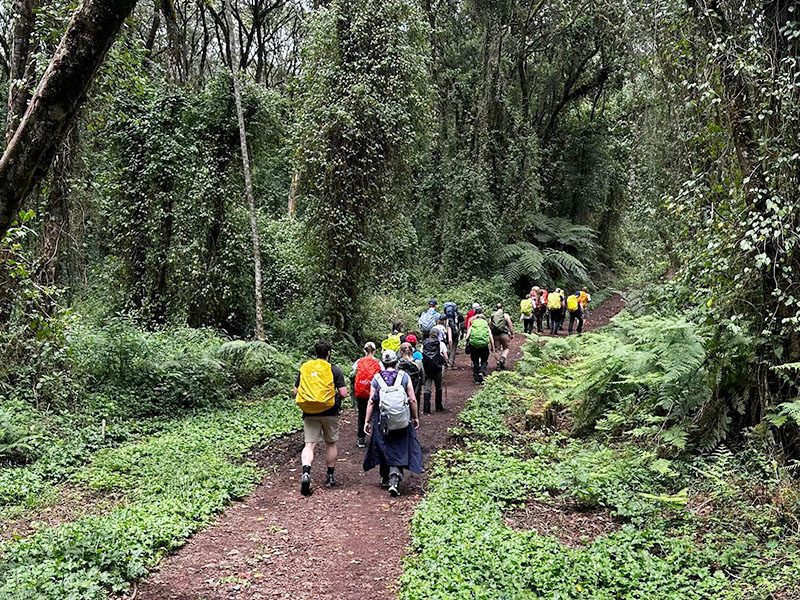
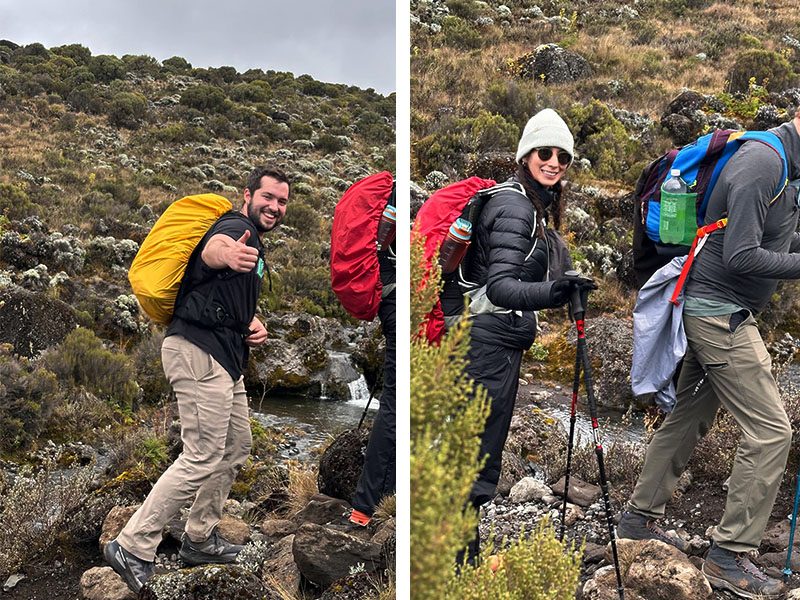
Park fees may include:
  • Conservation fees charged per day
  • Camping or hut fees depending on the route
  • Rescue fees
  • Guide and crew park access
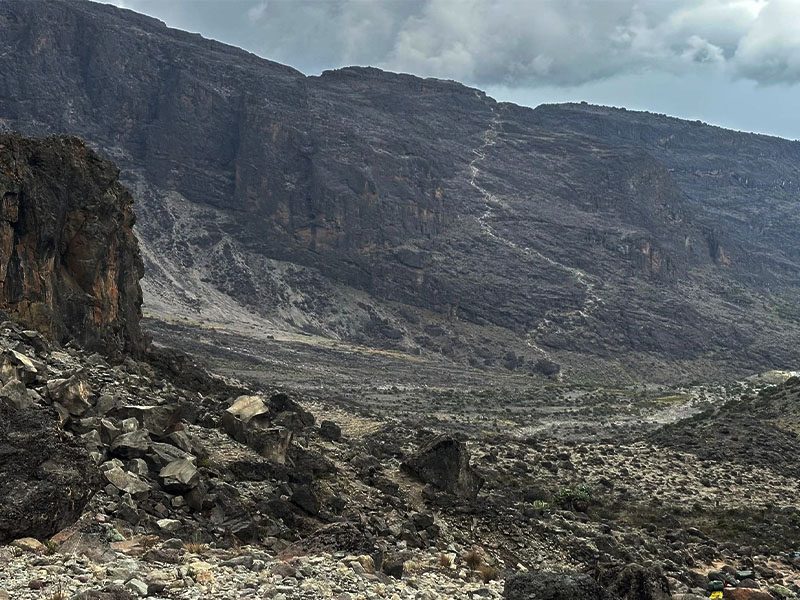
  • Value Added Tax (VAT)
Your entry is checked through official park registration and permit systems at the gate. This is one reason it is important to book with a licensed operator that handles park payments correctly and transparently.
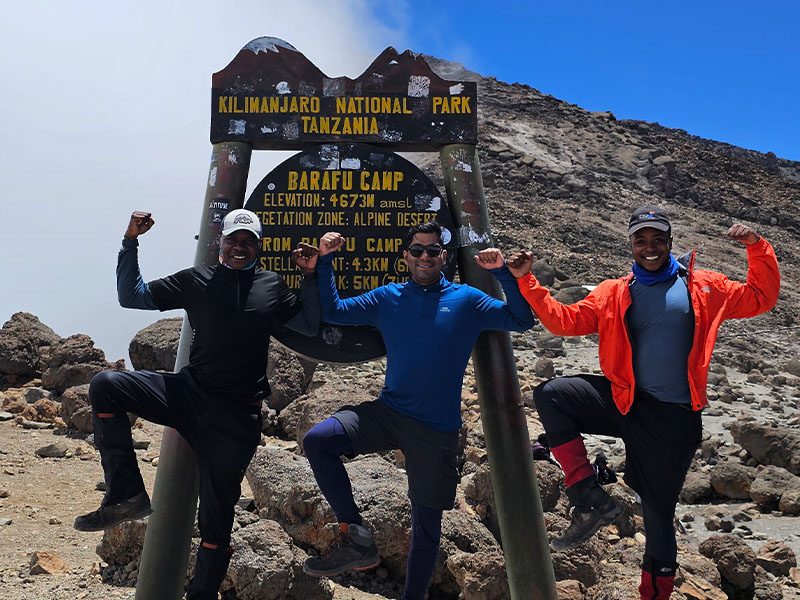
 
Park fees vary depending on the route and number of days on the mountain. Before comparing packages, read Kilimanjaro Climb Cost to understand how park fees, route length, crew support, and VAT affect your total budget.

 Leave No Trace – Strict Environmental Rules

Tanzania is serious about protecting Kilimanjaro’s fragile ecosystem. Regulations include:
  • No littering — All waste must be packed out
  • No removing plants, rocks, or wildlife
  • Toilet use is regulated
Tour companies must carry out client and staff trash and follow “leave no trace” principles.
 

 Kilimanjaro Rescue Services Are Monitored

The park operates a dedicated rescue team, and Kilimanjaro SAR (Search and Rescue) provides helicopter evacuation in serious cases. However:
  • Evacuations require valid insurance
  • All emergencies must be reported through your guide
  • Rangers coordinate and monitor all rescue operations
At Kili Quests, we carry pulse oximeters, oxygen, and WFR-trained staff on every trek.
 
 
Rescue on Kilimanjaro is only possible with proper coverage, so it’s essential to have the right policy,learn how to choose the best medical insurance for Kilimanjaro before your trek.
Helicopter flying over Mount Kilimanjaro during an emergency evacuation
Kilimanjaro helicopter rescue for trekkers in emergency situations — valid insurance is required

Offenders Face Fines or Expulsion

Breaking the rules can lead to:
  • Fines
  • Expulsion from the mountain
  • Blacklisting for future permits
  • In serious cases, legal action


What You Need to Know

  •   You must use a licensed tour operator
  •  A certified guide is mandatory
  •  You must stay at official camps/huts
  •  Porters are protected and regulated
  •  Park fees must be paid in advance
  •  Littering and damage to the environment is strictly forbidden
  •  Rescue is available — but must be handled properly
  •  Breaking rules results in fines or expulsion

Frequently Asked Questions About Kilimanjaro Trekking Rules

Do you need a permit to climb Mount Kilimanjaro?

Yes. Every climber must obtain a permit issued by Kilimanjaro National Park Authority before entering Mount Kilimanjaro. These permits are arranged through licensed tour operators and include park entry, conservation fees, rescue coverage, and campsite or hut access. Without an official permit, trekkers cannot legally begin the climb.

Can tourists climb Mount Kilimanjaro without a guide?

No. Independent trekking is not allowed on Mount Kilimanjaro. Tanzanian park regulations require all climbers to be accompanied by a certified local mountain guide from a licensed tour company. This rule helps ensure climber safety, proper route management, and protection of the mountain environment.

Why are climbers required to use a licensed tour operator?

Licensed operators ensure that trekking groups follow national park rules, provide certified guides, and treat porters fairly. Authorities require tour companies to organize permits, pay park fees, and coordinate logistics so that all treks comply with safety and environmental regulations.

Are there rules protecting porters on Kilimanjaro?

Yes. Organizations such as the Kilimanjaro Porters Assistance Project work with park authorities to protect porter welfare. Porters are limited to carrying about 20 kg of gear and must receive proper meals, fair wages, and adequate shelter during the trek.

Is camping anywhere allowed on Mount Kilimanjaro?

No. Trekkers must stay only at designated campsites or huts depending on the route. For example, the Marangu Route uses mountain huts, while routes like Machame Route and Lemosho Route use official campsites. Wild camping outside these areas is strictly prohibited.

What happens if someone breaks Kilimanjaro trekking rules?

Violating park regulations can lead to fines, removal from the mountain, or cancellation of trekking permits. In serious cases, climbers or tour companies may be banned from future expeditions. These rules help protect both trekkers and the fragile ecosystem of Kilimanjaro National Park

Ready to Trek Responsibly?

At Kili Quests, we follow every regulation set by KINAPA and KPAP to ensure safe, legal, and ethical trekking. You’ll be guided by a professional team that respects the mountain, the people, and you.Choosing the right company is part of the rules , here’s how to find a licensed and ethical operat

Related Articles

Is Mount Kilimanjaro One of the 7 Wonders?

See Kilimanjaro for Yourself

Climb one of Africa’s greatest natural wonders with local guides who know the routes, altitude, and mountain conditions.
 

Helpful Kilimanjaro Guides

OUR CATEGORIES

Is Mount Kilimanjaro One of the 7 Wonders?

Mount Kilimanjaro is Africa’s highest mountain and one of the most famous natural landmarks in the world. Rising to 5,895 meters / 19,341 feet, it stands alone above the plains of northern Tanzania and attracts climbers, photographers, nature lovers, and adventure travelers from around the world.
 
At the top stands Uhuru Peak, whose name carries a powerful connection to Tanzania’s independence and freedom.
 
But many travelers ask one simple question:
 
Is Mount Kilimanjaro one of the Seven Wonders of the World?
 
The answer depends on which “wonders” list you mean. Kilimanjaro is not one of the ancient Seven Wonders of the World, and it is not one of the New 7 Wonders of Nature winners. However, it is widely recognized as one of the Seven Natural Wonders of Africa and is protected within Kilimanjaro National Park, a UNESCO World Heritage Site.

Quick Answer: Is Mount Kilimanjaro One of the 7 Wonders?

Mount Kilimanjaro is not one of the ancient Seven Wonders of the World. That list included ancient human-made monuments, not natural landscapes.
 
Kilimanjaro is also not one of the New 7 Wonders of Nature winners. However, it is widely recognized as one of the Seven Natural Wonders of Africa because of its height, free-standing volcanic formation, snow-capped summit, ecosystems, and dramatic rise above the surrounding plains.
 
Kilimanjaro National Park is also a UNESCO World Heritage Site, officially recognized for protecting Africa’s highest mountain and one of the world’s most impressive free-standing volcanic landscapes.
Mount Kilimanjaro rising above the African savanna with snow on the summit
Kilimanjaro is considered one of the world’s greatest natural wonders and is a UNESCO World Heritage Site

Table of Contents

Which “Wonders” List Includes Kilimanjaro?

The phrase “Seven Wonders” can be confusing because there are different lists.
The ancient Seven Wonders of the World focused on human-made monuments from the ancient world. Kilimanjaro is not part of that list because it is a natural mountain.
The New 7 Wonders of Nature was a global campaign that selected seven natural sites. Kilimanjaro was part of the wider campaign, but it was not one of the final winners.
 
The list where Kilimanjaro fits best is the Seven Natural Wonders of Africa, where it is commonly listed alongside major African landmarks such as the Serengeti Migration, Ngorongoro Crater, the Nile River, the Sahara Desert, the Okavango Delta, and the Red Sea Reef.
 
So the correct answer is simple: Kilimanjaro is not one of the ancient Seven Wonders of the World, but it is one of Africa’s greatest natural wonders.
Wonder or Heritage List Is Kilimanjaro Included? Correct Explanation
Ancient Seven Wonders of the World No That list included ancient human-made monuments, not natural mountains.
New 7 Wonders of Nature No Kilimanjaro was part of the wider campaign, but it was not one of the final winners.
Seven Natural Wonders of Africa Yes Kilimanjaro is widely recognized as one of Africa’s greatest natural landmarks.
UNESCO World Heritage Site Yes Kilimanjaro National Park is protected for its outstanding natural value and mountain landscape.

Is Kilimanjaro a UNESCO World Heritage Site?

Yes. Kilimanjaro National Park is a UNESCO World Heritage Site. It was inscribed in 1987 and protects the upper part of Mount Kilimanjaro, including Africa’s highest peak.
 
UNESCO status is different from being a “Seven Wonder.” A UNESCO World Heritage Site is officially recognized for outstanding universal value and protected through conservation standards. A “wonder” list is usually a recognition or ranking list, depending on the organization that created it.
 
This means Kilimanjaro is not just famous because travelers admire it. It is globally recognized as a protected natural landscape with exceptional importance.

Tanzania’s Other UNESCO World Heritage Sites

Kilimanjaro is part of Tanzania’s wider UNESCO heritage network, which also includes famous natural and cultural sites such as Serengeti National Park, Ngorongoro Conservation Area, Stone Town of Zanzibar, Kondoa Rock-Art Sites, Kilwa Kisiwani and Songo Mnara, and Nyerere National Park.
 
This shows why Tanzania is one of Africa’s most important destinations for nature, wildlife, culture, and history. But for this article, the key point is simple: Kilimanjaro is not only famous; it is globally protected.

Why Kilimanjaro Is Still a Natural Wonder

Even though Kilimanjaro is not one of the ancient Seven Wonders of the World, it deserves its reputation as one of Africa’s greatest natural wonders.
 
Kilimanjaro is special because it is:
  • Africa’s highest mountain
  • One of the world’s most impressive free-standing volcanic mountains
  • A volcanic mountain formed by Kibo, Mawenzi, and Shira
  • A snow-capped summit near the equator
  • A mountain with several ecological zones, from rainforest to alpine desert
  • A powerful symbol of Tanzania, freedom, culture, and adventure
Kilimanjaro’s dramatic shape comes from three volcanic cones: Kibo, Mawenzi, and Shira. Learn more in our guide to Kibo, Mawenzi, and Shira.
 
Its natural beauty is not only about height. Climbers pass through rainforest, heath, moorland, alpine desert, and arctic summit conditions in one journey. Few mountains offer such dramatic environmental change in a single trek.
 
Kilimanjaro’s meaning is also cultural. To understand the communities living around the mountain, read our guide to Chagga Culture Around Mount Kilimanjaro.
 
This combination of height, isolation, volcanic history, glaciers, ecosystems, and cultural meaning is why Kilimanjaro stands among Africa’s most iconic natural landmarks.
Local tribespeople near Kilimanjaro showing cultural connection to the mountain
Kilimanjaro’s cultural heritage is also part of its global recognition

What UNESCO Status Means for Kilimanjaro

UNESCO recognition helps protect Kilimanjaro’s natural value, but it does not mean the mountain is free from pressure. Like many famous natural sites, Kilimanjaro faces challenges from climate change, glacier loss, tourism pressure, land use, and conservation needs.
 
Responsible tourism matters because climbers, guides, operators, park authorities, and local communities all play a role in protecting the mountain.
 
When you climb with a responsible local operator, you support better mountain practices, local employment, conservation awareness, and more respectful tourism.
Aerial view of Mount Kilimanjaro showing Kibo, Mawenzi, and Shira volcanic cones
Kilimanjaro was formed by three volcanic cones — Kibo, Mawenzi, and Shira — each with a unique history
Mount Kilimanjaro’s three volcanic peaks — Kibo, Mawenzi, and Shira seen from above
3 Volcanic peaks of mount kilimanjaro

What UNESCO Status Means for Protection

Being a UNESCO site brings more than just fame. It means:
  • Conservation protections to prevent overuse or deforestation
  • International funding for park preservation
  • Support for local communities through regulated tourism
  • Scientific monitoring of glaciers, species, and climate impact
  • Cultural safeguarding of local traditions and stories
When you climb with responsible operators like Kili Quests, you directly support sustainable tourism and cultural preservation.
Climber standing at Uhuru Peak sign on the summit of Mount Kilimanjaro
The summit of Kilimanjaro is called Uhuru Peak — named after Tanzania’s independence in 1961

Frequently Asked Questions About Kilimanjaro as a World Wonder

Is Mount Kilimanjaro one of the Seven Wonders of the World?

No. Mount Kilimanjaro is not one of the ancient Seven Wonders of the World. That list focused on ancient human-made monuments, while Kilimanjaro is a natural mountain.

Is Kilimanjaro one of the New 7 Wonders of Nature?

No. Kilimanjaro was part of the wider New 7 Wonders of Nature campaign, but it was not one of the final winners.

Is Mount Kilimanjaro one of the Seven Natural Wonders of Africa?

Yes. Mount Kilimanjaro is widely recognized as one of the Seven Natural Wonders of Africa because it is Africa’s highest mountain, a major volcanic landmark, and one of the continent’s most iconic natural features.

Is Kilimanjaro a UNESCO World Heritage Site?

Yes. Kilimanjaro National Park is a UNESCO World Heritage Site. It was inscribed in 1987 and protects Africa’s highest mountain, volcanic landscapes, forests, wildlife, and important ecosystems.

Why is Kilimanjaro considered a natural wonder?

Kilimanjaro is considered a natural wonder because it rises dramatically above the plains, reaches 5,895 meters, has several ecological zones, includes glaciers near the equator, and is one of the world’s most impressive free-standing volcanic mountains.

Plan Your Kilimanjaro Adventure with Local Experts

Mount Kilimanjaro may not be one of the ancient Seven Wonders of the World, but it is one of Africa’s greatest natural landmarks. Its height, volcanic shape, glaciers, forests, wildlife, and cultural meaning make it one of the most unforgettable places to visit in Tanzania.
 
If you are ready to experience Kilimanjaro for yourself, Kili Quests can help you choose the right route, prepare properly, and climb with experienced local guides.
 
Before choosing your climb, compare the main trails in our Kilimanjaro Routes Guide so you understand route length, scenery, difficulty, and acclimatization.
 
Contact us today to start planning your Kilimanjaro climb.

Related Articles