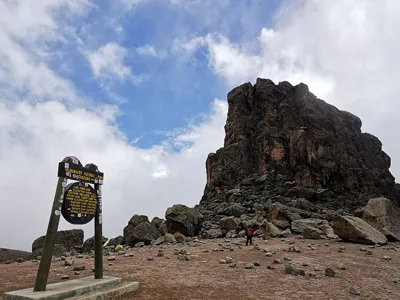
Lemosho Route Kilimanjaro: 8-Day Itinerary, Difficulty & Cost

Reach the Summit with Confidence

Your success depends on the right route, acclimatization, and expert guidance.
We plan every climb for a safe summit.

Plan Your Kilimanjaro Climb the Right Way

Kilimanjaro success depends on preparation and acclimatization.Explore these essential guides:

OUR CATEGORIES

Lemosho Route Kilimanjaro: 8-Day Itinerary, Difficulty & Cost

Why Choose the Lemosho Route?

The Lemosho Route is one of the best Kilimanjaro routes for climbers who want strong acclimatization, beautiful scenery, and a quieter start on the mountain. It begins on the remote western side of Mount Kilimanjaro, crosses the wide Shira Plateau, joins the southern circuit near Lava Tower, and reaches the summit from Barafu Camp.

This route is not the easiest way up Kilimanjaro, but it is one of the smartest choices for climbers who want enough time to adjust to altitude. The longer 8-day Lemosho itinerary gives your body more time to adapt, which can improve your summit chances compared with shorter, faster routes.

Lemosho is especially good for first-time Kilimanjaro climbers who want a scenic route without rushing the ascent. If you are still comparing routes, read our Kilimanjaro Routes Comparison: Which Route Is Best? to see how Lemosho compares with Machame, Marangu, Rongai, and the Northern Circuit.

Quick Answer: Is the Lemosho Route Worth It?

Yes, the Lemosho Route is worth it for most climbers who want a scenic, well-paced Kilimanjaro climb with better acclimatization. The 8-day version is the best choice for most travelers because it gives your body more time to adjust before summit night.
 
The route is especially strong for first-time climbers, photographers, and trekkers who want more than a rushed climb. It starts quietly on the western side of Kilimanjaro, crosses the Shira Plateau, passes Lava Tower and Barranco Wall, then joins the summit approach from Barafu Camp.
Best For Why Lemosho Works Well
First-time climbers The 8-day itinerary gives more time for altitude adjustment.
Scenery lovers The route crosses rainforest, Shira Plateau, Lava Tower, Barranco Wall, and alpine desert.
Climbers wanting fewer crowds early Lemosho starts on the quieter western side before joining the busier southern circuit.
Better acclimatization The route follows a gradual profile and includes the Lava Tower climb-high, sleep-low day.
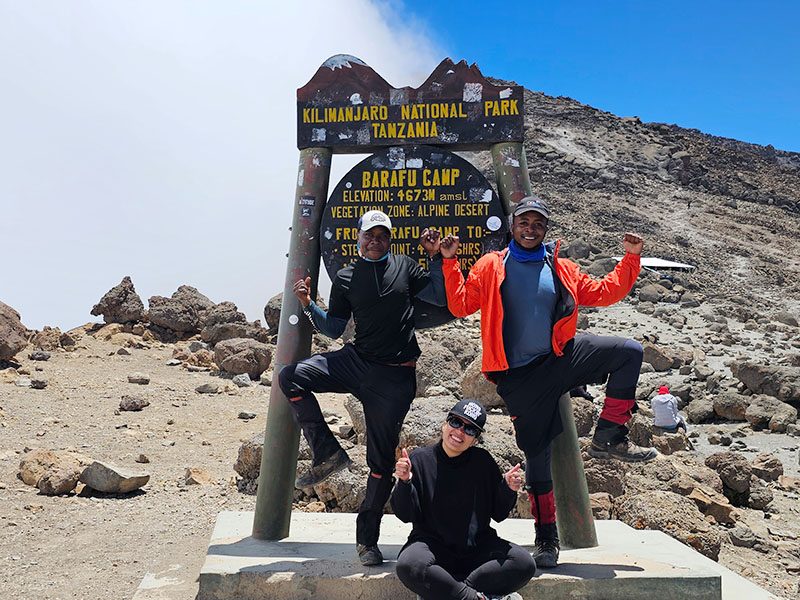
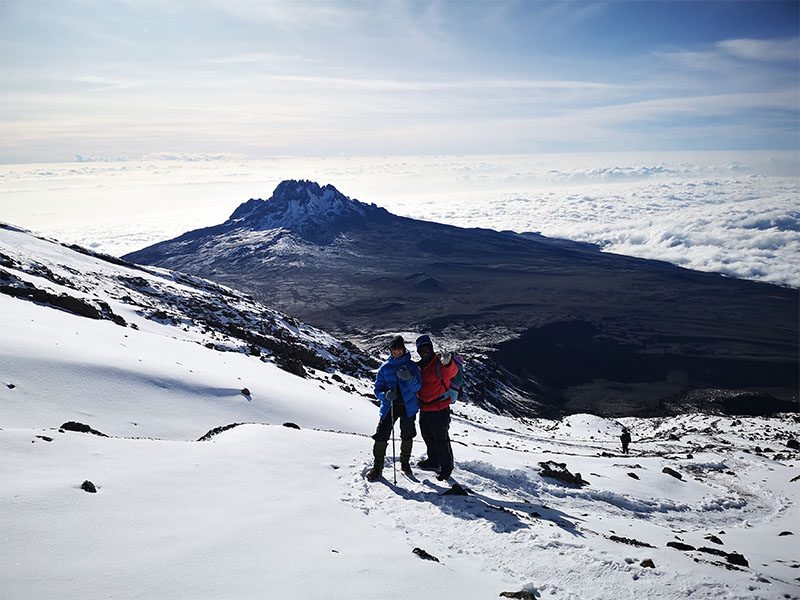
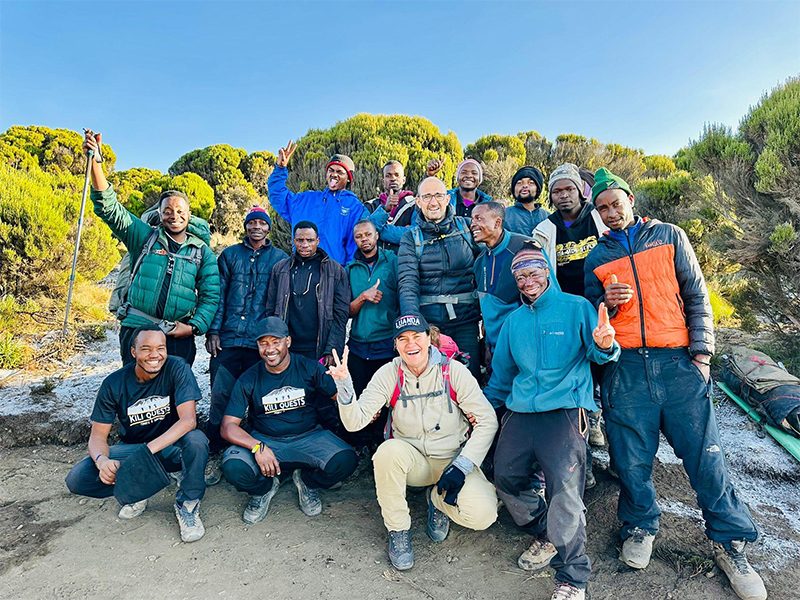
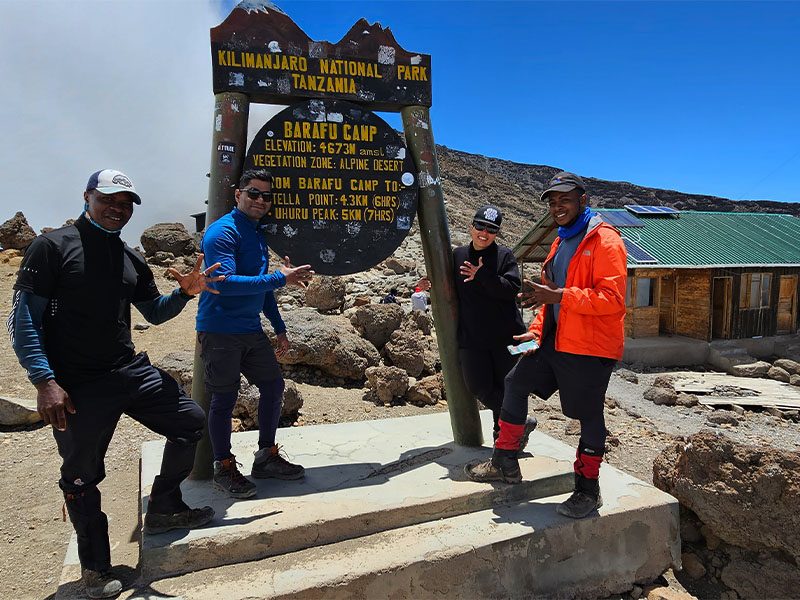
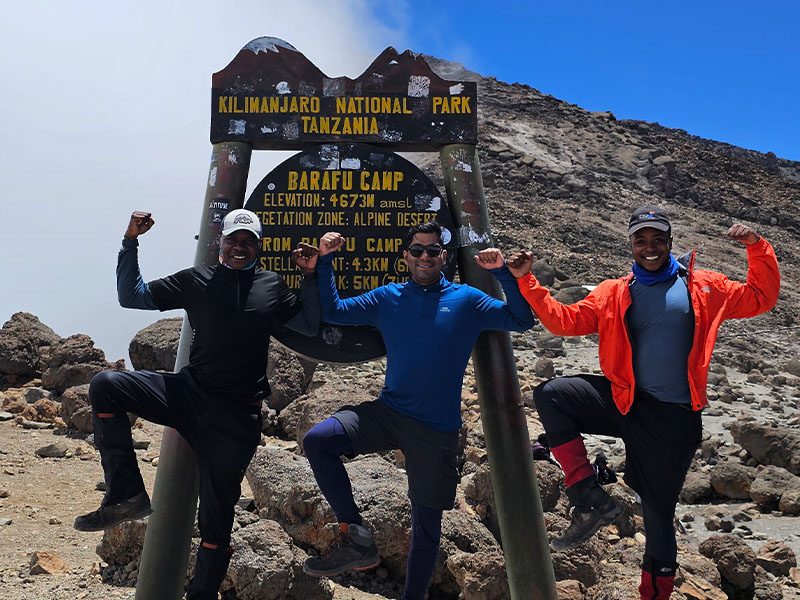
Climbers posing at Barafu Camp on the Lemosho Route before summit night on Mount Kilimanjaro
Climbers at Barafu Camp, the final staging point before summit night on the Lemosho Route.

Table of Contents

What Is the Lemosho Route on Kilimanjaro?

The Lemosho Route is a western approach route on Mount Kilimanjaro. It starts at Londorossi Gate, passes through rainforest, climbs onto the Shira Plateau, and then joins the southern circuit used by the Machame Route. From there, climbers continue toward Lava Tower, Barranco Camp, Karanga Camp, Barafu Camp, and finally Uhuru Peak.
 
The route is popular because it gives climbers a strong balance of scenery, acclimatization, and summit success. Compared with shorter routes, Lemosho gives your body more time to adapt to altitude, especially when done over 8 days.

Where Does the Lemosho Route Start?

The Lemosho Route begins at Londorossi Gate on the western side of Mount Kilimanjaro. After registration, climbers continue to the trailhead and begin walking through the rainforest toward Mti Mkubwa Camp. This western start is one reason Lemosho feels quieter and more remote during the first part of the climb.

How Long Is the Lemosho Route?

The Lemosho Route is usually completed in 7 or 8 days and covers about 70 kilometers / 43 miles. The 8-day version is strongly recommended for most climbers because it gives better acclimatization and reduces the pressure of gaining altitude too quickly.
 
If you are still deciding how many days you need, read our How Many Days to Climb Kilimanjaro guide before choosing your itinerary.

Lemosho Route Overview

Feature Details
Route Length 7 to 8 days
Distance ~70 km / 43 miles
Start Point Londorossi Gate, Western Kilimanjaro
Highest Point Uhuru Peak, 5,895 m / 19,341 ft
Difficulty Moderate to challenging
Best For Scenic views, high success rate, and fewer crowds
Success Rate ~98% on the 8-day itinerary

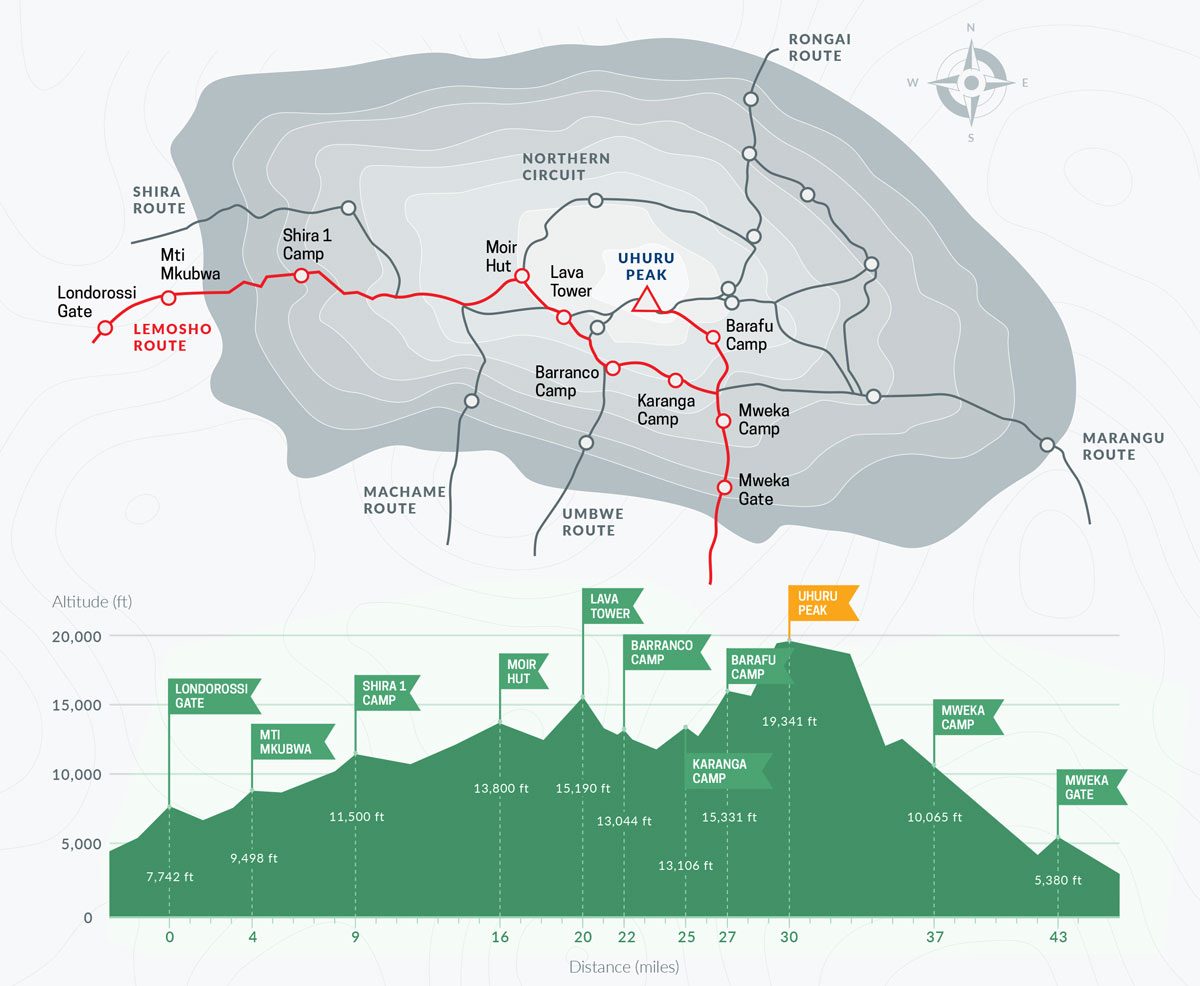
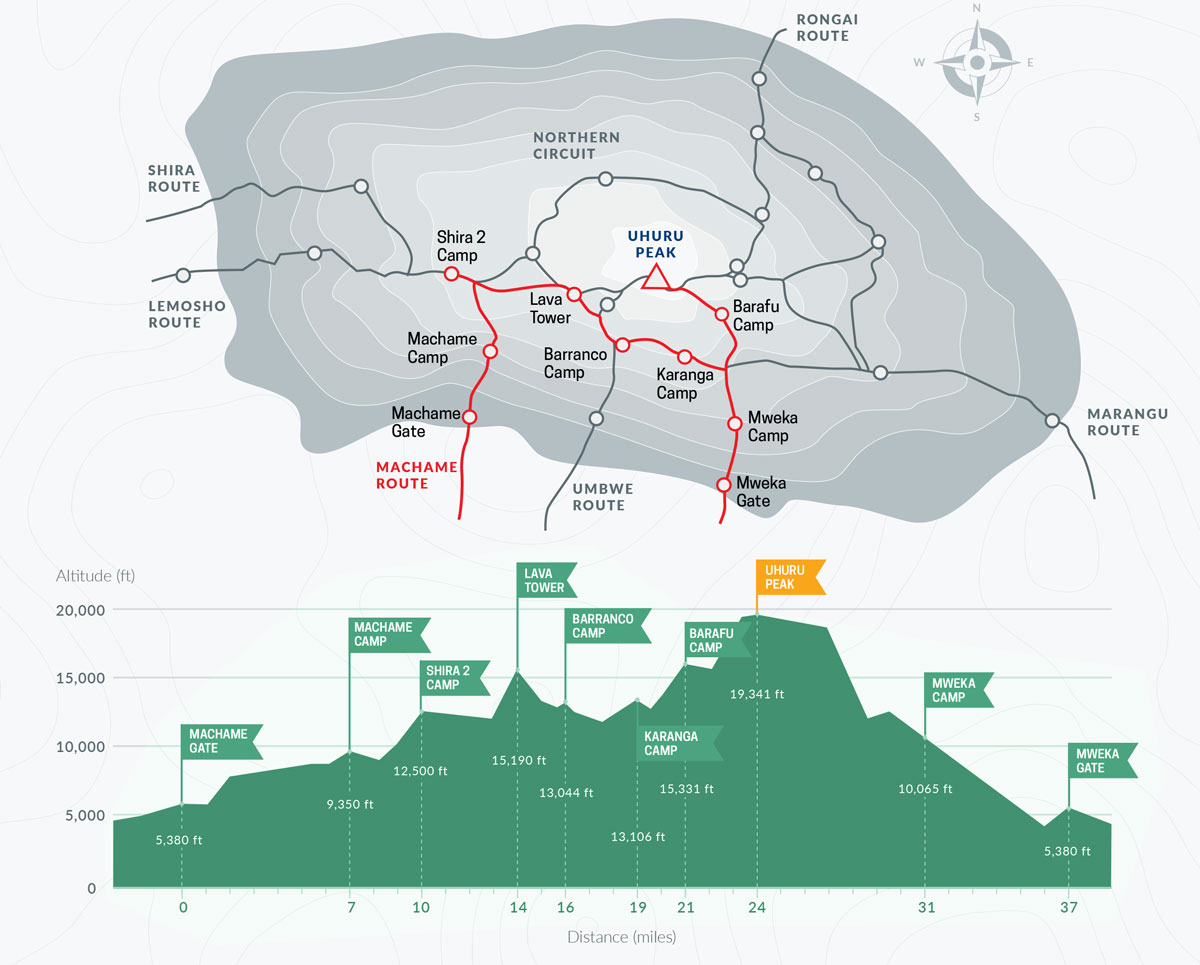
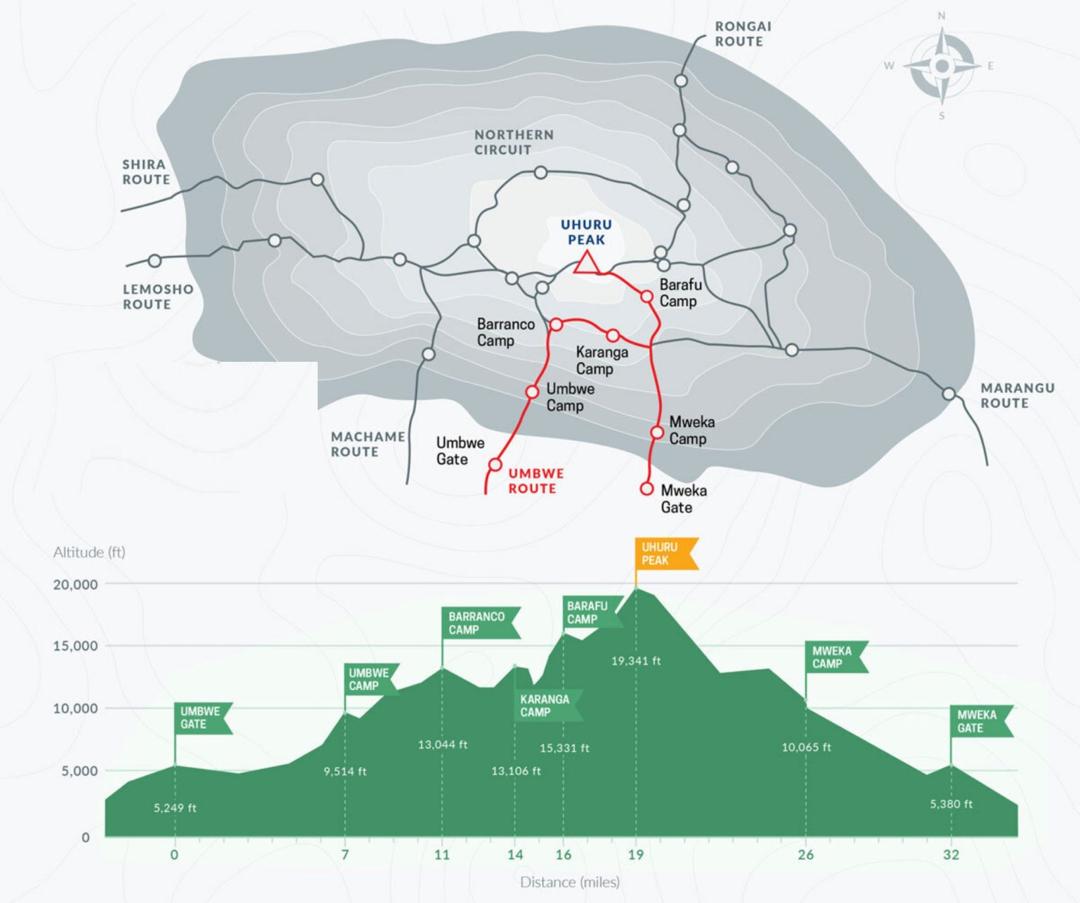
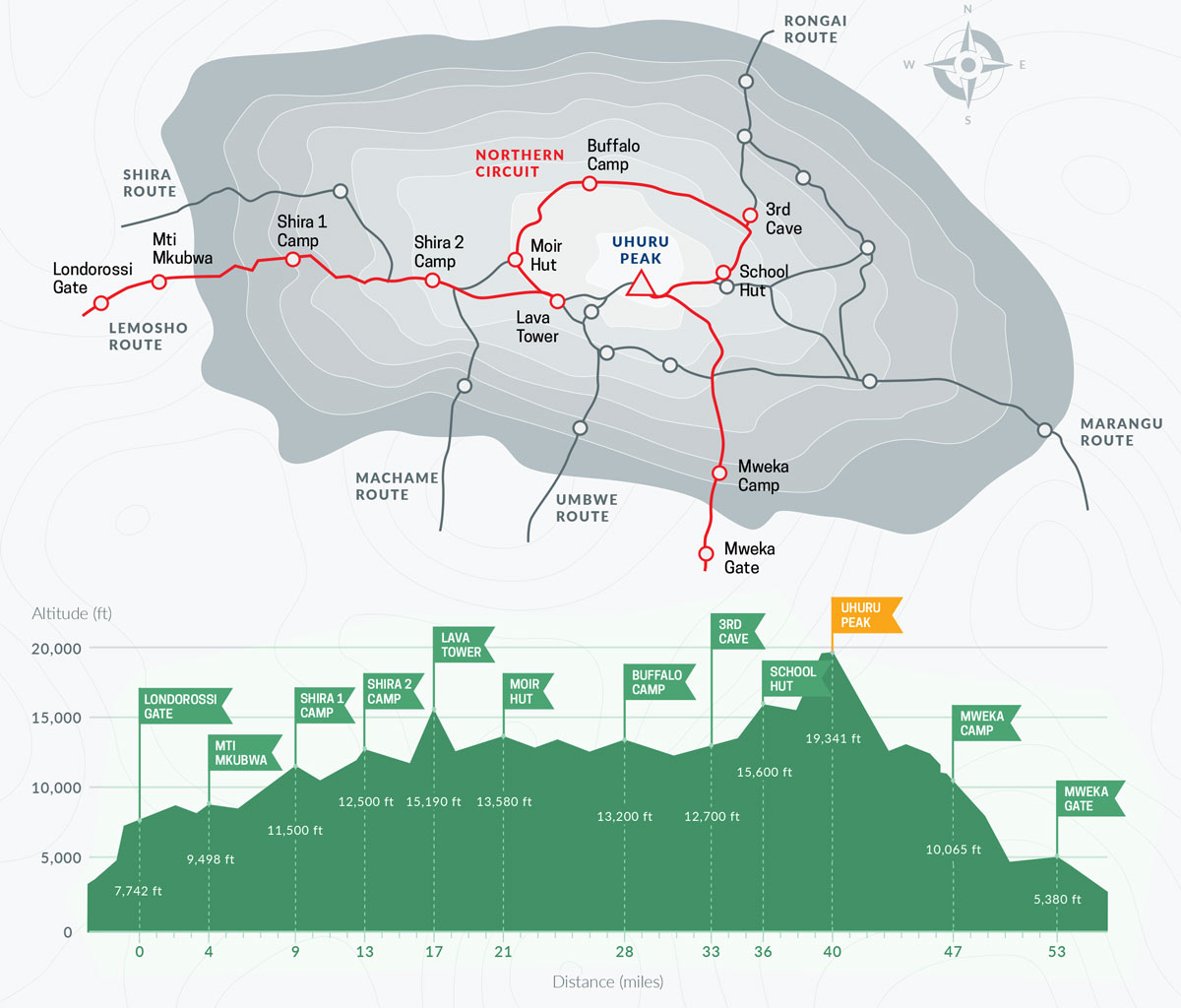
Lemosho Day Map and Elevation Profile

Lemosho Route map on Mount Kilimanjaro with full trail, elevation profile, and camp locations to Uhuru Peak
A scenic and well-acclimatized trail starting from Londorossi Gate and joining the Machame Route via Lava Tower.

8-Day Lemosho Route Itinerary

The 8-day Lemosho itinerary is the best version for most climbers because it gives more time for acclimatization before summit night. The route starts slowly, gains altitude gradually, and uses the important Lava Tower acclimatization day before sleeping lower at Barranco Camp.

Day 1 – Londorossi Gate to Mti Mkubwa Camp

The first day starts with registration at Londorossi Gate before entering the rainforest zone. The walk is usually short and gentle, which helps climbers begin slowly instead of rushing into altitude too fast.
  • Altitude: 2,100 m to 2,650 m
  • Hiking time: 3–4 hours
  • Zone: Rainforest
  • Camp: Mti Mkubwa Camp

Day 2: Mti Mkubwa Camp to Shira 1 Camp

Day 2 leaves the forest and climbs into the moorland zone. The trail becomes more open, and you begin to see the wide Shira Plateau. This is one of the first days where climbers start feeling the altitude, so pacing matters.
  • Altitude: 2,650 m to 3,610 m
  • Hiking time: 5–6 hours
  • Zone: Rainforest to moorland
  • Camp: Shira 1 Camp

Day 3: Shira 1 Camp to Shira 2 Camp

This is a gentler day across the Shira Plateau. The walk is not extremely steep, but it is important for acclimatization because you are now sleeping above 3,800 meters. Clear weather can give excellent views across the plateau.
  • Altitude: 3,610 m to 3,850 m
  • Hiking time: 4–5 hours
  • Zone: Moorland
  • Camp: Shira 2 Camp

Day 4: Shira 2 Camp to Barranco Camp via Lava Tower

This is one of the most important acclimatization days on the Lemosho Route. Climbers ascend to Lava Tower at about 4,640 meters, then descend to sleep at Barranco Camp. This follows the climb high, sleep-low principle, which helps the body adjust before going higher.
  • Altitude: 3,850 m to 4,640 m, then down to 3,960 m
  • Hiking time: 6–7 hours
  • Zone: Alpine desert
  • Camp: Barranco Camp
This is also the day when some climbers may start noticing altitude symptoms. Read our Altitude Sickness on Kilimanjaro guide so you understand what symptoms are normal and which signs should not be ignored.

Day 5: Barranco Camp to Karanga Camp

Day 5 begins with the Barranco Wall, one of the most famous parts of the Lemosho Route. It looks intimidating from camp, but most climbers find it manageable with slow movement and guide support. After the wall, the trail continues through valleys and ridges toward Karanga Camp.
  • Altitude: 3,960 m to 4,035 m
  • Hiking time: 4–5 hours
  • Highlight: Barranco Wall
  • Camp: Karanga Camp

Day 6: Karanga Camp to Barafu Camp

This is a shorter but important day because Barafu Camp is the base camp for summit night. Climbers arrive, rest, eat early, prepare summit gear, and try to sleep before the midnight summit push.
  • Altitude: 4,035 m to 4,673 m
  • Hiking time: 3–4 hours
  • Zone: Alpine desert
  • Camp: Barafu Camp

Day 7: Barafu Camp to Uhuru Peak, then down to Mweka Camp

Summit day is the hardest part of the Lemosho Route. The climb begins around midnight in cold, thin air. The trail climbs slowly toward Stella Point before continuing along the crater rim to Uhuru Peak, the highest point in Africa.
 
After reaching the summit, climbers descend back to Barafu Camp for a short rest, then continue down to Mweka Camp. This is a long day and requires mental strength, warm summit gear, and steady pacing.
  • Altitude: 4,673 m to 5,895 m, then down to 3,100 m
  • Hiking time: 12–14 hours total
  • Summit: Uhuru Peak
  • Camp: Mweka Camp
If you are worried about summit night, read our How Hard Is Mount Kilimanjaro? guide for a realistic look at the physical and mental challenge.

Day 8: Mweka Camp to Mweka Gate

The final day is a descent through the rainforest to Mweka Gate. After signing out, successful climbers receive their Kilimanjaro summit certificate before returning to Moshi or Arusha.
    • Altitude: 3,100 m to 1,640 m
    • Hiking time: 3–4 hours
    • Zone: Rainforest
    • Finish: Mweka Gate

7-Day vs 8-Day Lemosho Route: Which Is Better?

The Lemosho Route can be climbed in 7 or 8 days, but the 8-day itinerary is the better choice for most climbers. The extra day gives your body more time to adapt to altitude and makes the overall climb feel less rushed.
Option Best For Main Risk
7-Day Lemosho Fit climbers with some trekking experience Less time for acclimatization
8-Day Lemosho Most first-time climbers and travelers who want better acclimatization Higher cost because of the extra day
For most climbers, the extra day is worth it. Kilimanjaro is not a mountain where speed should be the goal. A slower itinerary gives you a better chance of reaching the summit safely and enjoying the climb.

Lemosho Route Difficulty and Acclimatization

How Difficult Is the Lemosho Route?

The Lemosho Route is moderately difficult. The trail is not technical, and you do not need climbing equipment, but the altitude, long trekking days, cold summit night, and mental fatigue make it a serious challenge.
 
The hardest part is usually summit night from Barafu Camp to Uhuru Peak. Climbers start in darkness, move slowly in freezing temperatures, and continue for several hours at high altitude. Good preparation, warm gear, and steady pacing are essential.

Why Lemosho Has Strong Acclimatization

Lemosho is one of the better Kilimanjaro routes for acclimatization because it gains altitude gradually and includes the important Lava Tower day. This gives the body exposure to higher altitude before descending to sleep lower at Barranco Camp.
 
The 8-day version is especially strong because it reduces the pressure of climbing too high too quickly. This is why Lemosho is often recommended for climbers who want a safer and more comfortable summit attempt.

Who Should Choose the Lemosho Route?

Choose the Lemosho Route if you are:
  • A first-time Kilimanjaro climber who wants better acclimatization
  • A trekker with average to good fitness
  • A traveler who wants one of Kilimanjaro’s most scenic routes
  • A climber who prefers a quieter start before joining the southern circuit
  • Someone who wants a strong balance of scenery, pacing, safety, and summit preparation
Training still matters. Even with a good route, weak preparation can make the climb harder than it needs to be. Read our Kilimanjaro Training Plan before your trek so you know how to prepare your legs, lungs, and endurance.

How Much Does the Lemosho Route Cost?

The Lemosho Route usually costs more than shorter Kilimanjaro routes because it takes more days on the mountain. More days mean more park fees, guide and porter support, meals, camping equipment, and mountain logistics.
 
The 8-day Lemosho Route is not normally the cheapest Kilimanjaro option, but it gives better acclimatization and a more complete mountain experience. Choosing only by price is a mistake if it forces you into a rushed itinerary with less time to adjust to altitude.
 
Your final cost depends on the number of climbers, route length, service level, season, and what is included in the package. Before comparing prices, read our Kilimanjaro Climb Cost so you understand park fees, crew support, equipment, food, transport, and other important costs.
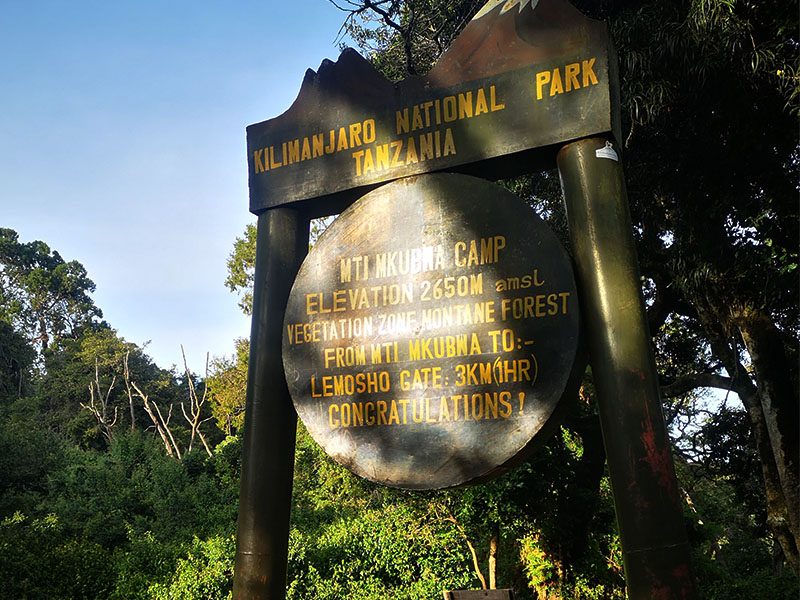
Mti Mkubwa Camp sign on Lemosho Route, Kilimanjaro National Park, showing elevation and distance to Lemosho Gate | Kili Quests
Mti Mkubwa Camp Sign (2,650m) – The first overnight stop on the Lemosho Route, located in the lush montane forest of Kilimanjaro.

Best Time to Climb the Lemosho Route

The best time to climb the Lemosho Route is during the drier months, especially from January to early March and from June to October. These months usually offer better trail conditions, clearer views, and more stable weather.
Season What to Expect Best For
January to early March Warmer conditions, good visibility, and fewer crowds than peak season Climbers who want a good balance of weather and quieter trails
June to October Drier weather, clear skies, colder nights, and busier trails Climbers who want the most reliable weather window
April to May Long rains, muddy trails, lower visibility, and wetter camps Usually not recommended
November Short rains and more unpredictable conditions Possible, but not ideal for most climbers
For a full month-by-month breakdown, read our Best Time to Climb Kilimanjaro guide before choosing your travel dates.

What Makes Lemosho Unique?

The Lemosho Route is unique because it combines a quieter western approach with some of Kilimanjaro’s most dramatic landscapes. The early days feel more remote than the busier southern routes, especially before Lemosho joins the main trail near Lava Tower and Barranco.

The route gives climbers a full mountain experience. You begin in rainforest, cross the Shira Plateau, pass through moorland and alpine desert, climb near Lava Tower, face the Barranco Wall, and finish with the summit push from Barafu Camp to Uhuru Peak.

Lemosho is not only scenic. Its real strength is pacing. The longer 8-day itinerary gives your body more time to adjust, which is why many climbers choose Lemosho when safety, acclimatization, and summit preparation matter more than speed.

Lemosho Route vs Machame Route

Lemosho and Machame are two of the most popular Kilimanjaro routes, and many climbers compare them before booking. Both routes use the southern circuit, both pass Lava Tower and Barranco Wall, and both usually summit from Barafu Camp. The main difference is the beginning of the route and the pacing.
Category Lemosho Route Machame Route
Starting Side Western Kilimanjaro Southern Kilimanjaro
Best Duration 8 days 7 days
Scenery Excellent, especially Shira Plateau and western approach Excellent, with varied landscapes and dramatic southern circuit views
Crowds Quieter at the start, busier after joining the southern circuit Busier from the beginning
Acclimatization Very strong on the 8-day itinerary Good on the 7-day itinerary
Best For Climbers who want scenery, better pacing, and a quieter start Climbers who want a popular, scenic, slightly shorter route
Choose Lemosho if you want more time, a quieter beginning, and one of the most scenic Kilimanjaro approaches. Choose Machame if you want a shorter scenic route and are comfortable with a busier trail. You can also read our Machame Route Kilimanjaro Guide for a deeper comparison.
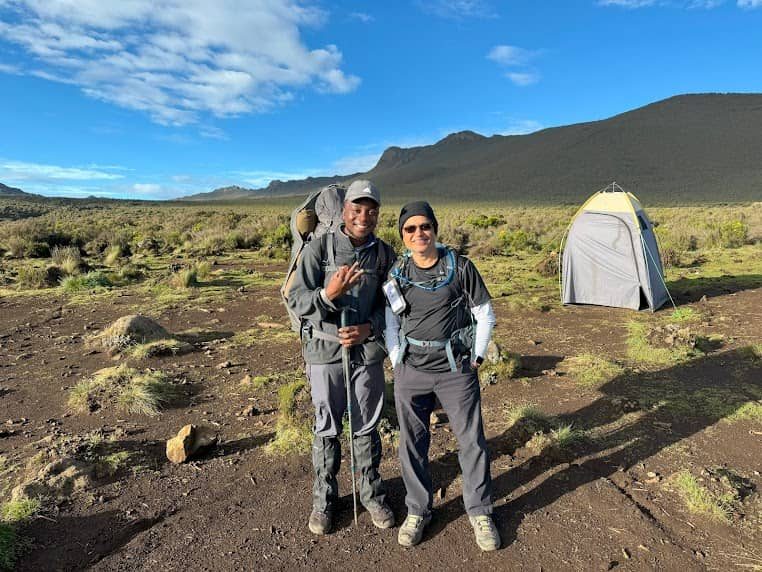
Two trekkers standing at Shira One Camp on the Lemosho Route, Kilimanjaro, with scenic moorland and tent in the background | Kili Quests
Shira One Camp (3,610m) – Trekkers enjoying a clear morning at Shira Plateau, the first high-altitude campsite on the Lemosho Route.

Is the Lemosho Route Right for You?

The Lemosho Route is right for you if you want a scenic Kilimanjaro climb with strong acclimatization and enough time to enjoy the mountain. It is especially good for climbers who do not want to rush the ascent and who understand that altitude, not technical climbing, is the biggest challenge on Kilimanjaro.

Choose Lemosho If You Want:

  • A scenic Kilimanjaro route with rainforest, Shira Plateau, Lava Tower, Barranco Wall, and summit views
  • A quieter start on the western side of the mountain
  • Better acclimatization on an 8-day itinerary
  • A strong route for first-time Kilimanjaro climbers
  • A route that balances scenery, pacing, and summit potential

Lemosho May Not Be Ideal If:

  • You only have 5 or 6 days for the climb
  • You are looking for the cheapest Kilimanjaro route
  • You prefer a shorter itinerary even if it gives less acclimatization time
  • You want the quietest route all the way to the summit, because Lemosho joins the southern circuit after Shira
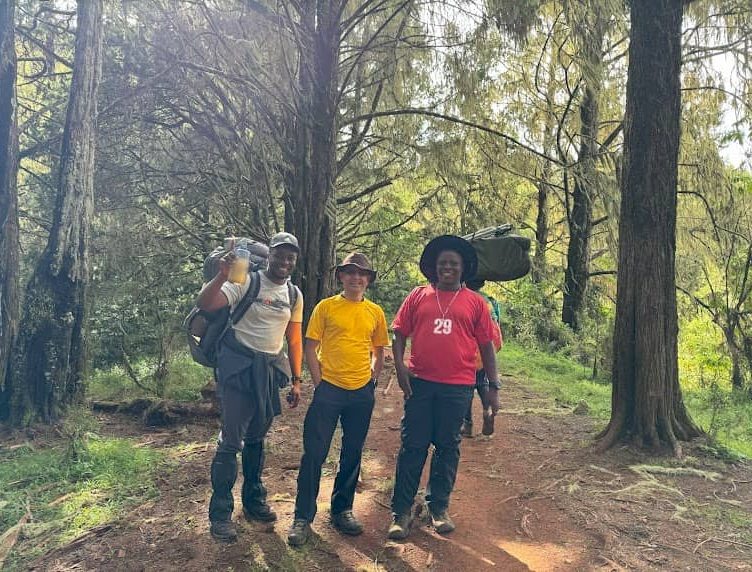
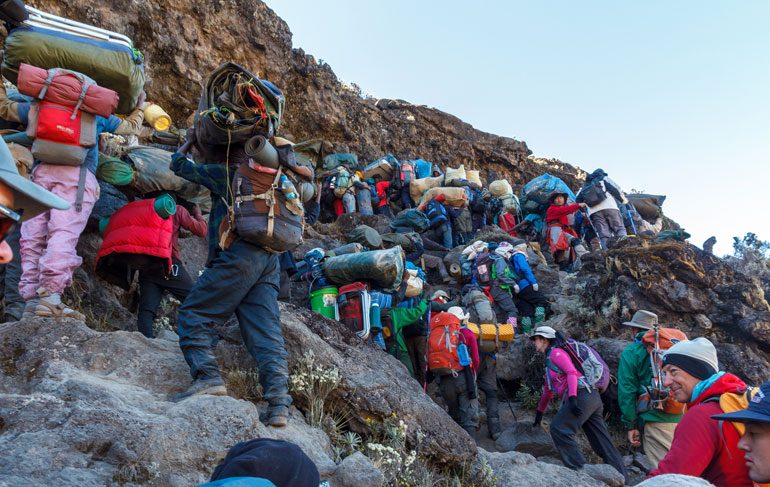
Trekkers and porters hiking through the forest into the moorland zone on the Lemosho Route, Mount Kilimanjaro | Kili Quests
Forest to Moorland Transition – Climbers and porters passing through the lush forest as they ascend toward the moorland zone on Day 2 of the Lemosho Route.

What to Pack for the Lemosho Route

The Lemosho Route crosses several climate zones, so you need to pack for rainforest, moorland, alpine desert, and freezing summit conditions. The most important items are warm layers, a waterproof jacket, strong hiking boots, gloves, a headlamp, a sleeping bag, and comfortable daypack essentials.
 
Do not underestimate summit night. Temperatures can feel extremely cold near Stella Point and Uhuru Peak, especially when wind and fatigue are added. Pack properly and test your gear before arrival.
 
Use our Kilimanjaro Packing List to prepare your clothing, boots, sleeping bag, summit gear, toiletries, and daypack items before your climb

Frequently Asked Questions About the Lemosho Route

How difficult is the Lemosho Route on Mount Kilimanjaro?

The Lemosho Route is moderately difficult. It is not technical, but the altitude, long trekking days, cold summit night, and mental fatigue make it challenging. The 8-day version is easier to manage than shorter routes because it gives more time for acclimatization.

How many days does the Lemosho Route take?

The Lemosho Route usually takes 7 or 8 days. The 8-day itinerary is better for most climbers because it provides more time to adjust to altitude before summit night.

Is the Lemosho Route good for beginners?

Yes, Lemosho is a strong choice for many first-time Kilimanjaro climbers. It gives better acclimatization than shorter routes and has a gradual profile, especially when climbed over 8 days. Beginners still need proper training and realistic preparation.

What is the success rate of the Lemosho Route?

The Lemosho Route has one of the stronger summit success profiles on Kilimanjaro, especially on the 8-day itinerary. Success depends on acclimatization, fitness, guide pacing, weather, health, and how well the climb is managed.

Is Lemosho better than Machame?

Lemosho is usually better if you want a quieter start, more scenery, and stronger acclimatization on an 8-day itinerary. Machame is also scenic and popular, but it is busier and usually done in fewer days.

How much does the Lemosho Route cost?

The Lemosho Route usually costs more than shorter routes because it includes more days on the mountain. More days mean more park fees, crew support, food, camping logistics, and guide services. The extra cost can be worth it if it improves acclimatization and summit preparation.

Climb Kilimanjaro via the Lemosho Route with Kili Quests

The Lemosho Route is one of the best choices if you want a scenic, well-paced Kilimanjaro climb with strong acclimatization. At Kili Quests, we plan Lemosho climbs with experienced local guides, proper pacing, safety checks, good mountain meals, fair porter care, and realistic summit preparation.
Our 8-day Lemosho itinerary is designed for climbers who want more than a rushed climb. You get time to adjust, time to enjoy the mountain, and a better chance of reaching Uhuru Peak safely.
 
Ready to climb Kilimanjaro on the Lemosho Route? Contact Kili Quests today and let our local team help you plan the right itinerary, dates, gear, and preparation for your climb.

Related Articles

Machame Route Kilimanjaro: 7-Day Itinerary, Difficulty & Cost

Reach the Summit with Confidence

Success on Kilimanjaro depends on the right route, acclimatization, and team.We plan every Machame climb for a safe summit.

Plan Your Machame Route the Right Way

The right route, acclimatization, and team make the difference.We plan your Machame climb for a safe summit

OUR CATEGORIES

Machame Route Kilimanjaro: 7-Day Itinerary, Difficulty & Cost

Why Choose the Machame Route?

The Machame Route is one of the most popular ways to climb Mount Kilimanjaro because it offers strong scenery, a varied trail, good acclimatization, and a classic Kilimanjaro adventure. It begins at Machame Gate on the southwestern side of the mountain, climbs through rainforest, crosses moorland and alpine desert, passes Lava Tower and Barranco Wall, and reaches the summit from Barafu Camp.

Machame is often called the “Whiskey Route” because it is more demanding than the Marangu Route, which is sometimes called the “Coca-Cola Route.” That does not mean Machame is only for expert climbers. Many first-time Kilimanjaro climbers choose Machame, but they should choose the 7-day version, train properly, and respect the altitude.

The Machame Route is best for climbers who want a scenic and active Kilimanjaro climb without choosing one of the longest routes. If you are still comparing your options, read our Kilimanjaro Routes Comparison: Which Route Is Best? to see how Machame compares with Lemosho, Marangu, Rongai, and the Northern Circuit.

Quick Answer: Is the Machame Route Worth It?

Yes, the Machame Route is worth it if you want a scenic, active, and popular Kilimanjaro climb with good acclimatization. The 7-day version is the best choice for most climbers because it gives more time to adjust to altitude before summit night.
 
Machame is not the easiest Kilimanjaro route, but it gives a strong balance of scenery, challenge, and summit preparation. It is best for climbers with average to good fitness who want a more adventurous route than Marangu but do not want the longer schedule of Lemosho or the Northern Circuit.
Best For Why Machame Works Well
Active trekkers The route has steeper sections, varied terrain, and a more adventurous feel.
First-time climbers with good fitness The 7-day itinerary gives better acclimatization than the shorter 6-day version.
Scenery lovers Machame crosses rainforest, moorland, Lava Tower, Barranco Wall, alpine desert, and summit terrain.
Climbers comparing popular routes Machame gives a strong balance of scenery, challenge, and route popularity.
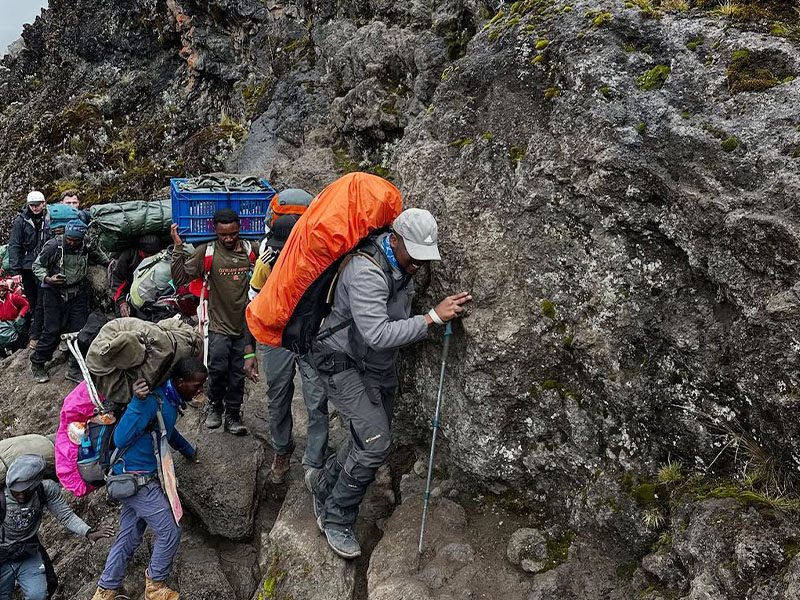
Trekkers and porters ascending the Kissing Rock section on Barranco Wall along the Machame Route, Kilimanjaro
The Kissing Rock on Barranco Wall, one of the most famous sections of the Machame Route on Mount Kilimanjaro.

Table of Contents

What Is the Machame Route on Kilimanjaro?

The Machame Route is a southern approach route on Mount Kilimanjaro. It starts at Machame Gate, climbs through rainforest, continues to Shira Cave Camp, crosses toward Lava Tower, descends to Barranco Camp, and then follows the southern circuit toward Karanga, Barafu, and Uhuru Peak.

Machame is popular because it gives climbers a full Kilimanjaro experience in 6 or 7 days. The route has varied scenery, good acclimatization when done over 7 days, and several memorable sections, including Lava Tower, Barranco Wall, and the summit climb from Barafu Camp.

  Where Does the Machame Route Start?

The Machame Route begins at Machame Gate on the southwestern side of Mount Kilimanjaro. The first hiking day enters the rainforest zone, where the trail can be humid, muddy, and slippery depending on weather conditions.

How Long Is the Machame Route?

The Machame Route is usually climbed in 6 or 7 days and covers about 62 kilometers / 37 miles. The 7-day version is strongly recommended for most climbers because it gives more time for acclimatization and makes the climb less rushed.
 
If you are deciding how many days you need, read our How Many Days to Climb Kilimanjaro guide before choosing your route.

Machame Route Overview

Feature Details
Route Length 6 or 7 days
Distance ~62 km / 37 miles
Start Point Machame Gate, southwest side
Highest Point Uhuru Peak, 5,895 m / 19,341 ft
Difficulty Moderate to challenging
Best For Hikers wanting adventure and scenery
Success Rate ~95% on the 7-day itinerary

Machame Route Days and Elevation Profile

Machame Route map on Mount Kilimanjaro showing trail path, elevation profile, and major camps to Uhuru Peak
A scenic Kilimanjaro trail via Lava Tower and Barafu Camp, descending through Mweka Gate.

7-Day Machame Route Itinerary

The 7-day Machame itinerary is the best version for most climbers because it gives more time for acclimatization than the 6-day option. The route still feels active and challenging, but the extra day helps reduce the pressure of gaining altitude too quickly.

Day 1 – Machame Gate to Machame Camp

The climb begins at Machame Gate, where your team completes park registration before entering the rainforest. The trail climbs steadily through thick forest, and conditions can be muddy or slippery after rain. This first day is not technically difficult, but the steady uphill walking can feel demanding.
  • Altitude: 1,800 m to 2,835 m
  • Hiking time: 5–6 hours
  • Zone: Rainforest
  • Camp: Machame Camp

Day 2: Machame Camp to Shira Cave Camp

Day 2 leaves the rainforest and enters the moorland zone. The trail becomes more open, with better views of Kilimanjaro and the surrounding landscape. The climb is steady, and you begin sleeping at a higher altitude, so slow pacing becomes important.
  • Altitude: 2,835 m to 3,750 m
  • Hiking time: 5–6 hours
  • Zone: Moorland
  • Camp: Shira Cave Camp

Day 3: Shira Cave Camp to Barranco Camp via Lava Tower

This is one of the most important acclimatization days on the Machame Route. Climbers ascend toward Lava Tower at about 4,630 meters, then descend to sleep lower at Barranco Camp. This follows the climb-high, sleep-low principle, which helps the body adapt before going higher.
  • Altitude: 3,750 m to 4,630 m, then down to 3,960 m
  • Hiking time: 6–7 hours
  • Zone: Alpine desert
  • Camp: Barranco Camp
This is also where some climbers may begin noticing altitude symptoms. Read our Altitude Sickness on Kilimanjaro guide so you understand what symptoms are common and which warning signs should not be ignored.

Day 4: Barranco Camp to Karanga Camp

Day 4 begins with the Barranco Wall, one of the most famous features on the Machame Route. The wall looks intimidating from camp, but most climbers manage it safely with slow movement and guide support. After the wall, the trail continues across ridges and valleys toward Karanga Camp.

  • Altitude: 3,960 m to 4,035 m
  • Hiking time: 4–5 hours
  • Highlight: Barranco Wall
  • Camp: Karanga Camp

Day 5: Karanga Camp to Barafu Camp

This is a shorter but important day because Barafu Camp is the base camp for summit night. Climbers arrive, rest, eat early, prepare warm summit gear, and try to sleep before the midnight summit attempt.
  • Altitude: 4,035 m to 4,673 m
  • Hiking time: 3–4 hours
  • Zone: Alpine desert
  • Camp: Barafu Camp

Day 6: Barafu Camp to Uhuru Peak, then down to Mweka Camp

Summit day is the hardest part of the Machame Route. The climb begins around midnight in cold, thin air. Climbers move slowly toward Stella Point before continuing along the crater rim to Uhuru Peak, the highest point in Africa.
 
After reaching the summit, climbers descend back to Barafu Camp for a short rest before continuing down to Mweka Camp. This is a long and exhausting day, so mental strength, warm clothing, and steady guide pacing are very important.
  • Altitude: 4,673 m to 5,895 m, then down to 3,100 m
  • Hiking time: 12–14 hours total
  • Summit: Uhuru Peak
  • Camp: Mweka Camp
If you are worried about the challenge, read our How Hard Is Mount Kilimanjaro? guide for a realistic look at summit night, altitude, fitness, and mental preparation.

Day 7: Mweka Camp to Mweka Gate

The final day is a descent through the rainforest to Mweka Gate. After signing out, successful climbers receive their Kilimanjaro certificate before returning to Moshi or Arusha.
  • Altitude: 3,100 m to 1,640 m
  • Hiking time: 3–4 hours
  • Zone: Rainforest
  • Finish: Mweka Gate

6-Day vs 7-Day Machame Route: Which Is Better?

The Machame Route can be climbed in 6 or 7 days, but the 7-day itinerary is the better choice for most climbers. The extra day gives your body more time to adjust to altitude and makes the climb less rushed.
Option Best For Main Risk
6-Day Machame Very fit climbers with previous trekking experience Faster ascent and less time for acclimatization
7-Day Machame Most first-time climbers and travelers who want better acclimatization Slightly higher cost because of the extra day
The 6-day Machame Route may look attractive because it saves time and money, but it gives your body less time to adapt. For most climbers, the 7-day version is the smarter choice because summit success depends more on acclimatization than speed.

Machame Route Difficulty, Acclimatization & Fitness

How Difficult Is the Machame Route?

The Machame Route is moderately difficult to challenging. It is not a technical climb, and you do not need ropes or climbing equipment, but the trail includes steep sections, long trekking days, high altitude, and a cold summit night.
 
The hardest part is usually summit night from Barafu Camp to Uhuru Peak. Climbers start around midnight, move slowly in freezing conditions, and continue for several hours at high altitude before reaching the summit. This is where fitness, mental strength, pacing, and warm gear matter most.

How Acclimatization Works on Machame

Machame has good acclimatization when done over 7 days because it includes the Lava Tower climb-high, sleep-low day. Climbers ascend to a higher altitude during the day, then descend to sleep lower at Barranco Camp. This helps the body adapt before the route continues toward Karanga and Barafu.
 
The 6-day version is more rushed, which can make acclimatization harder. If you want a stronger summit profile and a less pressured climb, choose the 7-day Machame itinerary.
 
Read our Kilimanjaro Success Rate by Route guide to understand how route choice, itinerary length, pacing, and acclimatization affect summit success.

Who Should Choose the Machame Route?

Choose the Machame Route if you are:


  • A first-time climber with average to good fitness
  • A trekker who wants a more active route than Marangu
  • A traveler who wants dramatic scenery in 7 days
  • A climber who wants good acclimatization without choosing a longer route
  • Someone who is comfortable with a popular and sometimes busy trail

Training still matters. Machame is not a route you should treat casually. Read our Kilimanjaro Training Plan before your climb so you know how to prepare your endurance, legs, lungs, and hiking strength.

How Much Does the Machame Route Cost?

The Machame Route usually costs less than longer routes such as Lemosho or the Northern Circuit because it is normally completed in 6 or 7 days. However, the final price still depends on the number of climbers, service level, park fees, guide and porter support, meals, equipment, transport, and what is included in the package.
 
The 7-day Machame Route costs more than the 6-day version because it adds one extra day of park fees, crew wages, food, and mountain logistics. For most climbers, that extra day is worth it because it gives better acclimatization and a stronger summit profile.
 
Do not choose Machame only because it may be cheaper than Lemosho.A lower price may not be a good value if the itinerary is too rushed or the operator cuts corners on safety, food, guides, or porter care.Before comparing packages, read Kilimanjaro Climb Cost so you understand park fees, crew support, route length, tips, gear, insurance, and other expenses before booking.
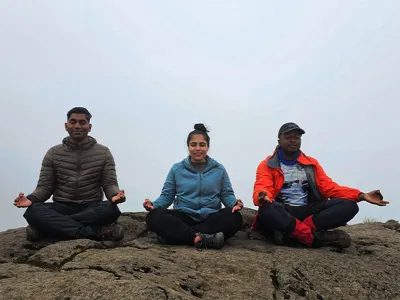
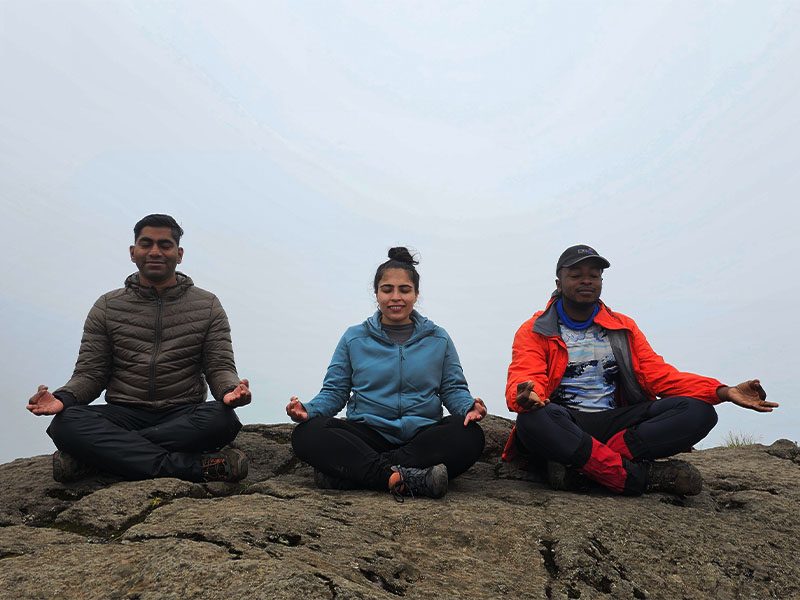
Trekkers meditating on a rock during a peaceful break on the Machame Route, Mount Kilimanjaro | Kili Quests
Mindful Moment on the Machame Trail – Climbers pause for a short meditation break on the way to Shira Camp, embracing Kilimanjaro’s calm Moorland environment.

Best Time to Climb the Machame Route

The best time to climb the Machame Route is during the drier months, especially from January to early March and from June to October. These months usually offer better trail conditions, clearer views, and more stable weather.
 
Season What to Expect Best For
January to early March Warmer conditions, good visibility, and fewer crowds than peak season Climbers who want a good balance of weather and trail conditions
June to October Drier weather, clear skies, colder nights, and busier trails Climbers who want the most reliable weather window
April to May Long rains, muddy trails, lower visibility, and wetter camps Usually not recommended
November Short rains and more unpredictable conditions Possible, but not ideal for most climbers
For a full month-by-month breakdown, read our Best Time to Climb Kilimanjaro guide before choosing your travel dates.

What Makes the Machame Route Special?

The Machame Route is special because it gives climbers a dramatic and varied Kilimanjaro experience in a 7-day itinerary. The trail starts in rainforest, climbs into moorland, crosses alpine desert, passes Lava Tower, climbs the Barranco Wall, and reaches the summit from Barafu Camp.
 
Machame is also popular because it gives better acclimatization than very short routes when climbed over 7 days. The Lava Tower day is especially important because climbers gain altitude during the day and sleep lower at Barranco Camp.
 
The route is not the quietest option on Kilimanjaro, but it is one of the most rewarding for climbers who want scenery, challenge, and a classic mountain experience.

Machame Route vs Lemosho Route

Machame and Lemosho are two of the best Kilimanjaro routes for scenery and acclimatization. Both routes pass Lava Tower, Barranco Wall, Karanga Camp, and Barafu Camp before summiting from the southern side. The biggest differences are the starting point, route length, crowd levels, and pacing.
Category Machame Route Lemosho Route
Starting Side Southwestern Kilimanjaro Western Kilimanjaro
Best Duration 7 days 8 days
Scenery Excellent, with rainforest, Lava Tower, Barranco Wall, and southern circuit views Excellent, with rainforest, Shira Plateau, western approach, Lava Tower, and Barranco Wall
Crowds Busier from the beginning Quieter at the start, busier after joining the southern circuit
Acclimatization Good on the 7-day itinerary Very strong on the 8-day itinerary
Best For Climbers who want a popular, scenic, active route in 7 days Climbers who want more time, a quieter start, and stronger acclimatization

Choose Machame if you want a scenic and active Kilimanjaro route in 7 days. Choose Lemosho if you want more time, a quieter beginning, and a stronger acclimatization profile. You can also read our Lemosho Route Kilimanjaro Guide for a deeper comparison.

Is the Machame Route Right for You?

The Machame Route is right for you if you want a scenic, active, and popular Kilimanjaro climb with good acclimatization on a 7-day itinerary. It is a strong choice for climbers who want more challenge than Marangu but do not want the longer schedule of Lemosho or the Northern Circuit.

Choose Machame If You Want:

  • A scenic Kilimanjaro route with rainforest, moorland, Lava Tower, Barranco Wall, and summit views
  • A more active and adventurous climb than Marangu
  • A popular route with strong support logistics
  • Good acclimatization on the 7-day itinerary
  • A classic Kilimanjaro trekking experience

Machame May Not Be Ideal If:

  • You want the quietest route on Kilimanjaro
  • You prefer the slowest possible acclimatization profile
  • You only want the easiest route
  • You are uncomfortable with steeper trail sections
  • You want a more remote start, where Lemosho may be a better choice
Trekkers posing with hiking poles at the Shira Cave Camp sign on Day 2 of the Machame Route, Kilimanjaro | Kili Quests
Shira Cave Camp (3,750m) – Climbers celebrate their arrival at this scenic moorland campsite on Day 2 of the Machame Route, Kilimanjaro.

What to Pack for the Machame Route

The Machame Route crosses several climate zones, so you need to pack for rainforest, moorland, alpine desert, and freezing summit conditions. The most important items include warm layers, waterproof clothing, broken-in hiking boots, gloves, a warm hat, a headlamp, a sleeping bag, trekking poles, and a comfortable daypack.
 
Do not underestimate summit night. The climb from Barafu Camp to Uhuru Peak is cold, slow, and physically demanding. Good gear can make a major difference in comfort, safety, and performance.
 
Use our Kilimanjaro Packing List to prepare your clothing, boots, sleeping bag, summit gear, toiletries, and daypack items before your climb.

Frequently Asked Questions About the Machame Route

How difficult is the Machame Route on Mount Kilimanjaro?

The Machame Route is moderately difficult to challenging. It does not require technical climbing skills, but it includes steep sections, long trekking days, high altitude, and a cold summit night. The 7-day version is easier to manage than the 6-day version because it gives more time for acclimatization.

Why is the Machame Route called the Whiskey Route?

The Machame Route is called the “Whiskey Route” because it is more physically demanding than the Marangu Route, which is often called the “Coca-Cola Route.” The nickname reflects the route’s steeper trail, longer camping style, and more adventurous character.

How many days does the Machame Route take?

The Machame Route usually takes 6 or 7 days. The 7-day itinerary is recommended for most climbers because it provides better acclimatization and makes the climb less rushed.

Is the Machame Route good for beginners?

Yes, Machame can be good for beginners who have average to good fitness and choose the 7-day itinerary. Beginners should train properly, walk slowly, use the right gear, and take altitude seriously.

Is Machame better than Lemosho?

Machame is better if you want a scenic, active, and popular route in 7 days. Lemosho is usually better if you want a quieter start, more time, and stronger acclimatization on an 8-day itinerary.

How much does the Machame Route cost?

The Machame Route usually costs less than longer routes because it takes fewer days, but the final price depends on route length, group size, service level, park fees, crew support, food, equipment, and transport. The 7-day version costs more than the 6-day version but gives better acclimatization.

Climb Kilimanjaro via the Machame Route with Kili Quests

The Machame Route is a strong choice if you want a scenic, active, and well-paced Kilimanjaro climb. At Kili Quests, we guide Machame climbs with experienced local guides, proper pacing, safety checks, good mountain meals, fair porter care, and realistic summit preparation.
 
Our 7-day Machame itinerary is designed for climbers who want better acclimatization than the shorter version while still enjoying one of Kilimanjaro’s most famous routes.
 
Ready to climb Kilimanjaro on the Machame Route? Contact Kili Quests today and let our local team help you choose the right dates, itinerary, gear, and preparation plan for your climb.

Related Articles

Marangu Route Kilimanjaro: 6-Day Itinerary, Huts & Cost

Plan Your Marangu Route the Right Way

Preparation, acclimatization, and route choice make the difference.Explore these essential guides:

Climb Kilimanjaro with Comfort

Marangu offers hut comfort, but pacing and acclimatization still matter.
We plan every trek for a safe summit.

OUR CATEGORIES

Marangu Route Kilimanjaro: 6-Day Itinerary, Huts & Cost

Why Choose the Marangu Route?

The Marangu Route is one of the oldest and most established routes on Mount Kilimanjaro. It is best known as the only main Kilimanjaro route with hut accommodation, making it a popular choice for climbers who prefer sleeping in huts instead of tents.
 
Marangu begins at Marangu Gate on the southeastern side of the mountain and follows the same trail up and down. The route passes through rainforest, moorland, alpine desert, and the high summit zone before reaching Gilman’s Point and continuing to Uhuru Peak.
 
Marangu is often called the “Coca-Cola Route,” but that nickname can be misleading. The trail may feel more straightforward than some camping routes, but the shorter itinerary gives climbers less time to acclimatize. For most climbers, the 6-day Marangu itinerary is a smarter choice than the 5-day version because it includes an acclimatization day at Horombo Hut.
 
If you are comparing Marangu with other Kilimanjaro routes, read Kilimanjaro Routes Comparison: Which Route Is Best? before choosing your climb.

Quick Answer: Is the Marangu Route Worth It?

Yes, the Marangu Route is worth it if you want the only Kilimanjaro route with hut accommodation and a more structured trekking experience. It is a good choice for climbers who prefer sleeping in huts, using a clear established trail, and following a shorter itinerary.
 
However, Marangu is not automatically the easiest route. The 5-day version can be difficult because it gives limited time for acclimatization. For most climbers, the 6-day Marangu Route is the better option because it adds an acclimatization day at Horombo Hut.
 
Marangu works best for climbers who value comfort and simplicity, but it may not be the best choice if your main priority is scenery variety, quiet trails, or the strongest acclimatization profile.
Best For Why Marangu Works Well
Climbers who prefer huts Marangu is the only main Kilimanjaro route with permanent hut accommodation.
First-time climbers wanting structure The route follows an established trail with clear camps and a predictable itinerary.
Budget-conscious climbers Marangu is often more affordable than longer camping routes because it usually takes fewer days.
Climbers with limited time The route can be completed in 5 or 6 days, although 6 days is strongly preferred.
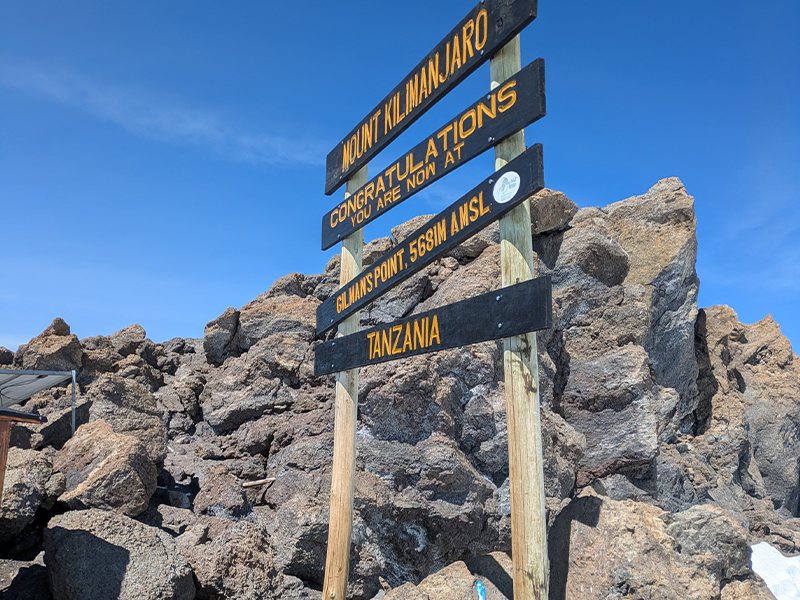
Alt Text: Gilman’s Point summit sign at 5,681 meters on Mount Kilimanjaro via the Marangu Route, with rocky terrain and blue sky | Kili Quests
Gilman’s Point (5,681m) marks the crater rim for trekkers ascending via the Marangu Route — a major achievement before reaching Uhuru Peak.

Table of Contents

What Is the Marangu Route on Kilimanjaro?

Where Does the Marangu Route Start?

The Marangu Route begins at Marangu Gate on the southeastern side of Mount Kilimanjaro. The trail passes through rainforest before opening into moorland and alpine desert zones.

How Long Is the Marangu Route?

The route typically takes 5 or 6 days to complete, covering approximately 72 kilometers (45 miles). The 6-day itinerary is strongly recommended to improve acclimatization and increase summit success.

Marangu Route Overview

Feature Details
Route Length 5 or 6 days
Distance About 72 km / 45 miles
Start Point Marangu Gate, southeastern Kilimanjaro
Highest Point Uhuru Peak, 5,895 m / 19,341 ft
Accommodation Permanent huts with shared sleeping rooms and dining areas
Difficulty Moderate, but altitude can be harder on short itineraries
Best For Climbers who want hut accommodation and a structured route
Success Profile Stronger on the 6-day itinerary than the shorter 5-day version
Because shorter routes allow less time for acclimatization, it’s important to understand how route choice affects summit success.Read our article about, Kilimanjaro Success Rate

Marangu Route Days and Elevation Profile

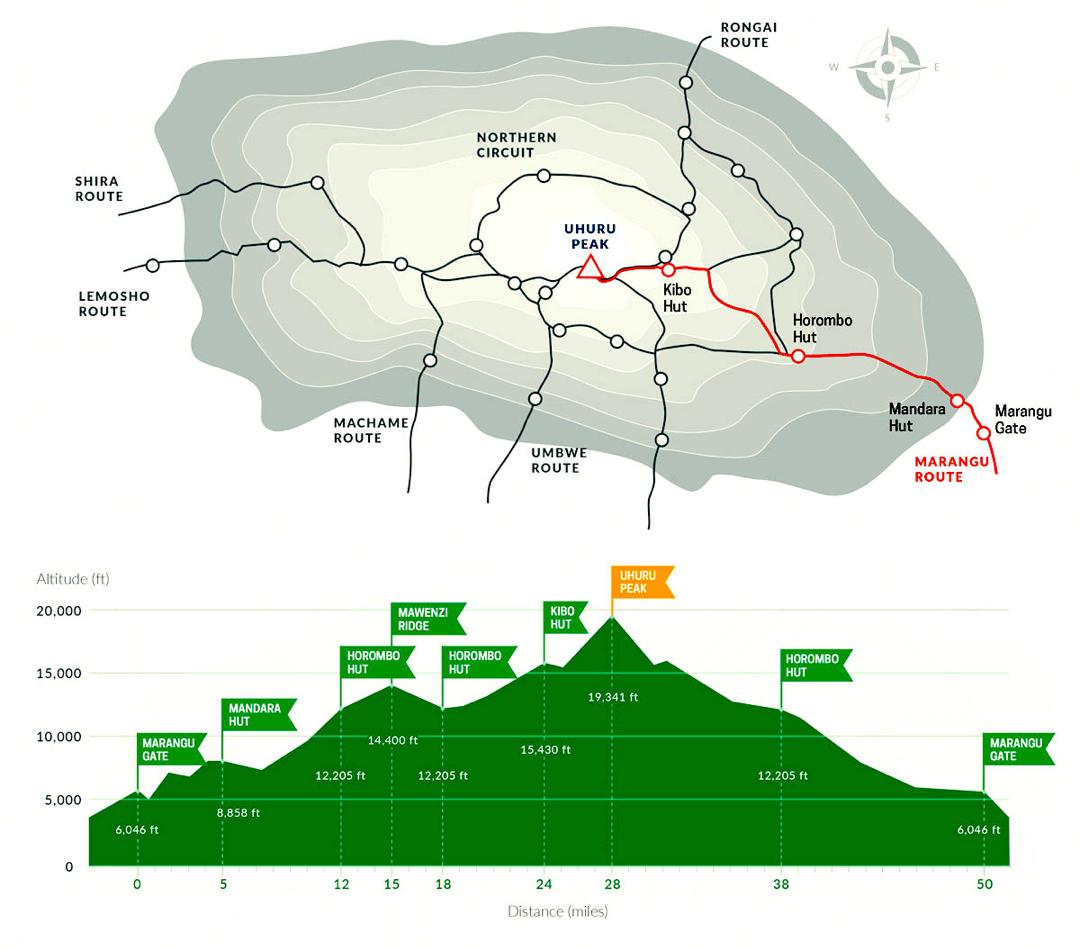
Marangu Route map on Mount Kilimanjaro showing elevation, trail path, and major camps to Uhuru Peak
Marangu Route Map – The only Kilimanjaro route with huts, following the same trail up and down via Horombo and Kibo Huts.

6-Day Marangu Route Itinerary

The 6-day Marangu itinerary is the better choice for most climbers because it includes an acclimatization day at Horombo Hut. The route is shorter than Lemosho or Northern Circuit, so the extra day is important for helping your body adjust before moving higher.

Day 1: Marangu Gate to Mandara Hut

The climb begins at Marangu Gate, where your team completes park registration before entering the rainforest. The trail climbs gradually through dense forest, where you may see blue monkeys, colobus monkeys, and tropical vegetation.
  • Altitude: 1,870 m to 2,700 m
  • Hiking time: 4–5 hours
  • Zone: Rainforest
  • Camp: Mandara Hut

Day 2: Mandara Hut to Horombo Hut

Day 2 leaves the rainforest and enters the moorland zone. The trail becomes more open, with views toward Mawenzi and the higher slopes of Kilimanjaro. This is one of the first days where altitude becomes more noticeable, so a slow pace matters.
  • Altitude: 2,700 m to 3,720 m
  • Hiking time: 6–7 hours
  • Zone: Moorland
  • Camp: Horombo Hut

Day 3 – Acclimatization Day at Horombo Hut

This extra day is one of the most important reasons to choose the 6-day Marangu itinerary instead of the 5-day version. Climbers usually take a short acclimatization hike toward Zebra Rocks, then return to sleep again at Horombo Hut.
 
This day helps your body adjust before moving higher to Kibo Hut. It does not guarantee altitude safety, but it gives your body more time to adapt.
  • Altitude: Around 3,720 m, with optional hike toward 4,000 m
  • Hiking time: 2–4 hours
  • Purpose: Acclimatization
  • Camp: Horombo Hut
For symptoms and warning signs, read Altitude Sickness on Kilimanjaro.

Day 4: Horombo Hut to Kibo Hut

The route continues through alpine desert toward Kibo Hut, the base for summit night. The landscape becomes drier, colder, and more exposed as you move higher. Climbers should walk slowly, drink regularly, and conserve energy for the summit attempt.
  • Altitude: 3,720 m to 4,700 m
  • Hiking time: 5–6 hours
  • Zone: Alpine desert
  • Camp: Kibo Hut

Day 5: Kibo Hut to Uhuru Peak, Then Down to Horombo Hut

Summit day is the hardest part of the Marangu Route. The climb usually begins around midnight and ascends steeply toward Gilman’s Point on the crater rim. From there, climbers continue toward Uhuru Peak, the highest point in Africa.
After reaching the summit, climbers descend back past Kibo Hut and continue down to Horombo Hut. This is a long and demanding day because of altitude, cold, darkness, and total hiking time.
  • Altitude: 4,700 m to 5,895 m, then down to 3,720 m
  • Hiking time: 12–14 hours total
  • Summit: Uhuru Peak
  • Camp: Horombo Hut
For a realistic look at summit night, read How Hard Is Kilimanjaro?

Day 6: Horombo Hut to Marangu Gate

The final day descends through moorland and rainforest back to Marangu Gate. After signing out, successful climbers receive their Kilimanjaro summit certificate before returning to Moshi or Arusha.
  • Altitude: 3,720 m to 1,870 m
  • Hiking time: 5–6 hours
  • Zone: Moorland to rainforest
  • Finish: Marangu Gate

How Much Does the Marangu Route Cost?

The Marangu Route is usually one of the more affordable Kilimanjaro routes because it is shorter than routes such as Lemosho and the Northern Circuit. Most Marangu climbs are completed in 5 or 6 days, which can reduce the total cost of park fees, crew support, food, and mountain logistics.
 
However, the cheapest Marangu climb is not always the best choice. The 5-day itinerary may cost less, but it gives your body less time to acclimatize. For most climbers, the 6-day Marangu Route is the smarter option because it includes an acclimatization day at Horombo Hut.
 
The final cost depends on several factors, including the number of climbers, route length, guide and porter support, hut logistics, meals, transport, park fees, equipment, and service level.
 
Do not choose Marangu only because it is cheaper. A lower price may not be a good value if the itinerary is rushed or the operator cuts corners on safety, food, guides, or porter care.Before comparing packages, read Kilimanjaro Climb Cost so you understand park fees, crew support, route length, tips, gear, insurance, and other expenses before booking.

Marangu Route Difficulty and Acclimatization

Is the Marangu Route Easy?

The Marangu Route is often described as one of the easier Kilimanjaro routes because the trail is more direct and climbers sleep in huts instead of tents. But this can be misleading.

Marangu is not technically difficult, but altitude can make it challenging. The route is usually completed in 5 or 6 days, which gives less time for acclimatization than longer routes such as Lemosho or Northern Circuit.

Why the 6-Day Marangu Route Is Better Than 5 Days

The 6-day Marangu itinerary is better because it adds an acclimatization day at Horombo Hut. This gives your body more time to adjust before going higher to Kibo Hut and attempting the summit.
 
The 5-day version is more rushed. It may cost less, but it gives your body less time to adapt to altitude. For most climbers, the 6-day version is the smarter and safer choice.

Who Should Choose the Marangu Route?

Choose the Marangu Route if you are:
  • A climber who prefers hut accommodation instead of tents
  • A traveler who wants a shorter and more structured Kilimanjaro itinerary
  • A budget-conscious climber who still wants a guided Kilimanjaro climb
  • Someone comfortable with a faster ascent profile
  • A climber who values comfort more than route variety
If your main goal is the strongest acclimatization profile, compare Marangu with Lemosho Route and Northern Circuit Route before deciding.

Best Time to Climb the Marangu Route

The best time to climb the Marangu Route is during the drier months, especially from January to early March and from June to October. These months usually offer better trail conditions, clearer views, and more stable weather.
 
Marangu can also be more comfortable than camping routes during wetter months because climbers sleep in huts. However, rain can still make the lower forest trail muddy and reduce visibility.
Season What to Expect Best For
January to early March Warmer conditions, good visibility, and fewer crowds than peak season. Climbers who want a good balance of weather and trail conditions.
June to October Drier weather, clearer skies, colder nights, and busier trails. Climbers who want the most reliable weather window.
April to May Long rains, muddy trails, lower visibility, and wetter conditions. Usually not recommended for most climbers.
November Short rains and more unpredictable conditions. Possible, but not ideal for most climbers.
For a full month-by-month breakdown, read Best Time to Climb Kilimanjaro before choosing your dates.

What Makes the Marangu Route Unique?

The Marangu Route is unique because it is the only main Kilimanjaro route with hut accommodation. Climbers sleep in shared huts at Mandara, Horombo, and Kibo instead of camping in tents.

It is also one of the most structured Kilimanjaro routes. The trail follows the same path up and down, which makes logistics simpler but gives less route variety than trails such as Lemosho, Machame, or Northern Circuit.

Marangu is often chosen by climbers who want a shorter route, hut accommodation, and a classic Kilimanjaro experience. Its main weakness is acclimatization. Because the route is usually done in 5 or 6 days, climbers need to take pacing seriously and should strongly consider the 6-day itinerary.
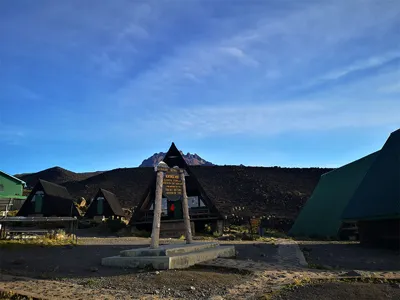
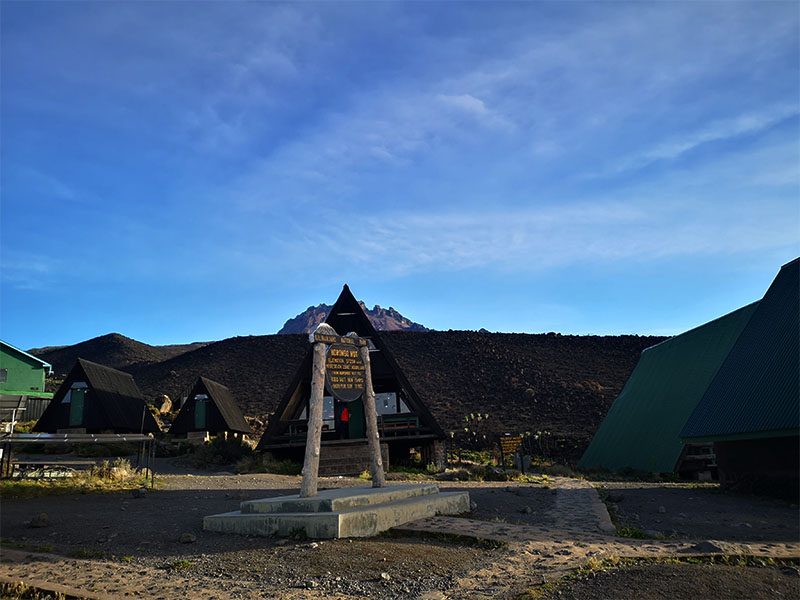
Horombo Huts on Mount Kilimanjaro’s Marangu Route with Mawenzi Peak in the background under a clear blue sky | Kili Quests
Horombo Huts (3,720m) on Kilimanjaro’s Marangu Route offer trekkers scenic views of Mawenzi Peak and a vital rest stop before Heading to Kibo Hut | Kili Quests.

Is the Marangu Route Right for You?

The Marangu Route is right for you if you want a hut-based Kilimanjaro climb with a shorter, more structured itinerary. It is especially attractive for climbers who prefer sleeping indoors instead of camping.

Choose Marangu If You Want:

  • Hut accommodation instead of tents
  • A shorter Kilimanjaro itinerary
  • A more structured and predictable route
  • A classic trail with established camps
  • A potentially more budget-friendly climb

Marangu May Not Be Ideal If:

  • You want the strongest acclimatization profile
  • You want the most scenic Kilimanjaro route
  • You prefer a quieter or more remote trail
  • You want a route that uses a different descent path
  • You only plan to choose the 5-day version

If you want stronger acclimatization and more scenery, compare Marangu with Lemosho Route and Machame Route before booking.

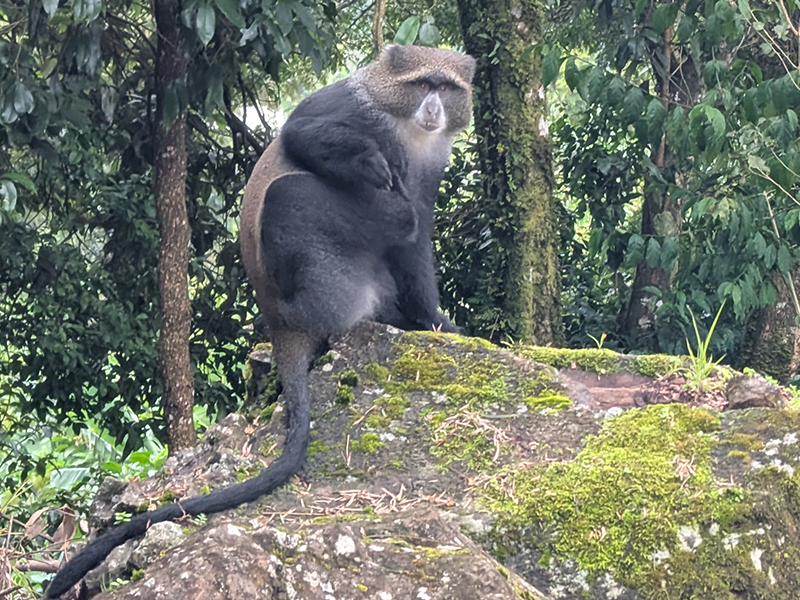
A Blue Monkey perched on a mossy rock in the rainforest zone of Mount Kilimanjaro, surrounded by dense green vegetation | Kili Quests
The Blue Monkey is one of the most commonly spotted primates in Kilimanjaro’s rainforest zone. Often seen near the lower trail sections like Marangu and Machame.

What to Pack for the Marangu Route

Even though Marangu uses huts, you still need proper mountain gear. The route crosses rainforest, moorland, alpine desert, and the cold summit zone, so your clothing must handle rain, wind, cold nights, and long trekking days.
 
Important items include warm layers, waterproof clothing, broken-in hiking boots, gloves, a warm hat, a headlamp, trekking poles, a sleeping bag, and daypack essentials.
 
Do not pack casually just because Marangu has huts. Summit night from Kibo Hut to Uhuru Peak can be extremely cold and physically demanding.
 
Use Kilimanjaro Packing List to prepare your clothing, boots, summit gear, toiletries, and daypack items before your climb.

Frequently Asked Questions About the Marangu Route

Why is the Marangu Route called the “Coca-Cola Route”?

The Marangu Route is nicknamed the “Coca-Cola Route” because it is considered one of the easier and more comfortable routes on Mount Kilimanjaro. It also has hut accommodation and historically offered bottled drinks at the camps.

Is the Marangu Route good for beginners?

Yes, many first-time climbers choose the Marangu Route because it has a clear trail and hut accommodation. However, the shorter itinerary means less time for acclimatization, so the 6-day version is strongly recommended.

How many days does the Marangu Route take?

The Marangu Route usually takes 5 or 6 days. The 6-day itinerary includes an acclimatization day at Horombo Hut, which improves the chances of reaching the summit.

Does the Marangu Route have huts?

Yes. The Marangu Route is the only Kilimanjaro route with permanent huts, including Mandara Hut, Horombo Hut, and Kibo Hut.

What summit point do climbers reach from the Marangu Route?

Climbers on the Marangu Route usually reach the crater rim at Gilman’s Point before continuing along the rim to Uhuru Peak, the highest point in Africa.

What wildlife can be seen on the Marangu Route?

The lower rainforest section of Mount Kilimanjaro often includes sightings of animals such as the Blue Monkey, colobus monkeys, and various bird species.

Climb Kilimanjaro via the Marangu Route With Kili Quests

The Marangu Route is a good choice if you want a hut-based Kilimanjaro climb with a shorter and more structured itinerary. But because the route gains altitude quickly, proper pacing and the 6-day itinerary are important.
 
At Kili Quests, we guide Marangu climbs with experienced local guides, steady pacing, daily health checks, good mountain meals, fair porter care, and clear summit preparation.
 
If you want hut accommodation without ignoring altitude risk, our team can help you choose the right Marangu itinerary and prepare properly for the climb.
 
Contact Kili Quests today to plan your Marangu Route Kilimanjaro climb with experienced local guides.

Related Articles

Rongai Route Kilimanjaro: 6–7 Day Itinerary, Difficulty & Cost

Plan Your Rongai Route Climb

The Rongai Route offers a quiet, steady path to the summit.
Get expert advice and a personalized quote for your climb.

Kilimanjaro Planning Guides

Choosing the right route is just the start. Explore these key guides:

OUR CATEGORIES

Rongai Route Kilimanjaro: 6–7 Day Itinerary, Difficulty & Cost

Rongai Route Kilimanjaro: Quiet Northern Trail from the North

 The Rongai Route is the only Kilimanjaro trail that approaches the mountain from the north, near the Kenya–Tanzania border. It is known for being quieter and drier than the southern routes, making it a strong choice for climbers who want a more peaceful trekking experience.

Rongai offers a steady ascent, remote wilderness, wide views, and dramatic scenery around Mawenzi Peak. It is not as lush or varied as Lemosho or Machame, but it gives climbers a quieter side of Kilimanjaro that many people never see.
The route is usually climbed in 6 or 7 days, with the 7-day itinerary offering a better acclimatization profile. If you want a less crowded trail with a gradual approach and a different Kilimanjaro experience, Rongai is worth considering.
 
For a full route comparison, see our Kilimanjaro Routes Comparison guide.

Quick Answer: Is the Rongai Route a Good Kilimanjaro Route?

Yes, the Rongai Route is a good Kilimanjaro route for climbers who want a quieter, drier, and more gradual trail from the northern side of the mountain. It is usually climbed in 6 or 7 days, with the 7-day version recommended for better acclimatization.
 
Rongai is best for climbers who prefer fewer crowds, remote scenery, and a steady approach. It is less dramatic than Lemosho or Machame in terms of scenery, but it offers excellent views of Mawenzi Peak and a peaceful wilderness feel.
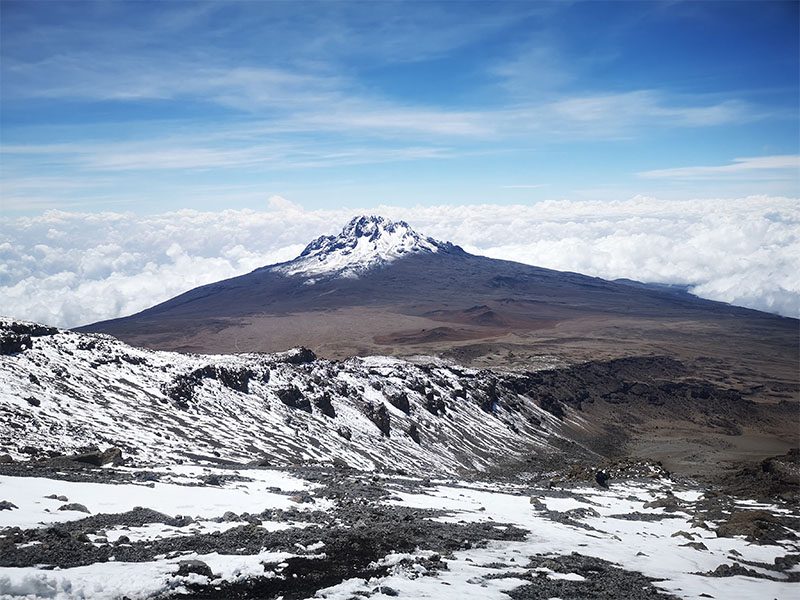
View of Mawenzi Peak from Stella Point on Mount Kilimanjaro
Mawenzi Peak views are one of the highlights of the Rongai Route near the summit zone.

Table of Contents

Why the Rongai Route Is Unique on Kilimanjaro

The Rongai Route is unique because it is the only official Kilimanjaro route that starts from the northern side of the mountain. Most other routes begin from the south or west, where rainfall is higher and trails are busier.
 
Because Rongai approaches from the drier northern side, it can be a strong option during wetter months. The trail also feels quieter and more remote, especially in the early stages near Simba Camp, Second Cave, and Kikelewa.
 
Another unique feature is the descent. Climbers ascend from the north but usually descend through the Marangu Route, giving them two different sides of Kilimanjaro in one trek.

Rongai Route Overview

Feature Rongai Route Details
Typical duration 6 to 7 days
Distance About 73 km / 45 miles
Starting point Rongai Gate, northern Kilimanjaro
Exit point Marangu Gate
Highest point Uhuru Peak, 5,895 m / 19,341 ft
Difficulty Moderate, with altitude still the main challenge
Best for Quiet trails, dry conditions, remote scenery, and steady ascent
Recommended option 7-day Rongai for better acclimatization
Not sure if Rongai is the right route for you? Compare all options in our Kilimanjaro Routes Comparison guide.

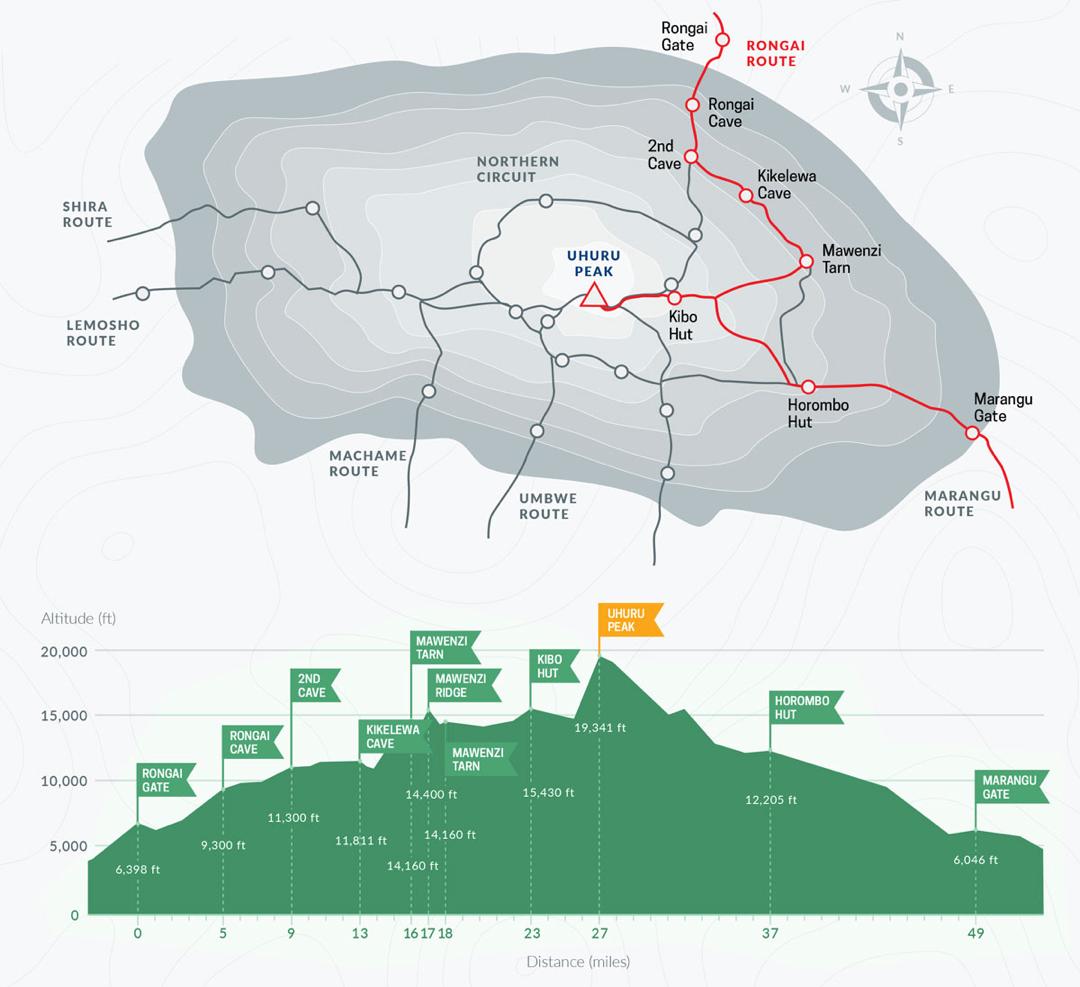
Rongai Route Days and Elevation Profile

Rongai Route map showing camps and elevation profile on Kilimanjaro
The Rongai Route approaches Kilimanjaro from the quieter northern side before descending through Marangu.

Who Is the Rongai Route Best For?

The Rongai Route is best for climbers who want a quieter Kilimanjaro experience with fewer crowds, a drier northern approach, and a steady trail profile.
 
It is a good choice for:
  • First-time climbers who want a less crowded route
  • Trekkers climbing during wetter months
  • Climbers who prefer remote wilderness over busy camps
  • People who want strong views of Mawenzi Peak
  • Trekkers who are comfortable choosing a 7-day itinerary for better acclimatization
Rongai is not the best choice if you want the most dramatic scenery or the strongest acclimatization profile. In that case, Lemosho or Northern Circuit may be better.

7-Day Rongai Route Itinerary

The 7-day Rongai Route is the better choice for most climbers because it gives more time for acclimatization than the shorter 6-day version. The route starts at Rongai Gate, passes through Simba Camp, Second Cave, Kikelewa, Mawenzi Tarn, and Kibo Hut, then descends through the Marangu Route after summit day.
 
Below is the typical 7-day Rongai itinerary.

Day 1: Rongai Gate to Simba Camp

  • Altitude: 2,000 m to 2,625 m
  • Time: 4–5 hours
  • Gentle hike through forest zone
Your adventure begins on the quiet northern side of Kilimanjaro at Rongai Gate, near the Kenya border. After registration, you’ll start a gentle hike through farmland and pine forest.
This section is relatively easy and allows your body to begin adjusting gradually. Wildlife sightings such as colobus monkeys are sometimes possible.You’ll arrive at Simba Camp in the afternoon, where you’ll enjoy your first night on the mountain.

Day 2: Simba Camp to Second Cave Camp

  • Altitude: 2,625 m to 3,450 m
  • Time: 5–6 hours
  • Beautiful views of Kibo and wilderness trail
The trail leaves the forest behind and enters the moorland zone, offering wide open views of Kibo Peak. The path remains steady and not too steep, making it a comfortable trekking day.As you gain altitude, you’ll begin to feel the effects of thinner air, so it’s important to maintain a slow, steady pace.Second Cave Camp provides a scenic and less crowded overnight stop.

Day 3: Second Cave to Kikelewa Camp

  • Altitude: 3,450 m to 3,600 m
  • Time: 4 hours
  • Scenic moorland terrain with fewer climbers
This is a shorter trekking day designed to support acclimatization. The trail becomes quieter and more remote, with fewer climbers compared to southern routes.You’ll hike across rolling moorland terrain with beautiful views of Mawenzi Peak, one of Kilimanjaro’s three volcanic cones.Kikelewa Camp is set in a sheltered valley, offering a peaceful atmosphere for rest and recovery.

Day 4: Kikelewa to Mawenzi Tarn Camp

  • Altitude: 3,600 m to 4,330 m
  • Time: 4–5 hours
  • Camp beneath rugged Mawenzi Peak
Today’s trek is steeper but rewarding, as you climb toward Mawenzi Tarn, one of the most scenic camps on Kilimanjaro.The camp sits beneath the dramatic spires of Mawenzi Peak, providing incredible views and a true high-altitude environment.This is an important acclimatization day, allowing your body to adjust before moving higher.

Day 5: Mawenzi Tarn to Kibo Hut

  • Altitude: 4,330 m to 4,700 m
  • Time: 4–5 hours
  • Final staging point before summit night
The landscape changes dramatically as you enter the alpine desert zone. Vegetation disappears, and the terrain becomes dry and rugged.The hike is steady but feels more demanding due to the altitude. You’ll arrive at Kibo Hut, the final base camp before your summit attempt.After an early dinner, you’ll rest for a few hours before beginning the summit push around midnight.

Day 6: Kibo Hut to Uhuru Peak, descend to Horombo Hut

  • Altitude: 4,700 m to 5,895 m (summit), then down to 3,720 m
  • Time: 12–14 hours
  • Overnight climb, summit at sunrise, long descent
This is the most challenging and rewarding day of the climb. You’ll start your summit attempt in the early hours of the morning, trekking slowly in the dark toward Gillman’s Point and Stella Point.From there, it’s a final push to Uhuru Peak — the highest point in Africa. Reaching the summit at sunrise is an unforgettable experience.After celebrating, you’ll descend back to Kibo Hut briefly, then continue down to Horombo Hut for rest.

Day 7: Horombo Hut to Marangu Gate

  • Altitude: 3,720 m to 1,870 m
  • Time: 5–6 hours
  • Final descent through forest and receive certificate
Your final day is a long but steady descent through moorland and forest zones. As you reach lower altitudes, the air becomes richer in oxygen, making the hike feel easier.At Marangu Gate, you’ll receive your summit certificate and celebrate the successful completion of your Kilimanjaro climb.
 
Choosing a longer itinerary like this significantly improves your chances of reaching the summit. Learn more about Kilimanjaro success rates and why Kilimanjaro climb duration plays a key role in summit success.

6-Day vs 7-Day Rongai Route: Which Is Better?

The Rongai Route can be climbed in either 6 or 7 days, but the 7-day itinerary is usually the better choice for acclimatization and comfort.
 
The 6-day version is shorter and may cost less, but it gives your body less time to adjust to altitude. The 7-day version adds more breathing room and creates a steadier climb profile, especially for first-time Kilimanjaro climbers.
Option Best For Main Consideration
6-Day Rongai Route Climbers with limited time and strong fitness Faster ascent with less acclimatization time
7-Day Rongai Route Most climbers, especially first-time Kilimanjaro trekkers Better acclimatization and a more comfortable pace
For most climbers, we recommend the 7-day Rongai Route because the extra day supports a safer and more comfortable climb.

Rongai Route Difficulty and Acclimatization

The Rongai Route is considered moderately difficult. The trail is not technical, and it is generally less steep than routes such as Machame, but it still reaches the same summit: Uhuru Peak at 5,895 meters.
 
The main challenge is altitude. Even though Rongai has a steady ascent profile, climbers still need enough time for the body to adjust. The 7-day itinerary is better than the 6-day version because it gives more time for acclimatization before summit night.
 
Rongai can be a good option for first-time climbers who want a quieter trail and a more gradual approach. However, it does not offer as many natural “climb high, sleep low” opportunities as some other routes, so pacing and guide support are very important.
 
For a deeper explanation of the challenge, read How Difficult Is Kilimanjaro? You can also read our guide on How to Acclimatize on Kilimanjaro before choosing your route.

Rongai Route Cost: What Affects the Price?

The cost of the Rongai Route depends on the number of days, group size, service level, park fees, crew support, transport, meals, camping equipment, and safety arrangements.
 
A 7-day Rongai climb usually costs more than a 6-day option because it requires an extra day of park fees, food, guide support, porter support, and camp logistics. However, the extra day can be worth it because it gives climbers more time to acclimatize.
 
Do not choose Rongai only by the cheapest price. Very low prices can mean weaker safety support, rushed itineraries, poor crew treatment, or missing services. A responsible Kilimanjaro climb should include experienced guides, proper meals, fair porter support, emergency planning, and clear inclusions.
 
For a full price breakdown, read our main guide to Kilimanjaro Climb Cost.

Best Time to Climb the Rongai Route

The Rongai Route is one of the better Kilimanjaro routes during wetter months because it approaches the mountain from the drier northern side. This does not mean it never rains, but conditions are often less wet than on the southern slopes.

The best times to climb Rongai are usually:

  • January to early March: warmer conditions and good visibility
  • June to October: drier weather and popular trekking months
  • November or wetter shoulder periods: Rongai can be a better option than some southern routes because of its drier northern approach

If you want the most stable weather, choose the main dry seasons. If you want fewer crowds and are comfortable with possible rain, Rongai can still be considered outside peak months.

For a full seasonal breakdown, read Best Time to Climb Kilimanjaro.
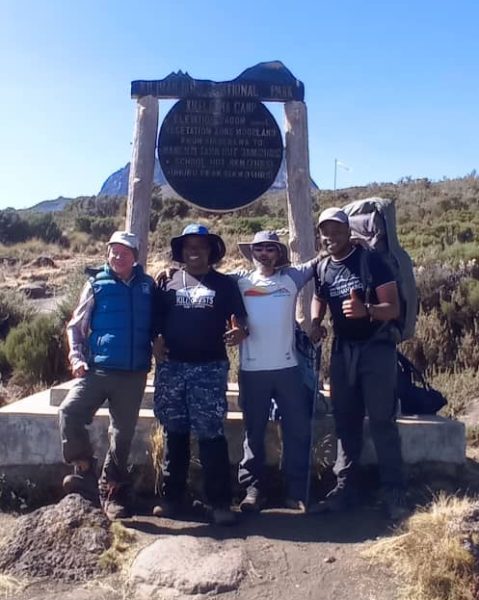
Trekkers at Kikelewa Camp on the Rongai Route with Mawenzi Peak in the distance
Kikelewa Camp offers peaceful moorland scenery and strong views toward Mawenzi Peak.

What Makes the Rongai Route Different?

Rongai is different from other Kilimanjaro routes because it gives climbers a quieter northern approach and a descent through the Marangu Route. This creates a different experience from routes that start and finish on the southern side.
 
Main differences include:
  • It is the only route that starts from northern Kilimanjaro
  • It is usually quieter than Machame and Marangu
  • It has a drier trail profile than southern routes
  • It offers strong views of Mawenzi Peak
  • It can be useful during wetter seasons
  • It descends through Marangu, giving climbers a different exit route
The trade-off is scenery. Rongai is beautiful, but it is generally less varied than Lemosho or Machame, especially in the early stages.

Is the Rongai Route Right for You?

The Rongai Route is a good choice if you want a quieter Kilimanjaro climb with fewer trekkers, drier conditions, and a gradual approach from the north.

Rongai may be right for you if:
  • You want a peaceful trail with fewer crowds
  • You are climbing during a wetter season
  • You prefer a steady ascent profile
  • You like remote wilderness and open landscapes
  • You want strong views of Mawenzi Peak
  • You are considering a 7-day itinerary for better acclimatization
Rongai may not be the best choice if you want the most dramatic scenery, the strongest acclimatization profile, or a very social trail experience. In that case, Lemosho, Machame, or Northern Circuit may be better options.
 

Rongai Route Pros and Cons

Pros Cons
Quieter than many popular Kilimanjaro routes Less scenic variety than Lemosho or Machame
Drier northern approach, useful in wetter periods Fewer natural climb-high, sleep-low features than some routes
Gradual trail profile, especially comfortable on 7 days Long travel to the starting gate from Moshi or Arusha
Excellent Mawenzi Peak views Summit night is still demanding and should not be underestimated
Descends through Marangu, giving two route experiences Not ideal for climbers who want the most varied scenery
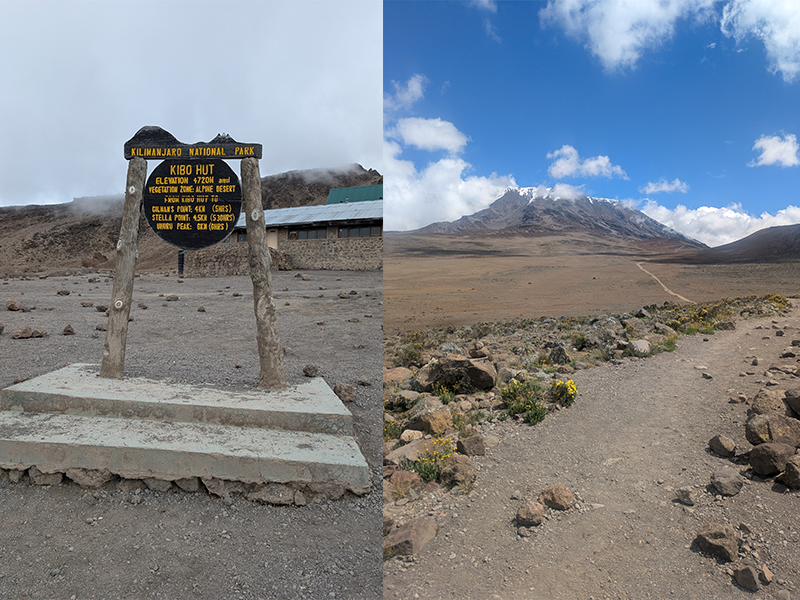
Kilimanjaro trekker walking through alpine desert near Kibo Hut on Rongai Route
The alpine desert near Kibo Hut marks the final stage before Rongai’s summit night.

Rongai vs Other Kilimanjaro Routes

Rongai is best understood by comparing it with the more popular Kilimanjaro routes.
 
  • Rongai vs Marangu: Rongai is quieter and starts from the north, while Marangu has hut accommodation and is often busier.
  • Rongai vs Machame: Machame is more scenic and social, while Rongai is quieter and drier.
  • Rongai vs Lemosho: Lemosho has more varied scenery and a stronger acclimatization profile, while Rongai offers solitude and a remote northern approach.
  • Rongai vs Northern Circuit: Northern Circuit is longer and has excellent acclimatization, while Rongai is shorter, quieter, and simpler.
If you are still unsure, compare all routes in our Kilimanjaro Routes Comparison guide.

What to Pack for the Rongai Route

Packing for Rongai is similar to other Kilimanjaro routes, but you should pay attention to dry, windy, and cold conditions as you move higher toward Mawenzi Tarn and Kibo Hut.
 
Important items include:
  • Warm layers for cold nights and summit day
  • Waterproof jacket and trousers
  • Broken-in hiking boots
  • Trekking poles for the descent
  • Sun protection for exposed sections
  • Warm gloves, hat, and neck gaiter
  • A good sleeping bag rated for cold conditions
  • A comfortable daypack for water, snacks, and extra layers
For the full gear checklist, read our Kilimanjaro Packing List.

Frequently Asked Questions About the Rongai Route

Is the Rongai Route difficult?

The Rongai Route is moderately difficult. It has a steady trail profile and is not technical, but altitude is still the main challenge. The 7-day itinerary is better for most climbers because it gives the body more time to adjust before summit night.

How many days does the Rongai Route take?

The Rongai Route usually takes 6 or 7 days. The 7-day itinerary is recommended for most climbers because it offers better acclimatization, a more comfortable pace, and a stronger summit profile than the shorter 6-day option.

Why choose the Rongai Route on Kilimanjaro?

Choose the Rongai Route if you want a quieter Kilimanjaro climb, a drier northern approach, remote scenery, strong Mawenzi Peak views, and fewer crowds than the busier southern routes.

Is the Rongai Route good during the rainy season?

Yes, Rongai can be a good option during wetter months because it approaches Kilimanjaro from the drier northern side. Rain is still possible, but the route is often less wet than southern approaches such as Machame, Umbwe, or Marangu.

Is Rongai better than Machame or Lemosho?

Rongai is better if you want a quieter and drier route with fewer trekkers. Machame and Lemosho are usually better if you want more scenic variety and stronger acclimatization features. For most climbers, the best choice depends on your travel dates, fitness, scenery preference, and how many days you can spend on the mountain.
 

Climb the Rongai Route With Kili Quests

The Rongai Route is a strong choice for climbers who want a quieter Kilimanjaro trail, a drier northern approach, and a steady 6–7 day route to the summit.
 
At Kili Quests, we recommend the 7-day Rongai itinerary for better acclimatization and a more comfortable pace. Our local guides help you plan the right route, prepare properly, and climb with safe support from the first day to the final descent.
 
Contact us today to plan your Rongai Route climb with Kili Quests.

Related Articles

Northern Circuit Kilimanjaro: 9-Day Itinerary, Difficulty & Cost

Climb with the Highest Success Rate

The Northern Circuit offers the best acclimatization — but pacing and guidance still matter.

Plan Your Climb the Right Way

Preparation and acclimatization make the difference.
Explore these guides:

OUR CATEGORIES

Northern Circuit Kilimanjaro: Longest Route With Best Acclimatization

The Northern Circuit Route is the longest Kilimanjaro route and one of the best choices for climbers who want strong acclimatization, quiet trails, and wide panoramic views around the mountain.

Starting from the western side of Kilimanjaro, the route follows the early section of the Lemosho trail before turning north and circling the quieter northern slopes. This gives climbers a longer, more gradual approach before summit night.

The standard 9-day Northern Circuit itinerary gives your body more time to adjust to altitude than shorter routes such as Marangu or 6-day Machame. That makes it one of the strongest Kilimanjaro routes for climbers who want a safer pace and a better summit profile when properly guided.

This guide covers the Northern Circuit itinerary, difficulty, acclimatization, cost, scenery, pros and cons, and who this route is best suited for.
 

Quick Answer: Is the Northern Circuit Route Good for Kilimanjaro?

Yes, the Northern Circuit is one of the best Kilimanjaro routes for acclimatization, scenery, and a quieter trekking experience. It is the longest main route on the mountain, usually completed in 9 days, which gives climbers more time to adapt to altitude.
 
The route starts from the western side, follows part of the Lemosho trail, then circles around the quieter northern slopes before heading to the summit. Because it takes more days and avoids the busiest trail sections for much of the climb, it is ideal for climbers who want a slower pace, fewer crowds, and strong acclimatization.
 
The main drawbacks are time and cost. The Northern Circuit takes longer and usually costs more than shorter routes, but for many climbers, the extra days are worth it.

Why Choose the Northern Circuit Route?

The Northern Circuit Route is best known for three things: excellent acclimatization, low crowds, and a long scenic journey around Kilimanjaro.
 
Unlike shorter routes that reach high altitude quickly, the Northern Circuit gives climbers more days on the mountain. This slower pace helps the body adjust better and reduces the pressure of rushing toward summit night.
 
The route also explores the quieter northern side of Kilimanjaro, where fewer climbers pass compared with the southern circuit, Machame, or Marangu routes. This makes the experience feel more remote and peaceful.
 
Choose the Northern Circuit if you want:


  • A longer 9-day Kilimanjaro itinerary
  • Strong acclimatization profile
  • Quieter trails with fewer crowds
  • Panoramic views around the mountain
  • A premium route with more time to adjust
  • A strong summit profile when properly paced
This is not usually the cheapest Kilimanjaro route, but it is one of the best for climbers who value safety, scenery, and acclimatization.
Climbers at Barafu Camp (4,673m) on Mount Kilimanjaro’s Northern Circuit Route, preparing for the final summit push to Uhuru Peak | Kili Quests
Barafu Camp is the final overnight base camp before summit day on the Northern Circuit. From here, climbers tackle the ascent to Uhuru Peak via Stella Point.

Table of Contents

What Is the Northern Circuit Route on Kilimanjaro?

The Northern Circuit Route is the longest main route on Mount Kilimanjaro. It begins from the western side at Londorossi Gate, follows the early part of the Lemosho Route, then turns north to circle around the quieter northern slopes.

This longer route gives climbers a more complete Kilimanjaro experience. Instead of heading quickly toward the southern circuit, the trail moves around the mountain, offering wide views, remote landscapes, and a quieter atmosphere before joining the final summit approach.

The Northern Circuit is usually completed in 9 days. Its biggest advantage is acclimatization. The extra days allow the body more time to adjust before reaching high camps and attempting Uhuru Peak.

Northern Circuit Route Overview

Feature Northern Circuit Route Details
Route duration Usually 9 days
Distance About 98 km / 61 miles
Starting point Londorossi Gate, western Kilimanjaro
Highest point Uhuru Peak, 5,895 m / 19,341 ft
Difficulty Moderate to challenging because of the length and summit night
Acclimatization One of the strongest profiles on Kilimanjaro due to the longer itinerary
Best for Climbers who want strong acclimatization, quieter trails, scenery, and enough time for a longer trek
Main drawback Takes more time and usually costs more than shorter routes
Because longer routes significantly improve summit success, it’s important to understand how itinerary length affects your chances of reaching the summit.
 
Read our article about, Kilimanjaro Success Rate

Northern Circuit Days and Elevation Profile

Northern Circuit Route map on Mount Kilimanjaro showing full circuit trail, elevation profile, and key camps to Uhuru Peak
The longest Kilimanjaro route, offering excellent acclimatization and 360° views around the mountain.

9-Day Northern Circuit Route Itinerary

Day 1: Londorossi Gate to Mti Mkubwa Camp

Altitude: 2,100 m → 2,650 m
Hiking time: 3–4 hours
 
The trek begins at Londorossi Gate on the western side of Kilimanjaro. After registration, you enter the rainforest zone and walk through a green, shaded trail toward Mti Mkubwa Camp. Wildlife sightings are possible in this lower forest section, especially monkeys and forest birds.

Day 2: Mti Mkubwa Camp to Shira 1 Camp

Altitude: 2,650 m → 3,610 m
Hiking time: 5–6 hours
 
The trail climbs out of the rainforest and into the moorland zone. As the vegetation opens, views across the Shira Plateau begin to appear. This is one of the first major altitude gains of the route, so a slow pace is important.

Day 3: Shira 1 Camp to Shira 2 Camp

Altitude: 3,610 m → 3,850 m
Hiking time: 4–5 hours
 
This day crosses the open Shira Plateau, one of Kilimanjaro’s most scenic high-altitude landscapes. The walking is steadier, with wide views of Kibo and the surrounding wilderness. The gradual profile helps climbers settle into the rhythm of the trek.

Day 4: Shira 2 Camp to Lava Tower to Moir Hut

Altitude: 3,850 m → 4,600 m → 4,200 m
Hiking time: 6–7 hours
 
This is an important acclimatization day. The trail climbs toward Lava Tower, a dramatic volcanic landmark at high altitude, before descending to Moir Hut for the night. This “climb high, sleep low” pattern helps the body adapt before the route moves around the northern slopes.

Day 5: Moir Hut to Buffalo Camp

Altitude: 4,200 m → 4,020 m
Hiking time: 5–6 hours
 
The route now moves into Kilimanjaro’s quieter northern side. This section feels more remote than the busier southern trails, with wide alpine landscapes and views stretching toward Kenya on clear days.
 

Day 6: Buffalo Camp to Third Cave Camp

Altitude: 4,020 m → 3,870 m
Hiking time: Around 5 hours
 
This is one of the quietest parts of the Northern Circuit. The trail crosses remote alpine desert terrain with fewer climbers and open views. The slightly lower sleeping altitude also supports acclimatization before the climb to base camp.

Day 7: Third Cave Camp to School Hut

Altitude: 3,870 m → 4,750 m
Hiking time: 4–5 hours
 
The trail climbs steadily toward School Hut, the base camp used for the summit attempt. This day is shorter but important, because you will rest, hydrate, eat early, and prepare for the midnight summit push.

Day 8: School Hut to Uhuru Peak to Mweka Camp

Altitude: 4,750 m → 5,895 m → 3,100 m
Hiking time: 12–14 hours
 
Summit day is the hardest part of the Northern Circuit Route. The climb usually begins around midnight in cold, dark conditions. You ascend slowly toward the crater rim, continue to Uhuru Peak, then descend to Mweka Camp after a short rest.
This is a long and demanding day, but the extended acclimatization profile of the Northern Circuit helps climbers arrive better prepared than on shorter routes.

Day 9: Mweka Camp to Mweka Gate

Altitude: 3,100 m → 1,640 m
Hiking time: 3–4 hours
 
The final day descends through the rainforest to Mweka Gate. After completing park checkout, successful climbers receive their summit certificate before returning to town.

Why the Northern Circuit Has a Strong Summit Profile

The Northern Circuit has one of the strongest summit profiles on Kilimanjaro because it gives climbers more time to acclimatize before summit night.
 
The 9-day itinerary allows a slower altitude gain, more recovery time, and better adjustment before reaching high camps. This is especially important because altitude is one of the main reasons climbers struggle on Kilimanjaro.

Longer Itinerary Means Better Acclimatization

More days on the mountain give your body more time to adapt to lower oxygen levels. This does not guarantee summit success, but it improves your chances when combined with proper pacing, hydration, nutrition, and guide support.

Lower Pressure Than Shorter Routes

Shorter routes can feel rushed because climbers gain altitude faster with less recovery time. The Northern Circuit spreads the climb over more days, making the experience more gradual.

Good Option for First-Time Climbers With Enough Time

The Northern Circuit can be a strong option for first-time climbers who want a slower pace and have enough time for a 9-day trek. It is still physically demanding, but the route gives the body more opportunity to adjust.
 
For climbers comparing route options, see our Kilimanjaro routes comparison guide

Northern Circuit Route Cost

The Northern Circuit usually costs more than shorter Kilimanjaro routes because it takes 9 days on the mountain. More days mean more park fees, crew wages, food, camping logistics, guide support, and mountain operations.
 
The final price depends on the number of climbers, whether the climb is private or group-based, the level of service, included transfers, hotel nights, equipment, safety support, and route arrangements.
 
The Northern Circuit is not the cheapest route, but it offers strong value for climbers who want better acclimatization, quieter trails, and a more complete Kilimanjaro experience.
 
If your main goal is to reduce cost, a shorter route may look cheaper. But on Kilimanjaro, choosing only by price can be a mistake. A longer route gives your body more time to adjust, which can make the climb safer and more enjoyable.
 
For a full breakdown of park fees, crew costs, inclusions, exclusions, and extra expenses, read our main guide to Kilimanjaro climb cost.

Northern Circuit Route Pros and Cons

Pros Cons
Excellent acclimatization profile due to the 9-day itinerary More expensive than shorter Kilimanjaro routes
Quieter northern slopes with fewer crowds Requires more time on the mountain
Beautiful 360-degree scenery around Kilimanjaro Longer distance can feel tiring for some climbers
Strong option for climbers who want a slower, safer pace Not ideal for travelers with limited vacation days

Best Time to Climb the Northern Circuit

The best time to climb the Northern Circuit is during Kilimanjaro’s drier trekking seasons, when visibility is better and trail conditions are more stable.
 
The best months are usually:
  • January to early March
  • June to October
January to early March can offer warmer conditions and fewer climbers. June to October is one of the most popular climbing seasons because of drier weather and clearer mountain views.
 
The Northern Circuit can be climbed outside these months, but rainier periods such as March to May and parts of November can make the trail wetter, colder, and less comfortable.
 
For a full seasonal breakdown, read our best time to climb Kilimanjaro guide.
 
Read our article about,Best Time to Climb Kilimanjaro 
Trekker climbing and hugging a rock on Kilimanjaro’s Barranco Wall, a fun and scenic segment encountered on the Northern Circuit via Lemosho | Kili Quests
The Barranco Wall, known as the “Breakfast Wall,” is a fun and challenging highlight of the Northern Circuit after it merges with Lemosho.

What Makes the Northern Circuit Unique?

The Northern Circuit is unique because it gives climbers one of the most complete journeys around Mount Kilimanjaro. Instead of following only the busier southern routes, it circles around the quieter northern slopes before heading toward the summit.

This gives the route a different feel from Machame, Marangu, or the standard Lemosho itinerary. You experience open plateau scenery, remote northern landscapes, views toward Kenya, and a longer approach that supports acclimatization.

Its biggest strength is the combination of time, scenery, and solitude. Its biggest drawback is that it requires more days and usually costs more.

Is the Northern Circuit Route Right for You?

The Northern Circuit Route is a strong choice if you want a longer, quieter, and better-acclimatized Kilimanjaro climb.


Choose the Northern Circuit if you:
  • Want one of the best acclimatization profiles on Kilimanjaro
  • Prefer fewer crowds and quieter trails
  • Have enough time for a 9-day climb
  • Want a scenic route with views around the mountain
  • Are willing to pay more for extra days and better pacing
  • Want a strong route option as a first-time climber
This route may not be ideal if you are short on time, looking for the cheapest climb, or prefer a faster itinerary. In that case, routes such as Machame or Marangu may be worth comparing, but they offer less time for acclimatization.

Northern Circuit vs Lemosho Route

The Northern Circuit and Lemosho Route both start from the western side of Kilimanjaro and share the early trail through Londorossi Gate, Mti Mkubwa, and the Shira Plateau.
 
The main difference is what happens after the early section. Lemosho usually continues toward the southern circuit and Barranco, while the Northern Circuit turns north and circles around the quieter side of the mountain.
 
Northern Circuit is usually better for climbers who want more acclimatization time, fewer crowds, and a longer trek. Lemosho is better for climbers who want excellent scenery and acclimatization but prefer a slightly shorter itinerary, usually 7 or 8 days.
 
Both are strong routes. The better choice depends on your time, budget, fitness, and comfort with a longer climb.
Three happy trekkers posing in front of the Barafu Camp sign on Kilimanjaro’s Northern Circuit Route, flexing muscles before summit day | Kili Quests
A light-hearted moment at Barafu Camp (4,673m) on the Northern Circuit Route — trekkers flex their energy and spirit before the final ascent to Uhuru Peak.

Frequently Asked Questions About the Northern Circuit Route

How long does the Northern Circuit Route take?

The Northern Circuit Route usually takes 9 days. This makes it the longest main Kilimanjaro route and gives climbers more time to acclimatize before summit night.

Is the Northern Circuit Route difficult?

The Northern Circuit is moderately challenging. The route is long, and summit night is still demanding, but the gradual 9-day itinerary helps many climbers adjust better than shorter routes.

The challenge is not technical climbing. It is the combination of distance, altitude, cold, and several days of trekking.

Why is the Northern Circuit good for acclimatization?

The Northern Circuit is good for acclimatization because it gives climbers more days on the mountain and follows a slower altitude profile. This allows the body more time to adjust before reaching high camps and attempting the summit.

Is the Northern Circuit good for beginners?

Yes, the Northern Circuit can be a good route for beginners who have enough time and budget for a longer climb. Its slower pace and strong acclimatization profile make it more forgiving than shorter routes.
However, beginners still need proper training, patience, and guide support.

Is the Northern Circuit better than Lemosho?

The Northern Circuit is usually better for acclimatization and solitude because it is longer and quieter. Lemosho is also scenic and well-acclimatized, but it is usually shorter.
 
Choose Northern Circuit if you want the longest, quietest, and most gradual route. Choose Lemosho if you want excellent scenery and acclimatization with fewer days.

Climb the Northern Circuit With Kili Quests

The Northern Circuit is one of the best Kilimanjaro routes for climbers who want more time, better acclimatization, fewer crowds, and a quieter mountain experience.
 
At Kili Quests, we plan Northern Circuit climbs with careful pacing, experienced local guides, proper safety checks, and full mountain support from start to summit. Our team helps you prepare, choose the right itinerary, and climb with a strategy that respects altitude instead of rushing it.
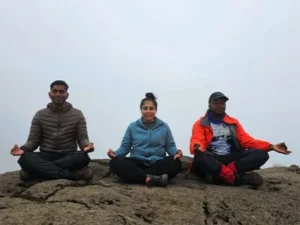
 
If you want a longer Kilimanjaro route with strong acclimatization and panoramic scenery, contact us to plan your Northern Circuit climb.

Related Articles

Shira Route Kilimanjaro: Itinerary, Difficulty & Cost

Choose the Right Kilimanjaro Route

The right route makes all the difference on Kilimanjaro.We help you plan your climb based on:

Plan Your Kilimanjaro Climb

Choosing the right route is key to your success.
Explore these guides to prepare properly:

OUR CATEGORIES

Shira Route Kilimanjaro: Remote Western Trail with Open Views

Climbing Kilimanjaro via the Shira Route offers one of the most scenic and remote experiences on the mountain, but it also comes with a serious altitude challenge.
 
Unlike most Kilimanjaro routes that begin lower in the rainforest, the Shira Route starts high on the western side of the mountain, around the Shira Plateau. This gives climbers wide-open views from the beginning, but it also means your body has less time to adjust during the first stage of the trek.
 
The Shira Route is best suited for experienced trekkers, climbers who have already spent time at altitude, or travelers who want a quieter trail with dramatic scenery. For most first-time climbers, the Lemosho Route is often a better choice because it starts lower and allows a more gradual acclimatization profile.
 
Before choosing this route, it is important to understand the itinerary, altitude profile, difficulty, cost, and how it compares with other Kilimanjaro routes.

Quick Answer: Is the Shira Route Good for Kilimanjaro?

The Shira Route is a scenic and quiet Kilimanjaro route that starts on the western side of the mountain and crosses the Shira Plateau before joining the southern circuit toward Barranco, Barafu, and Uhuru Peak.
 
It is a beautiful route, but it is not the best choice for everyone. The main challenge is the high starting altitude, which gives your body less time to adjust compared with routes that begin lower, such as Lemosho.
 
The Shira Route is best for experienced hikers, climbers who have already acclimatized, or trekkers who want remote scenery and fewer crowds. First-time climbers should compare it carefully with Lemosho before booking.

Why Choose the Shira Route?

The Shira Route is one of the quieter trails on Mount Kilimanjaro. It approaches the mountain from the west and gives climbers open views across the Shira Plateau early in the trek.
 
The route is known for:
  • Remote western approach
  • Wide-open plateau scenery
  • Fewer crowds than Machame or Marangu
  • Dramatic views of Kibo and volcanic landscapes
  • Access to famous landmarks such as Lava Tower and Barranco Wall
However, the Shira Route also has a major drawback: it starts high. This can make acclimatization more difficult, especially for climbers arriving from low altitude. Because of this, the route is better suited to trekkers with previous altitude experience or those who are already well acclimatized before the climb.
 
For many first-time climbers, the Lemosho Route offers a better balance of scenery, remoteness, and acclimatization.
Lava Tower on the Shira Route of Mount Kilimanjaro with a trekker standing near the volcanic rock formation.
Lava Tower is one of the most important acclimatization points on the Shira Route before descending toward Barranco Camp.

Table of Contents

Shira Route Overview

Feature Shira Route Details
Route duration Usually 7 days
Starting point Western Kilimanjaro / Shira Plateau area
Highest point Uhuru Peak, 5,895 m / 19,341 ft
Difficulty Challenging because of the high starting altitude
Scenery Open plateau views, volcanic landscapes, Lava Tower, Barranco Wall, and southern circuit scenery
Best for Experienced trekkers, altitude-prepared climbers, and travelers who want a quieter western approach
Main drawback Less gradual acclimatization than Lemosho because the route starts high

Shira Route Days and Elevation Profile

Shira Route map on Mount Kilimanjaro showing trail path from Shira Plateau to Uhuru Peak via Barranco and Barafu Camps
Begins at high altitude on the Shira Plateau and joins the Lemosho-Machame trail to the summit.

Shira Route Days and Elevation Profile

The Shira Route begins high on the western side of Kilimanjaro and crosses the Shira Plateau before joining the same southern circuit used by parts of the Lemosho and Machame routes.
 
This route usually follows a 7-day itinerary, passing through Shira 1 Camp, Shira 2 Camp, Lava Tower, Barranco Camp, Karanga Camp, Barafu Camp, Uhuru Peak, and Mweka Gate.
 
Because the route starts at a higher elevation than most Kilimanjaro routes, acclimatization must be taken seriously from the first day.

7-Day Shira Route Itinerary

Day 1: Shira Gate to Shira 1 Camp

Altitude: 3,600 m – 3,610 m
Hike Time: 1–2 hours
 
Your adventure begins high on the Shira Plateau  unlike most routes that start in the rainforest. This short first day helps your body begin adjusting to altitude while you enjoy wide, open views of the mountain and surrounding plains.

Day 2: Shira 1 to Shira 2 Camp

Altitude: 3,610 m – 3,850 m
Hike Time: 4–5 hours
 
A steady and gradual trek across alpine terrain. The landscape becomes more rugged and exposed, with fewer plants and more volcanic rock formations. This is an important day for building rhythm and pacing.

Day 3: Shira 2 to Barranco Camp (via Lava Tower)

Altitude: 3,850 m → 4,640 m → 3,960 m
Hike Time: 6–7 hours
 
One of the most important days for acclimatization. You climb up to Lava Tower (4,640 m), where many trekkers begin to feel the effects of altitude, before descending to Barranco Camp.
This “climb high, sleep low” strategy helps your body adapt and improves your chances of reaching the summit.
 
Read more about Kilimanjaro acclimatization if you want to understand how “climb high, sleep low” helps your body adjust.

Day 4: Barranco Camp to Karanga Camp

Altitude: 3,960 m → 4,035 m
Hike Time: 4–5 hours
 
Start the day by climbing the famous Barranco Wall — a steep but non-technical scramble that offers incredible views. After reaching the top, the trail continues through valleys and ridges toward Karanga Camp.

Day 5: Karanga Camp to Barafu Camp

Altitude: 4,035 m → 4,673 m
Hike Time: 3–4 hours
 
A shorter trekking day as you make your way to Barafu Camp, the base camp for your summit attempt. After lunch, you’ll rest, hydrate, and prepare your gear before an early night.

Day 6: Summit Day – Barafu Camp to Uhuru Peak to Mweka Camp

Altitude: 4,673 m → 5,895 m → 3,100 m
Hike Time: 12–14 hours
The most challenging and rewarding day of your climb. You’ll begin your ascent around midnight, trekking in cold, dark conditions toward Stella Point, then continue to Uhuru Peak , the highest point in Africa.After celebrating at the summit, you descend back to Barafu for a short rest, then continue down to Mweka Camp.
 
Understand what to expect in our Kilimanjaro summit day guide 

Day 7: Mweka Camp to Mweka Gate

Altitude: 3,100 m → 1,640 m
Hike Time: 3–4 hours
 
Your final descent takes you through lush rainforest terrain. At the gate, you’ll receive your summit certificate marking the end of your Kilimanjaro adventure.

Shira Route Difficulty and Acclimatization

The Shira Route is considered a challenging Kilimanjaro route mainly because it starts high on the mountain. Beginning around the Shira Plateau means climbers gain altitude quickly at the start of the trek, which gives the body less time to adjust.

The walking itself is not technical. You do not need ropes or climbing equipment, but you should be comfortable with multi-day trekking, long walking hours, and changing mountain conditions.

The hardest parts of the Shira Route are:
  • High starting altitude
  • Long trekking days after joining the southern circuit
  • Lava Tower acclimatization day
  • Barranco Wall section
  • Summit night from Barafu Camp
  • Long descent after reaching Uhuru Peak
This route is better for climbers who already have hiking experience or who have spent time at altitude before the trek. If you are a first-time climber and altitude is a major concern, compare Shira carefully with the Lemosho Route, which starts lower and offers a more gradual beginning.

Shira Route Cost

The Shira Route usually costs more than shorter Kilimanjaro routes because it is commonly done over 7 days and requires full mountain crew support, park fees, camping equipment, meals, transport, and safety logistics.
 
The final price depends on the number of climbers, service level, inclusions, guide and porter support, airport transfers, accommodation before and after the climb, and whether the climb is private or group-based.
 
Shira is not usually chosen as the cheapest Kilimanjaro option. It is chosen for scenery, remoteness, and the western approach. If price is your main concern, remember that the cheapest climb is not always the safest or best value, especially on a route where altitude management matters from the beginning.
 
For a full breakdown of park fees, crew costs, inclusions, exclusions, and extra expenses, read our main guide to Kilimanjaro climb cost.
View of Kibo Peak from Karanga Camp on the Shira Route with rocky alpine terrain in the foreground.
From Karanga Camp, the Shira Route offers dramatic views of Kibo before climbers continue toward Barafu and the summit.

Best Time to Climb the Shira Route

The best time to climb the Shira Route is during Kilimanjaro’s drier trekking seasons, when trail conditions are more stable and mountain views are clearer.

The best months are usually:
  • January to early March
  • June to October

January to early March can offer warmer conditions and fewer climbers. June to October is one of the most popular trekking periods because of drier weather and clearer skies.

The rainier periods, especially March to May and parts of November, can make the trail wetter, colder, and less comfortable. Since Shira starts high and crosses exposed terrain early, weather conditions can feel harsher than on lower forest-start routes.

For a full seasonal breakdown, read our best time to climb Kilimanjaro guide.

Shira Route Pros and Cons

Pros Cons
Quiet western approach with fewer climbers High starting altitude can make acclimatization harder
Beautiful open views across the Shira Plateau Not ideal for many first-time climbers
Joins the scenic southern circuit toward Barranco and Barafu Less gradual beginning than Lemosho
Passes famous landmarks such as Lava Tower and Barranco Wall Requires serious attention to pacing and altitude symptoms

What Makes the Shira Route Unique?

The Shira Route is unique because it begins high on the western side of Kilimanjaro and gives climbers immediate access to the open landscapes of the Shira Plateau.
 
Unlike routes that begin in dense rainforest, Shira starts with wide views, exposed terrain, and a strong sense of remoteness from the first day. It later joins the southern circuit, meaning climbers still experience major Kilimanjaro highlights such as Lava Tower, Barranco Wall, Barafu Camp, Stella Point, and Uhuru Peak.
 
The route’s biggest strength is scenery. Its biggest weakness is the high starting altitude

Is the Shira Route Right for You?

The Shira Route may be right for you if you want a quieter western approach, wide-open scenery, and a route that feels more remote at the beginning.

Choose the Shira Route if you:
  • Have previous high-altitude trekking experience
  • Want fewer crowds than Machame or Marangu
  • Prefer open plateau views and volcanic scenery
  • Are comfortable with a high starting altitude
  • Want to join the scenic southern circuit toward Barranco and Barafu
You may be better suited to another route if you are a first-time climber, worried about altitude, or want a more gradual start. In that case, the Lemosho Route is often a stronger choice because it starts lower while still offering excellent scenery.
Sweeping view of Mount Kilimanjaro’s Kibo Peak from Karanga Camp on the Shira Route, with rocky alpine terrain under a bright morning sky | Kili Quests
From Karanga Camp, Shira Route trekkers enjoy this dramatic view of Kibo — a reminder of the summit that awaits beyond Barafu Camp.

Shira Route vs Lemosho Route

The Shira and Lemosho routes both approach Kilimanjaro from the west and later join the southern circuit. The main difference is the starting altitude.
 
The Shira Route starts higher on the Shira Plateau, which gives climbers open views quickly but makes the first stage more demanding for acclimatization. The Lemosho Route starts lower and allows a more gradual beginning through forest and moorland zones.
 
For most first-time climbers, Lemosho is usually the better option because it offers similar scenery with a stronger acclimatization profile. Shira is better suited to trekkers who already have altitude experience or who specifically want the high western plateau start.

Frequently Asked Questions About the Shira Route

Where does the Shira Route start on Kilimanjaro?

The Shira Route starts on the western side of Mount Kilimanjaro near the Shira Plateau. Unlike routes that begin lower in the rainforest, Shira starts at a higher elevation, which gives climbers open views early but makes acclimatization more challenging.

Why is the Shira Route considered difficult?

The Shira Route is considered difficult mainly because of its high starting altitude. Climbers begin the trek already high on the mountain, which gives the body less time to adjust compared with routes that start lower.
 
The walking is not technical, but the altitude profile makes pacing and acclimatization very important.

How many days does the Shira Route take?

The Shira Route is usually completed in 7 days. This gives climbers time to cross the Shira Plateau, pass Lava Tower, continue through Barranco and Karanga, summit from Barafu Camp, and descend through Mweka Gate.

Is the Shira Route good for beginners?

The Shira Route is not usually the best choice for beginners because it starts high and can make acclimatization harder. Beginners are often better suited to routes with a more gradual start, such as Lemosho.
 
Shira can still be a good option for trekkers who already have hiking experience or have spent time at altitude before the climb.

Is Shira better than Lemosho?

For most first-time climbers, Lemosho is usually better than Shira because it starts lower and gives the body more time to adjust. Shira is quieter and scenic, but the high starting altitude makes it more demanding from the beginning.
 
The better route depends on your experience, fitness, altitude background, and comfort with a high start.

Climb the Shira Route With Kili Quests

The Shira Route is a beautiful but demanding Kilimanjaro trail. Its remote western approach and open plateau views make it memorable, but the high starting altitude means the route must be planned carefully.
 
At Kili Quests, we help you choose the right Kilimanjaro route based on your experience, fitness, travel dates, and acclimatization needs. If Shira is the right fit, our local mountain team will guide you with careful pacing, safety checks, proper support, and a clear summit strategy.
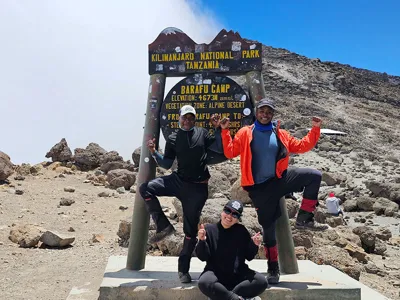
 
If you are unsure whether Shira or Lemosho is better for you, contact our team for honest route advice before booking.

Related Articles

Umbwe Route Kilimanjaro: Itinerary & Difficulty

Plan Your Umbwe Route Climb

The Umbwe Route is steep, direct, and built for experienced climbers.
Get expert advice and a personalized plan for your climb.

Kilimanjaro Planning Guides

Make the right decision before your climb:
Compare all Kilimanjaro routes

OUR CATEGORIES

Umbwe Route Kilimanjaro: Itinerary & Difficulty

The Umbwe Route is the steepest and most direct trail on Mount Kilimanjaro. It climbs quickly from the southern rainforest toward Barranco Camp before joining the southern circuit route to Barafu, Stella Point, and Uhuru Peak.
 
This route is quiet, scenic, and adventurous, but it is also one of the hardest ways to climb Kilimanjaro. The fast elevation gain gives your body less time to adjust, which makes acclimatization the biggest challenge on Umbwe.
 
For that reason, the Umbwe Route is best for experienced trekkers who are already comfortable with steep terrain, long hiking days, and high-altitude conditions. Most first-time climbers are better served by longer routes such as Machame Route Kilimanjaro, Lemosho Route Kilimanjaro, or the Northern Circuit.
 
Still comparing your options? Read our full Kilimanjaro routes comparison guide before choosing Umbwe.

Quick Answer: Is the Umbwe Route Good for Kilimanjaro?

The Umbwe Route is good only for experienced trekkers who want a steep, quiet, and direct climb on Kilimanjaro. It is not the best route for beginners because it gains altitude quickly and gives the body less time to acclimatize.
 
Umbwe is best for climbers who already have strong fitness, hiking experience, and confidence at altitude. If your main goal is better acclimatization and a more comfortable summit profile, routes such as Lemosho, Machame, or the Northern Circuit are usually better choices.
A climber stands on snow-covered terrain near Stella Point on Mount Kilimanjaro, holding a cup and trekking pole while overlooking the crater rim.
A trekker pauses to take in the spectacular view near Stella Point, where Kilimanjaro’s crater rim opens up into a vast, icy alpine landscape.

Table of Contents

Why the Umbwe Route Is Unique

The Umbwe Route is the most direct path up Kilimanjaro, ascending quickly through the southern slopes before joining the southern circuit near Barranco Camp.Unlike longer routes, Umbwe prioritizes speed over gradual acclimatization. This creates a more intense trekking experience, with fewer crowds and a strong sense of wilderness.However, the fast ascent makes it one of the riskiest routes in terms of altitude adaptation.

Umbwe Route Overview

Feature Details
Route duration Usually 6 days
Approximate distance About 53 km / 33 miles
Starting point Umbwe Gate
Finish point Mweka Gate
Highest point Uhuru Peak, 5,895 m / 19,341 ft
Difficulty Very challenging
Acclimatization profile Poorer than longer routes because of fast elevation gain
Best for Experienced trekkers who want a steep, quiet, direct route
Not ideal for Beginners, nervous hikers, or climbers who need more acclimatization time
Not sure if Umbwe is the right choice? Compare all options in our complete Kilimanjaro routes guide to find the best route for your experience level.

Umbwe Route Days and Elevation Profile

Umbwe Route map on Mount Kilimanjaro showing trail path, elevation chart, and key camps to Uhuru Peak
Kilimanjaro’s steepest and most direct route, ascending via Barranco and Karanga Camps.

Umbwe Route Camps and Elevation Gain

The Umbwe Route gains altitude quickly in the first two days, which is why it is considered one of the hardest Kilimanjaro routes for acclimatization. The climb starts at Umbwe Gate, passes through Umbwe Cave Camp, then joins the southern circuit near Barranco Camp before continuing toward Barafu and the summit.

Day Route Section Sleeping Altitude Acclimatization Note
Day 1 Umbwe Gate to Umbwe Cave Camp 2,850 m / 9,350 ft Steep first day through rainforest with fast elevation gain.
Day 2 Umbwe Cave Camp to Barranco Camp 3,900 m / 12,795 ft Big altitude jump; this is where acclimatization becomes serious.
Day 3 Barranco Camp to Karanga Camp 3,995 m / 13,106 ft Shorter altitude gain; useful recovery and adaptation day.
Day 4 Karanga Camp to Barafu Camp 4,650 m / 15,255 ft High-altitude base camp before summit night.
Day 5 Barafu Camp to Uhuru Peak, then down to Mweka Camp 3,100 m / 10,170 ft Longest and hardest day; summit push followed by major descent.
Day 6 Mweka Camp to Mweka Gate Exit at 1,640 m / 5,380 ft Final forest descent and certificate collection.

6-Day Umbwe Route Itinerary

The 6-day Umbwe itinerary is the standard version of this route, but it is also one of the most demanding ways to climb Kilimanjaro. The trail gains altitude quickly in the first two days before joining the southern circuit near Barranco Camp.
 
Because the route is steep and short, slow pacing and honest altitude monitoring are very important from the beginning.

Day 1: Umbwe Gate to Umbwe Cave Camp

The climb begins at Umbwe Gate, where your team completes park registration before entering the rainforest. The trail starts steeply and climbs through dense forest along a narrow ridge. This first day is more demanding than the opening day on many other Kilimanjaro routes because there are fewer flat sections.
 
The forest can be humid, muddy, and slippery after rain, so steady pacing is important. You will sleep at Umbwe Cave Camp, surrounded by thick vegetation and a quiet mountain atmosphere.
  • Altitude: 1,800 m to 2,850 m
  • Hiking time: 5–6 hours
  • Zone: Rainforest
  • Camp: Umbwe Cave Camp

Day 2: Umbwe Cave to Barranco Camp

Day 2 continues steeply as the trail leaves the rainforest and enters the moorland zone. The views begin to open as you climb higher, but the altitude gain is serious. This is one of the key reasons Umbwe is considered a difficult route.
 
By the time you reach Barranco Camp, the Umbwe Route joins the southern circuit used by routes such as Machame and Lemosho. From here, the trail becomes more familiar, but the early altitude gain has already made acclimatization more demanding.
  • Altitude: 2,850 m to 3,900 m
  • Hiking time: 5–6 hours
  • Zone: Moorland
  • Camp: Barranco Camp
This is where altitude can start to affect some climbers. Read our Altitude Sickness on Kilimanjaro guide so you understand common symptoms and warning signs before choosing a fast route like Umbwe.

Day 3: Barranco Camp to Karanga Camp

Day 3 begins with the Barranco Wall, one of the most famous features on Kilimanjaro’s southern circuit. The wall looks intimidating from camp, but most climbers manage it safely with slow movement and guide support.
 
After the Barranco Wall, the trail crosses ridges and valleys before descending into Karanga Valley and climbing again to Karanga Camp. This day is important because it gives your body a little more time to adjust before moving higher.
  • Altitude: 3,900 m to 3,995 m
  • Hiking time: 4–5 hours
  • Highlight: Barranco Wall
  • Camp: Karanga Camp

Day 4: Karanga Camp to Barafu Camp

Day 4 is shorter, but it takes you to Barafu Camp, the base camp for summit night. The landscape becomes drier, colder, and more exposed as you enter the alpine desert zone.
 
After reaching Barafu, climbers rest, eat early, prepare warm summit gear, and try to sleep before the midnight summit attempt. This is not the day to rush. Saving energy for summit night is more important than arriving fast.
  • Altitude: 3,995 m to 4,650 m
  • Hiking time: 3–4 hours
  • Zone: Alpine desert
  • Camp: Barafu Camp

Day 5: Barafu Camp to Uhuru Peak, then down to Mweka Camp

Summit day is the hardest part of the Umbwe Route. The climb usually begins around midnight in cold, thin air. Climbers move slowly toward Stella Point before continuing along the crater rim to Uhuru Peak, the highest point in Africa.
 
After reaching the summit, you descend back toward Barafu Camp for a short rest before continuing down to Mweka Camp. This is a long and exhausting day, so mental strength, warm clothing, slow pacing, and guide support are very important.
  • Altitude: 4,650 m to 5,895 m, then down to 3,100 m
  • Hiking time: 12–14 hours total
  • Summit: Uhuru Peak
  • Camp: Mweka Camp
If you are worried about summit night, read our How Hard Is Mount Kilimanjaro? guide for a realistic look at altitude, fitness, cold conditions, and mental preparation.

Day 6: Mweka Camp to Mweka Gate

The final day is a descent through the rainforest to Mweka Gate. The trail can be wet and slippery, especially after rain, so trekking poles are still useful even though you are going downhill.
 
After signing out at the gate, successful climbers receive their Kilimanjaro certificate before returning to Moshi or Arusha.
  • Altitude: 3,100 m to 1,640 m
  • Hiking time: 3–4 hours
  • Zone: Rainforest
  • Finish: Mweka Gate

Umbwe Route Difficulty and Acclimatization

The Umbwe Route is one of the most difficult Kilimanjaro routes because it climbs steeply and gains altitude quickly in the first two days. The challenge is not technical climbing. You do not need ropes, ice axes, or mountaineering experience. The real challenge is the combination of steep terrain, physical effort, and limited acclimatization time.
 
On longer routes, your body has more time to adjust gradually as you move higher. Umbwe gives you less of that buffer. This makes pacing, hydration, rest, and guide supervision especially important.
The route becomes more manageable after it joins the southern circuit near Barranco Camp, but by then you have already gained altitude quickly. That is why Umbwe is usually recommended for experienced trekkers rather than first-time Kilimanjaro climbers.
 
If you are still learning how altitude affects the body, read our Kilimanjaro altitude sickness guide before choosing this route. You should also understand the basic principles of Kilimanjaro acclimatization so you know why longer routes often provide a safer summit profile.

Safety on the Umbwe Route

Because the Umbwe Route gains altitude quickly, safety depends on slow pacing, daily health checks, hydration, and honest communication with your guide. Climbers should not ignore symptoms such as headache, nausea, dizziness, loss of appetite, or unusual fatigue.

A good Umbwe climb should include experienced guides, proper mountain equipment, emergency oxygen, pulse oximeter checks, and a clear descent plan if altitude symptoms become serious.

The biggest mistake on Umbwe is treating it like a short shortcut to the summit. It is not. The route is shorter, but the altitude challenge is higher because your body has less time to adjust.

Umbwe Route Cost

The Umbwe Route is often priced as a shorter Kilimanjaro climb because it is commonly completed in 6 days. However, the final cost still depends on the level of service, guide and crew support, park fees, camping equipment, safety equipment, transfers, meals, and group size.
 
Do not choose Umbwe only because it may cost less than longer routes. A shorter route can reduce the number of mountain days, but it can also reduce acclimatization time. For many climbers, paying for an extra day on a better-acclimatized route is a smarter decision.
 
For a full breakdown of park fees, crew support, tips, inclusions, and extra expenses, read our complete Kilimanjaro climb cost guide.
Climbers posing at Barafu Camp on the Lemosho Route before summit night on Mount Kilimanjaro
A cheerful moment at Barafu Camp, the final staging point on the steep and scenic Umbwe Route before the summit climb begins.

Best Time to Climb the Umbwe Route

The best time to climb the Umbwe Route is during Kilimanjaro’s drier seasons: January to early March and June to October.
 
Because Umbwe is steep from the first day, dry trail conditions are important. Rain can make the rainforest and ridge sections slippery, muddy, and more tiring.
 
Avoid the long rainy season from mid-March to May if possible. November can also bring short rains, especially on the lower mountain.
 
For a full month-by-month breakdown, read our complete best time to climb Kilimanjaro guide.
 

Is the Umbwe Route Right for You?

The Umbwe Route may be right for you if you are an experienced trekker, comfortable with steep trails, and confident hiking for several days at high altitude.

Choose Umbwe if you want a quiet, direct, and physically demanding Kilimanjaro route. It can be rewarding for strong climbers who understand the altitude challenge and do not want a crowded trail.

Avoid Umbwe if you are a beginner, unsure about your fitness, or want the best acclimatization profile. In that case, routes like Lemosho, Machame, or the Northern Circuit are usually better choices.

Who Should Avoid the Umbwe Route?

The Umbwe Route is not the right choice for everyone. You should avoid Umbwe if you are a first-time trekker, unsure about your fitness, nervous about steep trails, or worried about altitude sickness.

You should also avoid Umbwe if your main goal is the best possible acclimatization profile. In that case, a longer route such as Lemosho, Machame, or the Northern Circuit is usually a smarter choice.

Umbwe can be rewarding, but it is not the route to choose only because it is short. A shorter Kilimanjaro climb is not always easier. On Umbwe, the shorter schedule often makes the climb harder because your body has less time to adapt.
Umbwe Is Best For Umbwe Is Not Best For
Experienced trekkers First-time hikers
Climbers who want a steep challenge Climbers worried about altitude sickness
People who prefer quieter trails Travelers who want the easiest route
Fit climbers with previous altitude experience Climbers who need more acclimatization time

Umbwe Route Pros and Cons

The Umbwe Route is powerful for the right climber, but it is not a safe “shortcut” for everyone. Use this quick comparison before deciding whether it fits your experience level and altitude confidence.

Pros of the Umbwe Route Cons of the Umbwe Route
Very quiet compared to busier Kilimanjaro routes One of the hardest routes because of the steep ascent
Direct and adventurous trail from the southern side Less time for acclimatization, especially on the 6-day itinerary
Scenic rainforest and ridge sections in the early days Not recommended for most beginners or nervous hikers
Fewer crowds before joining the southern circuit near Barranco Higher altitude challenge than longer routes like Lemosho or Northern Circuit
Strong sense of achievement for experienced trekkers Can feel rushed if chosen only because it is short
View of Mawenzi Peak rising above the clouds as seen from Stella Point on Mount Kilimanjaro
Nearing Stella Point on the Umbwe Route — a snowy, high-altitude section with sweeping views of Mawenzi and the expansive volcanic landscape below.

What to Pack for the Umbwe Route

Packing for the Umbwe Route should focus on steep terrain, changing weather, and cold summit conditions. The early days can be humid in the rainforest, while the higher camps become dry, cold, and exposed.
 
You should bring strong hiking boots, trekking poles, layered clothing, rain protection, warm gloves, a headlamp, a sleeping bag rated for cold conditions, and enough personal items for six or seven days on the mountain.
 
Because Umbwe is steep from the first day, trekking poles are especially useful for balance, knee support, and reducing fatigue during descents. For a full item-by-item checklist, read our complete Kilimanjaro packing list before your climb.

Umbwe vs Machame and Umbwe vs Lemosho

Umbwe Route vs Machame Route

The Umbwe Route and Machame Route both approach Kilimanjaro from the southern side and eventually join the southern circuit, but they offer very different climbing experiences.
 
Umbwe is steeper, quieter, and more direct. It feels more remote in the early days and is better suited to experienced trekkers looking for a serious challenge.
Machame is more popular and usually offers a better acclimatization profile, especially on the 7-day version. It is still challenging, but it gives climbers a more balanced route with strong scenery, better pacing, and more gradual altitude adjustment.
 
For most climbers, Machame Route Kilimanjaro is the better choice. Umbwe is better only if you specifically want a steeper, quieter, and more demanding trail.

Umbwe Route vs Lemosho Route

Umbwe and Lemosho are almost opposite choices. Umbwe is short, steep, and direct. Lemosho is longer, more gradual, and better for acclimatization.
 
The Lemosho Route Kilimanjaro is usually a better choice for first-time climbers who want beautiful scenery and a stronger summit profile. It allows more time for the body to adjust and offers a more varied approach across the western side of Kilimanjaro.
 
Umbwe is better for experienced trekkers who want a tougher challenge and fewer crowds. Lemosho is better for climbers who want scenery, acclimatization, and a more comfortable route to the summit.

Frequently Asked Questions About the Umbwe Route

How difficult is the Umbwe Route on Kilimanjaro?

The Umbwe Route is considered the most challenging route on Mount Kilimanjaro. Its steep terrain and rapid altitude gain provide little time for acclimatization, making it best suited for experienced climbers.

Why is the Umbwe Route considered the toughest Kilimanjaro route?

The Umbwe Route follows a steep and direct path up the southern slopes of the mountain. Because climbers gain altitude quickly, the risk of altitude sickness is higher compared to longer routes like the Lemosho Route or Northern Circuit Route.

How many days does the Umbwe Route take?

Most climbers complete the Umbwe Route in 6 days, making it one of the shorter routes on Mount Kilimanjaro.

Is the Umbwe Route dangerous?

The Umbwe Route is not dangerous when managed properly by experienced guides, but it has a higher altitude challenge than longer Kilimanjaro routes. The main risk is not the trail itself. The bigger concern is rapid elevation gain and limited acclimatization time.

Is 6 days enough for the Umbwe Route?

Six days is the standard Umbwe itinerary, but it is not ideal for every climber. Because the route gains altitude quickly, a 7-day Umbwe itinerary gives more time for acclimatization and is usually a smarter choice for climbers who want a safer pace.

Which is better, Umbwe or Machame?

Machame is better for most climbers because it offers a more balanced route, better acclimatization, and strong scenery. Umbwe is better only for experienced trekkers who specifically want a steeper, quieter, and more demanding climb.

Which is better, Umbwe or Lemosho?

Lemosho is better for most first-time climbers because it is longer, more scenic, and better for acclimatization. Umbwe is shorter, steeper, and more intense, making it better for experienced climbers looking for a serious challenge.

Plan Your Umbwe Route Climb with Kili Quests

The Umbwe Route is not the easiest way to climb Kilimanjaro, but for the right climber, it can be one of the most rewarding. It is steep, quiet, direct, and physically demanding, so it needs honest planning and experienced mountain support.
 
At Kili Quests, we help you choose the right route based on your fitness, trekking experience, travel dates, and acclimatization needs. If Umbwe is not the safest fit, we will tell you clearly and recommend a better route.
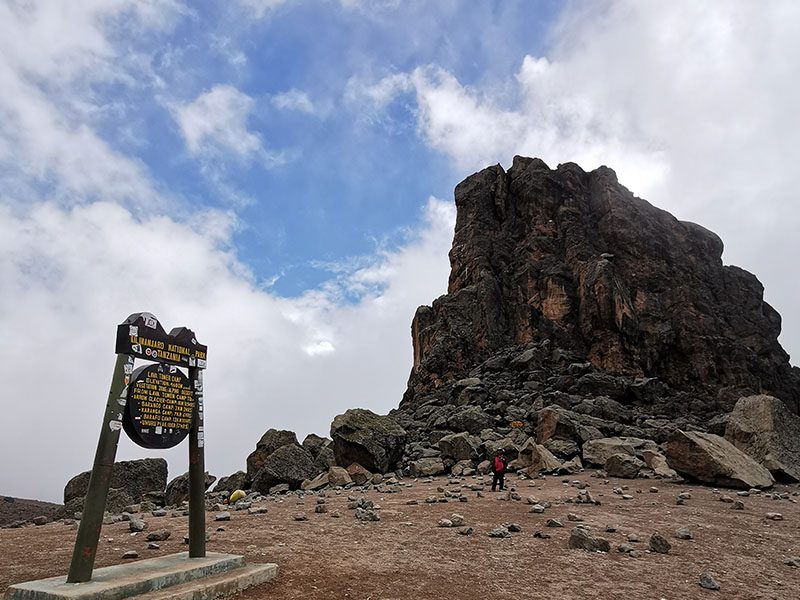
 
Contact us today to plan your Kilimanjaro climb with experienced local guides.

Related Articles

Mount Kilimanjaro Do’s and Don’ts for First-Time Climbers

Plan Your Kilimanjaro Climb

Climb safely, legally, and with the right support team.

Plan Your Climb the Right Way

 The right preparation ensures a safe and successful Kilimanjaro experience.

OUR CATEGORIES

Kilimanjaro Trekking Rules Every Tourist Must Know | Kili Quests

Know Before You Climb: Kilimanjaro’s Official Trekking Rules

Planning to climb Mount Kilimanjaro? It’s not just about physical preparation , it’s also important to understand the government rules and regulations that apply to every climber. Tanzania’s Kilimanjaro National Park Authority (KINAPA) enforces strict guidelines to protect trekkers, porters, and the environment.Here’s what every tourist must know before beginning the journey to the Roof of Africa.
 
Before planning your trek, it’s important to understand how difficult Kilimanjaro really is and what to expect physically
Trekkers registering at Kilimanjaro National Park gate before the climb
All climbers must register with a licensed tour operator before entering Kilimanjaro

Table of Contents

 You Must Climb with a Licensed Tour Operator

Independent trekking is not allowed on Mount Kilimanjaro. All climbers must book their trek through a registered tour operator licensed to operate inside Kilimanjaro National Park.

At Kili Quests, we operate legally under national park guidelines and organize climbs with licensed guides, proper crew support, safety equipment, meals, transport, and mountain logistics.
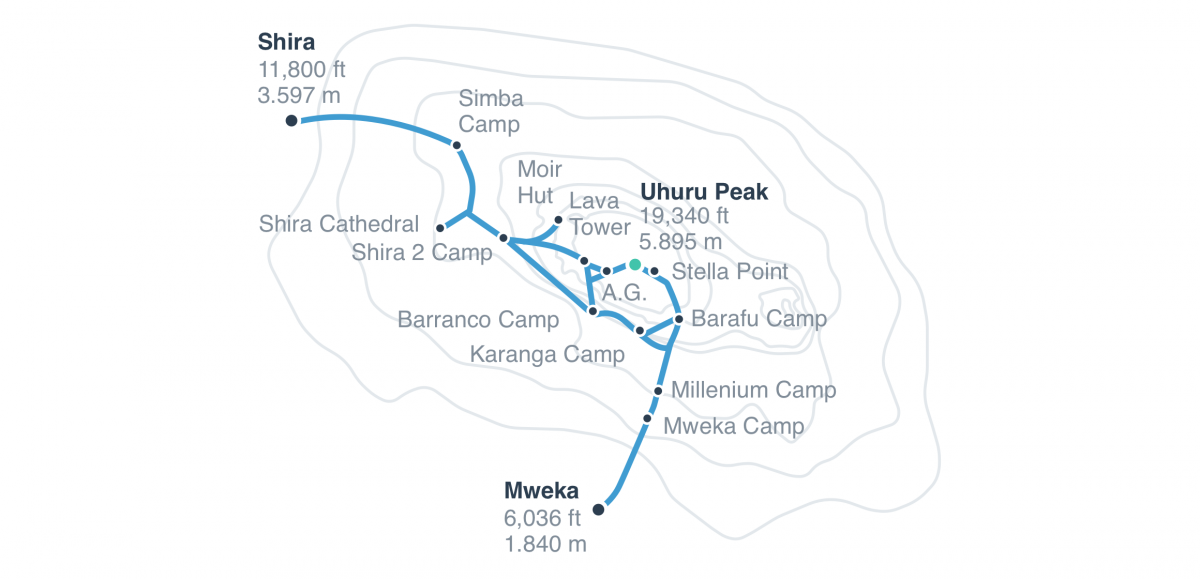
Choosing the right company matters because a proper Kilimanjaro package is more than just a guide fee. Before comparing prices, read Kilimanjaro Climb Cost to understand what a legal, properly supported climb should include.

A Certified Mountain Guide Is Mandatory

You cannot climb Kilimanjaro without a certified Tanzanian mountain guide. KINAPA requires each group to have at least one registered guide per group and often more depending on group size.All of our guides at Kili Quests are WFR-certified (Wilderness First Responder) and highly experienced in managing altitude and emergencies.
 
Kili Quests mountain guide attending Wilderness First Responder (WFR) certification course
Our Kilimanjaro guides are WFR-certified and trained to handle altitude-related emergencies

Camping and Hut Use Are Regulated

Each route has designated campsites or huts, and wild camping is strictly prohibited. For example:Marangu Route uses designated huts only Lemosho, Machame, Northern Circuit, and others use designated campsitesKINAPA rangers check park entry permits at each checkpoint to ensure all trekkers are on legal routes.
 
View of Kibo Peak from Karanga Camp on the Shira Route with rocky alpine terrain in the foreground.
Karanga Camp (3,963m) offers a peaceful stop on the Shira Route, with hot breakfast, scenic campsites, and stunning views of Kibo’s icy slopes.

 Porter Weight Limits and Welfare Are Protected

Kilimanjaro’s porters are vital — and protected. KINAPA and KPAP (Kilimanjaro Porters Assistance Project) enforce the following rules:
  • Porters can carry a maximum of 20 kg of client gear
  • Each trek must include enough porters for fair load distribution
  • Porters must receive proper meals, shelter, and fair wages

You Must Pay Kilimanjaro Park Fees Before Entry

Kilimanjaro park fees are paid before entering the national park and are normally included in your climb package through your licensed tour operator. These fees are required by Kilimanjaro National Park and are part of the legal cost of climbing the mountain.
Park fees may include:
  • Conservation fees charged per day
  • Camping or hut fees depending on the route
  • Rescue fees
  • Guide and crew park access
  • Value Added Tax (VAT)
Your entry is checked through official park registration and permit systems at the gate. This is one reason it is important to book with a licensed operator that handles park payments correctly and transparently.
 
Park fees vary depending on the route and number of days on the mountain. Before comparing packages, read Kilimanjaro Climb Cost to understand how park fees, route length, crew support, and VAT affect your total budget.

 Leave No Trace – Strict Environmental Rules

Tanzania is serious about protecting Kilimanjaro’s fragile ecosystem. Regulations include:
  • No littering — All waste must be packed out
  • No removing plants, rocks, or wildlife
  • Toilet use is regulated
Tour companies must carry out client and staff trash and follow “leave no trace” principles.
 

 Kilimanjaro Rescue Services Are Monitored

The park operates a dedicated rescue team, and Kilimanjaro SAR (Search and Rescue) provides helicopter evacuation in serious cases. However:
  • Evacuations require valid insurance
  • All emergencies must be reported through your guide
  • Rangers coordinate and monitor all rescue operations
At Kili Quests, we carry pulse oximeters, oxygen, and WFR-trained staff on every trek.
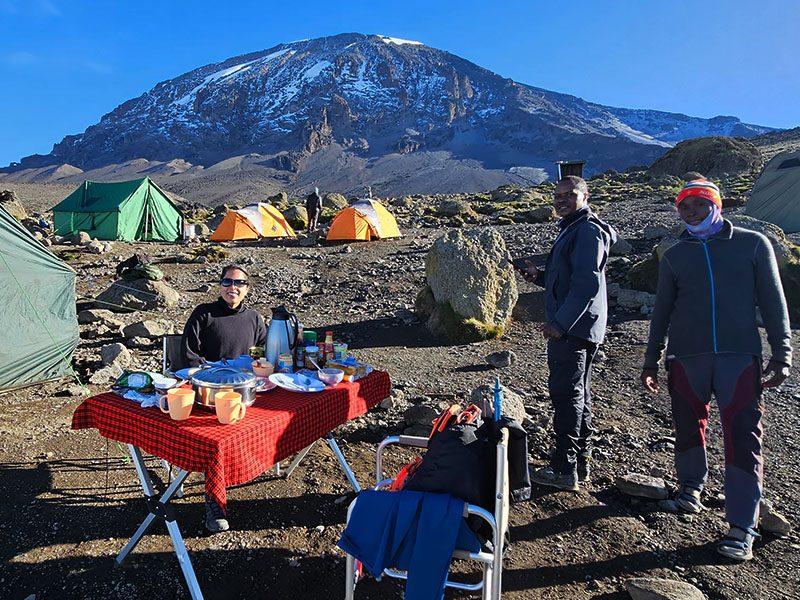
 
 
Rescue on Kilimanjaro is only possible with proper coverage, so it’s essential to have the right policy,learn how to choose the best medical insurance for Kilimanjaro before your trek.
Helicopter flying over Mount Kilimanjaro during an emergency evacuation
Kilimanjaro helicopter rescue for trekkers in emergency situations — valid insurance is required

Offenders Face Fines or Expulsion

Breaking the rules can lead to:
  • Fines
  • Expulsion from the mountain
  • Blacklisting for future permits
  • In serious cases, legal action


What You Need to Know

  •   You must use a licensed tour operator
  •  A certified guide is mandatory
  •  You must stay at official camps/huts
  •  Porters are protected and regulated
  •  Park fees must be paid in advance
  •  Littering and damage to the environment is strictly forbidden
  •  Rescue is available — but must be handled properly
  •  Breaking rules results in fines or expulsion

Frequently Asked Questions About Kilimanjaro Trekking Rules

Do you need a permit to climb Mount Kilimanjaro?

Yes. Every climber must obtain a permit issued by Kilimanjaro National Park Authority before entering Mount Kilimanjaro. These permits are arranged through licensed tour operators and include park entry, conservation fees, rescue coverage, and campsite or hut access. Without an official permit, trekkers cannot legally begin the climb.

Can tourists climb Mount Kilimanjaro without a guide?

No. Independent trekking is not allowed on Mount Kilimanjaro. Tanzanian park regulations require all climbers to be accompanied by a certified local mountain guide from a licensed tour company. This rule helps ensure climber safety, proper route management, and protection of the mountain environment.

Why are climbers required to use a licensed tour operator?

Licensed operators ensure that trekking groups follow national park rules, provide certified guides, and treat porters fairly. Authorities require tour companies to organize permits, pay park fees, and coordinate logistics so that all treks comply with safety and environmental regulations.

Are there rules protecting porters on Kilimanjaro?

Yes. Organizations such as the Kilimanjaro Porters Assistance Project work with park authorities to protect porter welfare. Porters are limited to carrying about 20 kg of gear and must receive proper meals, fair wages, and adequate shelter during the trek.

Is camping anywhere allowed on Mount Kilimanjaro?

No. Trekkers must stay only at designated campsites or huts depending on the route. For example, the Marangu Route uses mountain huts, while routes like Machame Route and Lemosho Route use official campsites. Wild camping outside these areas is strictly prohibited.

What happens if someone breaks Kilimanjaro trekking rules?

Violating park regulations can lead to fines, removal from the mountain, or cancellation of trekking permits. In serious cases, climbers or tour companies may be banned from future expeditions. These rules help protect both trekkers and the fragile ecosystem of Kilimanjaro National Park

Ready to Trek Responsibly?

At Kili Quests, we follow every regulation set by KINAPA and KPAP to ensure safe, legal, and ethical trekking. You’ll be guided by a professional team that respects the mountain, the people, and you.Choosing the right company is part of the rules , here’s how to find a licensed and ethical operat
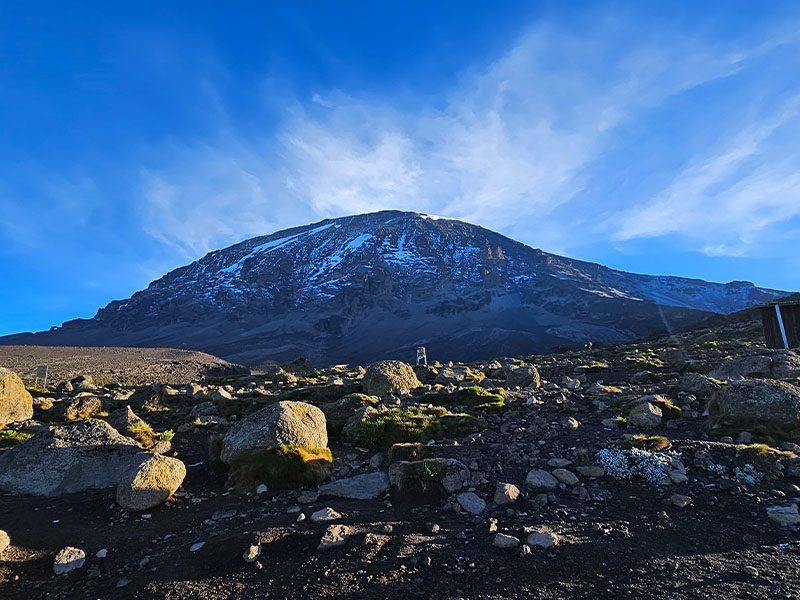
Related Articles

What Does Kilimanjaro Mean? Name Origin & History

Climb Kilimanjaro with Local Guides

Experience the mountain behind the name with local guides who understand its routes, history, culture, and summit challenge.

Related Kilimanjaro Stories

OUR CATEGORIES

Why Kilimanjaro Is Called ‘Kilimanjaro’ | Kili Quests

Mount Kilimanjaro is the highest mountain in Africa, but the meaning of its name is still debated. Unlike some famous mountains with clear naming origins, “Kilimanjaro” has several possible explanations connected to Swahili, Chagga language roots, early explorer records, snow, difficulty, and local stories.
 
No single meaning has been proven. Some people interpret Kilimanjaro as a “shining mountain” or “mountain of whiteness,” while others connect it to Chagga phrases describing a difficult or impossible climb. The truth is likely more complicated because the name passed through local languages, traders, missionaries, explorers, maps, and colonial spellings.
 
This article explains the main theories behind the name Kilimanjaro and why the mystery still matters today.
 
To understand the mountain’s physical shape and volcanic history, read our guide to what Mount Kilimanjaro is and how it formed.

Quick Answer: What Does Kilimanjaro Mean?

The exact meaning of “Kilimanjaro” is uncertain. Several theories exist, but no single origin has been proven.
 
One common explanation connects the name to Swahili and Chagga language roots, often interpreted as “mountain of whiteness” or “shining mountain” because of the snow and glaciers on the summit. Another theory links the name to Chagga words suggesting something difficult, impossible, or defeating to climb.
 
Early European explorers and missionaries recorded different spellings and interpretations, which helped standardize the name internationally. So the honest answer is this: Kilimanjaro does not have one confirmed meaning, but its name is tied to language, snow, local stories, early exploration, and the mountain’s powerful presence in East Africa.
Mount Kilimanjaro with local tribal regions such as Chagga and Pare surrounding the base
The origin of the name “Kilimanjaro” remains debated — with influences from Chagga, Swahili, Maasai, and colonial languages

Table of Contents

Why the Meaning of Kilimanjaro Is Uncertain

The meaning of Kilimanjaro is uncertain because the name passed through different languages, communities, interpreters, explorers, maps, and colonial records.
 
Local communities around the mountain did not always use one single name for the whole mountain in the same way outsiders later recorded it. Some names referred to specific peaks, such as Kibo and Mawenzi, while the wider name “Kilimanjaro” became more common through outside records.

European Records vs. Local Language

European missionaries and explorers helped spread the name “Kilimanjaro” internationally during the 19th century, but they did not create the mountain itself or the local meanings around it.

Johannes Rebmann, a German missionary, is widely credited as the first European to report seeing Kilimanjaro’s snow-covered summit in 1848. Later explorers, mapmakers, and colonial writers recorded the name in different spellings and interpretations.

One popular explanation connects “Kilima” with a Swahili word often interpreted as mountain or hill, and “Njaro” with a Chagga-related word linked to shining or whiteness. But this explanation is debated because mlima is the common Swahili word for mountain, while kilima usually means hill or small mountain.

This is why Kilimanjaro’s name is not simple. It likely passed through local speech, Swahili usage, guides, interpreters, and European writing before becoming the internationally recognized name.
Historical photograph of Mount Kilimanjaro from early exploration or colonial era
Historical explorers and early local communities referred to the mountain by various names before “Kilimanjaro” became widely accepted
Portrait of Johannes Rebmann, the first European to report seeing Mount Kilimanjaro in 1848
In 1848, German missionary Johannes Rebmann was the first European to report Kilimanjaro’s snow-covered summit to the outside world

Local Language Theories Behind Kilimanjaro

Several local language theories try to explain the name Kilimanjaro.
 
One Chagga-related theory suggests that the name may have come from a phrase such as Kilelema Kyaro or a similar form, sometimes interpreted as “that which defeats the caravan” or “that which is difficult to climb.” This theory connects the name to the mountain’s difficulty and the challenge of reaching its high slopes.
 
Another theory links the name to snow, whiteness, or brightness. From far away, Kilimanjaro’s white summit would have been one of its most striking features, especially before the glaciers began shrinking.
 
There are also ideas connected to nearby languages, including Pare interpretations related to coldness or water. These should be treated as possible influences, not proven origins.
The strongest point is this: Kilimanjaro’s name likely developed from a mixture of local language, Swahili usage, outside interpretation, and later map records.
Members of the Chagga tribe near Mount Kilimanjaro in traditional attire
Members of the Pare tribe from the southeastern Kilimanjaro region, dressed in traditional clothing
The Pare people, known for their rituals and herbal knowledge, view Kilimanjaro as a sacred force and conduct spiritual ceremonies in its presence

Did Pare or Maasai Words Influence the Name?

Some local explanations connect the name Kilimanjaro with words from nearby communities, including Pare or Maasai interpretations. These ideas often relate to coldness, water, greatness, or spiritual respect for the mountain.
 
However, these theories are harder to prove. The Pare people live southeast of Kilimanjaro around the Pare Mountains, while Maasai communities have long lived across nearby plains in northern Tanzania and southern Kenya.
 
Kilimanjaro’s name may have passed through several language environments before being written down by outsiders. That makes it possible that nearby languages influenced how people understood the mountain, but no single Pare or Maasai origin has been proven.
 
For more about traditional stories and beliefs around the mountain, read Mount Kilimanjaro Myths: Chagga, Maasai & Pare Beliefs.

Colonial Influence on the Name Kilimanjaro

During the colonial period, German and British writers recorded place names based on what they heard from local guides, traders, missionaries, and interpreters. Because different languages and dialects were spoken around the mountain, names could be simplified, misheard, or reshaped in written records.
 
By the late 19th century, “Kilimanjaro” appeared more regularly on European maps and publications. Over time, this spelling became internationally accepted, even though the exact original meaning remained uncertain.
 
This does not mean the name is fake. It means the modern spelling of Kilimanjaro was shaped by contact between local languages, Swahili-speaking networks, European records, and colonial-era mapmaking.
Historical image of Mount Kilimanjaro with glacier-covered summit during early exploration era
Early photographs of Kilimanjaro show more extensive glaciers and fewer local people

Kilimanjaro: A Name with Many Meanings

Theory Meaning
Swahili: Kilima + Njaro Hill of shining whiteness
Chagga: Kilelema Kyaro That which defeats caravans
Pare dialect Possibly “cold place” or “water source”
European explorers Misheard combination of tribal names
These meanings are historical theories, not confirmed translations. The name Kilimanjaro remains debated because it passed through local languages, Swahili-speaking networks, explorer records, and colonial mapmaking.
Hans Meyer 1889 map of Mount Kilimanjaro summit area
A look back in time — this 1990s Kilimanjaro map reflects how the mountain was explored, traveled, and understood decades ago.

Cultural Meaning Beyond the Name

For communities around the mountain, Kilimanjaro is more than a word on a map. It is connected to farming, water, forests, rain, ancestors, sacred places, and local identity.
 
The Chagga people, especially communities around the southern and eastern slopes, have lived close to the mountain for generations. Nearby Pare and Maasai communities also have their own cultural relationships with the wider Kilimanjaro landscape.
 
These stories do not prove one exact translation of the name, but they show why the mountain has always carried meaning beyond its height.
 
To understand the communities around the mountain, read Chagga Culture Around Mount Kilimanjaro.

Why the Name Kilimanjaro Still Matters Today

The name Kilimanjaro matters because it carries mystery, language, history, and identity. Even though no single meaning is proven, the different theories show how many communities, explorers, and storytellers tried to explain the mountain’s power.
 
For travelers, understanding the name adds depth to the climb. You are not just walking toward a summit; you are entering a landscape shaped by local languages, oral traditions, colonial records, and Tanzania’s modern identity.
 
Today, Kilimanjaro is known around the world as Africa’s highest mountain and one of the most iconic natural landmarks on Earth.
 
At its highest point stands Uhuru Peak, a name connected to Tanzania’s independence and freedom.

Frequently Asked Questions About the Name Kilimanjaro

What does the name Kilimanjaro mean?

The exact meaning of Kilimanjaro is still debated. Common theories connect the name with whiteness, shining snow, difficulty, greatness, caravans, or local spiritual ideas. No single meaning has been proven.

Does Kilimanjaro mean mountain of whiteness?

It may, according to one popular theory. This explanation connects the name with the snow and glaciers on Kilimanjaro’s summit. However, it is only one theory, not a confirmed translation.

Is Kilimanjaro a Swahili word?

Kilimanjaro is often linked to Swahili and Chagga language roots, but its exact origin is debated. The common Swahili word for mountain is mlima, while kilima usually means hill or small mountain, which makes the simple “kilima equals mountain” explanation more complicated.

Did local people originally call the mountain Kilimanjaro?

Not exactly. Some local communities referred to specific parts of the mountain, especially Kibo and Mawenzi, rather than using one single confirmed name for the whole mountain. The name Kilimanjaro became widely known through outside records, maps, and later international use.

How did European explorers influence the name Kilimanjaro?

European missionaries, explorers, and mapmakers helped standardize the spelling “Kilimanjaro” in international records. They recorded the name based on what they heard from local guides, Swahili speakers, traders, and interpreters.

Climb the Mountain Behind the Name

The meaning of Kilimanjaro may never be explained by one simple translation, but that is part of its power. The name carries snow, mystery, language, history, and the stories of people who have lived around the mountain for generations.
 
If you are ready to experience Kilimanjaro for yourself, Kili Quests can help you choose the right route, prepare properly, and climb with experienced local guides.
 
Contact us today to start planning your Kilimanjaro climb.

Related Articles

How Many Porters Do You Need on Kilimanjaro?

Climb Kilimanjaro the Right Way

Your success starts with the right team.
At Kili Quests, we focus on:
Plan Your Kilimanjaro Climb

Choosing the right route, budget, and plan makes a big difference in your success.
Explore these essential guides:

OUR CATEGORIES

How Many Porters Do You Need on Kilimanjaro?

Why Porters Matter on Mount Kilimanjaro

Climbing Kilimanjaro is not just about you and your guide. Behind every successful climb is a mountain crew that carries equipment, sets up camp, prepares water, supports meals, and keeps the expedition moving safely from one camp to the next.
 
Porters are the backbone of a Kilimanjaro trek. They carry tents, food supplies, cooking equipment, climbers’ duffel bags, and shared mountain gear so trekkers can focus on hiking, acclimatization, and reaching the summit safely.
 
At Kili Quests, we believe every climber should understand how many porters are needed, not only for planning, but also to respect the people who make every Kilimanjaro climb possible.
 
For a deeper look at their daily work, read our guide to Kilimanjaro porter responsibilities.

Quick Answer: How Many Porters Do You Need on Kilimanjaro?

Most Kilimanjaro climbs need about 3 to 5 porters per climber, depending on the route, number of days, group size, camping setup, and service level.
 
A solo climber may still need several porters because the crew must carry more than one personal duffel bag. They also carry tents, food, fuel, cooking equipment, safety items, and shared camp supplies.
 
Longer camping routes such as Lemosho, Machame, Rongai, and Northern Circuit usually require more porter support than shorter or hut-based climbs because more food and equipment must be moved between camps.
Kilimanjaro trekkers and porters smiling together at the end of a successful hike
Each climber on Kilimanjaro requires several porters to carry gear, food, and tents , a full support crew ensures safety and comfort

Table of Contents

Typical Porter-to-Climber Ratio on Kilimanjaro

A common estimate is 3 to 5 porters per climber, but this should be treated as a guide, not a fixed rule. The real number depends on the route, trek duration, equipment, food supplies, and how the climb is organized.
 
A proper porter ratio helps with:
  • Safe load distribution
  • Faster and better camp setup
  • Enough food, fuel, and water support
  • Better working conditions for the crew
  • A smoother trekking experience for climbers
If a Kilimanjaro climb looks unusually cheap, one thing to check is whether the operator is using enough porters. Cutting porter numbers can reduce the price, but it may also lead to overloaded crew members and weaker support on the mountain.
 
See how crew size affects appreciation and end-of-climb payments in our Kilimanjaro tipping guide.

What Porters Carry on Kilimanjaro

Porters carry the equipment needed to keep a multi-day Kilimanjaro climb running safely and comfortably. This includes both personal climber gear and shared group supplies.
 
Common items carried by porters include:
  • Climbers’ duffel bags
  • Sleeping tents and camping equipment
  • Dining tent and kitchen equipment
  • Food supplies and cooking fuel
  • Water containers and camp supplies
  • Staff gear and mountain support items
  • Private toilet equipment where included
  • Safety and emergency support items
Climbers usually carry only a small daypack with water, snacks, rain gear, warm layers, sunscreen, camera, and personal items needed during the day.
 
Porter load limits matter because responsible operators should not overload fewer porters to reduce costs. KPAP states that porter loads should not exceed 20 kg for company gear, excluding the porter’s personal kit.For the full breakdown, read our guide to Kilimanjaro porter weight limits.
 
To see what support, meals, equipment, and safety items are included in your trek, visit our guide to what’s included in our Kilimanjaro climb package.

How Many Porters Do You Need for Your Group?

Here’s a typical breakdown based on group size:
Group Size Typical Porters Other Crew Why This Crew Size Is Needed
1 climber 4–5 porters 1 guide, 1 cook Even solo climbs need support for tents, food, kitchen gear, safety items, and personal luggage.
2 climbers 8–9 porters 1–2 guides, 1 cook More climbers add duffel bags, meals, water needs, and camping supplies, even when some equipment is shared.
4 climbers 14–17 porters 2 guides, 1–2 cooks Group support increases because food, fuel, tents, dining setup, and porter load limits must be managed properly.
6 climbers 21–25 porters 3 guides, 2 cooks Larger groups need more porter support, but shared equipment can make the crew more efficient.
Kilimanjaro porter walking along the mountain trail with gear balanced on head
Porters walk long distances each day through tough terrain — carrying essential supplies that make your trek possible

Why the Number of Porters Changes

The number of porters needed for Kilimanjaro is not fixed. A responsible company calculates crew size based on the route, number of days, equipment, food supply, and safe load distribution.

Route Choice

Camping routes such as Machame, Lemosho, Rongai, and Northern Circuit usually require more porters because tents, kitchen gear, dining equipment, and camp supplies must be carried between camps.

The Marangu Route is different because climbers sleep in huts instead of tents. This can reduce some camping equipment needs, although porters are still required for duffel bags, food, and other support items.

Before choosing your trail, compare the main options in our Kilimanjaro routes guide.

Trek Duration

More days on the mountain means more food, fuel, and supplies. A 7-day or 8-day climb usually needs more porter support than a shorter climb because the crew must carry enough resources for the full expedition.
 
This is one reason longer routes often cost more than shorter routes. They provide better acclimatization time, but they also require more staff, food, and logistics.
 
To understand how crew size, park fees, food, route length, and logistics affect your total price, read our full guide to Kilimanjaro climb cost.

Level of Service

The style of climb also affects porter numbers. A basic camping setup may need fewer supplies, while a more comfortable climb may require extra equipment such as larger tents, private toilet tents, better dining support, or additional camp gear.
 
That does not mean extra porters are a bad thing. When the service level increases, crew size must also increase so that loads remain fair and the climb runs smoothly.
 
For example, climbs that include a private toilet tent, extra dining comfort, or more camp equipment may require additional porter support. This is normal when the extra equipment is planned responsibly and porter loads remain within safe limits.

Camping Routes vs Marangu Route

Camping routes usually require more porters because the team must carry tents, dining equipment, kitchen gear, and more camp supplies between each campsite. This applies to routes such as Machame, Lemosho, Rongai, Umbwe, and Northern Circuit.
 
The Marangu Route is different because climbers sleep in mountain huts instead of tents. This can reduce some camping equipment needs, but porters are still needed for duffel bags, food, cooking supplies, and other support items.
 
So the question is not only “how many porters per climber?” The better question is: which route are you climbing, how many days are you on the mountain, and what level of support is included?

Why Too Few Porters Can Be a Red Flag

Some climbers are surprised by the size of a Kilimanjaro mountain crew. But on Kilimanjaro, fewer porters does not always mean a better or more efficient climb.
 
In many cases, too few porters can be a warning sign.
 
A low-cost operator may reduce crew size to make the package look cheaper. The problem is that the same equipment still has to reach each camp: tents, food, cooking gear, fuel, water containers, safety items, and climbers’ duffel bags.
 
When there are not enough porters, the result can be:
  • Overloaded crew members
  • Poor camp organization
  • Delayed meals and camp setup
  • Lower morale among the team
  • Less reliable support for climbers
A proper crew size protects both the climber and the porter. It also shows that the operator is serious about safety, logistics, and ethical trekking.

Before Booking, Ask About Porter Support

Before choosing a Kilimanjaro operator, ask how the company plans porter numbers, load limits, meals, wages, and crew welfare.
 
A responsible company should be able to explain:
  • How many porters are used for your group size
  • How porter loads are controlled
  • Whether crew members receive proper meals and shelter
  • How tipping is handled
  • What support equipment is included in the climb
If the company cannot answer clearly, that is a red flag.

The Kili Quests Difference

At Kili Quests, porter welfare is part of how we plan every climb. We do not see porters as background workers. They are essential members of the mountain team.

Before each trek, we consider the route, group size, number of days, food supply, camping setup, and equipment needs so the crew is properly organized from the start.

We focus on:
  • The correct number of porters for each trek
  • Responsible load distribution
  • Fair wages and respectful treatment
  • Proper meals and mountain support for the crew
  • Safe working conditions throughout the climb
  • Experienced guides who manage the team properly
We do not just organize climbs. We support the people who make Kilimanjaro climbs possible.

For more about mountain safety, read our guide: Is Kilimanjaro dangerous?

Tipping and Respect for Kilimanjaro Porters

Porters are not just part of the logistics. They are part of the experience. They often reach camp before climbers, prepare the site, organize gear, support meals, and help keep the climb moving smoothly each day.
 
You can show respect by:
  • Greeting the crew each day
  • Learning a few Swahili words such as “asante” and “pole pole”
  • Keeping your duffel bag within the allowed weight
  • Following guide instructions at camp
  • Giving tips fairly at the end of the climb
Tipping is an important part of the Kilimanjaro climbing culture, but it should be handled transparently so the crew receives what is intended for them.
 
See full recommendations in our Kilimanjaro tipping guide.
Kilimanjaro trekker handing a thank-you tip to a smiling mountain guide at the end of the climb
Tipping your Kilimanjaro crew is a meaningful way to show appreciation for their hard work throughout the trek

Frequently Asked Questions About Kilimanjaro Porter Numbers

How many porters are needed for a Kilimanjaro trek?

Most Kilimanjaro expeditions need about 3 to 5 porters per climber. The exact number depends on the group size, route, number of days, camping setup, and level of service. Even solo climbers need several porters because the crew carries tents, food, cooking equipment, safety items, and shared camp supplies.

Why are so many porters required on Kilimanjaro?

Kilimanjaro climbs last several days and require moving equipment from camp to camp. Porters carry food, tents, cooking gear, water containers, duffel bags, and other support items so climbers can focus on hiking and acclimatization.

What is the weight limit for Kilimanjaro porters?

A common ethical standard is that porters should carry no more than 20 kg of company or client gear, excluding their own personal kit. This is why responsible operators plan enough porters instead of overloading fewer crew members.

Does the number of porters change depending on the route?

Yes. Longer camping routes such as Lemosho, Machame, Rongai, and Northern Circuit usually require more porters because they involve more days, more food, and more camping equipment. Hut-based routes such as Marangu may require a different crew setup.

Why is hiring enough porters important for ethical trekking?

Hiring enough porters keeps loads safer, improves camp organization, and protects the people who support the climb. If an operator uses too few porters, the climb may look cheaper, but the crew may be overloaded or poorly supported.

Climb with a Team That Values People

Choosing the right Kilimanjaro company is not only about price, route, or summit success. It is also about how people are treated on the mountain.
 
At Kili Quests, we organize climbs with ethical porter support, experienced local guides, safe logistics, and a mountain team that is respected from start to finish.
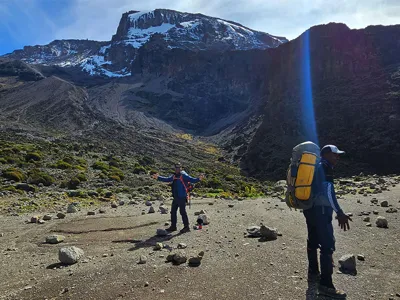
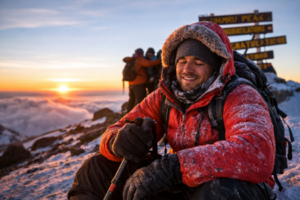
 
If you want a Kilimanjaro climb that is well-planned, responsible, and properly supported, contact us today to start planning your trek.
 
Request your custom Kilimanjaro climb plan with Kili Quests.

Related Articles