What to Expect on Kilimanjaro: Daily Itinerary Guide

Plan Your Kilimanjaro Itinerary

The right preparation makes your climb safer, easier, and more successful.

Plan Your Climb the Right Way

 The itinerary is just one part of your journey ,make sure everything is planned correctly.
 

OUR CATEGORIES

What to Expect on a Kilimanjaro Climb: Daily Itinerary Explained

Climbing Mount Kilimanjaro is not just a hike , it’s a multi-day journey through changing landscapes, increasing altitude, and a steady test of both physical and mental endurance.One of the most common questions climbers ask before booking is: “What will each day actually look like?”
 
Understanding the daily routine helps you prepare properly, manage your expectations, and feel more confident about the experience ahead.In this guide, we walk you through what to expect on a typical Kilimanjaro climb,Before choosing your itinerary, it’s important to understand how different routes affect your experience , see our guide to choosing the best Kilimanjaro route.from your first day on the trail to the moment you stand on Uhuru Peak.
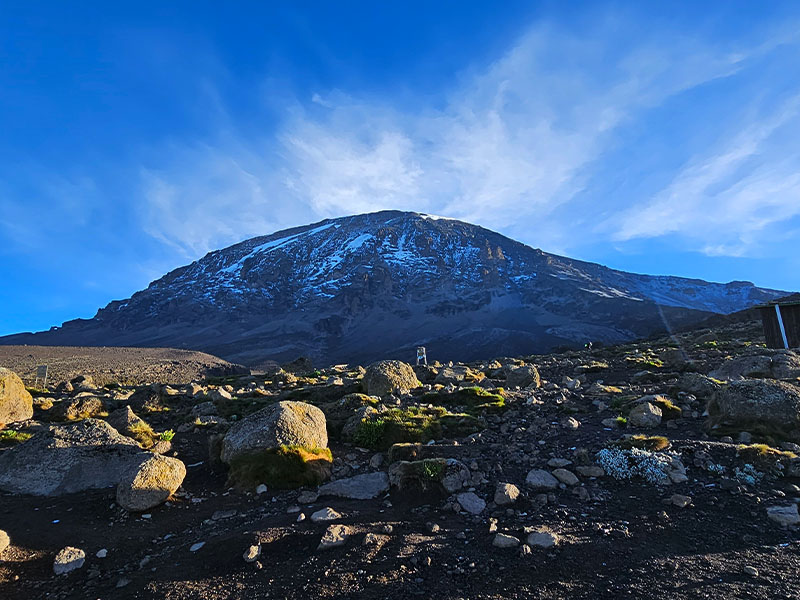
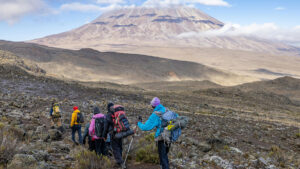
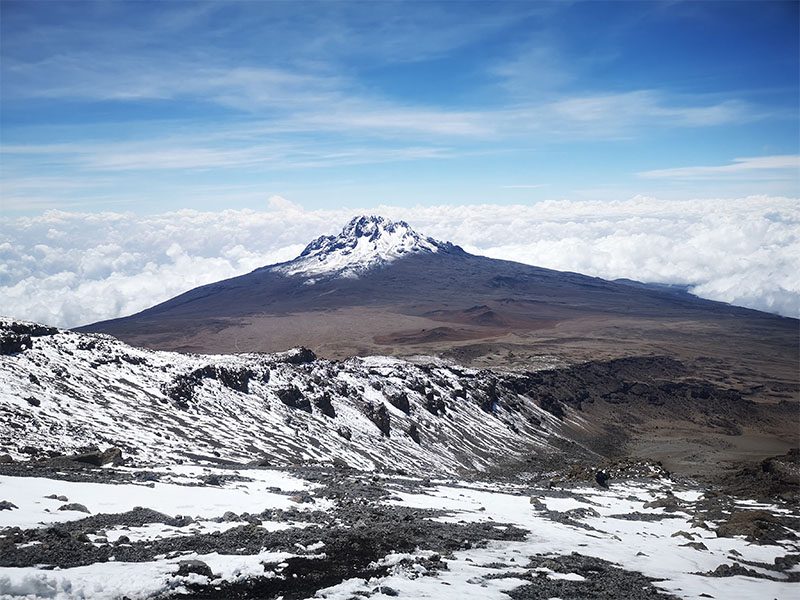
Sweeping view of Mount Kilimanjaro’s Kibo Peak from Karanga Camp on the Shira Route, with rocky alpine terrain under a bright morning sky | Kili Quests
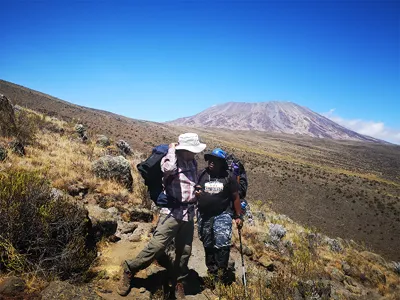
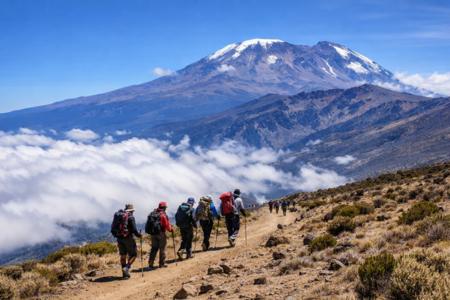
Climbers trekking through changing landscapes on Mount Kilimanjaro — from rainforest to summit

Table of Contents

What Is a Typical Kilimanjaro Itinerary Like?

Most Kilimanjaro climbs take between 6 to 9 days,The number of days you choose has a direct impact on success rate , explore our full Kilimanjaro cost breakdown to see how itinerary length affects pricing.depending on the route you choose. Each day follows a similar structure, but the environment, altitude, and difficulty gradually change.
You will:
  • Wake up early with tea or coffee
  • Trek for several hours at a slow pace
  • Take breaks for rest and meals
  • Arrive at camp in the afternoon
  • Eat dinner and rest for the next day
As the days go on, the altitude increases, and your body begins to feel the effects. This is why pacing and acclimatization are so important.

Day-by-Day Kilimanjaro Itinerary Breakdown

Day 1 – Arrival and First Trek Through Rainforest

Your journey begins at the park gate, where you complete registration before starting your trek.The first day takes you through lush rainforest, where you may see monkeys, birds, and dense vegetation. The trail is usually well-defined and not too steep, making it a good introduction to the climb.You will hike for a few hours before reaching your first camp.At this stage, the altitude is still relatively low, so most climbers feel comfortable and energized.

Day 2 – Entering the Moorland Zone

As you continue climbing, the landscape begins to change. The dense forest gives way to open moorland, with fewer trees and more expansive views.The air starts to feel cooler and drier, and you may begin to notice slight changes in your breathing.This is where your guides will start emphasizing “pole pole” — moving slowly to help your body adjust to the altitude.

Day 3 – Acclimatization and Higher Altitude

By the third day, altitude becomes more noticeable.
You may experience:
  • Mild headaches
  • Reduced appetite
  • Slower walking pace
Many itineraries include an acclimatization strategy such as “climb high, sleep low,” where you hike to a higher altitude during the day and then descend slightly to sleep.
This is one of the most important days for preparing your body for the summit.
 

Day 4 – Alpine Desert and Thinner Air

The environment now changes dramatically into alpine desert.The landscape becomes dry, rocky, and more exposed. Temperatures can vary widely between day and night, and the air feels thinner.At this stage, your energy levels may fluctuate, and simple tasks can feel more tiring.Staying hydrated and maintaining a steady pace becomes even more important.

Day 5 – Reaching High Camp (Summit Preparation)

You will reach high camp, usually in the afternoon.This is where you rest, eat, and prepare for summit night. Most climbers try to sleep early, although it can be difficult due to excitement and altitude.Your guides will brief you on what to expect during the summit push, including pacing, safety, and timing.This is a critical stage , how you feel here often determines how strong you’ll be during the summit.
 
At this stage, many climbers begin to feel the real difficulty , see how challenging the climb actually is in our guide on how hard Kilimanjaro is.

Day 6 – Summit Night and Uhuru Peak

Summit night begins around midnight.You will climb slowly in the dark for several hours, using a headlamp to guide your way. This is the most challenging part of the entire climb due to cold temperatures, altitude, and fatigue.After reaching the crater rim, you continue toward Uhuru Peak.Standing at the summit as the sun rises is an unforgettable experience.After a short time at the top, you begin your descent back to a lower camp.
 
Summit night is the most demanding part of the climb , proper preparation is key. Check our Kilimanjaro summit day gear guide to make sure you’re fully ready.

Day 7 – Descent and Return to Lower Altitude

The final day is usually a descent through lower zones.As you go down, the air becomes richer in oxygen, and your body starts to feel stronger again. Many climbers feel a sense of relief and accomplishment.By the time you reach the exit gate, you will have completed one of the most rewarding challenges in the world.
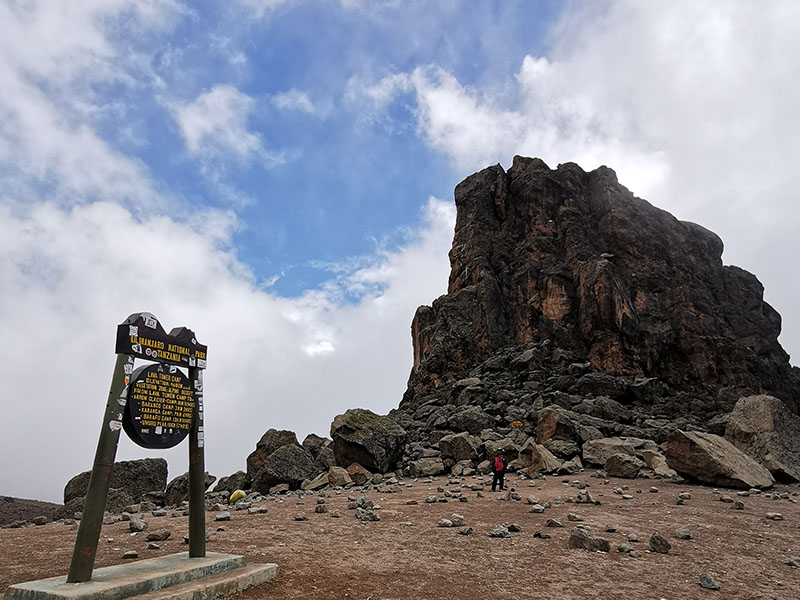
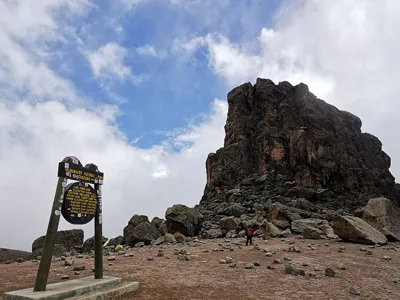
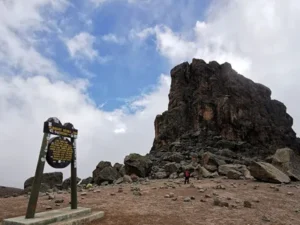
Lava Tower rising steeply at 4,630m on Mount Kilimanjaro’s Shira Route, with the trail sign and a trekker standing beneath the massive volcanic rock | Kili Quests
Lava Tower on Mount Kilimanjaro — a key acclimatization point where climbers hike high before descending to sleep lower.

What You’ll Experience Along the Way

Changing Landscapes

One of the most unique aspects of Kilimanjaro is the variety of ecosystems you pass through, from rainforest to alpine desert to glaciers near the summit.
 
From rainforest to arctic summit, the mountain passes through five distinct zones , explore them in detail in our Kilimanjaro ecological zones guide.

Physical and Mental Challenges

The climb tests both your body and your mindset. Some days feel easy, while others require patience and determination.
 
Preparing your body is just as important as understanding the itinerary — follow our Kilimanjaro training plan to build the endurance needed for each day of the climb.

Support from Your Guide Team

Your guides, porters, and cooks play a huge role in your experience. They support you every day, ensuring your safety, comfort, and success.

Be Prepared for the Journey, Not Just the Summit

Climbing Kilimanjaro is not just about reaching Uhuru Peak — it’s about the entire journey.
Each day brings new challenges, new landscapes, and new achievements. By understanding what to expect, you can prepare properly and enjoy the experience to the fullest.

Frequently Asked Questions About Kilimanjaro Itinerary

How many days does it take to climb Mount Kilimanjaro?

Climbing Mount Kilimanjaro typically takes between 6 and 9 days, depending on the route you choose and how much time you allow for acclimatization. While some routes can be completed in as little as five days, these shorter itineraries are not recommended for most climbers because they do not give your body enough time to adjust to the altitude.Longer itineraries, such as 7 or 8 days, are much more effective because they include gradual altitude gain and sometimes an extra acclimatization day. This significantly improves your chances of reaching Uhuru Peak and also makes the experience more comfortable.If your goal is to maximize your success rate rather than just finish quickly, choosing a longer itinerary is one of the best decisions you can make.

What does a typical day on Kilimanjaro look like?

A typical day on Kilimanjaro follows a structured routine designed to help your body adjust to altitude while maintaining a steady pace. You usually wake up early in the morning with tea or coffee brought to your tent, followed by breakfast before starting your trek.The hiking pace is slow and consistent, allowing you to conserve energy and acclimatize properly. Along the way, you take short breaks to rest, drink water, and enjoy snacks. Most days involve 4 to 7 hours of trekking, depending on the route and terrain.You usually arrive at camp in the early afternoon, giving you time to rest, eat, and prepare for the next day. Evenings are calm, with dinner served early so you can sleep and recover. This daily routine becomes essential in helping you adjust to the physical and mental demands of the climb..

Is every day on Kilimanjaro equally difficult?

Not every day on Kilimanjaro feels the same, and the level of difficulty changes as you gain altitude. The first few days are generally easier, as your body is still adjusting and the terrain is less demanding.As you climb higher, the air becomes thinner, and your body starts to feel the effects of reduced oxygen. This can make even simple walking feel more tiring. By the time you reach higher camps, your energy levels may fluctuate, and you may need to move more slowly.The most challenging day is summit day, which includes a long night climb in cold temperatures followed by a descent. However, because the difficulty increases gradually, your body has time to adapt, making the overall experience manageable with the right pace and preparation.

Do you hike every day during the Kilimanjaro climb?

Yes, you will be hiking every day during your Kilimanjaro climb, but the intensity and duration of each day vary. Some days involve longer trekking hours, while others are shorter and focused on acclimatization.There are also days where you hike to a higher altitude and then descend slightly to sleep, which helps your body adapt more effectively. This approach is known as “climb high, sleep low” and is a key part of successful itineraries.Although you are active every day, the pace is designed to be manageable, and you have enough time to rest and recover at camp.This balance between activity and recovery is what makes it possible for many climbers to complete the trek successfully.

Can beginners handle the Kilimanjaro itinerary?

Yes, beginners can successfully complete a Kilimanjaro itinerary, even without prior mountaineering experience. Kilimanjaro is often referred to as a “walkable mountain” because it does not require technical climbing skills such as ropes or harnesses.
However, this does not mean it is easy.Preparation is still important. Beginners should focus on building endurance through walking, hiking, and cardio exercises before the climb. Mental preparation is also important, as the journey requires patience and determination.Choosing the right route and itinerary plays a major role in success. Longer routes with better acclimatization significantly increase your chances of reaching the summit. With proper preparation, a positive mindset, and support from experienced guides, beginners can achieve this goal.

Start Your Kilimanjaro Journey with Confidence

Climbing Kilimanjaro with Trusted Local Experts .Knowing what to expect is the first step toward success.At Kili Quests, we guide you every step of the way  from your first day on the trail to the moment you reach Uhuru Peak
Related Articles

Lemosho Route: Scenic Kilimanjaro Trail

Reach the Summit with Confidence

Your success depends on the right route, acclimatization, and expert guidance.
We plan every climb for a safe summit.

Plan Your Kilimanjaro Climb the Right Way

Kilimanjaro success depends on preparation and acclimatization.Explore these essential guides:

OUR CATEGORIES

Lemosho Route on Kilimanjaro: Scenic Views & High Success Rate

Why Choose the Lemosho Route?

The Lemosho Route is widely considered one of the best ways to climb Mount Kilimanjaro  not because it is the easiest, but because it gives you the highest chance of success while offering some of the most dramatic scenery on the mountain.
 
Starting from the remote western side, the route begins in dense rainforest before opening into the vast Shira Plateau, one of the most unique landscapes on Kilimanjaro. Over several days, the trail allows your body to gradually adjust to altitude, which is the single most important factor for reaching Uhuru Peak.Unlike shorter routes that rush the ascent, Lemosho is designed for acclimatization, making it a strong choice for both first-time climbers and experienced trekkers looking for a safer and more enjoyable climb.
 
Each route has its own advantages depending on your goals, experience, and timeline — see our Kilimanjaro Routes Comparison: Which Route Is Best? to understand how Lemosho compares to other options.
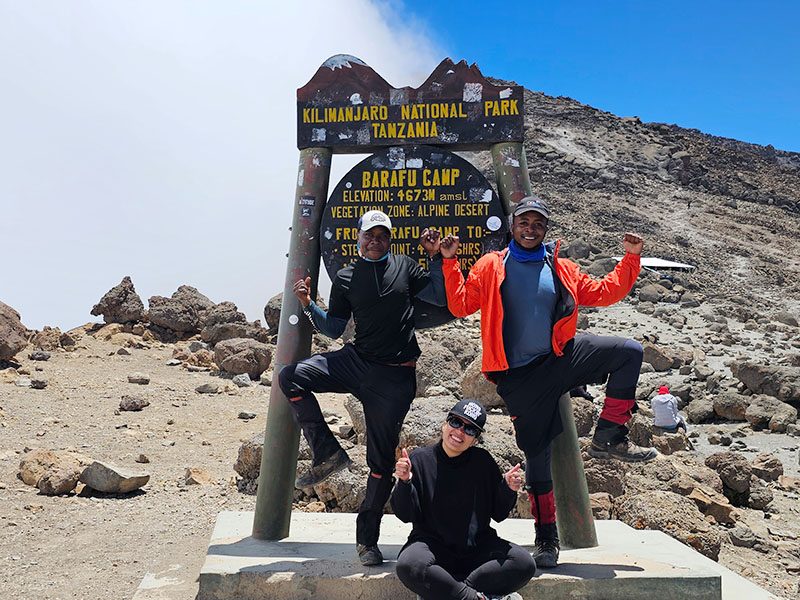
Smiling climbers posing at Barafu Camp (4,673m) on the Umbwe Route, striking fun poses before starting their summit ascent to Uhuru Peak | Kili Quests
A cheerful moment at Barafu Camp, the final staging point on the steep and scenic Lemosho Route before the summit climb begins.

Table of Contents

What Is the Lemosho Route on Kilimanjaro?

Where Does the Lemosho Route Start?

The route begins at Londorossi Gate, located on the western side of Kilimanjaro. The first day involves a drive followed by a short trek through dense rainforest, where wildlife sightings are sometimes possible.

How Long Is the Lemosho Route?

The route typically takes 7 to 8 days to complete, covering approximately 70 kilometers (43 miles). The 8-day version is strongly recommended because it allows better altitude adaptation and significantly increases summit success.

Lemosho Route Overview

Feature Details
Route Length        –       7 to 8 days
Distance                 –     ~70 km (43 miles)
Start Point             –   Londorossi Gate (Western Kilimanjaro)
Highest Point        –      Uhuru Peak (5,895 m / 19,341 ft)
Difficulty                – Moderate to challenging
Best For                  –  Scenic views,high success, fewer crowds
Success Rate        –   98% on the 8-day 

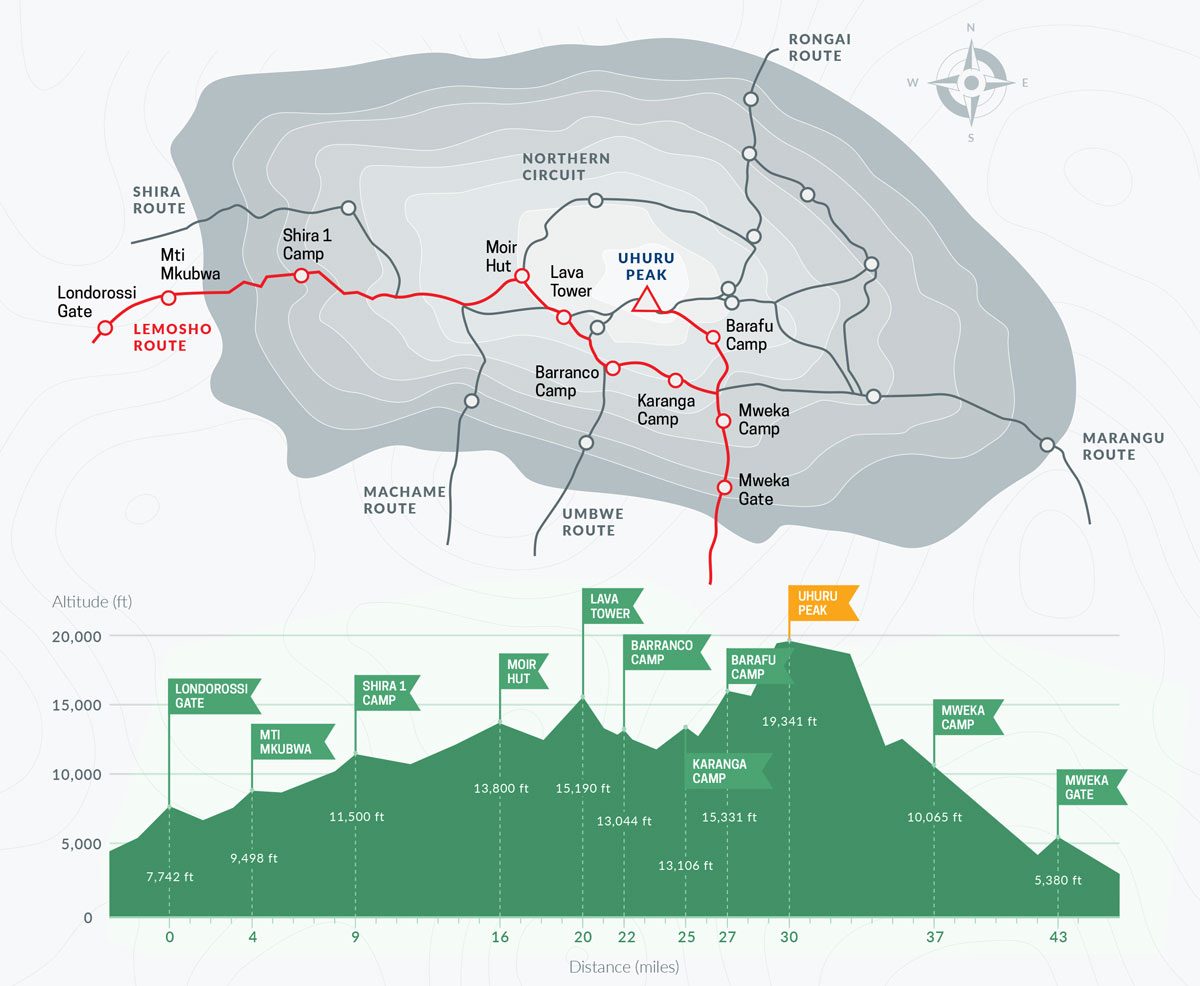
Lemosho Day Map and Elevation Profile

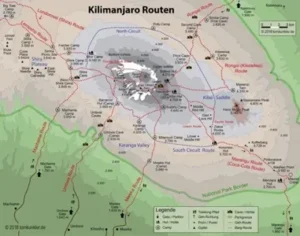
Lemosho Route map on Mount Kilimanjaro with full trail, elevation profile, and camp locations to Uhuru Peak
A scenic and well-acclimatized trail starting from Londorossi Gate and joining the Machame Route via Lava Tower.

Day-by-Day Itinerary (8-Day Version)

Day 1 – Londorossi Gate to Mti Mkubwa Camp

This first day is relatively short, allowing your body to begin adjusting gradually while trekking through lush rainforest.
  • Altitude: 2,100 m to 2,650 m
  • Hike Time: 3–4 hours
  • Forest zone with rich biodiversity

Day 2: Mti Mkubwa to Shira 1 Camp

Altitude: 2,650 m to 3,610 m
Hike Time: 5–6 hours
Enter the Shira Plateau with stunning open views

Day 3: Shira 1 to Shira 2 Camp

  • Altitude: 3,610 m to 3,850 m
  • Hike Time: 4–5 hours
  • Gentle trek with good acclimatization

Day 4: Shira 2 to Barranco Camp (via Lava Tower)

This is a key acclimatization day where you follow the “climb high, sleep low” principle, which is essential for reducing the risk of altitude sickness.
  • Altitude: 3,850 m to 4,640 m (up) → 3,960 m (down)
  • Hike Time: 6–7 hours
  • Acclimatization day with high-altitude exposure

Day 5: Barranco to Karanga Camp

  • Altitude: 3,960 m to 4,035 m
  • Hike Time: 4–5 hours
  • Climb the iconic Barranco Wall 257 meters (843 feet) tall

Day 6: Karanga to Barafu Camp

  • Altitude: 4,035 m to 4,673 m
  • Hike Time: 3–4 hours
  • Prepare for summit push

Day 7: Summit Day – Barafu to Uhuru Peak & down to Mweka Camp

Summit night is the most physically and mentally demanding part of the entire climb, as you trek in cold, thin air for several hours before reaching Uhuru Peak.
  • Altitude: 4,673 m to 5,895 m (summit), descend to 3,100 m
  • Hike Time: 12–14 hours total
  • Sunrise summit, then long descent

Read our article that explained ,How Hard Is Kilimanjaro?

Day 8: Mweka Camp to Mweka Gate

  • Altitude: 3,100 m to 1,640 m
  • Hike Time: 3–4 hours
  • Receive your summit certificate!

Lemosho Route Difficulty and Acclimatization

Is the Lemosho Route Difficult?

The Lemosho Route is considered moderately challenging, mainly due to its length and altitude rather than steep terrain. The longer itinerary spreads the physical effort over more days, making it more manageable than shorter routes.

Why Lemosho Has a High Success Rate

The extended itinerary allows your body more time to adapt to altitude, which is the biggest factor affecting summit success. Compared to shorter routes, climbers on Lemosho have significantly higher success rates.

Who Should Choose This Route?

  • First-time climbers
  • Trekkers with average fitness
  • Anyone prioritizing summit success over speed
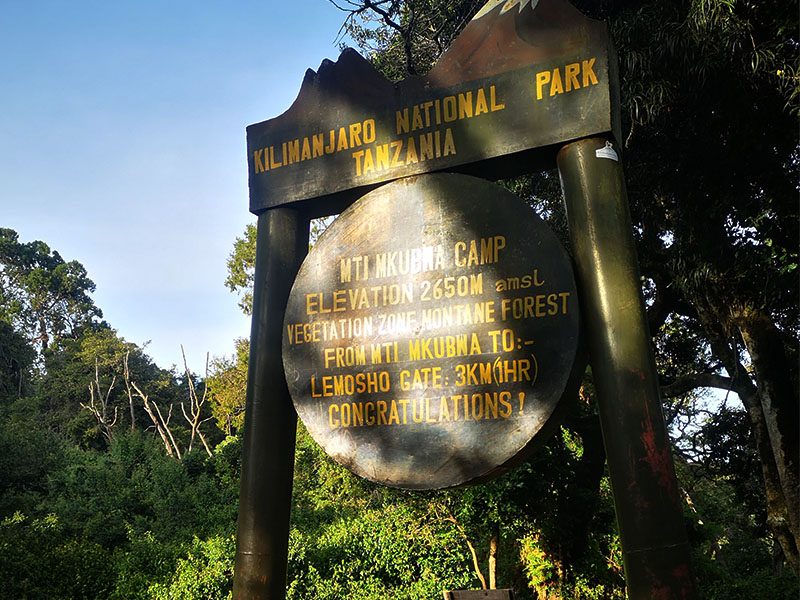
Mti Mkubwa Camp sign on Lemosho Route, Kilimanjaro National Park, showing elevation and distance to Lemosho Gate | Kili Quests
Mti Mkubwa Camp Sign (2,650m) – The first overnight stop on the Lemosho Route, located in the lush montane forest of Kilimanjaro.

Best Time to Climb the Lemosho Route

The best months are January to early March and June to October, when weather conditions are more stable and visibility is clear.
The best climbing windows are:
  • January to early March: Warm, with occasional clouds
  • June to October: Clear skies, cool and dry
Avoid April–May and November due to heavy and short rains

What Makes Lemosho Unique?

Starts on remote western side of the mountain

Crosses the dramatic Shira Plateau

Includes the acclimatization climb to Lava Tower

Barranco Wall is a thrilling highlight

Traverses all ecological zones, from rainforest to arctic summit

Acclimatization is the key to avoiding altitude sickness and successfully reaching the summit. Understanding how your body reacts at high altitude can make the difference between success and turning back early.

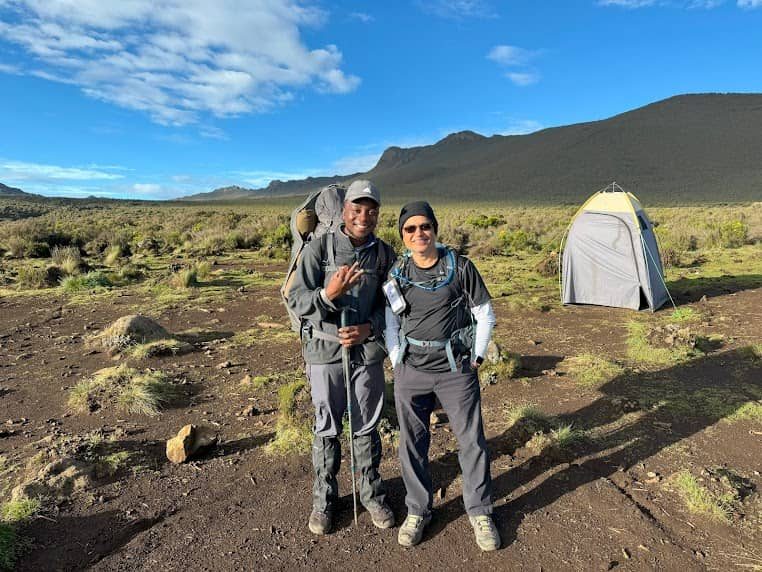
Two trekkers standing at Shira One Camp on the Lemosho Route, Kilimanjaro, with scenic moorland and tent in the background | Kili Quests
Shira One Camp (3,610m) – Trekkers enjoying a clear morning at Shira Plateau, the first high-altitude campsite on the Lemosho Route.

Is the Lemosho Route Right for You?

Choose Lemosho If You Want:

  • The best scenery on Kilimanjaro
  • A high summit success rate
  • A quieter start to your trek
  • More time to acclimatize

When Lemosho May Not Be Ideal

  • If you are short on time
  • If you are looking for the cheapest option
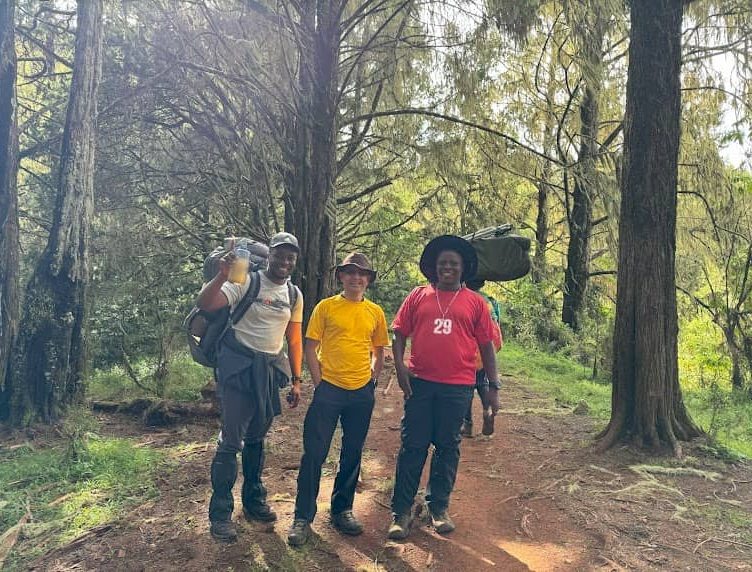
Trekkers and porters hiking through the forest into the moorland zone on the Lemosho Route, Mount Kilimanjaro | Kili Quests
Forest to Moorland Transition – Climbers and porters passing through the lush forest as they ascend toward the moorland zone on Day 2 of the Lemosho Route.

Frequently Asked Questions About the Lemosho Route

How difficult is the Lemosho Route on Mount Kilimanjaro?

The Lemosho Route is considered moderately challenging. While the trek covers a longer distance than some routes, the extended itinerary allows better acclimatization, making it suitable for climbers with average fitness levels.

How many days does the Lemosho Route take?

Most climbers complete the Lemosho Route in 7 or 8 days. The 8-day itinerary is recommended because it provides more time for acclimatization and increases the chances of reaching the summit.

What is the success rate of the Lemosho Route?

The Lemosho Route has one of the highest summit success rates on Mount Kilimanjaro, often exceeding 90%, especially on longer 8-day itineraries.

Where does the Lemosho Route start?

The route begins at Londorossi Gate on the western side of Mount Kilimanjaro. From there, trekkers hike through rainforest before reaching the Shira Plateau.

What makes the Lemosho Route special?

The Lemosho Route is known for its scenic landscapes, including rainforest trails, the Shira Plateau, Lava Tower, and the Barranco Wall. It also offers fewer crowds during the early days of the trek.

Is the Lemosho Route good for beginners?

Yes. Many first-time climbers choose the Lemosho Route because the longer itinerary helps with acclimatization, which increases the chances of reaching Uhuru Peak.

Climb Kilimanjaro via the Lemosho Route with Kili Quests

At Kili Quests, we focus on well-paced itineraries, experienced guides, and proper acclimatization to give you the best possible chance of reaching the summit safely.Our 8-day Lemosho climbs are designed to maximize success while allowing you to enjoy the journey across Kilimanjaro’s most scenic landscapes.
 
Contact us today to start planning your Lemosho adventure with our expert local team.

Related Articles

Machame Route Kilimanjaro: Most Popular Trek Guide

Reach the Summit with Confidence

Success on Kilimanjaro depends on the right route, acclimatization, and team.We plan every Machame climb for a safe summit.

Plan Your Machame Route the Right Way

The right route, acclimatization, and team make the difference.We plan your Machame climb for a safe summit

OUR CATEGORIES

Machame Route on Kilimanjaro: Most Popular Kilimanjaro Path

Why Choose the Machame Route?

The Machame Route is the most popular way to climb Mount Kilimanjaro, known for its scenic diversity, steeper trails, and strong summit success rate. Often called the “Whiskey Route,” it is more physically demanding than easier options like Marangu, but rewards climbers with some of the most varied landscapes on the mountain.
 
Unlike longer routes such as Lemosho, Machame follows a slightly faster ascent profile while still allowing for effective acclimatization. This makes it a great choice for trekkers who want a more active and challenging climb without sacrificing their chances of reaching Uhuru Peak.
 
Each route offers a different balance of difficulty, scenery, and acclimatization , see our Kilimanjaro Routes Comparison: Which Route Is Best? to understand how Machame compares to other options.
Trekkers and porters carefully ascending the Kissing Rock section on Barranco Wall along the Machame Route, Kilimanjaro | Kili Quests
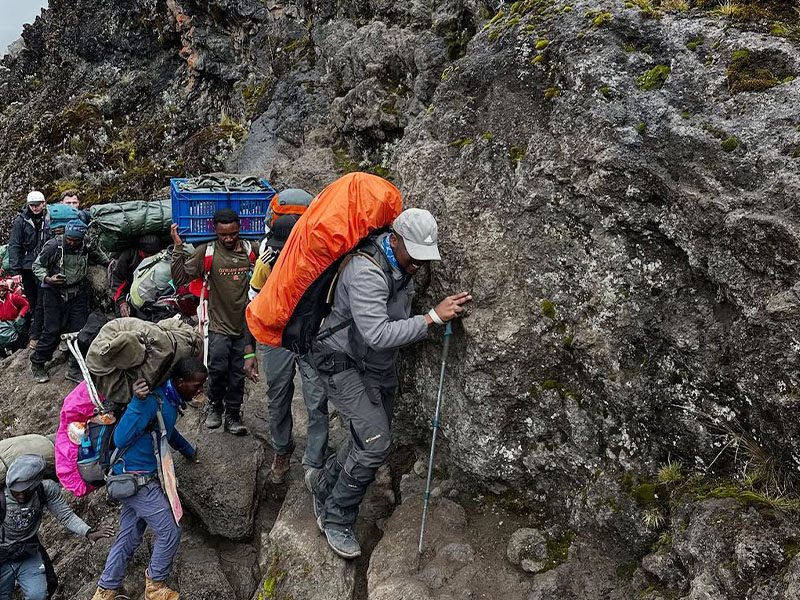
The Kissing Rock – Barranco Wall – Climbers squeeze through one of the most iconic and narrow points on the Machame Route: the "Kissing Rock" on Barranco Wall.

Table of Contents

What Is the Machame Route on Kilimanjaro?

  Where Does the Machame Route Start?

The Machame Route begins at Machame Gate on the southwestern side of Mount Kilimanjaro. The trail quickly enters dense rainforest before climbing into moorland and alpine desert zones.

How Long Is the Machame Route?

The route is typically completed in 6 or 7 days, covering approximately 62 kilometers (37 miles). The 7-day version is recommended because it provides better acclimatization and improves summit success.

Machame Route Overview

Feature Details
Route Length            –      6 or 7 days
Distance                    –    ~62 km (37 miles)
Start Point                –     Machame Gate (southwest side)
Highest Point          –      Uhuru Peak (5,895 m / 19,341 ft)
Difficulty                  –      Moderate to challenging
Best                           –      For  Hikers wanting adventure & scenery
Success Rate          –       ~95% on the 7-day Itinerary

Machame Route Days and Elevation Profile

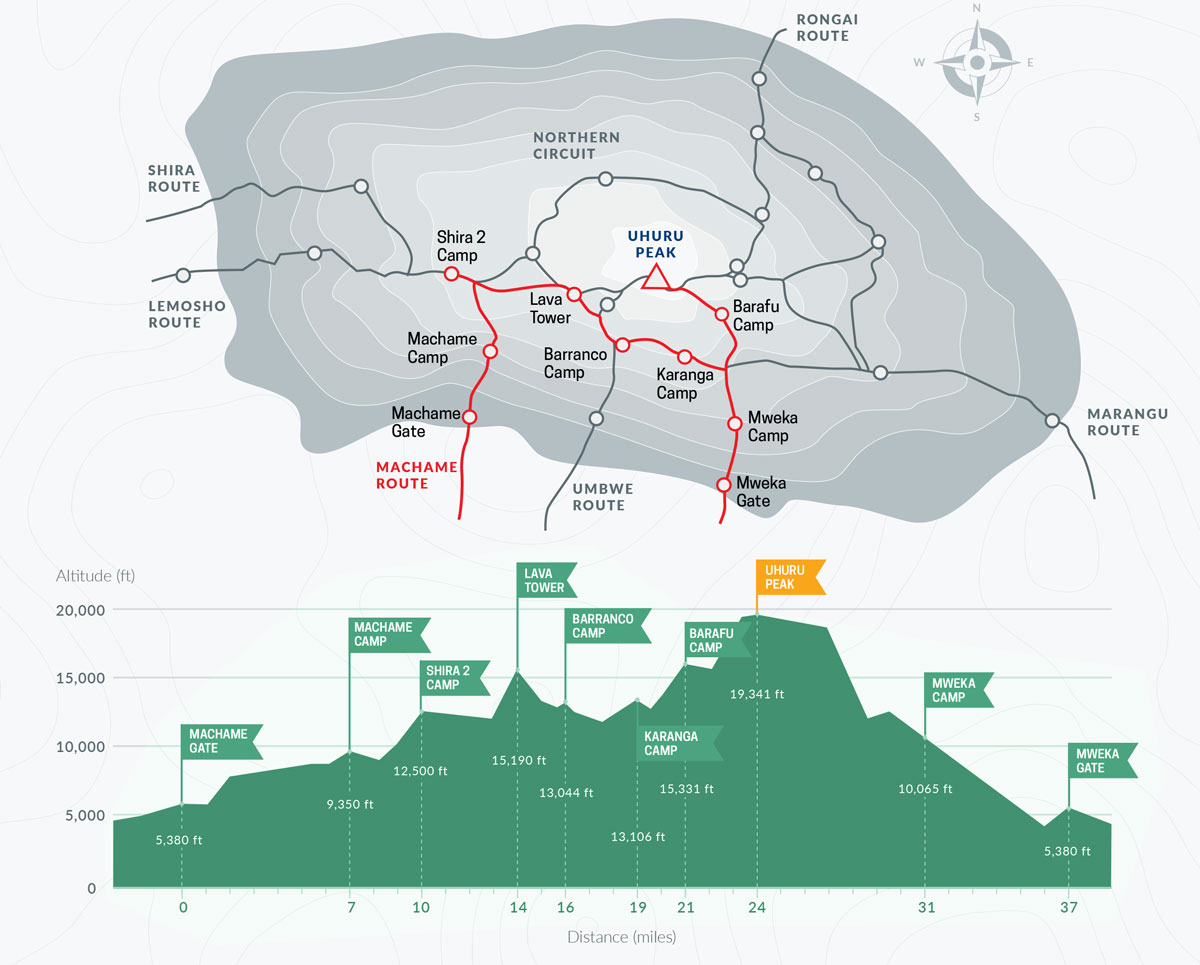
Machame Route map on Mount Kilimanjaro showing trail path, elevation profile, and major camps to Uhuru Peak
A scenic Kilimanjaro trail via Lava Tower and Barafu Camp, descending through Mweka Gate.

Machame Route Itinerary (7-Day Version)

Day 1 – Machame Gate to Machame Camp

This first day is a steady climb through rainforest, where humidity and muddy trails can make the hike feel more demanding than expected.
  • Altitude: 1,800 m to 2,835 m
  • Time: 5–6 hrs
  • Rainforest zone; trail can be muddy

Day 2: Machame Camp to Shira Cave Camp

  • Altitude: 2,835 m to 3,750 m
  • Time: 5 hrs
  • Enter moorland zone with stunning views

Day 3: Shira Camp to Barranco Camp (via Lava Tower)

This is a key acclimatization day following the “climb high, sleep low” principle, which helps your body adjust to altitude.
 
  • Altitude gain: up to 4,630 m, then sleep at 3,960 m
  • Time: 6–7 hrs
  • Acclimatization day with dramatic scenery

Day 4: Barranco to Karanga Camp

  • Altitude: 3,960 m to 4,035 m
  • Time: 4–5 hrs
  • Scramble the famous Barranco Wall

Day 5: Karanga to Barafu Camp

  • Altitude: 4,035 m to 4,673 m
  • Time: 3–4 hrs
  • Alpine desert zone, prepare for summit

Day 6: Summit Day – Barafu to Uhuru Peak & Mweka Camp

Summit night is the most challenging part of the climb, combining altitude, cold, and long trekking hours in low oxygen conditions.

  • Altitude: 4,673 m to 5,895 m, then descend to 3,100 m
  • Time: 12–14 hrs
  • Summit at sunrise, long descent
 Read Our Article about,How Hard Is Kilimanjaro?

Day 7: Mweka Camp to Mweka Gate

  • Altitude: 3,100 m to 1,640 m
  • Time: 3 hrs
  • Finish your trek with certificate ceremony

Machame Route Difficulty, Acclimatization & Fitness

Is the Machame Route Difficult?

The Machame Route is considered moderately challenging due to its steeper sections and faster elevation gain compared to longer routes like Lemosho.

How Acclimatization Works on Machame

Although shorter than Lemosho, Machame still includes important acclimatization days, especially around Lava Tower, helping improve summit success.
 
Read our article about, Kilimanjaro Success Rate

Who Should Choose This Route?

  • Trekkers in good physical condition
  • Climbers who prefer a more active pace
  • Those looking for a balance of challenge and scenery
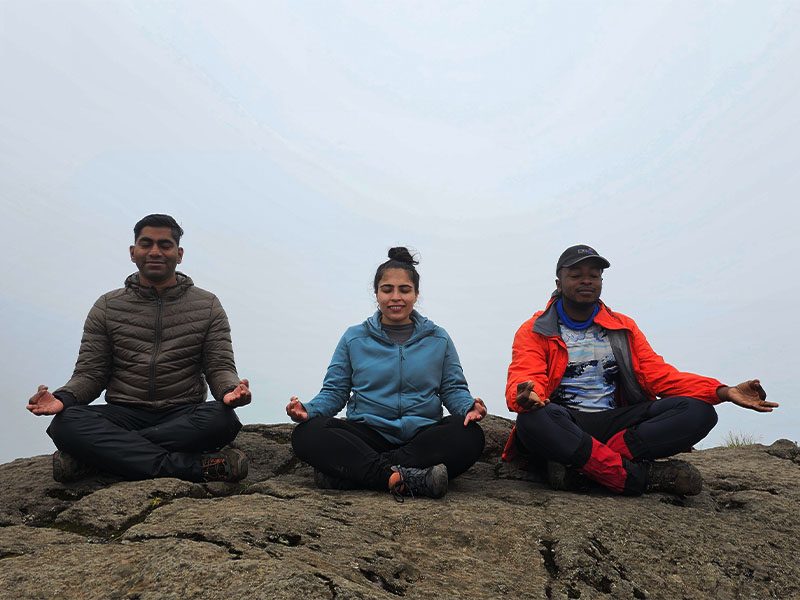
Trekkers meditating on a rock during a peaceful break on the Machame Route, Mount Kilimanjaro | Kili Quests
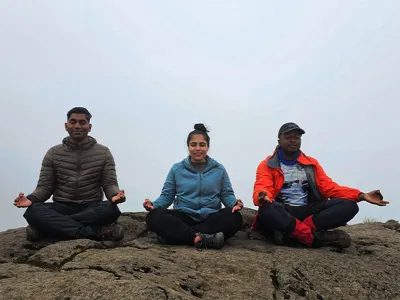
Mindful Moment on the Machame Trail – Climbers pause for a short meditation break on the way to Shira Camp, embracing Kilimanjaro’s calm Moorland environment.

Best Time to Climb the Machame Route

Dry Seasons (Best Conditions)

The best time to climb is during January–March and June–October, when trails are drier and visibility is clearer.

  •  January–March: Clear skies, mild weather
  • June–October: Dry season, most popular
  • Avoid April–May and November due to rain
Read our article about, Best Time to Climb Kilimanjaro

What Makes Machame Special?

 Iconic Barranco Wall challenge

Excellent views of Kibo and Mount Meru

Shared trail with Lemosho Route  from Shira  Route onwards

Wide ecological diversity — rainforest to arctic zone

Is the Machame Route Right for You?

Choose Machame If You Want:

  • A more active and challenging climb
  • Excellent scenery in fewer days
  • A popular route with strong success rates
 

When Machame May Not Be Ideal

  • If you prefer a slower pace
  • If you want maximum acclimatization (Lemosho better)
Trekkers posing with hiking poles at the Shira Cave Camp sign on Day 2 of the Machame Route, Kilimanjaro | Kili Quests
Shira Cave Camp (3,750m) – Climbers celebrate their arrival at this scenic moorland campsite on Day 2 of the Machame Route, Kilimanjaro.

Frequently Asked Questions About the Machame Route

How difficult is the Machame Route on Mount Kilimanjaro?

The Machame Route is considered moderately challenging. It includes steep sections such as the Barranco Wall and long trekking days, but it does not require technical climbing skills. With proper acclimatization and preparation, many trekkers successfully reach the summit.

Why is the Machame Route called the “Whiskey Route”?

The Machame Route is nicknamed the “Whiskey Route” because it is more physically demanding than the Marangu Route, which is known as the “Coca-Cola Route.”

How many days does it take to climb the Machame Route?

Most climbers complete the Machame Route in 6 or 7 days. The 7-day itinerary is recommended because it provides better acclimatization and increases summit success rates.

What is the success rate of the Machame Route?

The Machame Route has a high summit success rate, often around 90–95% on the 7-day itinerary due to its gradual acclimatization profile.

What makes the Machame Route popular?

The Machame Route is popular because it offers diverse scenery, including rainforest, moorland, alpine desert, and the summit glaciers of Mount Kilimanjaro. It also provides good acclimatization compared to shorter routes.

Which routes connect with the Machame Route?

Several routes join the Machame Route, including the Lemosho Route and Shira Route near the Shira Plateau before continuing toward the summit

Climb Kilimanjaro via Machame with Kili Quests

At Kili Quests, we guide climbers on the Machame Route with a strong focus on pacing, acclimatization, and safety. This route offers the perfect balance between challenge and success when approached correctly.Our 7-day Machame climbs are designed to give you the best chance of reaching Uhuru Peak while enjoying one of Kilimanjaro’s most scenic trails.

 
Kilimanjaro Packing List (Essential Gear Guide)
Contact us to plan your 7-day Machame Route trek.

Related Articles

Rongai Route Kilimanjaro: Quiet Northern Trail Guide

Plan Your Rongai Route Climb

The Rongai Route offers a quiet, steady path to the summit.
Get expert advice and a personalized quote for your climb.

Kilimanjaro Planning Guides

Choosing the right route is just the start. Explore these key guides:

OUR CATEGORIES

Rongai Route on Kilimanjaro: Quiet Kilimanjaro Trail from North

Why Choose the Rongai Route?

The Rongai Route is the only trail that approaches Mount Kilimanjaro from the north, near the Kenyan border. It’s known for being the quietest and driest route, making it a favorite for climbers seeking solitude and more stable trail conditions.Although less scenic than some western routes, Rongai offers a steady ascent profile, uninterrupted wilderness, and spectacular views of Mawenzi Peak. It’s also one of the best options during the rainy season.
 
Each route has its pros and cons , see our Kilimanjaro routes comparison guide to find the best option for your climb, or explore the Lemosho Route Kilimanjaro guide and Machame Route Kilimanjaro guide to compare scenery, difficulty, and success rates.
View of Mawenzi Peak from Stella Point on Mount Kilimanjaro, with snow-covered terrain and clouds below — typical scenery on the Rongai Route | Kili Quests
The Rongai Route’s final summit approach offers this dramatic view of Mawenzi Peak from Stella Point. A snowy, unforgettable moment near the crater rim.

Table of Contents

Why the Rongai Route Is Unique on Kilimanjaro

The Rongai Route is the only Kilimanjaro trail that approaches the mountain from the northern side, near the Kenya border. Unlike southern routes, it receives less rainfall, making it one of the driest options on Kilimanjaro.This unique approach offers a quieter trekking experience, fewer crowds, and uninterrupted views of the mountain’s wilderness  especially the dramatic Mawenzi Peak.

Rongai Route Overview

 Feature Details
Route Length                    –            6 or 7 days
Distance                              –          ~73 km (45 miles)
Start Point                           –           Rongai Gate (northeast Kilimanjaro)
Highest Point                      –           Uhuru Peak (5,895 m / 19,341 ft)
Difficulty                               –           Moderate
Best For                                 –           Quiet treks, dry seasons, steady ascent
Success Rate                         –           ~85% (7-day itinerary)
 
Not sure if Rongai is the right route for you? Compare all options in our Kilimanjaro routes comparison guide to choose the best path to the summit.

Rongai Route Days and Elevation Profile

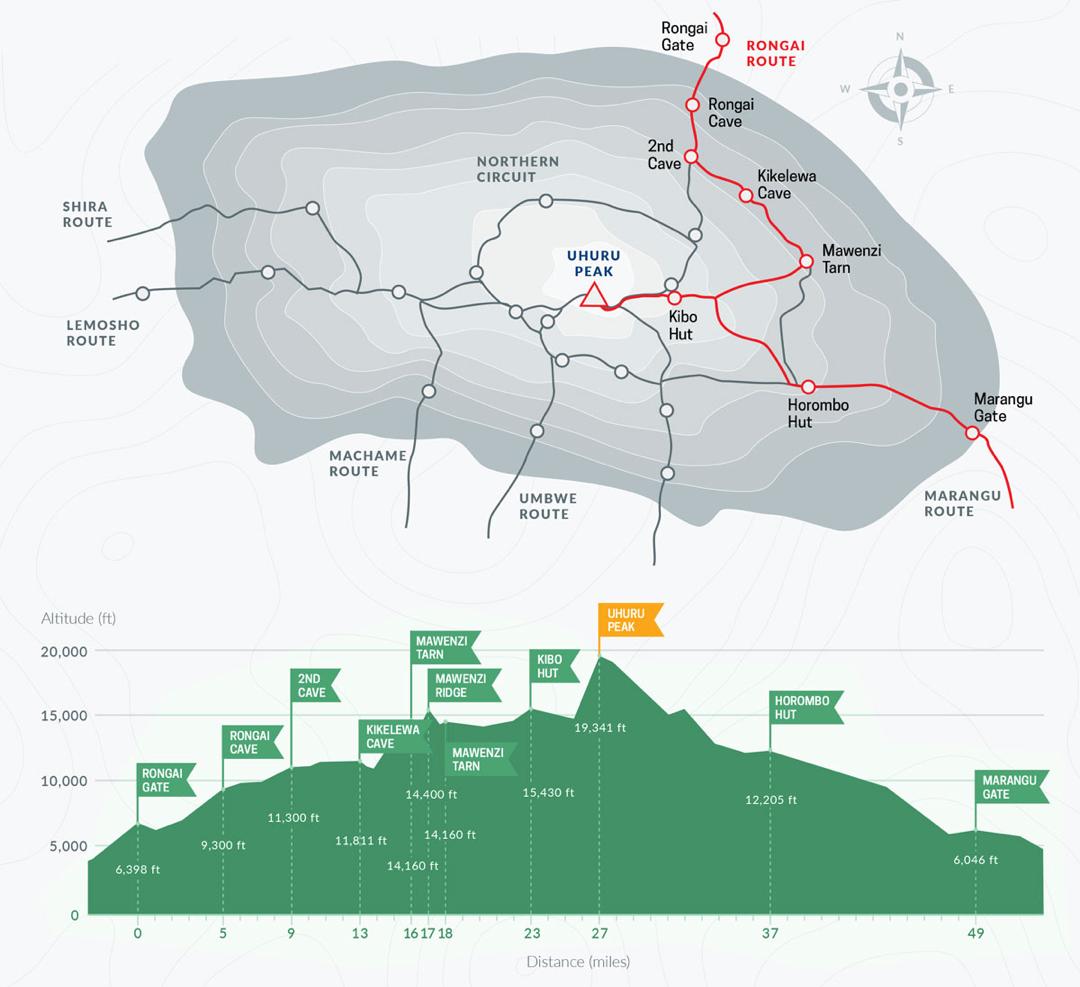
Rongai Route map on Mount Kilimanjaro showing ascent path, camps, and elevation profile to Uhuru Peak
A remote trail from the north side of Kilimanjaro, passing Mawenzi Tarn and Kibo Hut before summiting.

7-Day Rongai Route Itinerary

Day 1: Rongai Gate to Simba Camp

  • Altitude: 2,000 m to 2,625 m
  • Time: 4–5 hours
  • Gentle hike through forest zone
Your adventure begins on the quiet northern side of Kilimanjaro at Rongai Gate, near the Kenya border. After registration, you’ll start a gentle hike through farmland and pine forest.
This section is relatively easy and allows your body to begin adjusting gradually. Wildlife sightings such as colobus monkeys are sometimes possible.You’ll arrive at Simba Camp in the afternoon, where you’ll enjoy your first night on the mountain.

Day 2: Simba Camp to Second Cave Camp

  • Altitude: 2,625 m to 3,450 m
  • Time: 5–6 hours
  • Beautiful views of Kibo and wilderness trail
The trail leaves the forest behind and enters the moorland zone, offering wide open views of Kibo Peak. The path remains steady and not too steep, making it a comfortable trekking day.As you gain altitude, you’ll begin to feel the effects of thinner air, so it’s important to maintain a slow, steady pace.Second Cave Camp provides a scenic and less crowded overnight stop.

Day 3: Second Cave to Kikelewa Camp

  • Altitude: 3,450 m to 3,600 m
  • Time: 4 hours
  • Scenic moorland terrain with fewer climbers
This is a shorter trekking day designed to support acclimatization. The trail becomes quieter and more remote, with fewer climbers compared to southern routes.You’ll hike across rolling moorland terrain with beautiful views of Mawenzi Peak, one of Kilimanjaro’s three volcanic cones.Kikelewa Camp is set in a sheltered valley, offering a peaceful atmosphere for rest and recovery.

Day 4: Kikelewa to Mawenzi Tarn Camp

  • Altitude: 3,600 m to 4,330 m
  • Time: 4–5 hours
  • Camp beneath rugged Mawenzi Peak
Today’s trek is steeper but rewarding, as you climb toward Mawenzi Tarn, one of the most scenic camps on Kilimanjaro.The camp sits beneath the dramatic spires of Mawenzi Peak, providing incredible views and a true high-altitude environment.This is an important acclimatization day, allowing your body to adjust before moving higher.

Day 5: Mawenzi Tarn to Kibo Hut

  • Altitude: 4,330 m to 4,700 m
  • Time: 4–5 hours
  • Final staging point before summit night
The landscape changes dramatically as you enter the alpine desert zone. Vegetation disappears, and the terrain becomes dry and rugged.The hike is steady but feels more demanding due to the altitude. You’ll arrive at Kibo Hut, the final base camp before your summit attempt.After an early dinner, you’ll rest for a few hours before beginning the summit push around midnight.

Day 6: Kibo Hut to Uhuru Peak, descend to Horombo Hut

  • Altitude: 4,700 m to 5,895 m (summit), then down to 3,720 m
  • Time: 12–14 hours
  • Overnight climb, summit at sunrise, long descent
This is the most challenging and rewarding day of the climb. You’ll start your summit attempt in the early hours of the morning, trekking slowly in the dark toward Gillman’s Point and Stella Point.From there, it’s a final push to Uhuru Peak — the highest point in Africa. Reaching the summit at sunrise is an unforgettable experience.After celebrating, you’ll descend back to Kibo Hut briefly, then continue down to Horombo Hut for rest.

Day 7: Horombo Hut to Marangu Gate

  • Altitude: 3,720 m to 1,870 m
  • Time: 5–6 hours
  • Final descent through forest and receive certificate
Your final day is a long but steady descent through moorland and forest zones. As you reach lower altitudes, the air becomes richer in oxygen, making the hike feel easier.At Marangu Gate, you’ll receive your summit certificate and celebrate the successful completion of your Kilimanjaro climb.
 
Choosing a longer itinerary like this significantly improves your chances of reaching the summit. Learn more about Kilimanjaro success rates and why Kilimanjaro climb duration plays a key role in summit success.

Difficulty and Acclimatization

The Rongai Route is considered moderately difficult, but it is one of the more manageable Kilimanjaro routes thanks to its gradual ascent profile.Unlike steeper routes like Machame, Rongai allows your body more time to adjust to altitude, making it a good option for first-time climbers. The 7-day itinerary significantly improves acclimatization and increases your chances of reaching the summit.
 
If you’re unsure about the overall

Best Time to Climb the Rongai Route

One of Rongai’s biggest strengths is that it stays drier than southern routes. This makes it ideal during:
  • January to early March
  • June to October
  • April–May or November (when other routes are wetter)
Choosing the right season can make a big difference in your experience , see our full guide on best time to climb Kilimanjaro.
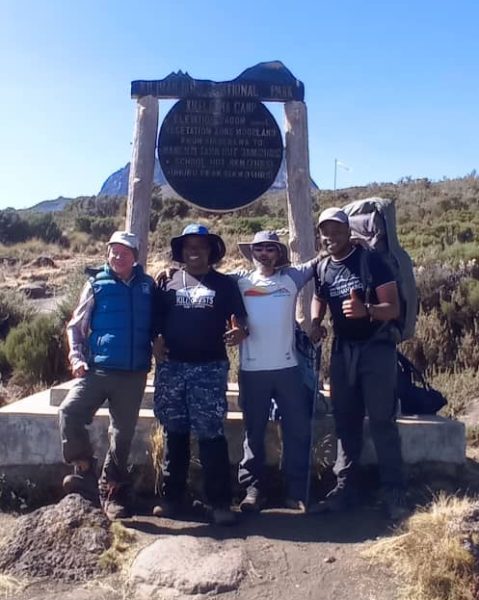
Group of Kilimanjaro trekkers posing at the Kikelelwa Camp sign on the Rongai Route, with Moorland vegetation and Mawenzi Peak in the distance | Kili Quests
Kikelelwa Camp (3,600m) is a scenic overnight stop on Kilimanjaro’s Rongai Route, offering hikers a closer view of Mawenzi and a peaceful high-moorland setting.

What Makes Rongai Unique?

  • Only northern approach to Kilimanjaro
  • Less crowded than any other route
  • Amazing views of Mawenzi Peak
  • You descend via Marangu Route — giving you two route experiences in one
  • Good wildlife sightings near Simba Camp
Lower traffic means quieter camps and a more wilderness-focused experience

Is the Rongai Route Right for You?

  • Want a peaceful, uncrowded trail
  • Are trekking during the rainy season
  • Prefer a gradual ascent
  • Enjoy remote nature and simplicity
Proper acclimatization is the key to avoiding altitude sickness , learn how to acclimatize properly on Kilimanjaro before your climb.
 

Rongai Route Pros and Cons

Pros

  • One of the quietest routes on Kilimanjaro
  • Drier conditions, ideal during rainy seasons
  • Gradual ascent profile for better comfort
  • Unique northern approach
 

Cons

  • Less scenic compared to Lemosho and Machame
  • Slightly lower success rate than longer routes
  • Fewer acclimatization features
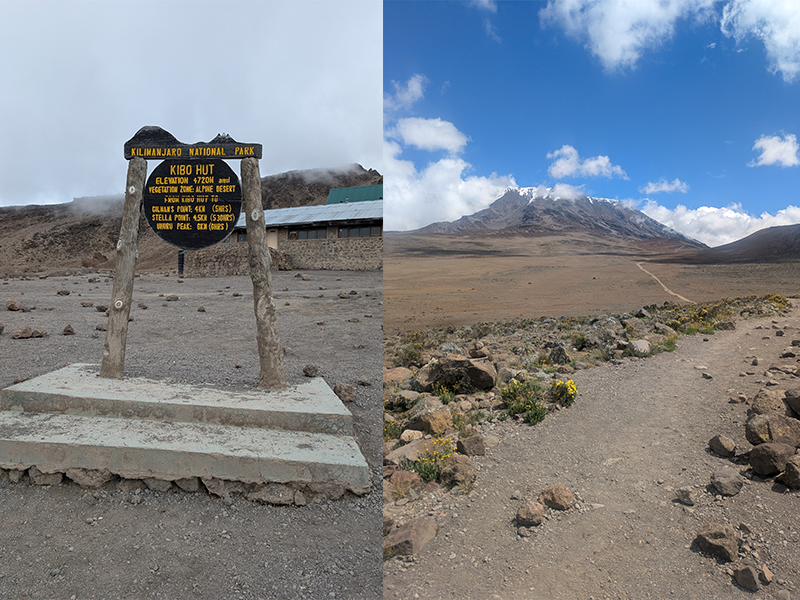
Kilimanjaro trekker walking across the dry alpine desert zone with summit in view
Kibo Hut is the final overnight stop on the Rongai Route before summit day. The surrounding alpine desert offers stark beauty and wide-open views toward Mawenzi.

Frequently Asked Questions About the Rongai Route

Where does the Rongai Route start on Kilimanjaro?

The Rongai Route begins at Rongai Gate on the northern side of Mount Kilimanjaro, close to the Kenya–Tanzania border. It is the only Kilimanjaro route that approaches the mountain from the north.

Is the Rongai Route difficult?

The Rongai Route is considered moderately difficult. Its gradual slope and steady elevation gain make it one of the more comfortable routes for acclimatization, especially on the 7-day itinerary.

Why choose the Rongai Route?

Many climbers choose the Rongai Route because it is quieter and less crowded than most other routes on Mount Kilimanjaro. It is also one of the driest routes, making it a good option during the rainy season.
 

Does the Rongai Route have good views?

Yes. While the scenery is different from the western routes, the Rongai Route offers spectacular views of Mawenzi Peak, alpine desert landscapes, and wide open wilderness.

How many days does it take to climb the Rongai Route?

The Rongai Route usually takes 6 or 7 days. The 7-day itinerary is recommended because it improves acclimatization and increases summit success.

Which route do climbers descend after Rongai?

After reaching Uhuru Peak, climbers who ascend via the Rongai Route usually descend via the Marangu Route, passing through Horombo Hut before exiting at Marangu Gate.

Climb Kilimanjaro via Rongai with Kili Quests

The Rongai Route is perfect for climbers looking for a quiet, less crowded path to the summit with a steady and manageable ascent.At Kili Quests, we design 7-day itineraries to maximize acclimatization and improve your chances of reaching Uhuru Peak, all supported by experienced local guides.
 
Contact us now to plan your Rongai Route climb with Kili Quests.

Related Articles