
Questions before you book? WhatsApp us: +255 (762) 187 967
This guide is for travellers deciding whether the Machame Route suits them and whether to climb it in 6 or 7 days. It follows the 7-day itinerary day by day, explains what one extra night at Karanga Camp changes, shows how the sleeping altitude rises, and gives our price. If you are still comparing routes, start with our Kilimanjaro routes comparison.
Experience behind this guide: Allen Minja, co-founder of Kili Quests, has more than 30 years of mountain experience. He has seen a great deal on the mountain, and he has watched how mountain tourism and the climbers who come to it have changed since his early years. He uses that experience to help our clients choose a route and plan their climb, whether they expect the mountain as it was in his era or as it is today.
Is the Machame Route worth it? Yes, if you are comfortable camping and want a scenic, active route. We recommend the 7-day itinerary. The 6-day goes from Barranco Camp straight to Barafu Camp, while the 7-day adds a night at Karanga Camp, so you have a full afternoon to rest before summit night. Machame is not the easiest route: your sleeping altitude rises by more than the CDC’s guide of about 500 m per night on two nights, so altitude still deserves respect. Kili Quests’ indicative Machame price (November 2026) is US$2,200 per person for 6 days and US$2,400 per person for 7 days. See what is included.
What Is the Machame Route?
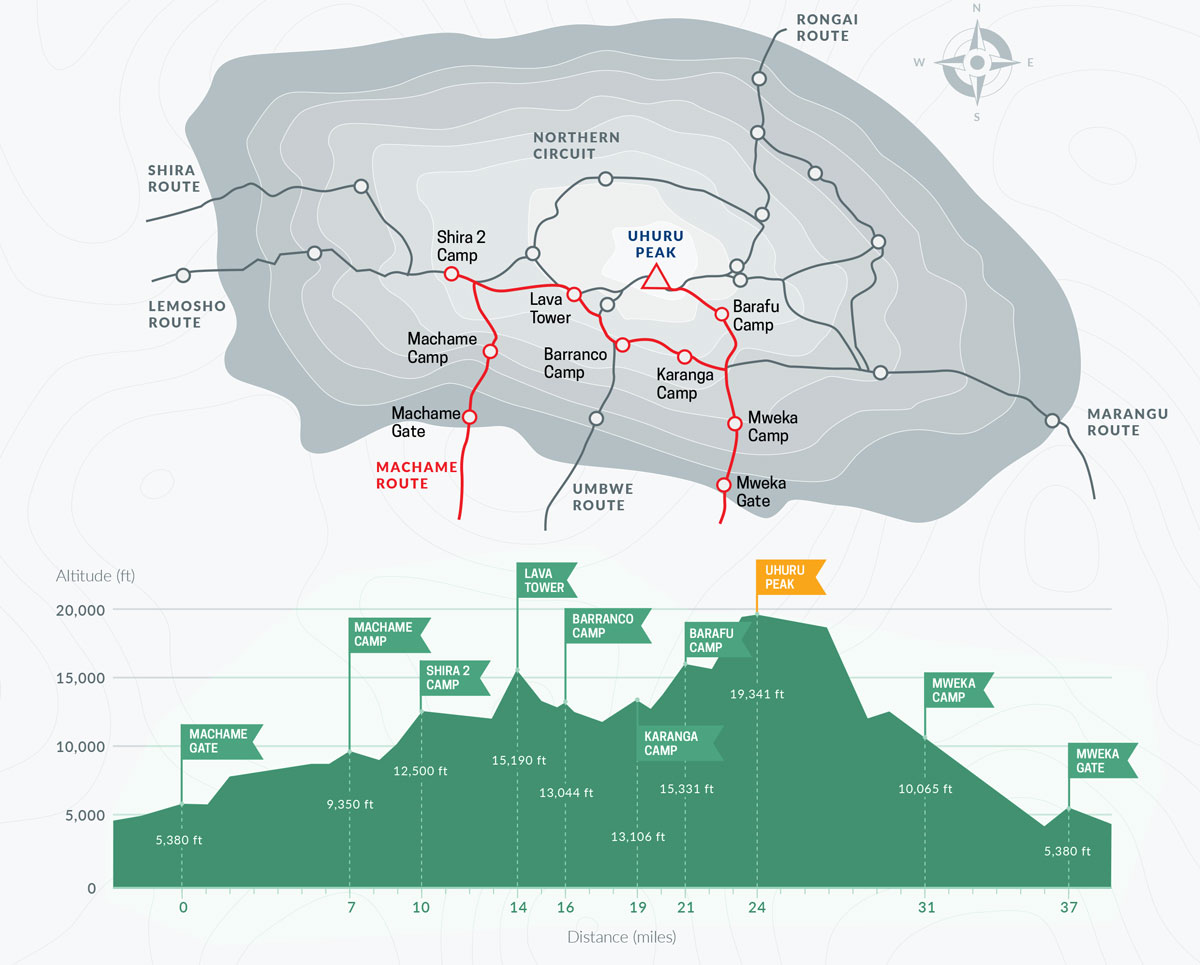
The Machame Route is a camping route on the southwestern side of Mount Kilimanjaro, and one of the most popular. It starts at Machame Gate (about 1,800 m), climbs through rainforest to Machame Camp and crosses the moorland to Shira Cave Camp. It then passes Lava Tower and the Barranco Wall, continues along the southern circuit through Karanga, and summits from Barafu Camp. You descend by the Mweka route to Mweka Gate.
Machame is often called the “Whiskey Route”, a nickname that sets it against Marangu’s “Coca-Cola Route”. It is steeper and more demanding than Marangu, and you sleep in tents. That does not mean it is only for experts, but it does mean you should choose the 7-day version, train properly and respect the altitude.
Machame Route at a glance
| Feature | Details |
|---|---|
| Length | 6 or 7 days. We recommend 7 days. |
| Distance | About 62 km (37 miles), gate to gate. Published figures vary by source. |
| Start | Machame Gate, about 1,800 m, southwest side |
| Finish | Mweka Gate, 1,640 m |
| Highest point | Uhuru Peak, 5,895 m (19,341 ft) |
| Accommodation | Tents at camps. There are no huts on this route. |
| Difficulty | Moderate to challenging. It is not a technical climb, but the days are long and summit night is cold and slow. |
| Kili Quests price | US$2,200 per person for 6 days; US$2,400 per person for 7 days (indicative, November 2026) |
Who Should Choose the Machame Route?
I often recommend Machame to climbers who are comfortable hiking uphill on consecutive days and who have previous altitude experience. Day one, from Machame Gate to Machame Camp, is about 11 km. Day two, towards Shira Cave Camp, can feel like climbing a long flight of stairs. For fit hikers with little altitude experience, I often suggest Lemosho instead.
| Your situation | Our advice |
|---|---|
| You are comfortable camping and hiking uphill on back-to-back days | Machame on 7 days is a good fit. |
| You have climbed at altitude before and want a scenic, active route | Machame is a strong choice. Lava Tower and the Barranco Wall are the highlights. |
| You are a beginner with little mountain experience | We often suggest Lemosho (7 or 8 days) or the 7-day Rongai first. If you choose Machame, take 7 days. |
| You strongly prefer huts to tents | Marangu is the only main route with huts. Read Machame vs Marangu. |
| You are uncomfortable with steeper sections or want the easiest route | Machame has steep trail and a scramble on the Barranco Wall. Ask us which route suits you. |
7-Day Machame Route Itinerary
The 7-day itinerary is the version we recommend for most climbers. Sleeping elevations and hiking times below are approximate. Actual times vary with your pace, the weather, trail conditions and how long you rest.
| Day | Route | Sleeping altitude | Hiking time |
|---|---|---|---|
| 1 | Machame Gate to Machame Camp | 2,835 m | 5–6 hours |
| 2 | Machame Camp to Shira Cave Camp | 3,750 m | 5–6 hours |
| 3 | Shira Cave Camp to Lava Tower (lunch), then down to Barranco Camp | 3,900 m | 6–7 hours |
| 4 | Barranco Camp over the Barranco Wall to Karanga Camp | 3,995 m | 4–5 hours |
| 5 | Karanga Camp to Barafu Camp | About 4,670 m | 3–4 hours |
| 6 | Barafu Camp to Uhuru Peak, then down to Mweka Camp or Millennium Camp | Mweka Camp about 3,100 m, or Millennium Camp 3,820 m | 12–14 hours to Millennium Camp, or 15–18 hours to Mweka Camp, including rest |
| 7 | Mweka Camp to Mweka Gate | Finish at the gate (1,640 m) | 3–4 hours |
Day 1: Machame Gate to Machame Camp
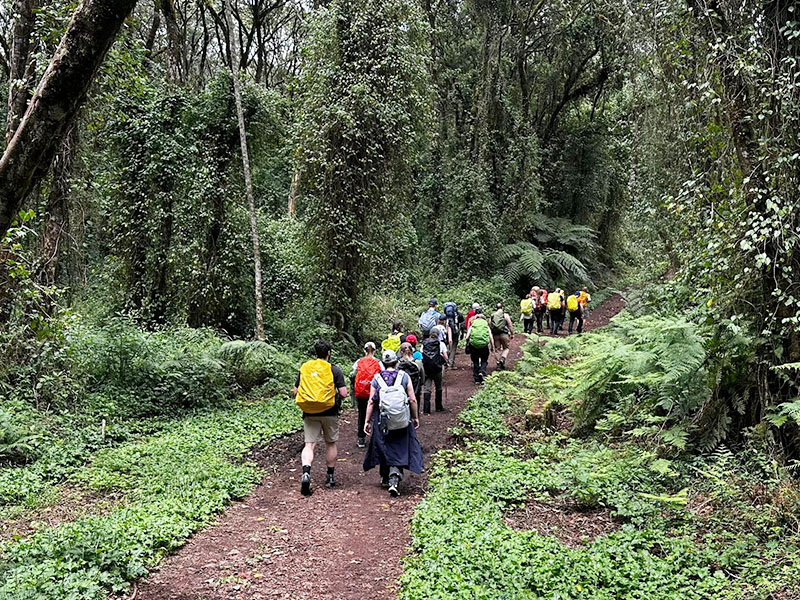
Your team completes park registration at Machame Gate, then you walk into the rainforest. The trail climbs steadily through thick forest, and it can be muddy or slippery after rain. The day is not technical, but the steady uphill walking is demanding.
- Altitude: about 1,800 m to 2,835 m
- Distance: about 11 km
- Hiking time: 5–6 hours
- Zone: rainforest
Day 2: Machame Camp to Shira Cave Camp
You leave the rainforest and enter the moorland. The trail opens up, with better views of Kilimanjaro. Your sleeping altitude rises by about 915 m, so walk slowly and drink regularly. Day two can feel like climbing a long flight of stairs.
- Altitude: 2,835 m to 3,750 m
- Hiking time: 5–6 hours
- Zone: moorland
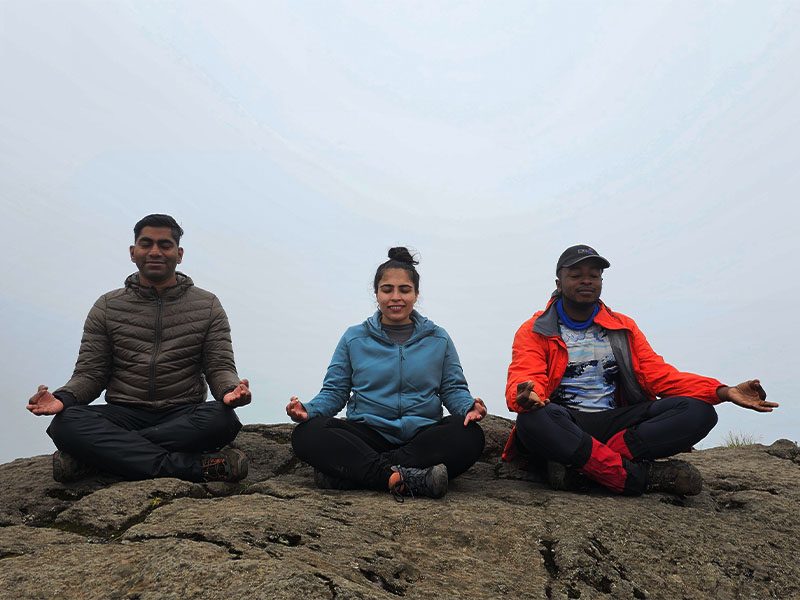

Day 3: Shira Cave Camp to Barranco Camp via Lava Tower
This is the main acclimatization day on Machame. You climb towards Lava Tower at about 4,600 m, where we have lunch (we do not sleep there), and then descend about 700 m to sleep lower at Barranco Camp. Climbing high and sleeping low gives your body time at altitude without raising your sleeping altitude much, because you sleep at 3,900 m, about 150 m above the previous night.
- Altitude: 3,750 m up to about 4,600 m, then down to 3,900 m
- Hiking time: 6–7 hours
- Zone: alpine desert
- Camp: Barranco Camp
Some climbers begin to notice altitude symptoms on this day. Read our guide to altitude sickness symptoms and causes so you know which symptoms are common and which warning signs must not be ignored.
Day 4: Barranco Camp to Karanga Camp
The day starts with the Barranco Wall, one of the best-known sections of the Machame Route. It looks intimidating from camp, but most climbers manage it safely with slow movement and guide support. After the wall, the trail continues over ridges and valleys to Karanga Camp, where the 7-day itinerary sleeps.
- Altitude: 3,900 m to 3,995 m
- Hiking time: 4–5 hours
- Highlight: Barranco Wall
- Camp: Karanga Camp
Day 5: Karanga Camp to Barafu Camp
This is a shorter day. You walk about 3 to 4 hours to Barafu Camp, the base camp for summit night, and have lunch and time to rest. We wake you at 11:00 pm for summit night.
- Altitude: 3,995 m to about 4,670 m
- Hiking time: 3–4 hours
- Zone: alpine desert
- Camp: Barafu Camp
Day 6: Barafu Camp to Uhuru Peak, then down to Mweka Camp or Millennium Camp
Summit day is the hardest day on the Machame Route. We wake you at 11:00 pm, serve tea, coffee and biscuits at 11:30 pm and leave at midnight. It takes about 5 hours to reach Stella Point, then about 6 hours to Uhuru Peak at a normal pace, or about 7 hours if you are slower. Coming back down to Barafu takes 3 to 4 hours. You then rest at Barafu for 1 to 2 hours. After the rest, it is about 2 hours (about 4 km) to Millennium Camp or about 5 hours (about 12 km) to Mweka Camp.
Counting the rest at Barafu, the day from the midnight start takes about 12 to 14 hours if you sleep at Millennium Camp, and 15 to 18 hours if you continue to Mweka Camp. The decision to continue on summit night depends on how you are doing and how the previous days went. After the summit, we sleep either at Millennium Camp (3,820 m), which lies on the descent route above Mweka Camp, or at Mweka Camp. The plan depends on your group, and your guide confirms it with you.
- Altitude: about 4,670 m to 5,895 m, then down to 3,820 m (Millennium Camp) or about 3,100 m (Mweka Camp)
- Total time from the midnight start, including the 1 to 2 hour rest at Barafu: 12–14 hours to Millennium Camp, or 15–18 hours to Mweka Camp
- Summit: Uhuru Peak
- Camp: Millennium Camp or Mweka Camp, depending on the plan for your group
If you are worried about the challenge, read how hard Kilimanjaro is, and see our summit night guide.
Day 7: Mweka Camp to Mweka Gate
The last day descends through the rainforest to Mweka Gate. If you slept at Millennium Camp instead of Mweka Camp, you start this day from Millennium and walk the longer distance to the gate. After you sign out, climbers who reached the summit receive their Kilimanjaro summit certificate before the transfer back to Moshi or Arusha.
- Altitude: about 3,100 m to 1,640 m
- Hiking time: 3–4 hours
- Zone: rainforest
- Finish: Mweka Gate
6-Day or 7-Day Machame: What One Night at Karanga Changes
The difference between our 6-day and 7-day Machame itineraries is one night at Karanga Camp. On the 7-day itinerary we sleep at Karanga after crossing the Barranco Wall. The next morning we walk about 3 to 4 hours to Barafu Camp, have lunch and have time to rest. We wake you at 11:00 pm for summit night.
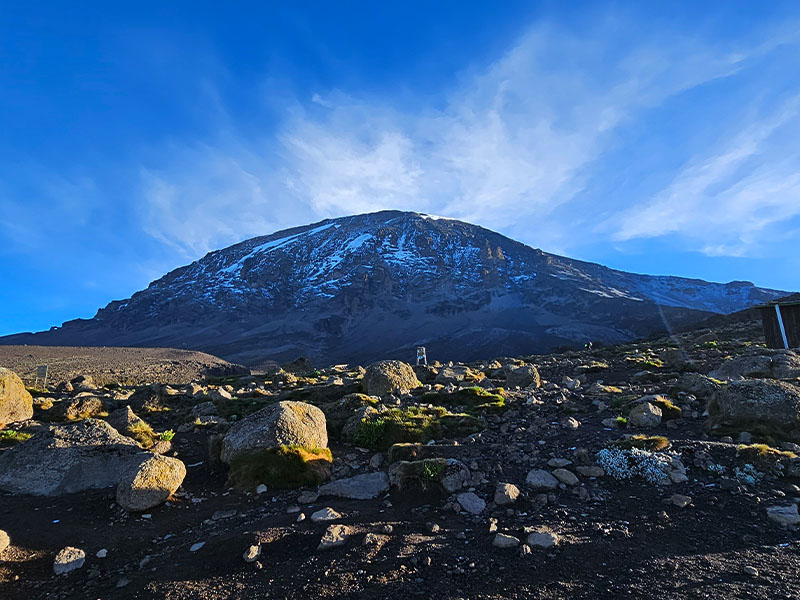
On the 6-day itinerary we skip Karanga Camp. You cross the Barranco Wall, walk on past Karanga and continue to Barafu Camp the same day. The stretch from Karanga to Barafu usually takes 3 to 4 hours, and because you have already been walking since Barranco, we plan for about 4 hours. Climbers usually reach Barafu at around 5:00 to 6:00 pm. Dinner is around 6:30 to 7:30 pm, and we wake you at 11:00 pm. After dinner and the health check you have only a few hours to rest, compared with a full afternoon on the 7-day itinerary.
| Difference | 6-day Machame | 7-day Machame |
|---|---|---|
| Night after the Barranco Wall | Barafu Camp (about 4,670 m) | Karanga Camp (3,995 m) |
| Karanga to Barafu | Same day as the Barranco Wall, about 4 hours | The next morning, about 3 to 4 hours, then lunch and rest |
| Arrival at Barafu | Usually 5:00 to 6:00 pm | After the 3 to 4 hour morning walk from Karanga, then lunch |
| Rest before the 11:00 pm wake-up | A few hours after dinner and the health check | A full afternoon |
| Price per person (indicative, November 2026) | US$2,200 | US$2,400 |
If your dates allow, the extra night at Karanga gives you that time before summit night. It does not guarantee a summit or protect you from altitude illness.
Machame Route Difficulty and Altitude
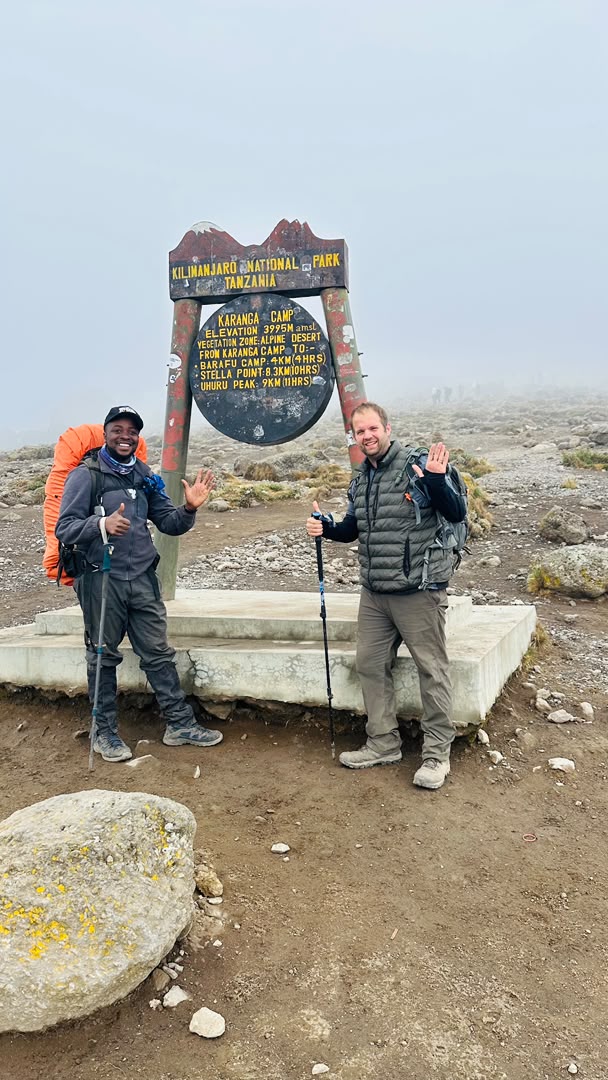
The Machame Route is moderately difficult to challenging. It is not a technical climb, and you do not need ropes or climbing equipment, but the trail has steep sections, long days, high altitude and a cold summit night. The hardest part is summit night from Barafu Camp, when you climb slowly in freezing conditions for hours at high altitude.
The table shows where you sleep each night on the 7-day itinerary.
| Night | Camp | Sleeping altitude | Change from previous night |
|---|---|---|---|
| 1 | Machame Camp | 2,835 m | Starting point |
| 2 | Shira Cave Camp | 3,750 m | +915 m |
| 3 | Barranco Camp | 3,900 m | +150 m |
| 4 | Karanga Camp | 3,995 m | +95 m |
| 5 | Barafu Camp | About 4,670 m | +675 m |
The CDC’s travel guidance advises that above 3,000 m, your sleeping altitude should rise by no more than about 500 m per night, with an extra night for every 1,000 m gained. It also says its advice can be too fast for some travellers and too slow for others, and that training and physical fitness do not affect your risk of altitude illness.
Machame’s climb-high, sleep-low day over Lava Tower helps, and the small gains on nights 3 and 4 give you time to adjust. But two nights, at Shira Cave and Barafu, rise by more than the CDC’s guide, so no Machame itinerary removes the risk of altitude illness. The 6-day itinerary asks more of your body because it reaches Barafu a day earlier.
Report a headache, nausea, dizziness, unusual tiredness or loss of appetite to your guide as soon as it starts. Walking more slowly reduces effort but does not treat altitude illness. A climber with symptoms should not go to a higher sleeping altitude until the guide has assessed them, and if symptoms get worse, going down may be necessary.
For symptoms and what to do, read our guide to altitude sickness on Kilimanjaro.
Kili Quests’ summit success planning estimates
The length of a climb affects how much time you have to adjust to altitude. For planning and explaining route options to clients, Kili Quests uses the following general estimates by itinerary length:
| Itinerary length | Kili Quests planning estimate |
|---|---|
| 5 days | About 25%–35% |
| 6 days | About 40%–60% |
| 7 days | About 65%–85% |
| 8 or more days | About 85%–95%, often over 90% on routes such as the Northern Circuit and 8-day Lemosho |
For Machame, that places the 6-day itinerary at about 40% to 60% and the 7-day itinerary at about 65% to 85%.
How to read these figures: These are Kili Quests’ general planning estimates by itinerary length. They are not official park statistics, independently audited results or a guarantee for an individual climber. Actual outcomes depend on the route, acclimatization, health, weather, pace and the decision to continue or descend when necessary. A longer itinerary gives more time to adjust, but no itinerary guarantees reaching Uhuru Peak.
For more detail, read our guide to Kilimanjaro summit chances by route.
What a Day on the Machame Route Looks Like With Kili Quests
Machame is a camping route, so the way the crew runs each day matters as much as the route. This is how a normal walking day goes with us.
- Morning: we wake you at 6:00 or 6:30 am, depending on the next day’s distance. Bed tea, coffee or hot water comes to your tent, and about 10 minutes later you get warm water in a bowl for washing.
- Breakfast and start: breakfast starts an hour after wake-up and takes about 45 minutes. After a 15-minute health check we leave at 8:00 or 8:30.
- On the trail: we walk 3 to 7 hours, and normally arrive in camp about 1:00 to 2:00 pm.
- Lunch: a hot meal served at camp, never on the trail. The exception is the Lava Tower day, when lunch is at Lava Tower and we do not sleep there.
- Evening: dinner is around 6:30 to 7:30 pm, followed by the health check and a briefing for the next day. Everyone is asleep by about 9:00 pm.
We check your oxygen saturation routinely twice a day, in the morning and after dinner, with extra checks if someone feels unwell, and we carry a first aid kit and an oxygen cylinder on every climb. If you feel unwell at any time, tell your guide straight away. An oxygen reading alone cannot show that you are safe to continue, so guides also consider how you feel.
On camping routes, porters carry your gear and your sleeping mattress. A waiter brings washing and drinking water, and we provide a private toilet with a dedicated toilet porter who cleans it and carries it away when it is full. Our standard is 3 porters per climber. You carry a daypack of about 5 to 7 kg with 3 to 4 litres of water, snacks, medication, rain gear and sunscreen.
How Much Does the Machame Route Cost?
Kili Quests’ indicative Machame prices (November 2026, in US dollars, per person) are:
- 6-day Machame: US$2,200
- 7-day Machame: US$2,400
The 7-day itinerary costs more because it adds a day on the mountain. Message us your dates and group size and we will confirm the exact price.
The final price depends on the number of climbers and the services included. Machame usually costs less than longer routes such as Lemosho or the Northern Circuit.
| Included in the price | Not included |
|---|---|
|
|
Tips are not included in the price. We recommend 20% of the package price per person, which is US$440 on the 6-day and US$480 on the 7-day Machame. For a full breakdown of what affects the price of any Kilimanjaro climb, read our Kilimanjaro climb cost guide.
Do not choose Machame only because it costs less than Lemosho. A lower price is not good value if the itinerary is too rushed or the operator cuts corners on safety, food, guides or porter care.
Best Time to Climb the Machame Route
The drier months, January to early March and June to October, usually give better trail conditions, clearer views and more stable weather. Rain makes the lower forest muddy and reduces visibility, and camps are wetter. For a month-by-month breakdown, read our guide to the best time to climb Kilimanjaro.
| Season | What to expect |
|---|---|
| January to early March | Warmer conditions, good visibility and fewer crowds than peak season. |
| June to October | Drier weather and clear skies, with colder nights and busier trails. |
| April to May | Long rains, muddy trails, lower visibility and wetter camps. Usually not recommended. |
| November | Short rains and less predictable conditions. Possible, but not ideal for most climbers. |
Machame or Lemosho?
Machame and Lemosho are two of the best Kilimanjaro routes for scenery. Both pass Lava Tower, the Barranco Wall, Karanga and Barafu before summiting from the southern side. The differences are where you start, how many days you take and how much experience you have.
| Feature | Machame | Lemosho |
|---|---|---|
| Start | Machame Gate, southwest side, 1 to 2 hours’ drive from a Moshi hotel | Western side, 3 to 4 hours’ drive from a Moshi hotel |
| Days | 6 or 7 | 7 or 8 |
| Price (indicative, November 2026) | US$2,200 per person for 6 days; US$2,400 per person for 7 days | US$2,700 to 3,000 per person |
| Best for | Climbers comfortable hiking uphill on consecutive days, with previous altitude experience | Fit hikers with little altitude experience |
For a deeper comparison, read Machame vs Lemosho: Which Kilimanjaro Route Is Better? or see our Lemosho route guide.
What to Pack for the Machame Route
The Machame Route crosses rainforest, moorland, alpine desert and freezing summit conditions, so you need to pack for all of them. Your main items are warm layers, waterproof clothing, broken-in hiking boots, gloves, a warm hat, a headlamp, a sleeping bag, trekking poles and a comfortable daypack. You can rent a sleeping bag before the climb.
Crampons: Kili Quests does not supply crampons, and they are not part of a normal climb. Icy, slippery conditions are most likely from around 15 January to March and can continue through the rain seasons. When the path is icy and slippery, our guides fit crampons at Stella Point or lower. If you want a pair for those conditions, bring your own or rent one in Moshi before the climb.
Do not underestimate summit night. Use our Kilimanjaro packing list for the full kit.
Frequently Asked Questions About the Machame Route
How difficult is the Machame Route?
Moderately difficult to challenging. It does not need technical climbing skills, but it has steep sections, long days, high altitude and a cold summit night. Your sleeping altitude rises by more than about 500 m on two nights, which is more than the CDC advises above 3,000 m, so fitness alone does not remove the risk of altitude illness. The 7-day itinerary gives you more time than the 6-day.
Should I choose the 6-day or 7-day Machame Route?
Choose 7 days if your dates allow. The only difference is one night at Karanga Camp. On the 6-day you cross the Barranco Wall and continue to Barafu the same day, arriving around 5:00 to 6:00 pm, with a few hours of rest before the 11:00 pm wake-up. On the 7-day you sleep at Karanga and have a full afternoon at Barafu. Neither guarantees a summit.
Is the Machame Route good for beginners?
It can be, if you are fit, comfortable camping and comfortable hiking uphill on consecutive days, and you take the 7-day itinerary. If you have little mountain experience, we often suggest Lemosho (7 or 8 days) or the 7-day Rongai first. Whichever route you choose, walk slowly and tell your guide about symptoms early.
How much does the Machame Route cost with Kili Quests?
Our indicative November 2026 price is US$2,200 per person for the 6-day Machame and US$2,400 per person for the 7-day, in US dollars. The price includes park fees, tents and mattresses, meals, crew wages, transfers, a private portable flush toilet and two hotel nights. It does not include tips, visa fees, personal gear, insurance or flights. Message us your dates and group size for the exact price.
Is Machame better than Lemosho?
Neither is better for everyone. Machame suits climbers who are comfortable hiking uphill on consecutive days and have altitude experience, and it costs less (US$2,200 to 2,400 against US$2,700 to 3,000). Lemosho suits fit hikers with little altitude experience and takes 7 or 8 days. Tell us your hiking experience and dates and we will suggest the route that fits.
Plan your Machame climb with Kili Quests
Tell us your preferred dates, group size and hiking experience, and whether you are comfortable camping. We will tell you whether the 6-day or 7-day Machame itinerary, or another route, fits you best. You can also see our 7-day Machame trek itinerary.