Northern Circuit Kilimanjaro: 9-Day Itinerary, Difficulty & Cost

Climb with the Highest Success Rate

The Northern Circuit offers the best acclimatization — but pacing and guidance still matter.

Plan Your Climb the Right Way

Preparation and acclimatization make the difference.
Explore these guides:

OUR CATEGORIES

Northern Circuit Kilimanjaro: Longest Route With Best Acclimatization

The Northern Circuit Route is the longest Kilimanjaro route and one of the best choices for climbers who want strong acclimatization, quiet trails, and wide panoramic views around the mountain.

Starting from the western side of Kilimanjaro, the route follows the early section of the Lemosho trail before turning north and circling the quieter northern slopes. This gives climbers a longer, more gradual approach before summit night.

The standard 9-day Northern Circuit itinerary gives your body more time to adjust to altitude than shorter routes such as Marangu or 6-day Machame. That makes it one of the strongest Kilimanjaro routes for climbers who want a safer pace and a better summit profile when properly guided.

This guide covers the Northern Circuit itinerary, difficulty, acclimatization, cost, scenery, pros and cons, and who this route is best suited for.
 

Quick Answer: Is the Northern Circuit Route Good for Kilimanjaro?

Yes, the Northern Circuit is one of the best Kilimanjaro routes for acclimatization, scenery, and a quieter trekking experience. It is the longest main route on the mountain, usually completed in 9 days, which gives climbers more time to adapt to altitude.
 
The route starts from the western side, follows part of the Lemosho trail, then circles around the quieter northern slopes before heading to the summit. Because it takes more days and avoids the busiest trail sections for much of the climb, it is ideal for climbers who want a slower pace, fewer crowds, and strong acclimatization.
 
The main drawbacks are time and cost. The Northern Circuit takes longer and usually costs more than shorter routes, but for many climbers, the extra days are worth it.

Why Choose the Northern Circuit Route?

The Northern Circuit Route is best known for three things: excellent acclimatization, low crowds, and a long scenic journey around Kilimanjaro.
 
Unlike shorter routes that reach high altitude quickly, the Northern Circuit gives climbers more days on the mountain. This slower pace helps the body adjust better and reduces the pressure of rushing toward summit night.
 
The route also explores the quieter northern side of Kilimanjaro, where fewer climbers pass compared with the southern circuit, Machame, or Marangu routes. This makes the experience feel more remote and peaceful.
 
Choose the Northern Circuit if you want:


  • A longer 9-day Kilimanjaro itinerary
  • Strong acclimatization profile
  • Quieter trails with fewer crowds
  • Panoramic views around the mountain
  • A premium route with more time to adjust
  • A strong summit profile when properly paced
This is not usually the cheapest Kilimanjaro route, but it is one of the best for climbers who value safety, scenery, and acclimatization.
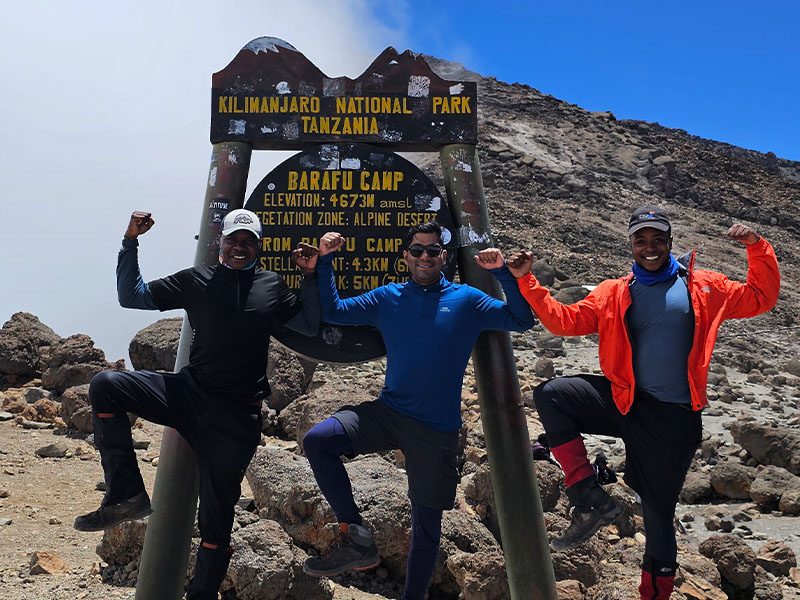
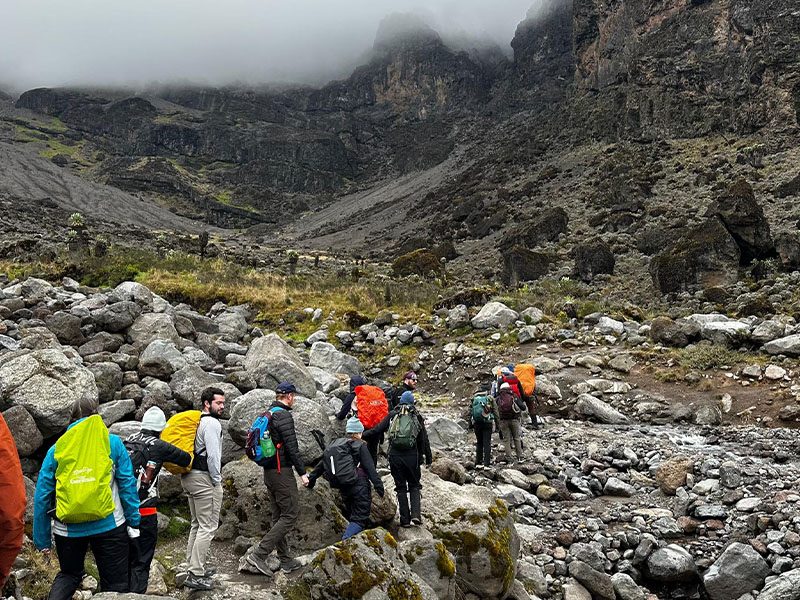
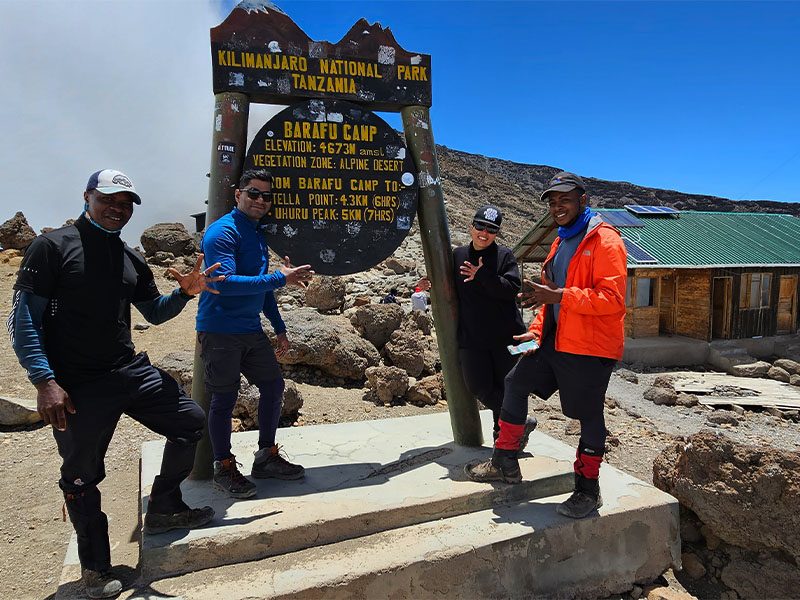
Climbers at Barafu Camp (4,673m) on Mount Kilimanjaro’s Northern Circuit Route, preparing for the final summit push to Uhuru Peak | Kili Quests
Barafu Camp is the final overnight base camp before summit day on the Northern Circuit. From here, climbers tackle the ascent to Uhuru Peak via Stella Point.

Table of Contents

What Is the Northern Circuit Route on Kilimanjaro?

The Northern Circuit Route is the longest main route on Mount Kilimanjaro. It begins from the western side at Londorossi Gate, follows the early part of the Lemosho Route, then turns north to circle around the quieter northern slopes.

This longer route gives climbers a more complete Kilimanjaro experience. Instead of heading quickly toward the southern circuit, the trail moves around the mountain, offering wide views, remote landscapes, and a quieter atmosphere before joining the final summit approach.

The Northern Circuit is usually completed in 9 days. Its biggest advantage is acclimatization. The extra days allow the body more time to adjust before reaching high camps and attempting Uhuru Peak.

Northern Circuit Route Overview

Feature Northern Circuit Route Details
Route duration Usually 9 days
Distance About 98 km / 61 miles
Starting point Londorossi Gate, western Kilimanjaro
Highest point Uhuru Peak, 5,895 m / 19,341 ft
Difficulty Moderate to challenging because of the length and summit night
Acclimatization One of the strongest profiles on Kilimanjaro due to the longer itinerary
Best for Climbers who want strong acclimatization, quieter trails, scenery, and enough time for a longer trek
Main drawback Takes more time and usually costs more than shorter routes
Because longer routes significantly improve summit success, it’s important to understand how itinerary length affects your chances of reaching the summit.
 
Read our article about, Kilimanjaro Success Rate

Northern Circuit Days and Elevation Profile
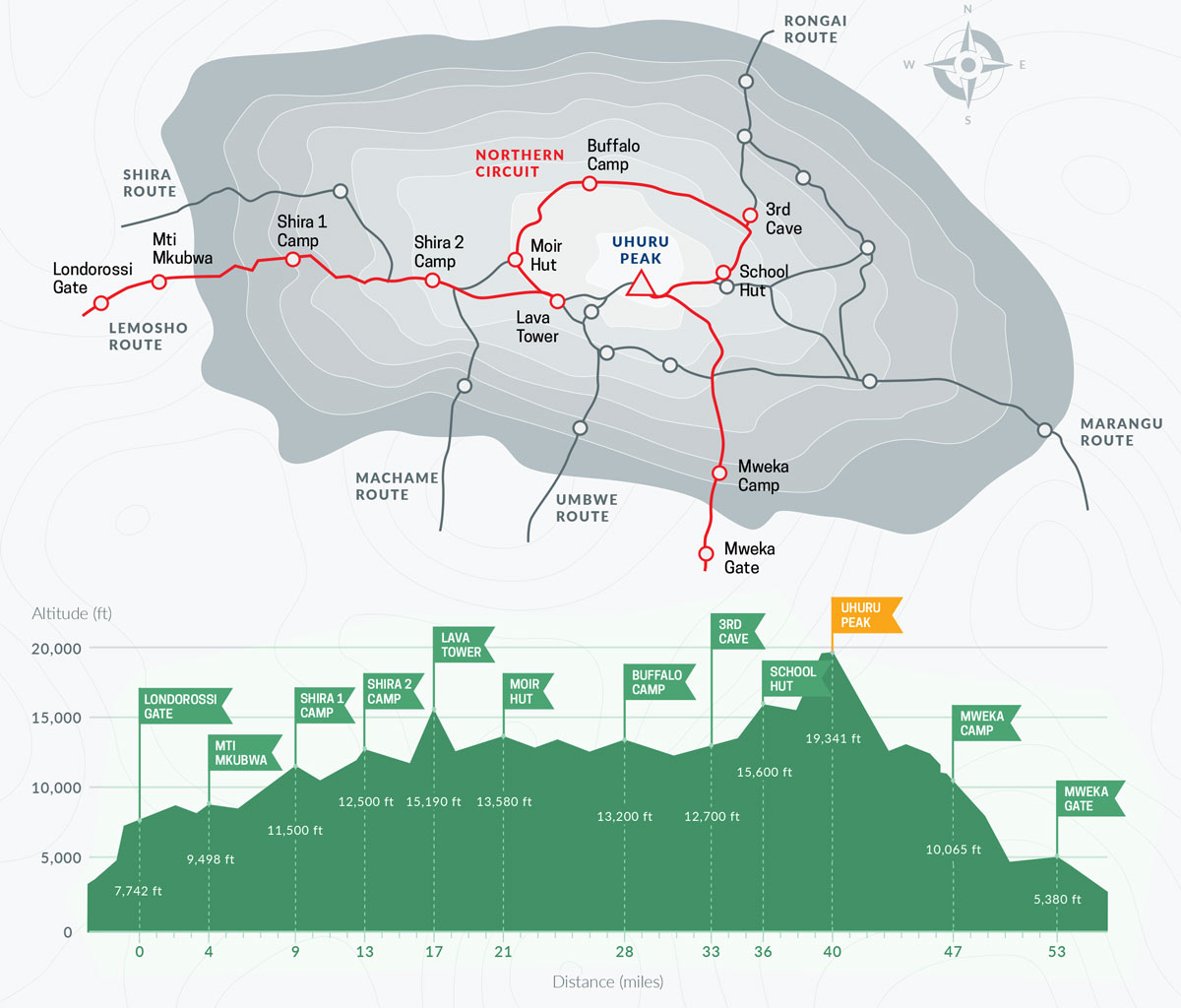
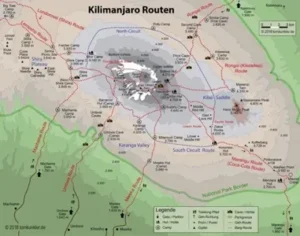
Northern Circuit Route map on Mount Kilimanjaro showing full circuit trail, elevation profile, and key camps to Uhuru Peak
The longest Kilimanjaro route, offering excellent acclimatization and 360° views around the mountain.

9-Day Northern Circuit Route Itinerary

Day 1: Londorossi Gate to Mti Mkubwa Camp

Altitude: 2,100 m → 2,650 m
Hiking time: 3–4 hours
 
The trek begins at Londorossi Gate on the western side of Kilimanjaro. After registration, you enter the rainforest zone and walk through a green, shaded trail toward Mti Mkubwa Camp. Wildlife sightings are possible in this lower forest section, especially monkeys and forest birds.

Day 2: Mti Mkubwa Camp to Shira 1 Camp

Altitude: 2,650 m → 3,610 m
Hiking time: 5–6 hours
 
The trail climbs out of the rainforest and into the moorland zone. As the vegetation opens, views across the Shira Plateau begin to appear. This is one of the first major altitude gains of the route, so a slow pace is important.

Day 3: Shira 1 Camp to Shira 2 Camp

Altitude: 3,610 m → 3,850 m
Hiking time: 4–5 hours
 
This day crosses the open Shira Plateau, one of Kilimanjaro’s most scenic high-altitude landscapes. The walking is steadier, with wide views of Kibo and the surrounding wilderness. The gradual profile helps climbers settle into the rhythm of the trek.

Day 4: Shira 2 Camp to Lava Tower to Moir Hut

Altitude: 3,850 m → 4,600 m → 4,200 m
Hiking time: 6–7 hours
 
This is an important acclimatization day. The trail climbs toward Lava Tower, a dramatic volcanic landmark at high altitude, before descending to Moir Hut for the night. This “climb high, sleep low” pattern helps the body adapt before the route moves around the northern slopes.

Day 5: Moir Hut to Buffalo Camp

Altitude: 4,200 m → 4,020 m
Hiking time: 5–6 hours
 
The route now moves into Kilimanjaro’s quieter northern side. This section feels more remote than the busier southern trails, with wide alpine landscapes and views stretching toward Kenya on clear days.
 

Day 6: Buffalo Camp to Third Cave Camp

Altitude: 4,020 m → 3,870 m
Hiking time: Around 5 hours
 
This is one of the quietest parts of the Northern Circuit. The trail crosses remote alpine desert terrain with fewer climbers and open views. The slightly lower sleeping altitude also supports acclimatization before the climb to base camp.

Day 7: Third Cave Camp to School Hut

Altitude: 3,870 m → 4,750 m
Hiking time: 4–5 hours
 
The trail climbs steadily toward School Hut, the base camp used for the summit attempt. This day is shorter but important, because you will rest, hydrate, eat early, and prepare for the midnight summit push.

Day 8: School Hut to Uhuru Peak to Mweka Camp

Altitude: 4,750 m → 5,895 m → 3,100 m
Hiking time: 12–14 hours
 
Summit day is the hardest part of the Northern Circuit Route. The climb usually begins around midnight in cold, dark conditions. You ascend slowly toward the crater rim, continue to Uhuru Peak, then descend to Mweka Camp after a short rest.
This is a long and demanding day, but the extended acclimatization profile of the Northern Circuit helps climbers arrive better prepared than on shorter routes.

Day 9: Mweka Camp to Mweka Gate

Altitude: 3,100 m → 1,640 m
Hiking time: 3–4 hours
 
The final day descends through the rainforest to Mweka Gate. After completing park checkout, successful climbers receive their summit certificate before returning to town.

Why the Northern Circuit Has a Strong Summit Profile

The Northern Circuit has one of the strongest summit profiles on Kilimanjaro because it gives climbers more time to acclimatize before summit night.
 
The 9-day itinerary allows a slower altitude gain, more recovery time, and better adjustment before reaching high camps. This is especially important because altitude is one of the main reasons climbers struggle on Kilimanjaro.

Longer Itinerary Means Better Acclimatization

More days on the mountain give your body more time to adapt to lower oxygen levels. This does not guarantee summit success, but it improves your chances when combined with proper pacing, hydration, nutrition, and guide support.

Lower Pressure Than Shorter Routes

Shorter routes can feel rushed because climbers gain altitude faster with less recovery time. The Northern Circuit spreads the climb over more days, making the experience more gradual.

Good Option for First-Time Climbers With Enough Time

The Northern Circuit can be a strong option for first-time climbers who want a slower pace and have enough time for a 9-day trek. It is still physically demanding, but the route gives the body more opportunity to adjust.
 
For climbers comparing route options, see our Kilimanjaro routes comparison guide

Northern Circuit Route Cost

The Northern Circuit usually costs more than shorter Kilimanjaro routes because it takes 9 days on the mountain. More days mean more park fees, crew wages, food, camping logistics, guide support, and mountain operations.
 
The final price depends on the number of climbers, whether the climb is private or group-based, the level of service, included transfers, hotel nights, equipment, safety support, and route arrangements.
 
The Northern Circuit is not the cheapest route, but it offers strong value for climbers who want better acclimatization, quieter trails, and a more complete Kilimanjaro experience.
 
If your main goal is to reduce cost, a shorter route may look cheaper. But on Kilimanjaro, choosing only by price can be a mistake. A longer route gives your body more time to adjust, which can make the climb safer and more enjoyable.
 
For a full breakdown of park fees, crew costs, inclusions, exclusions, and extra expenses, read our main guide to Kilimanjaro climb cost.

Northern Circuit Route Pros and Cons

Pros Cons
Excellent acclimatization profile due to the 9-day itinerary More expensive than shorter Kilimanjaro routes
Quieter northern slopes with fewer crowds Requires more time on the mountain
Beautiful 360-degree scenery around Kilimanjaro Longer distance can feel tiring for some climbers
Strong option for climbers who want a slower, safer pace Not ideal for travelers with limited vacation days

Best Time to Climb the Northern Circuit

The best time to climb the Northern Circuit is during Kilimanjaro’s drier trekking seasons, when visibility is better and trail conditions are more stable.
 
The best months are usually:
  • January to early March
  • June to October
January to early March can offer warmer conditions and fewer climbers. June to October is one of the most popular climbing seasons because of drier weather and clearer mountain views.
 
The Northern Circuit can be climbed outside these months, but rainier periods such as March to May and parts of November can make the trail wetter, colder, and less comfortable.
 
For a full seasonal breakdown, read our best time to climb Kilimanjaro guide.
 
Read our article about,Best Time to Climb Kilimanjaro 
Trekker climbing and hugging a rock on Kilimanjaro’s Barranco Wall, a fun and scenic segment encountered on the Northern Circuit via Lemosho | Kili Quests
The Barranco Wall, known as the “Breakfast Wall,” is a fun and challenging highlight of the Northern Circuit after it merges with Lemosho.

What Makes the Northern Circuit Unique?

The Northern Circuit is unique because it gives climbers one of the most complete journeys around Mount Kilimanjaro. Instead of following only the busier southern routes, it circles around the quieter northern slopes before heading toward the summit.

This gives the route a different feel from Machame, Marangu, or the standard Lemosho itinerary. You experience open plateau scenery, remote northern landscapes, views toward Kenya, and a longer approach that supports acclimatization.

Its biggest strength is the combination of time, scenery, and solitude. Its biggest drawback is that it requires more days and usually costs more.

Is the Northern Circuit Route Right for You?

The Northern Circuit Route is a strong choice if you want a longer, quieter, and better-acclimatized Kilimanjaro climb.


Choose the Northern Circuit if you:
  • Want one of the best acclimatization profiles on Kilimanjaro
  • Prefer fewer crowds and quieter trails
  • Have enough time for a 9-day climb
  • Want a scenic route with views around the mountain
  • Are willing to pay more for extra days and better pacing
  • Want a strong route option as a first-time climber
This route may not be ideal if you are short on time, looking for the cheapest climb, or prefer a faster itinerary. In that case, routes such as Machame or Marangu may be worth comparing, but they offer less time for acclimatization.

Northern Circuit vs Lemosho Route

The Northern Circuit and Lemosho Route both start from the western side of Kilimanjaro and share the early trail through Londorossi Gate, Mti Mkubwa, and the Shira Plateau.
 
The main difference is what happens after the early section. Lemosho usually continues toward the southern circuit and Barranco, while the Northern Circuit turns north and circles around the quieter side of the mountain.
 
Northern Circuit is usually better for climbers who want more acclimatization time, fewer crowds, and a longer trek. Lemosho is better for climbers who want excellent scenery and acclimatization but prefer a slightly shorter itinerary, usually 7 or 8 days.
 
Both are strong routes. The better choice depends on your time, budget, fitness, and comfort with a longer climb.
Three happy trekkers posing in front of the Barafu Camp sign on Kilimanjaro’s Northern Circuit Route, flexing muscles before summit day | Kili Quests
A light-hearted moment at Barafu Camp (4,673m) on the Northern Circuit Route — trekkers flex their energy and spirit before the final ascent to Uhuru Peak.

Frequently Asked Questions About the Northern Circuit Route

How long does the Northern Circuit Route take?

The Northern Circuit Route usually takes 9 days. This makes it the longest main Kilimanjaro route and gives climbers more time to acclimatize before summit night.

Is the Northern Circuit Route difficult?

The Northern Circuit is moderately challenging. The route is long, and summit night is still demanding, but the gradual 9-day itinerary helps many climbers adjust better than shorter routes.

The challenge is not technical climbing. It is the combination of distance, altitude, cold, and several days of trekking.

Why is the Northern Circuit good for acclimatization?

The Northern Circuit is good for acclimatization because it gives climbers more days on the mountain and follows a slower altitude profile. This allows the body more time to adjust before reaching high camps and attempting the summit.

Is the Northern Circuit good for beginners?

Yes, the Northern Circuit can be a good route for beginners who have enough time and budget for a longer climb. Its slower pace and strong acclimatization profile make it more forgiving than shorter routes.
However, beginners still need proper training, patience, and guide support.

Is the Northern Circuit better than Lemosho?

The Northern Circuit is usually better for acclimatization and solitude because it is longer and quieter. Lemosho is also scenic and well-acclimatized, but it is usually shorter.
 
Choose Northern Circuit if you want the longest, quietest, and most gradual route. Choose Lemosho if you want excellent scenery and acclimatization with fewer days.

Climb the Northern Circuit With Kili Quests

The Northern Circuit is one of the best Kilimanjaro routes for climbers who want more time, better acclimatization, fewer crowds, and a quieter mountain experience.
 
At Kili Quests, we plan Northern Circuit climbs with careful pacing, experienced local guides, proper safety checks, and full mountain support from start to summit. Our team helps you prepare, choose the right itinerary, and climb with a strategy that respects altitude instead of rushing it.
 
If you want a longer Kilimanjaro route with strong acclimatization and panoramic scenery, contact us to plan your Northern Circuit climb.

Related Articles

Kilimanjaro Altitude Sickness: Symptoms & Causes

Climb Kilimanjaro Safely

Altitude is the biggest challenge on Kilimanjaro , but with the right preparation and expert guidance, you can reach the summit safely and confidently.

Choose Your Route

OUR CATEGORIES

Altitude Sickness on Kilimanjaro: What You Need to Know

Mount Kilimanjaro rises to 5,895 meters / 19,341 feet, where oxygen levels are much lower than at sea level. The climb does not require ropes or technical mountaineering skills, but altitude sickness is the biggest safety challenge most trekkers need to understand before climbing.

Altitude sickness can affect anyone. It does not matter if you are young, fit, experienced, or mentally strong. As you climb higher, your body must adjust to thinner air. If it does not adapt well enough, symptoms can appear and may become serious if ignored.

This guide explains altitude sickness on Kilimanjaro, including what causes it, early symptoms, serious danger signs, when descent may be needed, and how professional guides monitor climbers on the mountain. For a deeper prevention-focused guide, read How to Acclimatize on Kilimanjaro.

Quick Answer: How Serious Is Altitude Sickness on Kilimanjaro?

Altitude sickness is common on Kilimanjaro because climbers gain elevation quickly over several days. Mild symptoms such as headache, nausea, tiredness, poor sleep, or loss of appetite can happen as the body adjusts to altitude.
 
Mild symptoms do not always mean the climb is over, but they must be reported to your guide immediately. Serious symptoms such as confusion, loss of coordination, difficulty breathing at rest, or a worsening headache are dangerous and may require immediate descent.
 
The most important rule is simple: do not hide symptoms. Altitude sickness becomes more dangerous when climbers ignore early warning signs and continue climbing without telling their guide.
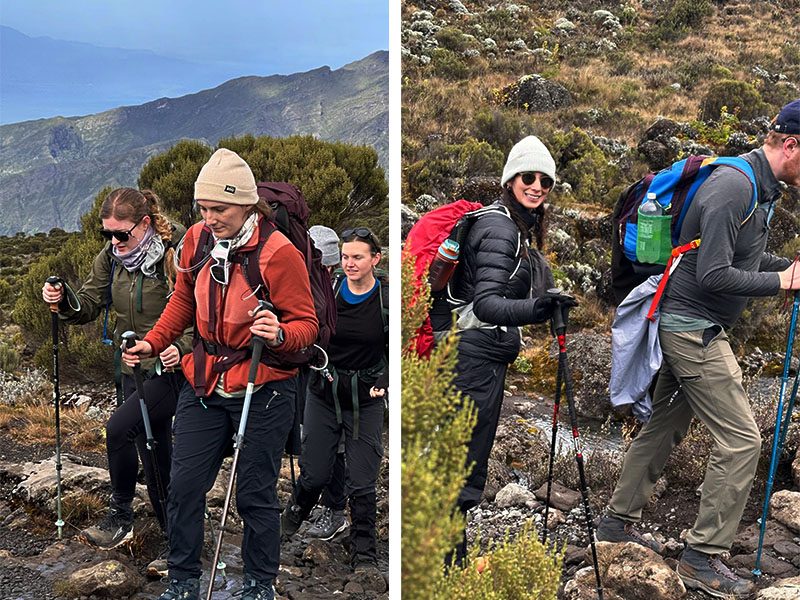
Tourists trekking on Mount Kilimanjaro at high altitude with guides | Kili Quests
Step by step — staying hydrated, steady, and supported helps you adapt as altitude increases.

Table of Contents

What Is Altitude Sickness?

Altitude sickness, also called Acute Mountain Sickness, happens when your body struggles to adjust to lower oxygen levels at high altitude. On Kilimanjaro, this risk increases as you climb through higher camps and approach the summit zone.

The condition can begin with mild symptoms, but it can become dangerous if symptoms worsen and the climber continues ascending. This is why altitude sickness should never be treated as normal tiredness. It is a safety issue that requires attention, monitoring, and honest communication with your guide.Altitude sickness exists in three main forms, each with increasing severity:
 
Proper acclimatization is the key to prevention, and you can learn more in our detailed guide on Kilimanjaro acclimatization strategies.

Types of Altitude Sickness on Kilimanjaro

Type of Altitude Sickness Severity Common Symptoms What It Means
Acute Mountain Sickness (AMS) Mild to moderate Headache, nausea, fatigue, dizziness, loss of appetite, and difficulty sleeping. The most common form of altitude sickness and an early warning sign that the body needs more time to adjust.
High Altitude Pulmonary Edema (HAPE) Serious Shortness of breath at rest, persistent cough, chest tightness, and extreme fatigue. A dangerous condition caused by fluid buildup in the lungs. Immediate descent and medical attention are required.
High Altitude Cerebral Edema (HACE) Medical emergency Severe headache, confusion, difficulty walking straight, slurred speech, and loss of coordination. The most severe form of altitude sickness, involving brain swelling due to lack of oxygen. Immediate descent is critical.

Acute Mountain Sickness (AMS)

This is the most common and mildest form of altitude sickness. Many climbers experience some level of AMS during their trek.
Typical symptoms include:
  • Headache
  • Nausea or vomiting
  • Fatigue or weakness
  • Dizziness
  • Loss of appetite
  • Difficulty sleeping
While AMS is usually manageable, it should never be ignored. Early symptoms are your body’s warning signs that you need to slow down and allow more time to adjust.
 

High Altitude Pulmonary Edema (HAPE)

HAPE is a serious and potentially life-threatening condition caused by fluid buildup in the lungs. It can develop if altitude sickness is not properly managed.
Symptoms may include:
  • Shortness of breath, even at rest
  • Persistent cough (sometimes with fluid)
  • Tightness in the chest
  • Extreme fatigue
HAPE requires immediate descent and medical attention. It is one of the most dangerous altitude-related conditions on the mountain.

High Altitude Cerebral Edema (HACE)

HACE is the most severe form of altitude sickness and involves swelling of the brain due to lack of oxygen.
Symptoms may include:
  • Severe headache
  • Confusion or disorientation
  • Difficulty walking in a straight line (ataxia)
  • Slurred speech
  • Loss of coordination
HACE is a medical emergency. Immediate descent is critical, and delays can be life-threatening.

Why Does Altitude Sickness Happen on Kilimanjaro?

One of the main reasons altitude sickness is common on Kilimanjaro is the speed of the ascent.Within just a few days, climbers go from below 2,000 meters to nearly 6,000 meters. This rapid gain in elevation does not give the body enough time to adapt naturally to lower oxygen levels.At high altitude, your body must work harder to function. Your breathing rate increases, your heart works harder, and your body begins adjusting its oxygen use. Without enough time to adapt, symptoms of altitude sickness can develop.
Several factors can increase your risk:
  • Climbing too quickly without proper acclimatization
  • Not drinking enough water
  • Skipping rest or acclimatization days
  • Ignoring early warning signs
  • Poor pacing during the climb

Understanding these factors helps you make better decisions and reduce your risk.

Choosing the right itinerary plays a major role, as explained in our Kilimanjaro routes comparison guide, where different routes offer different acclimatization profiles.

Common Symptoms to Watch For

Recognizing symptoms early is one of the most important parts of staying safe on Kilimanjaro.

Early Symptoms of AMS

Early symptoms are usually mild but should be taken seriously. These include:
  • Headache
  • Nausea or vomiting
  • Loss of appetite
  • Dizziness
  • Fatigue or unusual weakness
  • Poor or disturbed sleep
These symptoms often appear as you gain altitude and may improve with rest, hydration, and proper pacing.

Severe Symptoms (HAPE and HACE)

More serious symptoms indicate a dangerous level of altitude sickness and require immediate action.
These may include:
  • Shortness of breath even while resting
  • Persistent cough or chest tightness
  • Difficulty walking in a straight line (ataxia)
  • Confusion or unusual behavior
  • Slurred speech
If these symptoms appear or worsen, the only safe and effective treatment is immediate descent to a lower altitude.

How Common Is Altitude Sickness on Kilimanjaro

Altitude sickness is one of the most common challenges on Kilimanjaro because the summit is very high and the ascent happens within a limited number of days. Many climbers experience mild symptoms such as headache, tiredness, poor sleep, or reduced appetite at some point during the trek.

Mild symptoms are not unusual, but they must be watched carefully. The danger comes when symptoms get worse, when a climber hides how they feel, or when the group continues ascending despite warning signs.
 
Severe altitude sickness is less common, but it is serious. Conditions such as HAPE and HACE can become life-threatening if descent is delayed. This is why experienced guides monitor climbers daily and make safety decisions based on symptoms, oxygen levels, walking condition, and overall behavior.
 
The risk depends on several factors, including route length, ascent speed, pacing, hydration, previous altitude exposure, and how quickly symptoms are reported.

When Should a Climber Descend on Kilimanjaro?

Descent may be necessary when altitude sickness symptoms become severe or continue to worsen despite rest and support. On Kilimanjaro, the safest response to serious altitude illness is to go lower, because lower altitude gives the body more oxygen and can prevent the condition from becoming life-threatening.
 
You should alert your guide immediately if you experience:
  • Severe headache that does not improve
  • Confusion or unusual behavior
  • Difficulty walking in a straight line
  • Loss of coordination
  • Shortness of breath while resting
  • Persistent cough or chest tightness
  • Worsening nausea or vomiting
  • Extreme weakness that makes walking difficult
Immediate descent is the most important treatment for serious altitude sickness. Medication, oxygen, or rest may help in some situations, but they should not be used to delay descent when danger signs are present.
 
This is why climbers should never hide symptoms to “push through.” Summit success is not more important than safety.

Who Is Most at Risk of Altitude Sickness?

Altitude sickness does not discriminate. It can affect anyone, including experienced hikers and physically fit individuals.However, certain factors can increase your risk:
  • Having no previous experience above 3,000 meters
  • Ascending too quickly without enough acclimatization
  • Poor hydration during the climb
  • Ignoring early symptoms and continuing to ascend
It is important to understand that fitness alone does not protect you from altitude sickness. The key to prevention is proper pacing, acclimatization, and listening to your body.

What to Do If You Experience Altitude Sickness Symptoms

Even with good preparation, some climbers may experience mild symptoms of altitude sickness. The key is to respond quickly and appropriately.
 
The first step is always to tell your guide honestly how you feel. Do not wait until symptoms become severe, and do not pretend you are fine because you want to continue climbing.
 
If symptoms are mild, your guide may recommend:
  • Slowing the pace
  • Resting and monitoring symptoms
  • Drinking water regularly
  • Eating even if appetite is low
  • Avoiding further unnecessary exertion
  • Checking oxygen levels and general condition
  • Adjusting the next stage if needed
Medication should only be used under proper medical advice or guide protocol.

If Symptoms Are Mild

Mild symptoms may include headaches, slight dizziness, or fatigue. These are common and do not necessarily mean you need to stop your climb.
In this situation, you should:
  • Inform your guide immediately
  • Rest and allow your body to recover
  • Drink more water
  • Take medication if recommended
  • Adjust your pace or shorten the next day’s hike

Early communication with your guide is critical, as they can monitor your condition and decide the best course of action.

If Symptoms Become Severe

If symptoms worsen  such as intense headaches, nausea, confusion, or difficulty breathing  immediate action is required.The only effective treatment for serious altitude sickness is descent.Descending to a lower altitude allows your body to recover and prevents the condition from becoming life-threatening. This is why experienced guides closely monitor climbers and make safety decisions when necessary.
Happy tourist walking along a high-altitude trail on Kilimanjaro with a smile and trekking gear | Kili Quests
High spirits at high altitude — staying positive, prepared, and well-guided makes all the difference.

The Role of Professional Guides in Altitude Safety

Climbing Kilimanjaro with experienced guides is one of the most important safety decisions you can make. A good guide does more than lead the trail. They monitor your pace, observe your symptoms, check your condition, and make decisions when altitude becomes a concern.
 
At Kili Quests, safety is treated seriously throughout the climb. Our guides monitor climbers daily, including oxygen saturation, pulse, walking condition, appetite, sleep quality, and visible symptoms. This helps the team identify problems early instead of waiting until symptoms become dangerous.
 
If a climber shows signs of serious altitude sickness, the guide’s priority is safety, not summit pressure. This may mean slowing the pace, stopping further ascent, using emergency oxygen if needed, or arranging descent to a lower altitude.
 
They are trained to recognize early signs of altitude sickness and take action before the situation becomes serious.This may include adjusting your pace, recommending rest, or organizing a descent if necessary. Having a knowledgeable and experienced team around you makes a significant difference in both safety and success.
 
Choosing a professional operator is just as important as preparation, which is why many climbers explore our Kilimanjaro climbing packages for a complete guided experience.
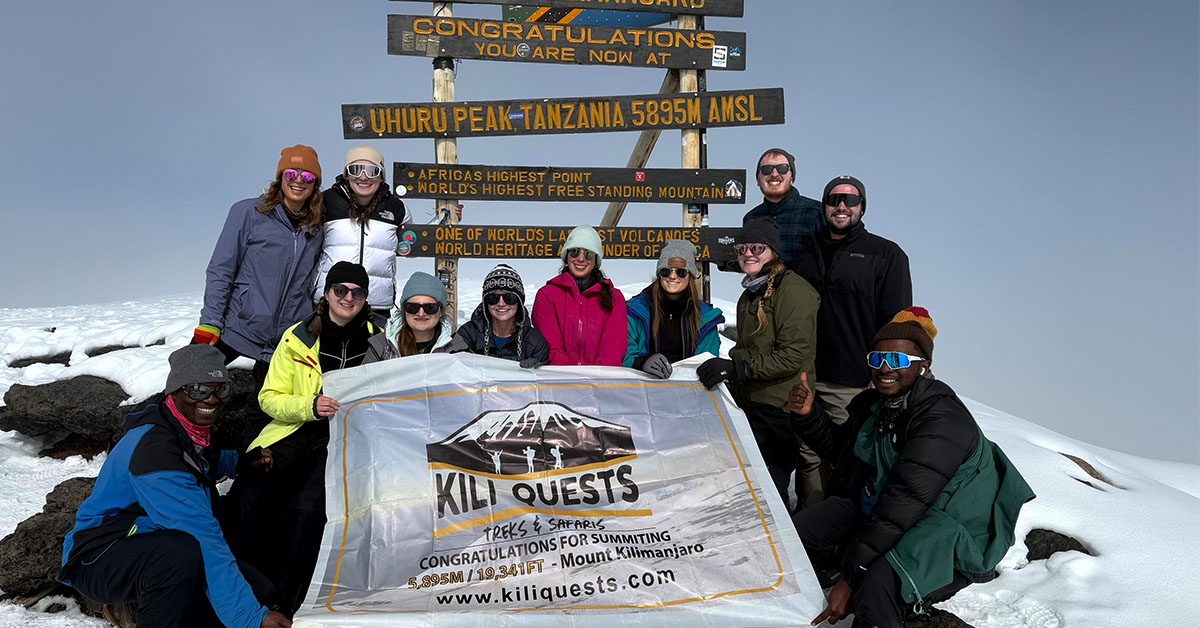
Group of trekkers celebrating together at Uhuru Peak, the summit of Mount Kilimanjaro
With the right pace and preparation, reaching the summit is not just possible — it’s unforgettable.

How to Reduce the Risk of Altitude Sickness

You cannot fully guarantee that altitude sickness will not happen, but you can reduce the risk by making smart choices before and during the climb.
The most important steps are:
  • Choose a route with enough acclimatization time
  • Walk slowly from the first day
  • Drink water regularly
  • Eat enough food, even when appetite drops
  • Avoid rushing to camp
  • Tell your guide immediately when symptoms appear
  • Do not ignore headaches, nausea, dizziness, or unusual fatigue
This article focuses on symptoms and safety response. For a full prevention guide covering pacing, route choice, climb-high-sleep-low strategy, and acclimatization days, read How to  Acclimatize on Mount Kilimanjaro.

Do You Need Oxygen for Kilimanjaro Altitude Sickness?

Most climbers do not use supplemental oxygen as part of a normal Kilimanjaro climb. Kilimanjaro is usually climbed through gradual acclimatization, slow pacing, and proper guide monitoring.
 
However, emergency oxygen is important for safety. It may be used if a climber develops serious altitude symptoms and needs support during descent or emergency response. Oxygen can help stabilize a climber temporarily, but it is not a replacement for descent when symptoms are severe.
 
If breathing difficulty, confusion, loss of coordination, or severe weakness appears, the priority is to go lower as quickly and safely as possible under guide supervision.

Should You Take Diamox for Kilimanjaro?

Some climbers use Diamox to help with altitude adjustment, but it should only be taken after speaking with a doctor before the trip. It is not a guarantee against altitude sickness, and it does not replace proper acclimatization, slow pacing, hydration, or guide monitoring.
 
If you plan to use Diamox, discuss it with a qualified medical professional before traveling to Tanzania. You should understand the dosage, timing, possible side effects, and whether it is safe for your personal health situation.
 
Do not start medication on the mountain without proper advice unless it is part of an agreed medical plan or emergency protocol.

Frequently Asked Questions About Altitude Sickness on Kilimanjaro

How can you reduce the risk of altitude sickness on Kilimanjaro?

You can reduce the risk by choosing a route with enough days, walking slowly, staying hydrated, eating properly, and reporting symptoms early. However, altitude sickness cannot be fully guaranteed away because every body reacts differently to high altitude.
 
The best approach is to climb with enough acclimatization time, follow your guide’s pace, and avoid rushing the mountain. For a full prevention strategy, read How to Acclimatize on Kilimanjaro.

Can physically fit people still get altitude sickness?

Yes, physical fitness does not protect you from altitude sickness. This is one of the most misunderstood aspects of climbing Kilimanjaro.Altitude sickness is caused by reduced oxygen levels at high elevation, not by a lack of strength or endurance. Even highly trained athletes can develop symptoms if they ascend too quickly or do not acclimatize properly.In some cases, very fit individuals are actually at higher risk because they may walk faster than recommended, pushing their bodies too quickly to higher altitudes. On Kilimanjaro, success is not about speed  it is about pacing, patience, and allowing your body time to adjust.

How can you effectively prevent altitude sickness on Kilimanjaro?

Preventing altitude sickness requires a combination of preparation, smart decision-making, and discipline during the climb.The most effective strategies include choosing a longer route that allows for proper acclimatization, walking slowly at a steady pace, and staying well hydrated throughout the trek. Drinking enough water helps your body function efficiently at altitude and reduces the severity of symptoms.It is also important to eat regularly, even when your appetite decreases, as your body needs energy to adapt. Listening to your guide is equally critical, as experienced guides monitor your condition and can adjust your pace or schedule when needed.Preventing altitude sickness is not about one single action  it is about consistently following the right habits throughout the entire climb.

Which Kilimanjaro routes are best for avoiding altitude sickness?

Routes that allow more time for acclimatization are the best options for reducing the risk of altitude sickness.The Lemosho Route and Northern Circuit are widely considered the most effective because they include more days on the mountain and a gradual ascent profile. This gives your body the time it needs to adjust to decreasing oxygen levels.The Machame Route, when done over 7 days, is also a strong option, offering a good balance between duration and acclimatization.Shorter routes, such as the 5-day Marangu itinerary, are generally less effective because they involve a faster ascent and provide less time for the body to adapt.

What should you do if altitude sickness symptoms get worse?

If altitude sickness symptoms begin to worsen, it is essential to act quickly and take the situation seriously. Ignoring symptoms or continuing to climb can lead to more severe and potentially dangerous conditions.The most important step is to inform your guide immediately. Guides are trained to assess your condition and determine the best course of action. This may include resting, adjusting your pace, or stopping further ascent.If symptoms become severe  such as difficulty breathing, confusion, or loss of coordination  immediate descent to a lower altitude is necessary. Descent is the only effective treatment for serious altitude sickness and can quickly improve your condition.Taking early action is the key to staying safe on the mountain.

Climb Kilimanjaro With Safety-Focused Local Guides

Altitude sickness is the biggest safety concern on Kilimanjaro, but the right route, pace, monitoring, and guide team make a major difference. The goal is not only to reach the summit. The goal is to climb with a plan that respects altitude and protects your health.

At Kili Quests, our local guides support climbers with steady pacing, daily health checks, oxygen monitoring, emergency oxygen, proper mountain meals, and clear safety decisions when symptoms appear.

If you are worried about altitude, we can help you choose a route and itinerary that gives your body a better chance to adjust.

Contact Kili Quests today to plan a safer Kilimanjaro climb with experienced local guides.

Related Articles

Kilimanjaro Medicines List: What to Bring for Altitude

Stay Safe on Kilimanjaro

Your health is key to reaching the summit safely.

Plan Your Kilimanjaro Climb

Good preparation makes your climb safer and easier.

OUR CATEGORIES

Kilimanjaro Medicine Kit: What to Bring

Climbing Mount Kilimanjaro is a high-altitude trek, so your health preparation matters as much as your fitness. Cold temperatures, long hiking days, lower oxygen levels, dehydration, and poor sleep can all affect how your body performs on the mountain.
 
A good Kilimanjaro medicine kit should help you manage common trail problems such as mild headaches, stomach issues, blisters, allergies, and personal health needs. But medicine should never be used to hide serious altitude symptoms or push through danger signs.
 
Before your climb, speak with a doctor or travel clinic about altitude medication, malaria prevention, personal prescriptions, and any health condition that could affect your trek. You should also understand how altitude affects your body on Kilimanjaro and why proper acclimatization is one of the most important parts of a safe climb.

Quick Answer: What Medicines Should You Bring for Kilimanjaro?

For Kilimanjaro, most climbers prepare a small personal medicine kit with items for altitude concerns, mild pain, nausea, stomach problems, diarrhea, blisters, allergies, hydration support, and personal prescriptions.
 
Altitude medication such as acetazolamide is commonly discussed for high-altitude travel, but it should only be used after advice from a doctor or travel clinic. Medicine does not replace proper acclimatization, slow pacing, hydration, guide monitoring, or descent when symptoms become serious.
 
 The CDC describes acetazolamide as a medicine that can help speed acclimatization in some altitude-risk situations, but prevention still depends heavily on proper ascent planning.
Painkiller carried for use during the climb

Table of Contents

Important Medical Note Before Your Kilimanjaro Climb

This guide is for general planning only. It does not replace advice from a qualified doctor, pharmacist, or travel clinic.
 
Every climber has different health needs, allergies, medication history, and altitude risk. Before traveling to Tanzania, ask a medical professional about altitude sickness prevention, malaria prevention, vaccines, personal prescriptions, and any condition that could affect your climb.
 
Never use medicine to hide worsening altitude symptoms and continue climbing. Headache, nausea, tiredness, dizziness, appetite loss, and sleep problems can be signs of altitude sickness, and symptoms can become serious if ignored.

Kilimanjaro Medicine Kit Overview

Item Why It May Help Important Note
Altitude medication May help some climbers with altitude acclimatization. Discuss with a doctor before your climb.
Pain relief May help with mild headaches, muscle aches, or general discomfort. Do not use painkillers to ignore worsening altitude symptoms.
Anti-nausea medicine May help with nausea or dizziness. Ask a doctor what is safe for you.
Diarrhea treatment Useful for travel-related stomach problems. Severe diarrhea can cause dehydration and should be treated seriously.
Electrolytes Help replace salts lost through sweating, diarrhea, or low appetite. Useful support, but not a cure for altitude sickness.
Blister care Helps protect feet during long trekking days. Pack blister plasters, tape, and basic wound care items.
Allergy medicine May help with mild allergies, dust, or irritation. Bring your usual allergy medicine if you normally use it.
Personal prescriptions Essential for existing medical conditions. Carry enough for the whole trip, plus extra days if possible.

Altitude Medication for Kilimanjaro

Altitude sickness is one of the main health concerns on Kilimanjaro. The best protection is a good route choice, slow pacing, proper acclimatization, hydration, rest, and honest communication with your guide.
 
Some climbers discuss altitude medication such as acetazolamide with a doctor before the climb. This medicine may help the body adjust to altitude, but it is not suitable for everyone and should not be taken without medical advice.
 
Medication should never be treated as permission to rush the mountain. If symptoms become worse, the safest response may be rest, monitoring, or descent.

Pain Relief, Nausea, and Stomach Medicine

Many climbers carry basic medicine for mild headaches, muscle aches, nausea, or stomach discomfort. These items can be helpful, but they must be used carefully.
 
A headache can be a normal discomfort, but it can also be an early altitude symptom. Nausea, vomiting, dizziness, loss of appetite, unusual fatigue, and poor sleep should not be ignored. Tell your guide early if symptoms appear.
 
Do not test new medicine for the first time on the mountain unless your doctor has advised it.

Personal Medication and Prescriptions

 If you use regular medication, bring enough for the full trip plus extra in case of travel delays. This may include asthma inhalers, allergy medicine, diabetes medication, blood pressure medicine, or any other prescribed treatment.
 
Keep important medication in your daypack, not only in your duffel bag. You should also carry a doctor’s note or prescription copy if you travel with controlled or important medication.

First Aid Items for Kilimanjaro

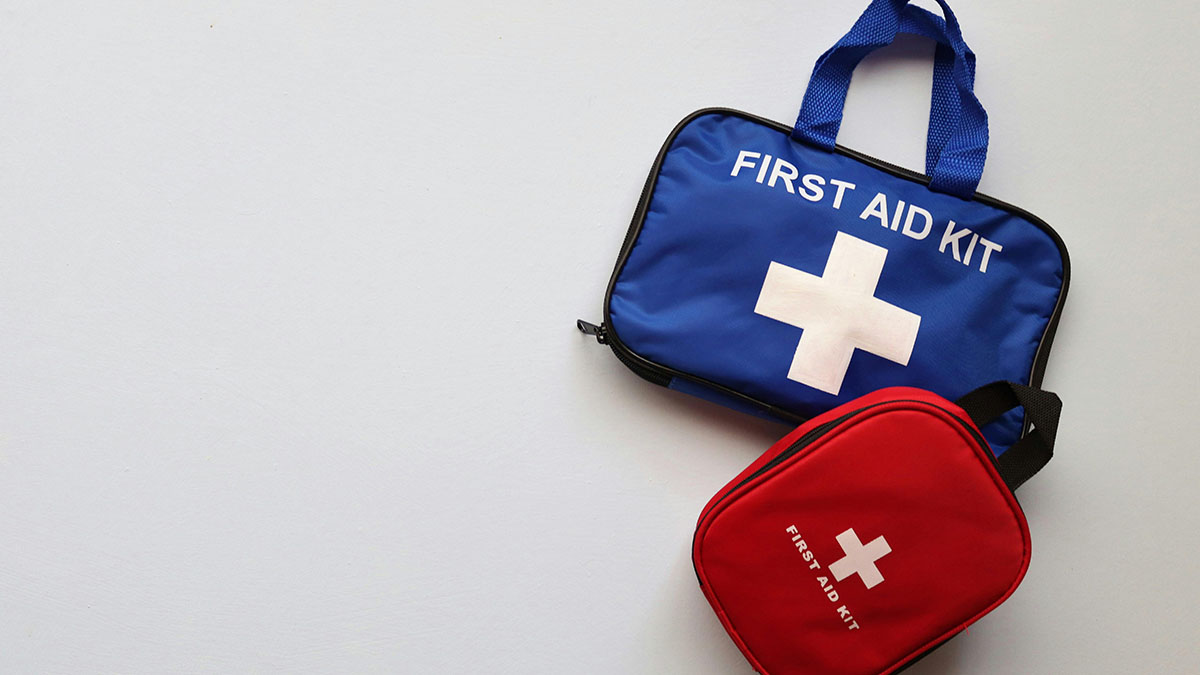
Your guides should carry a mountain first aid kit, but climbers should still bring a small personal kit for minor issues.
 
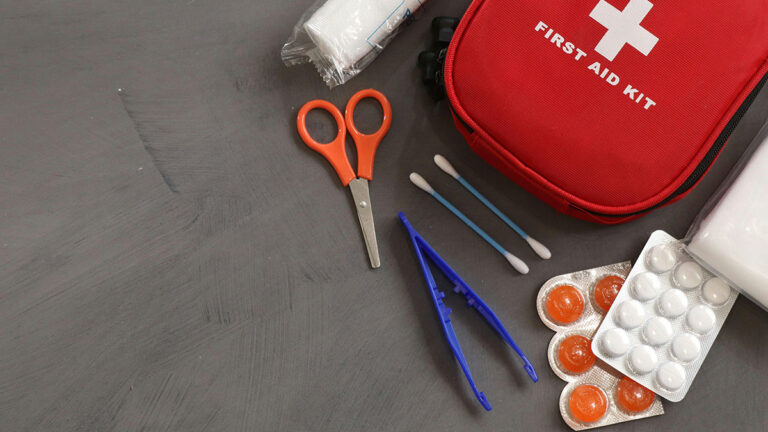
Useful personal items include blister pads, bandages, antiseptic wipes, medical tape, lip balm, sunscreen, hand sanitizer, and any personal items you normally use for small injuries or irritation.
 
For a full gear list, read our Kilimanjaro packing list.
Essential first aid supplies for mountain safety.

Hydration, Sun Protection, and Recovery

Health on Kilimanjaro is not only about medicine. Hydration, food, sleep, warmth, and sun protection all matter.
 
Drink regularly, eat even when your appetite drops, protect your skin and eyes from strong sun, and keep warm at night. Avoid alcohol before and during the climb because it can affect hydration, sleep, and recovery.
 
Electrolytes can help support hydration, especially if you are sweating heavily or have stomach problems, but they do not prevent altitude sickness by themselves.

Altitude Warning Signs

Tell your guide if you notice headache, nausea, vomiting, dizziness, unusual tiredness, loss of appetite, or difficulty sleeping. These are common altitude sickness symptoms and should be monitored carefully.
 
More serious warning signs include confusion, difficulty walking, severe breathlessness, chest pain, or worsening symptoms that do not improve. CDC adventure travel guidance notes that mental status changes and loss of coordination can be warning signs of high-altitude cerebral edema, while breathlessness at rest can be a sign of life-threatening high-altitude pulmonary edema.

Malaria Medication and Travel Health

Kilimanjaro’s higher elevations are not the same as Tanzania’s lower-elevation regions. Many travelers spend time in Moshi, Arusha, safari parks, Zanzibar, or Dar es Salaam before or after the climb.
 
The CDC recommends that travelers going to certain areas of Tanzania take prescription medicine to prevent malaria, and it lists malaria transmission in areas below 1,800 meters / 5,900 feet. Speak with a doctor or travel clinic before your trip so you know what is right for your itinerary.

When to Seek Medical Help on the Mountain

Tell your guide immediately if symptoms become stronger or do not improve with rest. Do not wait until symptoms are severe.

Important warning signs include:
  1. worsening headache
  2. repeated vomiting
  3. confusion or unusual behavior
  4. difficulty walking straight
  5. severe weakness
  6. chest pain
  7. breathlessness at rest
  8. blue lips or fingers

On Kilimanjaro, your guide’s decision matters. If your symptoms suggest serious altitude illness, the safest option may be to stop climbing, rest, or descend. Medicine should never be used to push through dangerous symptoms.

What Not to Do With Medicine on Kilimanjaro

Medicine can support your climb, but it should never be used to ignore serious symptoms or force your body higher when it is struggling with altitude.
 
Avoid these mistakes:
  1. Do not take unfamiliar medicine for the first time on the mountain.
  2. Do not use painkillers to hide a worsening altitude headache.
  3. Do not continue climbing if symptoms become stronger.
  4. Do not mix medications without medical advice.
  5. Do not rely on medicine instead of proper acclimatization.
  6. Do not ignore your guide’s recommendation to rest or descend.
The safest Kilimanjaro climb depends on preparation, slow pacing, honest symptom reporting, and good guide decisions. Medicine is only one part of the safety plan.

Frequently Asked Questions About Kilimanjaro Medicines

What medicines should I bring for Kilimanjaro?

Most climbers prepare a small personal medicine kit with items for altitude concerns, mild pain, nausea, stomach problems, diarrhea, blisters, allergies, hydration support, and personal prescriptions. Speak with a doctor before taking altitude medication, malaria medication, antibiotics, or unfamiliar medicine.

Do I need Diamox for Kilimanjaro?

Not every climber uses Diamox, which is a brand name for acetazolamide. Some climbers discuss it with a doctor because it may help with altitude acclimatization, but it is not suitable for everyone and should not replace a good route choice, slow pacing, and proper acclimatization.

Should I bring painkillers for Kilimanjaro?

Many climbers bring basic pain relief for mild headaches or muscle aches. However, painkillers should not be used to hide worsening altitude symptoms. If a headache becomes stronger or comes with nausea, dizziness, vomiting, weakness, or confusion, tell your guide immediately.

Should I bring painkillers for Kilimanjaro?

Many climbers bring basic pain relief for mild headaches or muscle aches. However, painkillers should not be used to hide worsening altitude symptoms. If a headache becomes stronger or comes with nausea, dizziness, vomiting, weakness, or confusion, tell your guide immediately.

Do I need malaria tablets for Kilimanjaro?

You may need malaria prevention medicine for Tanzania, especially if your trip includes lower-elevation areas before or after the climb. Speak with a doctor or travel clinic before traveling so your malaria plan matches your full itinerary.

What medicine should I avoid on Kilimanjaro?

Avoid taking unfamiliar medicine for the first time on the mountain unless your doctor has approved it. Also avoid using medication to push through serious symptoms such as worsening headache, repeated vomiting, confusion, difficulty walking, severe weakness, or breathlessness at rest.

Climb Kilimanjaro with Better Health Preparation

Your medicine kit is only one part of a safe Kilimanjaro climb. Route choice, acclimatization, guide support, hydration, nutrition, warm gear, and honest symptom reporting all matter.
 
At Kili Quests, we help climbers prepare with realistic route advice, experienced local guides, daily health monitoring, and clear safety support on the mountain.
 
Contact us today to plan your Kilimanjaro climb with a team that takes health and safety seriously.

Related Articles