Machame vs Lemosho: Which Route Is Better?-Kili Quests

Questions before you book? WhatsApp us: +255 (762) 187 967

Quick answer: Machame or Lemosho?

If you are fit but have limited experience at altitude and enough time, we often suggest the 8-day Lemosho, because you sleep at both Shira 1 (3,610 m) and Shira 2 (3,850 m), only 240 m apart. No route can guarantee that you avoid altitude illness. Choose Machame, ideally the 7-day itinerary, if you are comfortable hiking uphill on consecutive days, have been at altitude before, or want to spend less. With Kili Quests, Machame costs about USD 2,200 to 2,400 per person and Lemosho about USD 2,700 to 3,000 for 7 or 8 days (indicative prices, November 2026). Neither route needs technical climbing skills.

Machame and Lemosho are two of the most popular camping routes on Kilimanjaro, and from the day they meet they follow the same trail to the summit. The real difference is the first part of the climb: where you start, how many nights you spend at each height, and what it costs. The decision that matters most is how much time your body gets to adjust to altitude before summit night.

This guide compares the two routes using our own itineraries, sleeping altitudes and prices, and public guidance from the CDC. This guide is written by Given Minja and dedicated to Allen Minja, Kili Quests co-founder and Kilimanjaro guide, and it draws on his observations from more than 30 years on the mountain. For every route side by side, see our Kilimanjaro routes comparison.

Machame vs Lemosho at a glance

Machame and Lemosho routes compared on Kili Quests itineraries
FeatureMachame routeLemosho route
StartMachame Gate, on the southern sideThe western side of the mountain
Drive from a Moshi hotelAbout 1 to 2 hoursAbout 3 to 4 hours
Length we offer6 or 7 days7 or 8 days
AccommodationTents, with a private toilet and a dedicated toilet porterTents, with a private toilet and a dedicated toilet porter
Where the routes meetIn the Lava Tower and Barranco section: day 3 on 7-day Machame and 7-day Lemosho, and day 4 on 8-day Lemosho
Summit climbFrom Barafu Camp via Stella Point: about 6 hours to Uhuru Peak (about 7 if slower), on both routes
Kili Quests priceAbout USD 2,200 to 2,400 per personAbout USD 2,700 to 3,000 per person for 7 or 8 days

On a normal walking day on either route you can expect about 3 to 7 hours on the trail. For the full itineraries, see our 7-day Machame route guide and our Lemosho route guide.
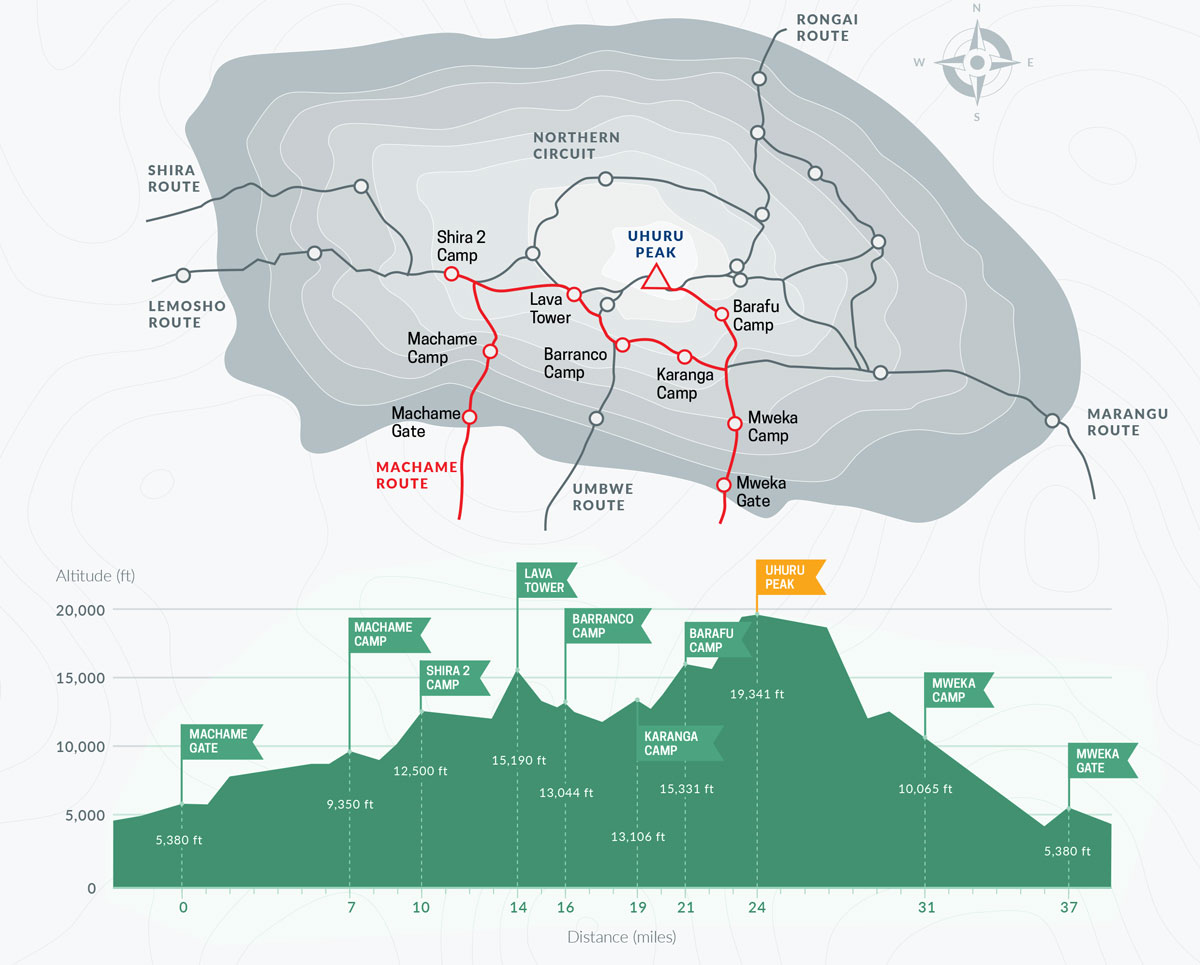
Kili Quests map of the 7-day Machame route on Mount Kilimanjaro
Route map: the 7-day Machame route.
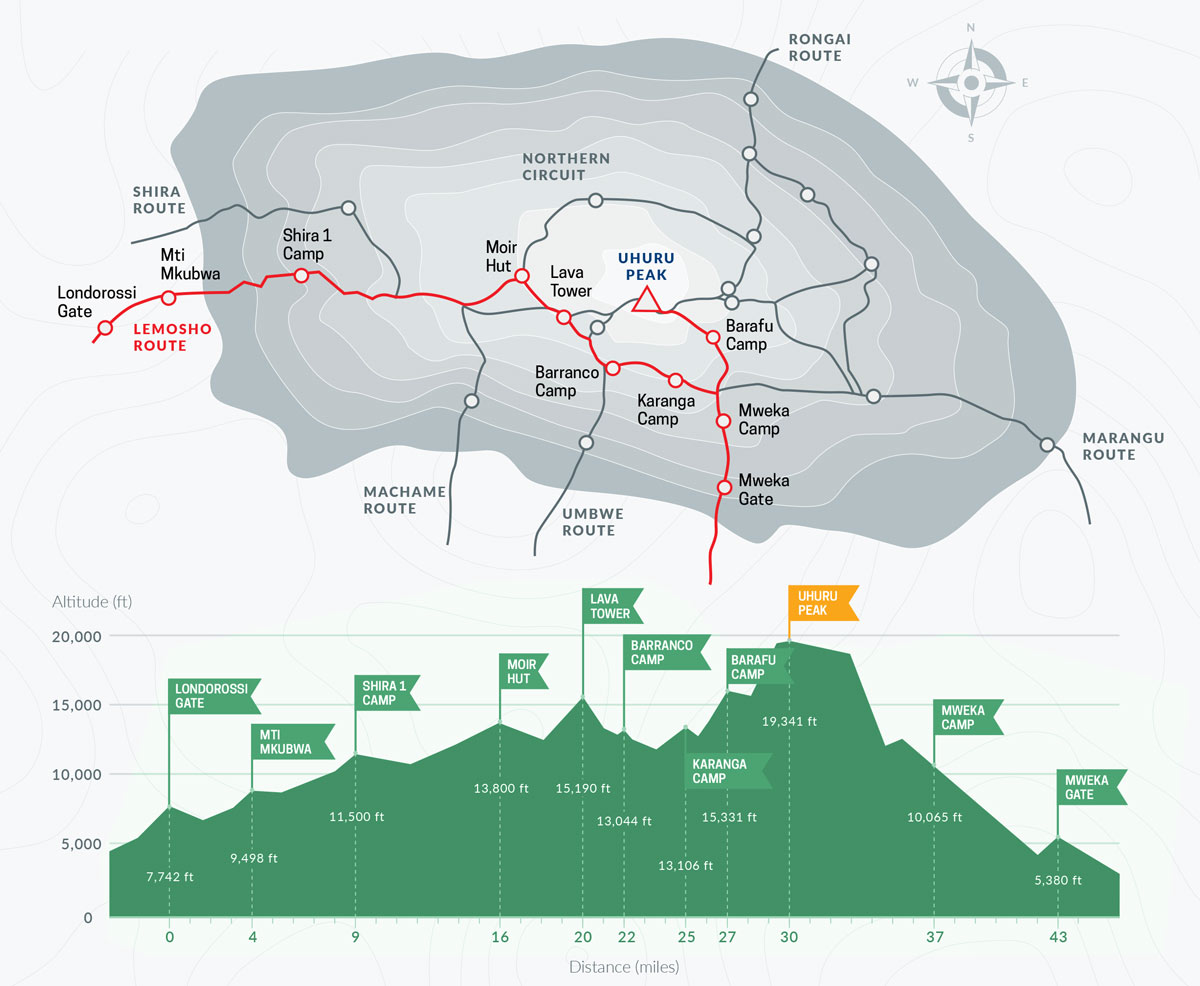
Kili Quests map of the Lemosho route on Mount Kilimanjaro
Route map: the Lemosho route.

Day-by-day itineraries: 7-day Machame, 7-day Lemosho and 8-day Lemosho

The number of days changes where you sleep and how the early stages are spread. This table shows each itinerary day by day. The lunch at Lava Tower marks the day the two routes meet.

Day-by-day itineraries on Kili Quests
Day7-day Machame7-day Lemosho8-day Lemosho
1Machame Gate to Machame CampLemosho trailhead to Mti MkubwaLemosho trailhead to Mti Mkubwa
2Machame Camp to Shira Cave CampMti Mkubwa to Shira 1 for lunch, then on to Shira 2Mti Mkubwa to Shira 1
3Shira Cave Camp to Barranco, with lunch at Lava TowerShira 2 to Barranco, with lunch at Lava TowerShira 1 to Shira 2
4Barranco to Karanga, over the Barranco WallBarranco to Karanga, over the Barranco WallShira 2 to Barranco, with lunch at Lava Tower
5Karanga to BarafuKaranga to BarafuBarranco to Karanga, over the Barranco Wall
6Barafu to Uhuru Peak, then down to Mweka Camp or Millennium CampBarafu to Uhuru Peak, then down to Mweka Camp or Millennium CampKaranga to Barafu
7Mweka Camp or Millennium Camp to Mweka GateMweka Camp or Millennium Camp to Mweka GateBarafu to Uhuru Peak, then down to Mweka Camp or Millennium Camp
8––Mweka Camp or Millennium Camp to Mweka Gate

You do not sleep at Lava Tower on either route. After Uhuru Peak you descend to Mweka Camp or Millennium Camp for the night, and the next morning you walk to Mweka Gate. Summit-day hours to each camp are given in the difficulty section below.

Acclimatization: which route gives your body more time?

The CDC advises that once you are sleeping above 3,000 m, your sleeping altitude should rise by no more than 500 m per night, and that you should add an extra night for every 1,000 m you gain. It also says that adding extra days to a trek can make it safer. The CDC also states that training and physical fitness do not affect the risk of altitude illness. These are general guidelines, not a guarantee that any itinerary will prevent altitude illness.

Sleeping altitudes by route, in order (approximate, from Kili Quests itineraries)
RouteSleeping camps and altitudes
7-day MachameMachame Camp 2,835 m, Shira Cave Camp 3,720 m, Barranco 3,900 m, Karanga 3,995 m, Barafu 4,650 m
7-day LemoshoMti Mkubwa, Shira 2 3,850 m, Barranco 3,900 m, Karanga 3,995 m, Barafu 4,650 m
8-day LemoshoMti Mkubwa, Shira 1 3,610 m, Shira 2 3,850 m, Barranco 3,900 m, Karanga 3,995 m, Barafu 4,650 m

On the 8-day Lemosho you sleep at Shira 1 as well, which is the extra night. On 6-day Machame you skip the Karanga night and go from Barranco to Barafu in one day.

How Lemosho handles altitude

Allen Minja often suggests Lemosho to climbers who have limited experience at altitude, and this is why. Shira 1 and Shira 2 have the same habitat and vegetation, and on the 8-day itinerary you spend two nights at nearly the same elevation, 3,610 m at Shira 1 and 3,850 m at Shira 2. That is a small gain between the two camps, and the extra night gives you more time on the mountain before the climb continues towards Barranco. The climb from Mti Mkubwa to Shira 1 is still a real increase in sleeping altitude, and the extra night does not remove the risk of altitude illness.

The day from Shira 2 to Barranco is not a flat one. You walk up to Lava Tower, at about 4,600 m, roughly the height of Barafu Camp (4,650 m), have lunch there, and then descend about 700 m to sleep at Barranco, at 3,900 m. That is only 50 m above Shira 2, so you climb high during the day and sleep low at night. Machame climbers do the same Lava Tower day, so both routes share it.

We also run Lemosho in 7 days, on the same route with one night fewer. On the 7-day itinerary you pass Shira 1 (3,610 m) for lunch and continue the same day to Shira 2 (3,850 m), so you sleep in the Shira area once instead of twice. The Cathedral Point walk and the Lava Tower day are the same on both itineraries. If you have no altitude experience and can spare the extra day, the 8-day gives your body more time in the Shira area.

On the way to Shira 2 we also walk via Cathedral Point, a high point on the Shira Plateau at 3,872 m, and then sleep at Shira 2, at 3,850 m. The difference is small, only 22 m, so we use it as practice for the climb-high, sleep-low habit rather than as a big gain. Allen estimates the gentler Shira 1 to Shira 2 section at about 10 km.

How Machame handles altitude

Machame has a bigger early step. Machame Camp is at 2,835 m and Shira Cave Camp at 3,720 m, a rise of 885 m in one night, which is more than the 500 m a night that the CDC advises above 3,000 m. The second day to Shira Cave Camp is the one that can feel like climbing a long flight of stairs. After that, the Lava Tower day lets you climb high and sleep lower: you have lunch at Lava Tower, at about 4,600 m, you do not sleep there, and you continue down to Barranco at 3,900 m.

The 7-day itinerary then sleeps at Karanga (3,995 m) and walks about 3 to 4 hours to Barafu the next day, with lunch and a rest before summit night. The 6-day itinerary crosses the Barranco Wall, passes Karanga and continues to Barafu in one day. Karanga to Barafu takes about 4 hours at the end of a long day, so you usually arrive at Barafu between 5:00 and 6:00 pm, with dinner and then a wake-up call at 11:00 pm. That is why we prefer the 7-day itinerary.

Both routes make the same last step before summit day, from Karanga (3,995 m) up to Barafu (4,650 m), a rise of 655 m. On every itinerary except the 6-day Machame you spend a night at Karanga first. No itinerary removes the risk of altitude illness, and individual responses differ.

What Allen Minja sees on shorter itineraries

As a guide, Allen sees that climbers on shorter itineraries are more likely to reach summit night already tired and sleepy, with altitude-sickness symptoms such as nausea and headache, and some do not reach the top because their body has not had enough time to rest and acclimatize. A good night’s sleep before summit night is hard to get on a short schedule. This is why the Karanga night on 7-day Machame matters, and why he suggests Lemosho to climbers who have not been at altitude before. These are Allen’s observations as a guide, not medical diagnoses. — Allen Minja

Our guides check each climber’s oxygen saturation twice a day, in the morning and after dinner. A reading is one piece of information, never the whole picture: it is read alongside how the climber looks and feels, and a reading alone cannot show that someone is safe to continue. For symptoms and what to do about them, read our guide to altitude sickness on Kilimanjaro.

Difficulty: which route is harder?

Neither route needs technical climbing skills, so the real challenge on both is altitude, endurance and summit night. Our guide to how hard Kilimanjaro is covers that in more detail. Here is where Machame and Lemosho differ.

  • Machame is harder in the first days. The first day from Machame Gate to Machame Camp is about 11 km, and the second day to Shira Cave Camp can feel like a long flight of stairs. Allen often recommends Machame to climbers who are comfortable hiking uphill on consecutive days and who have been at altitude before.
  • Lemosho spreads the same climb over more camps. On the 8-day itinerary you sleep at both Shira camps, and the climb between them is small. Lemosho is the route Allen suggests to fit hikers without altitude experience. It is not a shortcut: it has more walking days, and it starts with a longer drive.
  • The Barranco Wall is shared. Both routes cross it after the Lava Tower day. It is a scramble where you use your hands, so you stow your poles, and one narrow section called Kissing Rock has you hug the rock to pass.

Summit night is the same on both routes. From Barafu Camp it takes about 5 hours to Stella Point and about 6 hours to Uhuru Peak (about 7 if you are slower). The whole summit day runs 12 to 15 hours to Millennium Camp, or 15 to 18 hours to Mweka Camp, rest included. So the route you choose changes the days before summit night, not the summit night itself.

Scenery and crowds

The first days look different. Machame starts at Machame Gate and climbs to Machame Camp, then continues toward Shira Cave Camp. Lemosho starts on the western side, walks to Mti Mkubwa camp on day one, then crosses the Shira Plateau, with Shira 1 and Shira 2 camps in the same habitat. After the routes meet on the Lava Tower day, the scenery is identical: Lava Tower, Barranco, Karanga, Barafu and the summit climb.
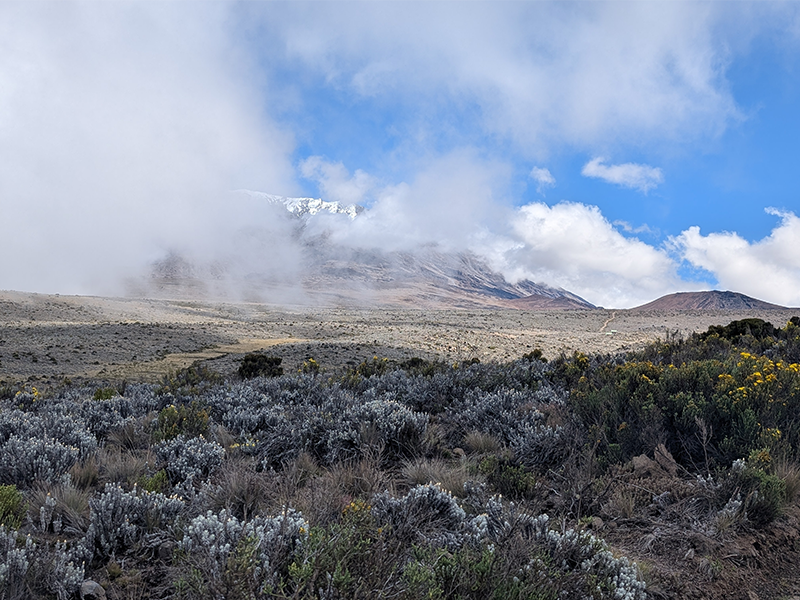
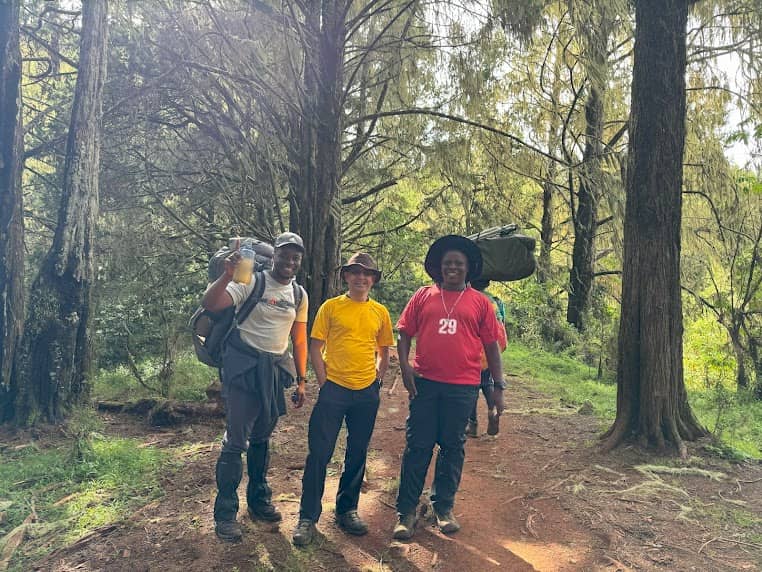
Moorland vegetation on Mount Kilimanjaro
Moorland vegetation on Mount Kilimanjaro.
Moorland on the Lemosho route on Kilimanjaro
Moorland on the Lemosho route.
Breakfast at Karanga Camp on Kilimanjaro
Karanga Camp, which both routes use.

Both routes can be busy, and how busy depends on the season. From the Lava Tower day the two routes share one trail and the same camps, so a Lemosho climber meets Machame climbers from then on. If a quieter mountain matters to you, the season you choose matters. Our month-by-month guide to the best time to climb Kilimanjaro shows how the seasons differ.

Cost: which route is cheaper?

Machame costs less. With Kili Quests, Machame is about USD 2,200 to 2,400 per person and Lemosho is about USD 2,700 to 3,000 per person for 7 or 8 days. These are indicative prices from November 2026, in US dollars, and they are ranges, not fixed quotations: the exact price depends on your itinerary, your group size and what is included.

Lemosho costs more for three reasons:

  • Distance: the drive from a Moshi hotel to Lemosho is about 3 to 4 hours, against about 1 to 2 hours to Machame Gate.
  • Crew: more days on the mountain mean a bigger crew.
  • Food: a bigger crew means more food to carry and cook.

When you compare quotes, check how many days each includes, the group size and what is covered. Our Kilimanjaro climb cost guide lists what a price normally includes.

Which route should you choose?

Start with your altitude experience, then your time and budget. Here is how we match them.

Which route suits which climber
Your situationRoute we suggestWhy
Fit, with little or no altitude experienceLemosho, the 8-day itinerary if you canTwo nights at Shira 1 and Shira 2, only 240 m apart
Comfortable hiking uphill on consecutive days, and been at altitude before7-day MachameShorter, lower price, and a Karanga night before Barafu
Budget matters mostMachameLower price than Lemosho
You want the shortest drive to the startMachameAbout 1 to 2 hours, against 3 to 4 hours
You want the most time on the mountain8-day LemoshoEight days, with two Shira nights
Only six days are available6-day Machame, with careYou go from Barranco to Barafu in one day, so we prefer 7 days

If this is your first Kilimanjaro climb, think about your hiking experience, your available time and how many days you can allow for acclimatization. A fit beginner can climb either route, but Allen generally suggests the 8-day Lemosho for climbers with limited altitude experience who can spare the extra day. The 7-day Machame is another option for climbers who are comfortable hiking uphill on consecutive days. Fitness helps with the physical demands of the trek, but the CDC says it does not affect your risk of altitude illness. If you are unsure, share your dates and hiking experience with our team and we will help you choose.

Machame vs Lemosho: pros and cons

Pros and cons of each route on Kili Quests itineraries
RouteProsCons
Machame
  • Costs less than Lemosho
  • Shorter drive to the start
  • 6 or 7 days
  • Karanga night on the 7-day itinerary
  • First day is about 11 km
  • A rise of 885 m to Shira Cave Camp on night two
  • 6-day version reaches Barafu the same day as Barranco
Lemosho
  • Two Shira nights only 240 m apart on the 8-day itinerary
  • Sleeping altitude rises only 50 m from Shira 2 to Barranco, after a climb-high day over Lava Tower
  • More time on the mountain
  • Costs more than Machame
  • Drive to the start is about 3 to 4 hours
  • More days, so a bigger crew and more food

Frequently asked questions about Machame vs Lemosho

Which route is better, Machame or Lemosho?

Neither route is better for everyone. We usually suggest the 8-day Lemosho to fit climbers who have limited altitude experience and enough time. We recommend Machame, ideally the 7-day itinerary, to climbers who are comfortable hiking uphill on consecutive days and have been at altitude before, or who have fewer days or a smaller budget. Your time, budget, hiking experience and individual response to altitude should all shape the decision.

Is Machame or Lemosho better for beginners?

Both routes can suit a beginner who is physically prepared. For climbers with limited altitude experience we generally recommend the 8-day Lemosho, because you sleep at both Shira 1 and Shira 2, only 240 m apart, which gives your body time to adjust. Machame can also suit beginners who are comfortable with consecutive uphill days, and we prefer its 7-day itinerary to the 6-day. The CDC says fitness does not affect the risk of altitude illness, so strength alone is not a reason to choose the shorter route.

Is Lemosho worth the extra cost?

It can be, if you have little altitude experience and the time for an 8-day climb. With Kili Quests, Lemosho is about USD 2,700 to 3,000 per person and Machame about USD 2,200 to 2,400 (indicative, November 2026). Lemosho costs more because of the longer drive from Moshi, the bigger crew and the extra food. If your budget or days are limited, the 7-day Machame is a sound choice.

Do Machame and Lemosho use the same trail?

Not at the start. Machame begins at Machame Gate on the southern side and Lemosho begins on the western side. They meet on the day that goes over Lava Tower to Barranco, which is day 4 on 8-day Lemosho. After that they share the same camps at Barranco, Karanga and Barafu, the summit climb, and the descent to Mweka Gate.

Is Machame harder than Lemosho?

Machame is harder in the first days. The first day is about 11 km and the second can feel like a long flight of stairs, with a rise of 885 m in sleeping altitude. Lemosho has more walking days but gentler steps between the Shira camps. Summit night is the same on both, and neither route needs technical climbing skills.

Not sure which route fits you?

Share your dates and hiking experience and we will recommend the route and length that suit you. No operator can guarantee a summit.

  • When would you like to climb?
  • How many days can you spend on the mountain?
  • Have you hiked uphill on consecutive days, or been at altitude before?
  • How many people will be joining?
  • Is budget a deciding factor?

WhatsApp us: +255 (762) 187 967

Read traveller reviews of Kili Quests on Tripadvisor.

About the author

Given Minja is a Kilimanjaro guide at Kili Quests in Moshi, Tanzania, with more than eight years of guiding experience. Given Minja and fellow guide Daniel Munuo each completed Sentinel Outdoor Institute’s 80-hour Wilderness First Responder course and a Sentinel Outdoor Institute CPR course. Allen Minja, Kili Quests co-founder and Kilimanjaro guide with more than 30 years of mountain experience, is the source of the guiding observations in this article. Learn more about Kili Quests and the team.

Sources

Sleeping altitudes, itinerary details, summit-day times and prices come from Kili Quests itineraries and guiding experience, and are approximate. Prices are in US dollars per person and can change. This article gives general information, not individual medical advice. See a doctor before climbing, especially if you have a heart, lung or circulation condition.

Keep planning your climb
Kilimanjaro Climb Cost: Full Price Breakdown | Kili Quests

Questions before you book? WhatsApp us: +255 (762) 187 967

Quick answer: what does a Kilimanjaro climb cost?

With Kili Quests, a guided Kilimanjaro climb costs about USD 1,800 to 3,500 per person, depending on the route and number of days: Marangu USD 1,800 to 2,000, Machame USD 2,200 to 2,400, Rongai and Umbwe about USD 2,400, Shira about USD 2,600, Lemosho USD 2,700 to 3,000, and the Northern Circuit USD 3,000 to 3,500 (indicative prices, November 2026). Group size can lower the price per person, so send us your group size for a group quote. The price includes all park fees, camping equipment, meals for climbers and crew, crew wages, an oxygen cylinder, a pulse oximeter, a private portable flush toilet, transfers to the park gate and two hotel nights. It does not include flights, your visa, travel insurance, personal gear or tips. For tips, we advise 20 percent of the package price per person. See the price table and our tipping guidance.

Kilimanjaro is not a cheap trip, and the prices you see online are hard to compare. One operator’s quote may include park fees, hotel nights and a toilet tent, and another’s may not. This guide shows what we charge, what is inside that price, what you pay on top, and which questions to ask any operator before you send a deposit.

It is written by Given Minja and draws on guiding observations from Allen Minja, Kili Quests co-founder and Kilimanjaro guide with more than 30 years of mountain experience. The prices are ours, so they describe how Kili Quests works, not every operator. For the routes themselves, see our Kilimanjaro routes comparison.

Kili Quests prices by route

These are indicative prices in US dollars per person for 2026, and we confirm the exact price when you tell us your dates and group size. The route and the number of days on the mountain are the biggest things that move the price.

Kili Quests indicative prices per person, USD, November 2026
RoutePrice per person (USD)What to know
Marangu1,800 to 2,000Less expensive partly because it uses mountain huts rather than a full camping arrangement. The final price still depends on the itinerary length, crew arrangements and group size.
Machame2,200 to 2,400USD 2,400 per person, and for groups of 5 to 8 climbers we offer prices starting from USD 2,200. Camping route. About 1 to 2 hours by road from a Moshi hotel to Machame Gate.
RongaiAbout 2,400Camping route, and one of the quieter routes.
UmbweAbout 2,400Camping route.
ShiraAbout 2,600Camping route.
Lemosho2,700 to 3,000Camping route for 7 or 8 days. About 3 to 4 hours by road from a Moshi hotel to the start, plus a bigger crew for more days and more food.
Northern Circuit3,000 to 3,500The longest route, and one of the quieter routes.

Group size can change the price per person. For example, Machame is USD 2,400 per person, and for groups of 5 to 8 climbers we start offering from USD 2,200 per person. To get the price for your group, send us a message with your group size and dates, and we will reply with the cost for your group. For route detail, read our guides to the Machame route and the Lemosho route.

Comparing prices. Published prices for Kilimanjaro climbs vary a lot, and a price is only useful if you know what it includes. That is why the next sections list exactly what we include.

What affects the cost of climbing Kilimanjaro?

Several things shape the price of a climb. These are the main ones, and each of them is part of what a package has to cover.

  • Route and days. More days mean more park fees, more food and more crew time.
  • Park fees. Conservation, camping or hut, and rescue fees are charged by TANAPA and add up with every day and night on the mountain.
  • Food. Our price covers all meals for clients and for the porters for the whole climb. A longer climb and a bigger crew mean more food to buy, carry and cook, and a cook to prepare it. This is one reason Lemosho costs more than Machame. Every climber needs adequate meals on every route, including Marangu.
  • Mountain crew. Guides, porters and cooks are paid wages for every day of the climb. We use 3 porters per climber on a standard camping climb, and a luxury climb with a bed, a big tent and a daily hot-water shower uses 5 porters per climber.
  • Camping equipment. Tents, client mattresses, a mess tent, a cooking tent, chairs, tables, plates, cooking gas and lamps all have to be provided, carried and kept in good condition. Marangu is hut-based, so on camping routes operators must provide and transport tents, mattresses and dining facilities that a hut route does not need. We do not carry tents, a dining table or chairs on Marangu.
  • Transport and hotel nights. Lemosho starts about 3 to 4 hours by road from a Moshi hotel, while Machame Gate is about 1 to 2 hours. Our price also covers transfers to the park gate and two hotel nights, one before and one after the climb.
  • Group size. Park fees are charged per person, but crew and transport costs are shared across the group, so the number of people climbing together can change the cost per person. On Machame, for example, groups of 5 to 8 climbers can start from USD 2,200 per person.
  • Comfort level. Private toilet, bed, shower and menu all change the cost.
  • Safety equipment. An oxygen cylinder, a pulse oximeter, a blood pressure machine and a first aid kit are a cost to the operator, so ask what is included.

For a view of how season changes crowding on these routes, see our guide to the best time to climb Kilimanjaro.

Kilimanjaro park fees explained

Park fees are the largest single cost on most climbs, and they are set by Tanzania National Parks (TANAPA), not by the operator, so they cannot be negotiated. The tariff for 1 July 2026 to 30 June 2027 lists the fees below in Tanzanian shillings (TZS) for a non-resident adult aged 16 or over on Kilimanjaro. We also show each fee in US dollars (USD). The shilling amounts equal the older 2023/24 dollar tariff at about TZS 2,555 per US dollar, which is our own calculation, so in dollars the fees have not changed.

Kilimanjaro National Park fees, non-resident adult, 2026/27 tariff
FeeTZSUSDHow it is charged
Conservation (park entry) fee178,85070Per person, per 24 hours on the mountain
Camping fee (public campsites)127,75050Per person, per night
Hut fee (Marangu route)153,30060Per person, per night
Upper Barafu campsite255,500100Per person, per night
Rescue fee51,10020Per person, per trip

The tariff also lists small charges for the crew: TZS 3,500 for a mountain guide and TZS 5,000 for a porter or a cook, which is about USD 1.40 and USD 2. These are separate from the visitor fees above, and the operator pays them.

Here is what the visitor fees add up to on a camping climb. The totals are our own arithmetic from the table above, and they leave out the crew charges and any route-specific charges.

Park fees per person on a camping climb, 2026/27 tariff
ClimbConservationCampingRescueTotal
7 days (7 park days, 6 nights)TZS 1,251,950
(USD 490)
TZS 766,500
(USD 300)
TZS 51,100
(USD 20)
TZS 2,069,550
(USD 810)
8 days (8 park days, 7 nights)TZS 1,430,800
(USD 560)
TZS 894,250
(USD 350)
TZS 51,100
(USD 20)
TZS 2,376,150
(USD 930)

TANAPA’s public tariff page still shows the 2023/24 financial year, so check the current figures on the Tanzania National Parks (TANAPA) website or with us before you plan around them. The tariff information says its fees are inclusive of 18 percent VAT where applicable, so we have not added VAT to these totals. Some operators add 18 percent on top of the published amounts, so ask how any quote treats VAT. At Kili Quests, all park fees are inside the package price. When you compare quotes, ask whether park fees are in them.

Guide, porter and cook costs

Crew wages are the second big cost. We pay guides, porters and cooks at the rates the authorities recommend, and those wages are inside our package price. The daily porter rate KINAPA has established for the mountain is TSh 25,000. Our daily wages by role are:

Kilimanjaro porters on the mountain
Kilimanjaro porters. Their wages are inside our package price.
Daily crew wages at Kili Quests (Tanzanian shillings)
Crew roleDaily wage (TSh)
Porter25,000
Assistant cook30,000
Waiter30,000
Cook35,000
Guide50,000

Our crew set-up on a standard camping climb looks like this:

  • Porters: 3 per climber. You carry only a daypack of about 5 to 7 kg, and the porters carry your duffel bag, tents, food and camp equipment. For more on loads, read how many porters you need on Kilimanjaro.
  • Cooks: 1 cook for up to 8 climbers, 2 for 9 to 15 climbers and 3 for 16 to 25 climbers.
  • Toilet: a private portable flush toilet with a dedicated toilet porter.
  • Safety: an oxygen cylinder and a first aid kit on every climb, with pulse oximeter checks twice a day.

What our price includes and does not include

What a Kili Quests climb price covers
Included in the priceNot included
All park fees: entry, camping and rescue feesTips for guides, porters and cooks
Camping equipment: tents, chairs, tables, mess tent, cooking tent, client mattresses, plates, forks, knives, cooking gas and lampsYour visa
Oxygen cylinder, pulse oximeter and blood pressure machinePersonal trekking gear such as sleeping bag, boots and clothing (available to rent)
All meals for clients and porters for the whole climbTravel insurance and personal expenses such as laundry, phone and drinks
Wages for porters, guides and cooks at the rates the authorities recommendFlights, and overland transfers to Kilimanjaro International Airport or Arusha if you arrive from Nairobi
All transport costs to organize the climb, including preparation, porters and foodHotel nights beyond the two included nights
Transfers from your hotel or the airport to the park gate
Private portable flush toilet
Two hotel nights: one before and one after the climb

The camping equipment applies to our camping routes. On Marangu you sleep in huts. Our Kilimanjaro climb package page explains each inclusion in more detail.

Breakfast served at Karanga Camp on Kilimanjaro
Breakfast at Karanga Camp. Meals for clients and crew are part of the package price.

Extra costs to budget for

These costs sit outside any operator’s climb price, so add them to your plan.

Costs to plan for besides the climb package
CostWhat to expect
TipsWe advise 20 percent of the package price per person. See the next section.
Tanzania visaFees depend on your nationality and visa type. The official ordinary single-entry visa fee is USD 50 and the multiple-entry visa is USD 100, and US citizens are required to apply for the multiple-entry visa. Apply through the official Tanzania Immigration e-visa portal and check the requirements for your passport before you pay.
FlightsDepend on where you fly from and the season. Check current fares to Kilimanjaro International Airport, Dar es Salaam or Nairobi.
Travel insuranceChoose a policy that covers trekking to the summit at 5,895 m and helicopter evacuation, and read what altitude it allows.
Personal gearSleeping bag, boots, clothing and similar items can be rented. Use our Kilimanjaro packing list to decide what to buy and what to rent, and our gear rental guide for what to rent in Moshi and Arusha.
Extra hotel nightsTwo nights are included. Any additional night is extra.

How much to tip on Kilimanjaro: Kili Quests guidance

Tips are not part of our package price. Our guidance is that clients tip 20 percent of the climb package price per person, for the guides, porters and cooks who looked after the group. Here is why we suggest it.

Climbing crews do hard work to make a client’s Kilimanjaro dream come true, and many of them depend on this job. When the low season arrives and there are no trips, some go back to farming, and they need capital for that, along with things like insurance for their families. Tips earned in the season are what they draw on, so they can say they saved while they were working.

Here is what that looks like in dollars at the ends of each Kili Quests price range. The amounts are our own arithmetic from the guidance.

Kili Quests tipping guidance, USD per person
RoutePackage priceTip at 20 percent
Marangu1,800 to 2,000360 to 400
Machame2,200 to 2,400440 to 480
Rongaiabout 2,400480
Umbweabout 2,400480
Shiraabout 2,600520
Lemosho2,700 to 3,000540 to 600
Northern Circuit3,000 to 3,500600 to 700

This is Kili Quests’ own guidance. If you have questions about tipping before your climb, message us on WhatsApp, or read our Kilimanjaro tipping guide.

Budget, standard and luxury climbs

Quotes fall into broad levels of service. Here is how we separate two of them.

Standard and luxury climbs at Kili Quests
LevelPorters per climberWhat changes
Standard3Camping with tents, a mess tent, mattresses, meals, a private portable flush toilet and safety equipment, as listed above.
Luxury5Adds a bed, a big tent and hot water for a shower every day. These comforts need extra crew to carry.

Luxury prices depend on your route and what you want to add, so message us on WhatsApp for a quote.

Why Kilimanjaro prices differ between operators

A lower price is not automatically a problem. When you compare lower-priced packages, check carefully what is included, because differences can relate to accommodation, equipment, crew arrangements, transport, meals and other services. Before you pay anyone, ask:

  • Are all park fees, including rescue fees, in the price, and how is VAT treated?
  • How many porters per climber, and what wage do they receive?
  • Is there an oxygen cylinder and a first aid kit on every climb, and who carries them?
  • Are pulse oximeter checks done every day?
  • How many climbers share one guide and one cook?
  • Is a toilet provided, and who carries it?
  • Are airport transfers and hotel nights included, and how many?
  • How many days is the itinerary, and where do you sleep each night?
  • What do breakfast and dinner look like, and what tents and mattresses are supplied?

Food and tents deserve a close look. Appetite can change at altitude, so a well-run kitchen plans enough food, with alternatives for a climber who does not feel like the meal on offer, especially before summit night. A tent that lets rain in makes it harder to sleep and recover before the next day.

Marangu: why our itinerary is six days. Marangu is the hut route, so you sleep in mountain huts and not in tents. Allen Minja has seen the cheaper Marangu packages that other operators sell. Our Marangu itinerary is six days long, with one extra day for acclimatization, so your body has more time to adjust to the altitude.

This extra day makes Marangu with Kili Quests an option for beginners who prefer huts to tents. It does not remove the risk of altitude illness, so prepare well and follow your guide’s advice.

What not to cut from your budget

Some savings cost you more than they save.

  • Acclimatization days. The CDC advises that above 3,000 m you should not increase your sleeping altitude by more than 500 m per night, and that you should add a rest night for every 1,000 m gained. Fitness does not change that risk. Our acclimatization guide explains how our itineraries handle it, and our guide to altitude sickness symptoms and causes explains what to watch for.
  • Emergency oxygen and first aid. Ask for them in writing.
  • Proper meals and rest for the crew. Ask how the crew is fed and housed on the mountain.
  • Good boots and warm clothing. Rent what you do not own rather than skipping it.
  • Insurance. Buy a policy that covers the altitude and evacuation.

Example budgets using Kili Quests prices

Here is one way to add up a first-time budget for a US traveler, using the package price, our tipping guidance and the USD 100 US visa fee. The totals are our own arithmetic and do not include flights, insurance, personal gear or extra hotel nights.

Example budgets per person for a US traveler, USD
RoutePackageTips (20%)US visaTotal
Machame2,200 to 2,400440 to 4801002,740 to 2,980
Lemosho2,700 to 3,000540 to 6001003,340 to 3,700

Is climbing Kilimanjaro worth the cost?

Your price pays for park fees, a mountain crew, food, camping equipment, transport and safety equipment. What matters is knowing exactly what each quote covers, so you can compare like with like.

Smiling climbers on a Kili Quests Kilimanjaro trek
A moment from a Kili Quests climb.

Given Minja: “Our work is to deliver for every client who climbs with us. We make sure their expectations are met and then go beyond them. The best thing that can happen to us is when a client tells a friend: ‘Go with Allen. He is the right person for you.’”

Allen Minja does not only guide. He makes sure he understands each client and uses all of his skill to meet their expectations and give them a better experience on the mountain.

Frequently asked questions about Kilimanjaro costs

How much does it cost to climb Kilimanjaro with Kili Quests?

Our indicative prices in November 2026 range from about USD 1,800 per person for Marangu to USD 3,500 for the Northern Circuit, depending on the route. Every route is listed in the price table above. Group size can lower the price per person: on Machame, for example, the price is USD 2,400 per person and groups of 5 to 8 climbers can start from USD 2,200. Send us a message with your group size and dates and we will reply with the cost for your group.

Are park fees included in the price?

Yes. At Kili Quests, the price includes all park fees: entry, camping and rescue fees. The amounts depend on the route, the number of days and the current TANAPA tariff, so see the park fees section above and confirm current rates with TANAPA. Ask any other operator to confirm in writing that park fees are included.

How much should I tip on Kilimanjaro?

We advise 20 percent of the package price per person, for the guides, porters and cooks. On a Machame climb at USD 2,200 to 2,400, that is about USD 440 to 480. Tips are not included in the package price.

Why do Kilimanjaro prices vary so much between operators?

Park fees are set by TANAPA, so differences can relate to crew arrangements, food, equipment, group size, itinerary length and what the price includes. Ask each operator what is in the price, how many porters you get per climber, and whether oxygen, a first aid kit and pulse oximeter checks are provided.

What other costs should I budget for besides the climb?

Flights, your visa (the official fee is USD 50 for an ordinary single-entry visa and USD 100 for a multiple-entry visa, depending on nationality and visa type), travel insurance, personal trekking gear or rental, tips, personal expenses, and any hotel nights beyond the two we include.

Want an exact price for your dates?

Share your dates, group size and hiking experience and we will recommend a route and send you a price. No operator can guarantee a summit.

  • When would you like to climb?
  • How many people will be joining?
  • Which route are you considering, or would you like us to suggest one?
  • Do you want a standard or luxury climb?

WhatsApp us: +255 (762) 187 967

Read traveller reviews of Kili Quests on Tripadvisor.

About the author

Given Minja is a Kilimanjaro guide at Kili Quests in Moshi, Tanzania, with more than eight years of guiding experience. Given Minja and fellow guide Daniel Munuo each completed Sentinel Outdoor Institute’s 80-hour Wilderness First Responder course and a Sentinel Outdoor Institute CPR course. Allen Minja, Kili Quests co-founder and Kilimanjaro guide with more than 30 years of mountain experience, is the source of the guiding observations in this article. Learn more about Kili Quests and the team.

Sources

Kili Quests prices, inclusions, crew numbers and tipping guidance come from Kili Quests itineraries and operations. Prices are indicative, in US dollars per person, and can change. Park fees, visa fees and wages change over time, so confirm current figures before you book. This article gives general information, not individual medical or financial advice.

Keep planning your climb
Machame Route Kilimanjaro: 7-Day Itinerary, Difficulty & Cost

Questions before you book? WhatsApp us: +255 (762) 187 967

This guide is for travellers deciding whether the Machame Route suits them and whether to climb it in 6 or 7 days. It follows the 7-day itinerary day by day, explains what one extra night at Karanga Camp changes, shows how the sleeping altitude rises, and gives our price. If you are still comparing routes, start with our Kilimanjaro routes comparison.

Experience behind this guide: Allen Minja, co-founder of Kili Quests, has more than 30 years of mountain experience. He has seen a great deal on the mountain, and he has watched how mountain tourism and the climbers who come to it have changed since his early years. He uses that experience to help our clients choose a route and plan their climb, whether they expect the mountain as it was in his era or as it is today.

Is the Machame Route worth it? Yes, if you are comfortable camping and want a scenic, active route. We recommend the 7-day itinerary. The 6-day goes from Barranco Camp straight to Barafu Camp, while the 7-day adds a night at Karanga Camp, so you have a full afternoon to rest before summit night. Machame is not the easiest route: your sleeping altitude rises by more than the CDC’s guide of about 500 m per night on two nights, so altitude still deserves respect. Kili Quests’ indicative Machame price (November 2026) is US$2,200 per person for 6 days and US$2,400 per person for 7 days. See what is included.

What Is the Machame Route?

The Machame Route is a camping route on the southwestern side of Mount Kilimanjaro, and one of the most popular. It starts at Machame Gate (about 1,800 m), climbs through rainforest to Machame Camp and crosses the moorland to Shira Cave Camp. It then passes Lava Tower and the Barranco Wall, continues along the southern circuit through Karanga, and summits from Barafu Camp. You descend by the Mweka route to Mweka Gate.

Machame is often called the “Whiskey Route”, a nickname that sets it against Marangu’s “Coca-Cola Route”. It is steeper and more demanding than Marangu, and you sleep in tents. That does not mean it is only for experts, but it does mean you should choose the 7-day version, train properly and respect the altitude.

Machame Route at a glance

FeatureDetails
Length6 or 7 days. We recommend 7 days.
DistanceAbout 62 km (37 miles), gate to gate. Published figures vary by source.
StartMachame Gate, about 1,800 m, southwest side
FinishMweka Gate, 1,640 m
Highest pointUhuru Peak, 5,895 m (19,341 ft)
AccommodationTents at camps. There are no huts on this route.
DifficultyModerate to challenging. It is not a technical climb, but the days are long and summit night is cold and slow.
Kili Quests priceUS$2,200 per person for 6 days; US$2,400 per person for 7 days (indicative, November 2026)

Who Should Choose the Machame Route?

I often recommend Machame to climbers who are comfortable hiking uphill on consecutive days and who have previous altitude experience. Day one, from Machame Gate to Machame Camp, is about 11 km. Day two, towards Shira Cave Camp, can feel like climbing a long flight of stairs. For fit hikers with little altitude experience, I often suggest Lemosho instead.

Your situationOur advice
You are comfortable camping and hiking uphill on back-to-back daysMachame on 7 days is a good fit.
You have climbed at altitude before and want a scenic, active routeMachame is a strong choice. Lava Tower and the Barranco Wall are the highlights.
You are a beginner with little mountain experienceWe often suggest Lemosho (7 or 8 days) or the 7-day Rongai first. If you choose Machame, take 7 days.
You strongly prefer huts to tentsMarangu is the only main route with huts. Read Machame vs Marangu.
You are uncomfortable with steeper sections or want the easiest routeMachame has steep trail and a scramble on the Barranco Wall. Ask us which route suits you.

7-Day Machame Route Itinerary

The 7-day itinerary is the version we recommend for most climbers. Sleeping elevations and hiking times below are approximate. Actual times vary with your pace, the weather, trail conditions and how long you rest.

Machame Route map on Mount Kilimanjaro showing the trail, the camps and the elevation profile to Uhuru Peak
Machame Route map, from Machame Gate past Lava Tower and Barafu Camp to Mweka Gate.
DayRouteSleeping altitudeHiking time
1Machame Gate to Machame Camp2,835 m5–6 hours
2Machame Camp to Shira Cave Camp3,750 m5–6 hours
3Shira Cave Camp to Lava Tower (lunch), then down to Barranco Camp3,900 m6–7 hours
4Barranco Camp over the Barranco Wall to Karanga Camp3,995 m4–5 hours
5Karanga Camp to Barafu CampAbout 4,670 m3–4 hours
6Barafu Camp to Uhuru Peak, then down to Mweka Camp or Millennium CampMweka Camp about 3,100 m, or Millennium Camp 3,820 m12–14 hours to Millennium Camp, or 15–18 hours to Mweka Camp, including rest
7Mweka Camp to Mweka GateFinish at the gate (1,640 m)3–4 hours

Day 1: Machame Gate to Machame Camp

Your team completes park registration at Machame Gate, then you walk into the rainforest. The trail climbs steadily through thick forest, and it can be muddy or slippery after rain. The day is not technical, but the steady uphill walking is demanding.

  • Altitude: about 1,800 m to 2,835 m
  • Distance: about 11 km
  • Hiking time: 5–6 hours
  • Zone: rainforest
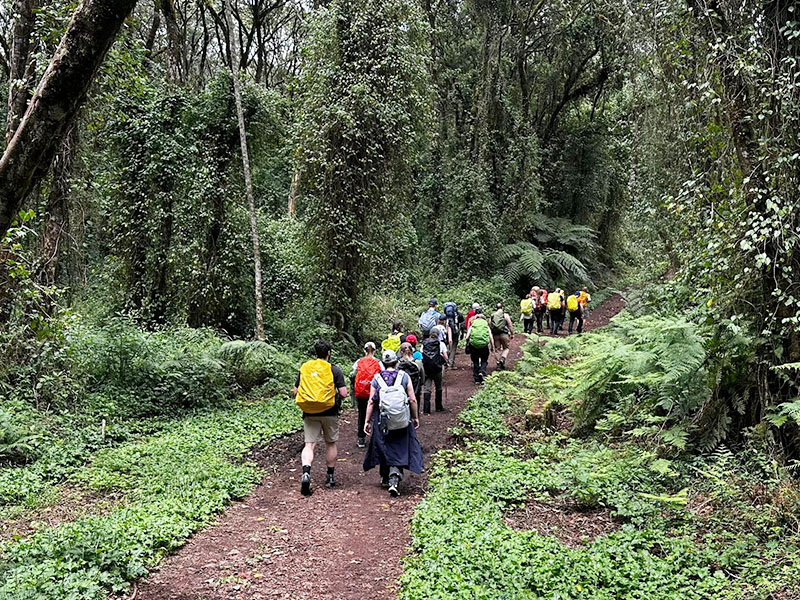
A trekker heading into the rainforest zone on Kilimanjaro
A trekker heading into the rainforest zone, where Machame begins.

Day 2: Machame Camp to Shira Cave Camp

You leave the rainforest and enter the moorland. The trail opens up, with better views of Kilimanjaro. Your sleeping altitude rises by about 915 m, so walk slowly and drink regularly. Day two can feel like climbing a long flight of stairs.

  • Altitude: 2,835 m to 3,750 m
  • Hiking time: 5–6 hours
  • Zone: moorland
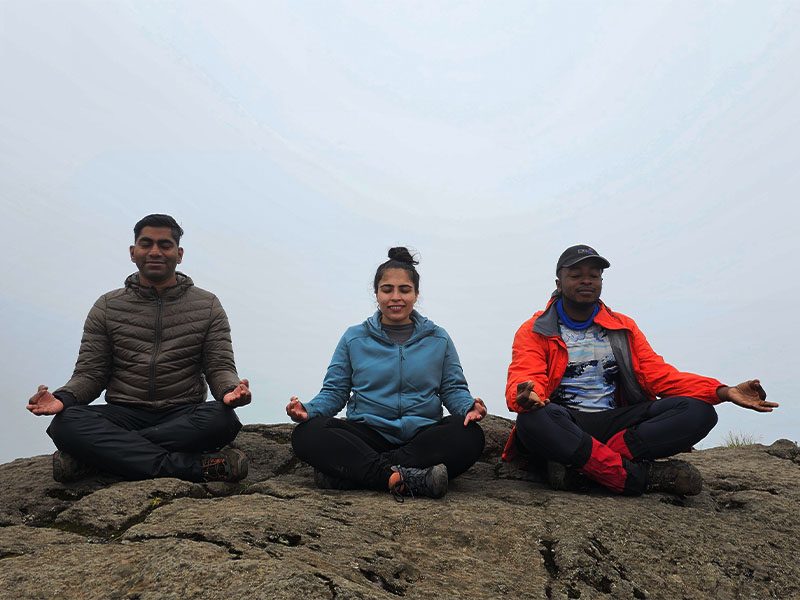
Trekkers meditating on a rock during a break on the way to Shira Cave Camp on the Machame Route
A break on the way to Shira Cave Camp on day 2.
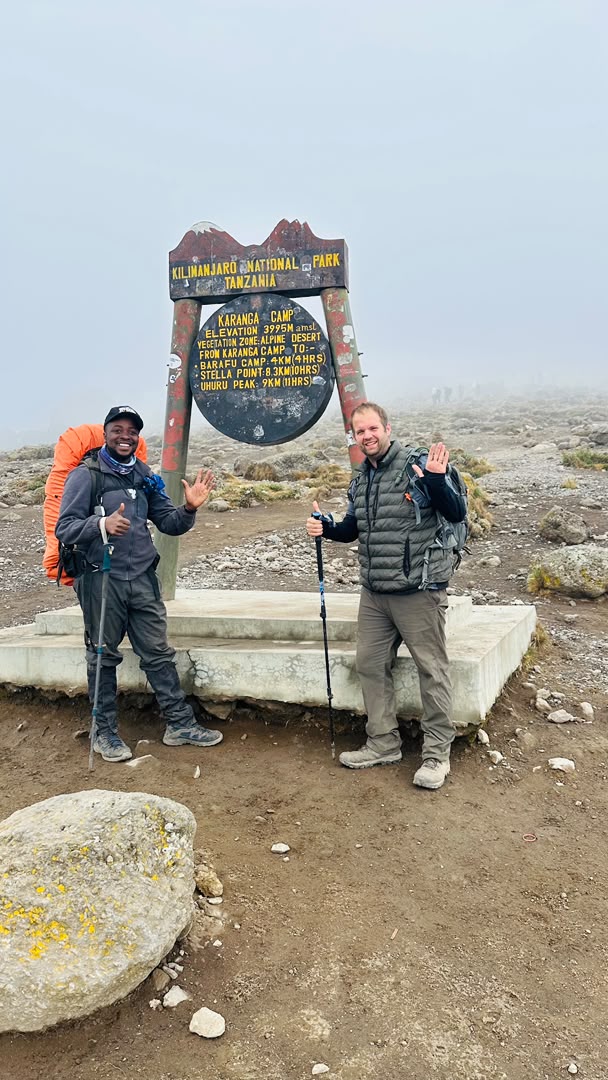
Trekkers with hiking poles at the Shira Cave Camp sign on day 2 of the Machame Route
Arriving at Shira Cave Camp (3,750 m) on day 2.

Day 3: Shira Cave Camp to Barranco Camp via Lava Tower

This is the main acclimatization day on Machame. You climb towards Lava Tower at about 4,600 m, where we have lunch (we do not sleep there), and then descend about 700 m to sleep lower at Barranco Camp. Climbing high and sleeping low gives your body time at altitude without raising your sleeping altitude much, because you sleep at 3,900 m, about 150 m above the previous night.

  • Altitude: 3,750 m up to about 4,600 m, then down to 3,900 m
  • Hiking time: 6–7 hours
  • Zone: alpine desert
  • Camp: Barranco Camp

Some climbers begin to notice altitude symptoms on this day. Read our guide to altitude sickness symptoms and causes so you know which symptoms are common and which warning signs must not be ignored.

Day 4: Barranco Camp to Karanga Camp

The day starts with the Barranco Wall, one of the best-known sections of the Machame Route. It looks intimidating from camp, but most climbers manage it safely with slow movement and guide support. After the wall, the trail continues over ridges and valleys to Karanga Camp, where the 7-day itinerary sleeps.

  • Altitude: 3,900 m to 3,995 m
  • Hiking time: 4–5 hours
  • Highlight: Barranco Wall
  • Camp: Karanga Camp

Day 5: Karanga Camp to Barafu Camp

This is a shorter day. You walk about 3 to 4 hours to Barafu Camp, the base camp for summit night, and have lunch and time to rest. We wake you at 11:00 pm for summit night.

  • Altitude: 3,995 m to about 4,670 m
  • Hiking time: 3–4 hours
  • Zone: alpine desert
  • Camp: Barafu Camp

Day 6: Barafu Camp to Uhuru Peak, then down to Mweka Camp or Millennium Camp

Summit day is the hardest day on the Machame Route. We wake you at 11:00 pm, serve tea, coffee and biscuits at 11:30 pm and leave at midnight. It takes about 5 hours to reach Stella Point, then about 6 hours to Uhuru Peak at a normal pace, or about 7 hours if you are slower. Coming back down to Barafu takes 3 to 4 hours. You then rest at Barafu for 1 to 2 hours. After the rest, it is about 2 hours (about 4 km) to Millennium Camp or about 5 hours (about 12 km) to Mweka Camp.

Counting the rest at Barafu, the day from the midnight start takes about 12 to 14 hours if you sleep at Millennium Camp, and 15 to 18 hours if you continue to Mweka Camp. The decision to continue on summit night depends on how you are doing and how the previous days went. After the summit, we sleep either at Millennium Camp (3,820 m), which lies on the descent route above Mweka Camp, or at Mweka Camp. The plan depends on your group, and your guide confirms it with you.

  • Altitude: about 4,670 m to 5,895 m, then down to 3,820 m (Millennium Camp) or about 3,100 m (Mweka Camp)
  • Total time from the midnight start, including the 1 to 2 hour rest at Barafu: 12–14 hours to Millennium Camp, or 15–18 hours to Mweka Camp
  • Summit: Uhuru Peak
  • Camp: Millennium Camp or Mweka Camp, depending on the plan for your group

If you are worried about the challenge, read how hard Kilimanjaro is, and see our summit night guide.

Day 7: Mweka Camp to Mweka Gate

The last day descends through the rainforest to Mweka Gate. If you slept at Millennium Camp instead of Mweka Camp, you start this day from Millennium and walk the longer distance to the gate. After you sign out, climbers who reached the summit receive their Kilimanjaro summit certificate before the transfer back to Moshi or Arusha.

  • Altitude: about 3,100 m to 1,640 m
  • Hiking time: 3–4 hours
  • Zone: rainforest
  • Finish: Mweka Gate

6-Day or 7-Day Machame: What One Night at Karanga Changes

The difference between our 6-day and 7-day Machame itineraries is one night at Karanga Camp. On the 7-day itinerary we sleep at Karanga after crossing the Barranco Wall. The next morning we walk about 3 to 4 hours to Barafu Camp, have lunch and have time to rest. We wake you at 11:00 pm for summit night.

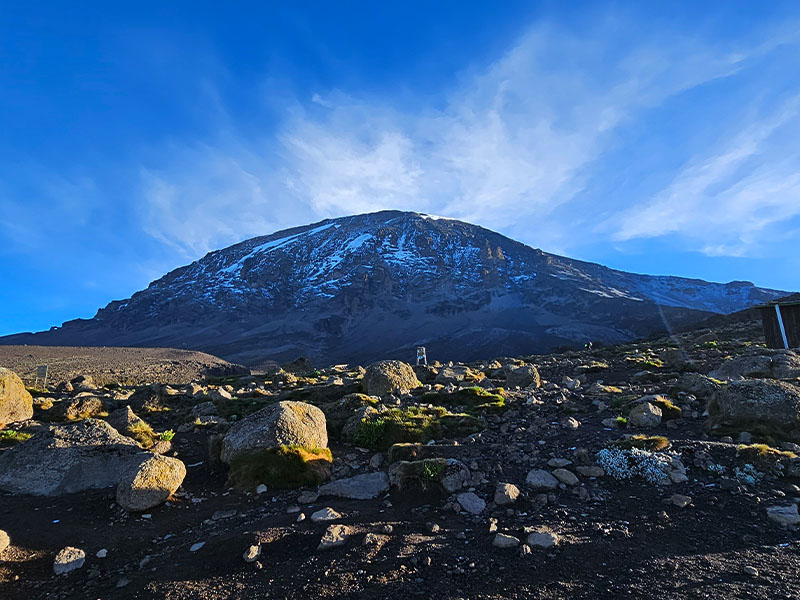
View of the mountain from Karanga Camp on the Machame route
The view of the mountain from Karanga Camp, where our 7-day Machame itinerary sleeps.

On the 6-day itinerary we skip Karanga Camp. You cross the Barranco Wall, walk on past Karanga and continue to Barafu Camp the same day. The stretch from Karanga to Barafu usually takes 3 to 4 hours, and because you have already been walking since Barranco, we plan for about 4 hours. Climbers usually reach Barafu at around 5:00 to 6:00 pm. Dinner is around 6:30 to 7:30 pm, and we wake you at 11:00 pm. After dinner and the health check you have only a few hours to rest, compared with a full afternoon on the 7-day itinerary.

Difference6-day Machame7-day Machame
Night after the Barranco WallBarafu Camp (about 4,670 m)Karanga Camp (3,995 m)
Karanga to BarafuSame day as the Barranco Wall, about 4 hoursThe next morning, about 3 to 4 hours, then lunch and rest
Arrival at BarafuUsually 5:00 to 6:00 pmAfter the 3 to 4 hour morning walk from Karanga, then lunch
Rest before the 11:00 pm wake-upA few hours after dinner and the health checkA full afternoon
Price per person (indicative, November 2026)US$2,200US$2,400

If your dates allow, the extra night at Karanga gives you that time before summit night. It does not guarantee a summit or protect you from altitude illness.

A guide with climbers at Karanga Camp
Given Minja with clients at Karanga Camp.

Machame Route Difficulty and Altitude

The Machame Route is moderately difficult to challenging. It is not a technical climb, and you do not need ropes or climbing equipment, but the trail has steep sections, long days, high altitude and a cold summit night. The hardest part is summit night from Barafu Camp, when you climb slowly in freezing conditions for hours at high altitude.

The table shows where you sleep each night on the 7-day itinerary.

NightCampSleeping altitudeChange from previous night
1Machame Camp2,835 mStarting point
2Shira Cave Camp3,750 m+915 m
3Barranco Camp3,900 m+150 m
4Karanga Camp3,995 m+95 m
5Barafu CampAbout 4,670 m+675 m

The CDC’s travel guidance advises that above 3,000 m, your sleeping altitude should rise by no more than about 500 m per night, with an extra night for every 1,000 m gained. It also says its advice can be too fast for some travellers and too slow for others, and that training and physical fitness do not affect your risk of altitude illness.

Machame’s climb-high, sleep-low day over Lava Tower helps, and the small gains on nights 3 and 4 give you time to adjust. But two nights, at Shira Cave and Barafu, rise by more than the CDC’s guide, so no Machame itinerary removes the risk of altitude illness. The 6-day itinerary asks more of your body because it reaches Barafu a day earlier.

Report a headache, nausea, dizziness, unusual tiredness or loss of appetite to your guide as soon as it starts. Walking more slowly reduces effort but does not treat altitude illness. A climber with symptoms should not go to a higher sleeping altitude until the guide has assessed them, and if symptoms get worse, going down may be necessary.

For symptoms and what to do, read our guide to altitude sickness on Kilimanjaro.

Kili Quests’ summit success planning estimates

The length of a climb affects how much time you have to adjust to altitude. For planning and explaining route options to clients, Kili Quests uses the following general estimates by itinerary length:

Itinerary lengthKili Quests planning estimate
5 daysAbout 25%–35%
6 daysAbout 40%–60%
7 daysAbout 65%–85%
8 or more daysAbout 85%–95%, often over 90% on routes such as the Northern Circuit and 8-day Lemosho

For Machame, that places the 6-day itinerary at about 40% to 60% and the 7-day itinerary at about 65% to 85%.

How to read these figures: These are Kili Quests’ general planning estimates by itinerary length. They are not official park statistics, independently audited results or a guarantee for an individual climber. Actual outcomes depend on the route, acclimatization, health, weather, pace and the decision to continue or descend when necessary. A longer itinerary gives more time to adjust, but no itinerary guarantees reaching Uhuru Peak.

For more detail, read our guide to Kilimanjaro summit chances by route.

What a Day on the Machame Route Looks Like With Kili Quests

Machame is a camping route, so the way the crew runs each day matters as much as the route. This is how a normal walking day goes with us.

  • Morning: we wake you at 6:00 or 6:30 am, depending on the next day’s distance. Bed tea, coffee or hot water comes to your tent, and about 10 minutes later you get warm water in a bowl for washing.
  • Breakfast and start: breakfast starts an hour after wake-up and takes about 45 minutes. After a 15-minute health check we leave at 8:00 or 8:30.
  • On the trail: we walk 3 to 7 hours, and normally arrive in camp about 1:00 to 2:00 pm.
  • Lunch: a hot meal served at camp, never on the trail. The exception is the Lava Tower day, when lunch is at Lava Tower and we do not sleep there.
  • Evening: dinner is around 6:30 to 7:30 pm, followed by the health check and a briefing for the next day. Everyone is asleep by about 9:00 pm.

We check your oxygen saturation routinely twice a day, in the morning and after dinner, with extra checks if someone feels unwell, and we carry a first aid kit and an oxygen cylinder on every climb. If you feel unwell at any time, tell your guide straight away. An oxygen reading alone cannot show that you are safe to continue, so guides also consider how you feel.

On camping routes, porters carry your gear and your sleeping mattress. A waiter brings washing and drinking water, and we provide a private toilet with a dedicated toilet porter who cleans it and carries it away when it is full. Our standard is 3 porters per climber. You carry a daypack of about 5 to 7 kg with 3 to 4 litres of water, snacks, medication, rain gear and sunscreen.

How Much Does the Machame Route Cost?

Kili Quests’ indicative Machame prices (November 2026, in US dollars, per person) are:

  • 6-day Machame: US$2,200
  • 7-day Machame: US$2,400

The 7-day itinerary costs more because it adds a day on the mountain. Message us your dates and group size and we will confirm the exact price.

The final price depends on the number of climbers and the services included. Machame usually costs less than longer routes such as Lemosho or the Northern Circuit.

Included in the priceNot included
  • All park fees: entry, camping and rescue fees
  • Tents, chairs, tables, a mess tent, a cooking tent, client mattresses, cutlery, plates, cooking gas and lamps
  • Oxygen cylinder, pulse oximeter and blood pressure machine
  • All meals for clients and crew
  • Wages for porters, guides and cooks at authority-recommended rates
  • All transport costs for organizing the climb
  • Transfers from your hotel or the airport to the park gate
  • A private portable flush toilet
  • Two hotel nights: one before and one after the climb
  • Tips for guides, porters and cooks
  • Visa fees
  • Personal trekking gear such as sleeping bags, boots and clothing (rentable)
  • Travel insurance and personal expenses
  • Flights, or overland transfers to Kilimanjaro International Airport or Arusha from Nairobi
  • Extra hotel nights

Tips are not included in the price. We recommend 20% of the package price per person, which is US$440 on the 6-day and US$480 on the 7-day Machame. For a full breakdown of what affects the price of any Kilimanjaro climb, read our Kilimanjaro climb cost guide.

Do not choose Machame only because it costs less than Lemosho. A lower price is not good value if the itinerary is too rushed or the operator cuts corners on safety, food, guides or porter care.

Best Time to Climb the Machame Route

The drier months, January to early March and June to October, usually give better trail conditions, clearer views and more stable weather. Rain makes the lower forest muddy and reduces visibility, and camps are wetter. For a month-by-month breakdown, read our guide to the best time to climb Kilimanjaro.

SeasonWhat to expect
January to early MarchWarmer conditions, good visibility and fewer crowds than peak season.
June to OctoberDrier weather and clear skies, with colder nights and busier trails.
April to MayLong rains, muddy trails, lower visibility and wetter camps. Usually not recommended.
NovemberShort rains and less predictable conditions. Possible, but not ideal for most climbers.

Machame or Lemosho?

Machame and Lemosho are two of the best Kilimanjaro routes for scenery. Both pass Lava Tower, the Barranco Wall, Karanga and Barafu before summiting from the southern side. The differences are where you start, how many days you take and how much experience you have.

FeatureMachameLemosho
StartMachame Gate, southwest side, 1 to 2 hours’ drive from a Moshi hotelWestern side, 3 to 4 hours’ drive from a Moshi hotel
Days6 or 77 or 8
Price (indicative, November 2026)US$2,200 per person for 6 days; US$2,400 per person for 7 daysUS$2,700 to 3,000 per person
Best forClimbers comfortable hiking uphill on consecutive days, with previous altitude experienceFit hikers with little altitude experience

For a deeper comparison, read Machame vs Lemosho: Which Kilimanjaro Route Is Better? or see our Lemosho route guide.

What to Pack for the Machame Route

The Machame Route crosses rainforest, moorland, alpine desert and freezing summit conditions, so you need to pack for all of them. Your main items are warm layers, waterproof clothing, broken-in hiking boots, gloves, a warm hat, a headlamp, a sleeping bag, trekking poles and a comfortable daypack. You can rent a sleeping bag before the climb.

Crampons: Kili Quests does not supply crampons, and they are not part of a normal climb. Icy, slippery conditions are most likely from around 15 January to March and can continue through the rain seasons. When the path is icy and slippery, our guides fit crampons at Stella Point or lower. If you want a pair for those conditions, bring your own or rent one in Moshi before the climb.

Do not underestimate summit night. Use our Kilimanjaro packing list for the full kit.

Frequently Asked Questions About the Machame Route

How difficult is the Machame Route?

Moderately difficult to challenging. It does not need technical climbing skills, but it has steep sections, long days, high altitude and a cold summit night. Your sleeping altitude rises by more than about 500 m on two nights, which is more than the CDC advises above 3,000 m, so fitness alone does not remove the risk of altitude illness. The 7-day itinerary gives you more time than the 6-day.

Should I choose the 6-day or 7-day Machame Route?

Choose 7 days if your dates allow. The only difference is one night at Karanga Camp. On the 6-day you cross the Barranco Wall and continue to Barafu the same day, arriving around 5:00 to 6:00 pm, with a few hours of rest before the 11:00 pm wake-up. On the 7-day you sleep at Karanga and have a full afternoon at Barafu. Neither guarantees a summit.

Is the Machame Route good for beginners?

It can be, if you are fit, comfortable camping and comfortable hiking uphill on consecutive days, and you take the 7-day itinerary. If you have little mountain experience, we often suggest Lemosho (7 or 8 days) or the 7-day Rongai first. Whichever route you choose, walk slowly and tell your guide about symptoms early.

How much does the Machame Route cost with Kili Quests?

Our indicative November 2026 price is US$2,200 per person for the 6-day Machame and US$2,400 per person for the 7-day, in US dollars. The price includes park fees, tents and mattresses, meals, crew wages, transfers, a private portable flush toilet and two hotel nights. It does not include tips, visa fees, personal gear, insurance or flights. Message us your dates and group size for the exact price.

Is Machame better than Lemosho?

Neither is better for everyone. Machame suits climbers who are comfortable hiking uphill on consecutive days and have altitude experience, and it costs less (US$2,200 to 2,400 against US$2,700 to 3,000). Lemosho suits fit hikers with little altitude experience and takes 7 or 8 days. Tell us your hiking experience and dates and we will suggest the route that fits.

Plan your Machame climb with Kili Quests

Tell us your preferred dates, group size and hiking experience, and whether you are comfortable camping. We will tell you whether the 6-day or 7-day Machame itinerary, or another route, fits you best. You can also see our 7-day Machame trek itinerary.

WhatsApp us: +255 (762) 187 967

Read traveller reviews of Kili Quests on Tripadvisor.

Marangu Route Kilimanjaro: 6-Day Itinerary, Huts & Cost

Questions before you book? WhatsApp us: +255 (762) 187 967

Is the Marangu Route worth it? Yes, if you want to sleep in huts instead of tents and you choose the 6-day itinerary, which adds an acclimatization day with a hike to Zebra Rocks (4,020 m). Marangu is the only main Kilimanjaro route with huts. It is not automatically the easiest route: your sleeping altitude rises by about 1,000 m on two nights, which is faster than the pace the CDC advises for altitude. Kili Quests’ Marangu price is US$1,800 to 2,000 per person (indicative, November 2026), and the 5-day itinerary is US$1,800. See what is included.

This guide is for travellers deciding whether the Marangu Route suits them, and whether to climb it in 5 or 6 days. It follows the 6-day itinerary day by day, describes the huts, explains the price and shows how the altitude profile affects your choice. If you are still comparing routes, start with our Kilimanjaro routes comparison.

What Is the Marangu Route?

The Marangu Route is one of the oldest and most established routes on Mount Kilimanjaro, and the only main route where climbers sleep in huts instead of tents. It starts at Marangu Gate (1,843 m) on the southeastern side of the mountain and uses the same trail up and down. The trail crosses rainforest, moorland and alpine desert before reaching the crater rim at Gilman’s Point. From there climbers continue to Stella Point and then Uhuru Peak (5,895 m).

Marangu is often called the “Coca-Cola Route”, and that nickname can mislead. The trail may feel more straightforward than some camping routes, and the route historically offered bottled drinks at the camps. But the short itinerary gives your body less time to adjust to altitude, so the extra comfort does not make it easy.

Marangu Route at a glance

FeatureDetails
Length5 or 6 days. We recommend 6 days.
DistanceAbout 72 km (45 miles) there and back, gate to gate. Published figures vary by source.
Start and finishMarangu Gate, 1,843 m
6-day acclimatization hikeZebra Rocks, 4,020 m, from Horombo Hut and back
Highest pointUhuru Peak, 5,895 m
AccommodationHuts at Mandara, Horombo and Kibo. Rooms of 3 to 6 beds. Bring your own sleeping bag.
Typical Kili Quests crew1 cook, 1 guide and 5 to 6 porters
Kili Quests priceUS$1,800 to 2,000 per person (indicative, November 2026). The 5-day itinerary is US$1,800.
DifficultyNot technical. Altitude is the challenge, especially on 5 days.
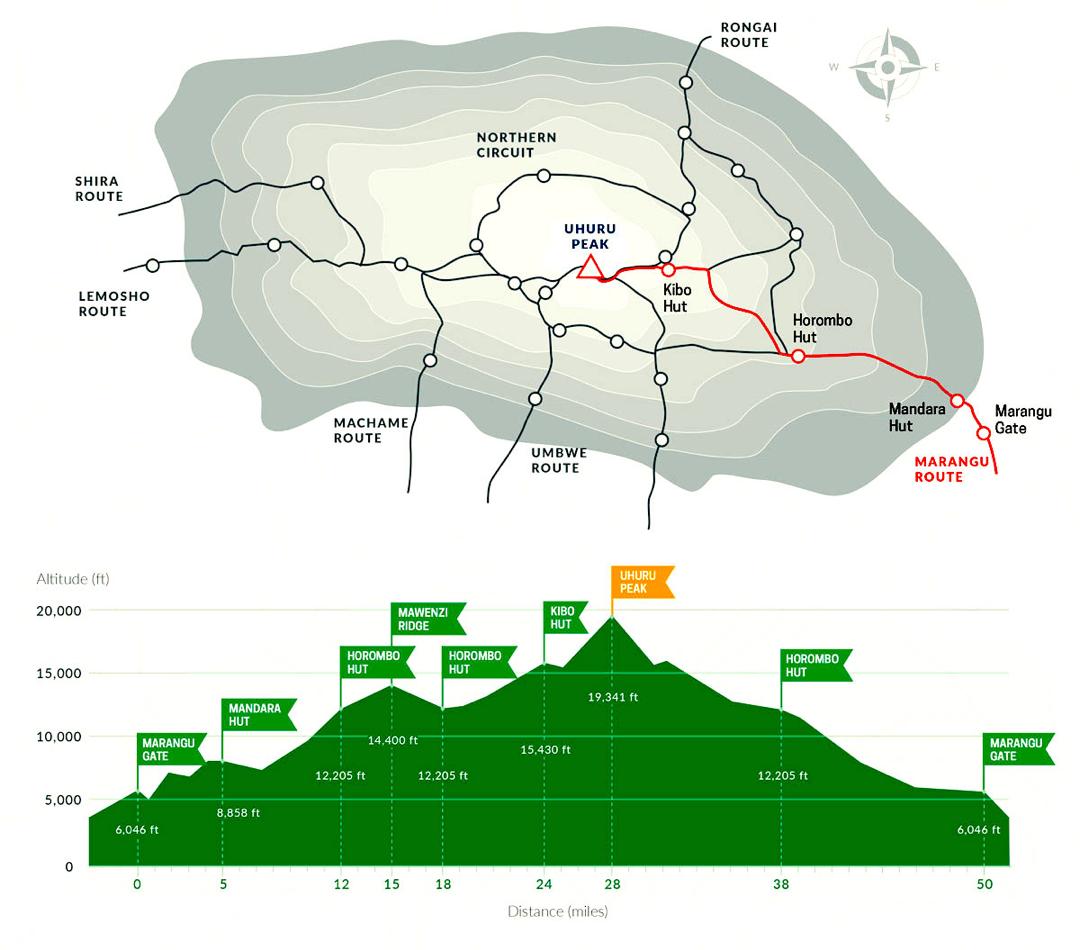
Marangu Route map showing the trail, the three huts and Uhuru Peak
The Marangu Route map. The trail goes up and down the same way, via Mandara, Horombo and Kibo huts.

Who Should Choose the Marangu Route?

The right route depends on how you feel about camping and how much altitude experience you have. This is how we advise climbers who ask us.

Your situationOur advice
You strongly prefer sleeping in hutsChoose the 6-day Marangu Route, not the 5-day version.
It is your first climb and you are comfortable camping7-day Machame is the better fit.
You are fit but have little altitude experience and are open to campingWe usually suggest Lemosho or 7-day Rongai.
You want route variety or a quieter trailMarangu uses the same path up and down, and huts are shared with other groups. Quieter routes include the Northern Circuit and Rongai.
You are short on time or budgetThe 5-day itinerary is US$1,800. We still recommend 6 days if you can.

For a side-by-side view of huts and tents, read Machame vs Marangu.

6-Day Marangu Route Itinerary

The 6-day itinerary adds an acclimatization day at Horombo Hut. Because Marangu is shorter than Lemosho or the Northern Circuit, that extra day matters. Sleeping altitudes below are approximate, and published figures differ by about 20 m between sources.

DayRouteSleeping altitudeHiking time
1Marangu Gate to Mandara HutAbout 2,720 mAbout 4 hours
2Mandara Hut to Horombo HutAbout 3,720 m5–6 hours
3Acclimatization hike to Zebra Rocks (4,020 m) and back to HoromboAbout 3,720 m3–4 hours
4Horombo Hut to Kibo HutAbout 4,720 mAbout 5 hours
5Kibo Hut to Uhuru Peak, then down to Horombo HutAbout 3,720 m12–14 hours
6Horombo Hut to Marangu GateFinish at the gate (1,843 m)5–6 hours

Day 1: Marangu Gate to Mandara Hut

Your team completes park registration at Marangu Gate, then you walk into the rainforest. The trail climbs gradually through dense forest, where you may see blue monkeys and colobus monkeys.

  • Altitude: 1,843 m to about 2,720 m
  • Distance: 8 km
  • Hiking time: about 4 hours
  • Zone: rainforest
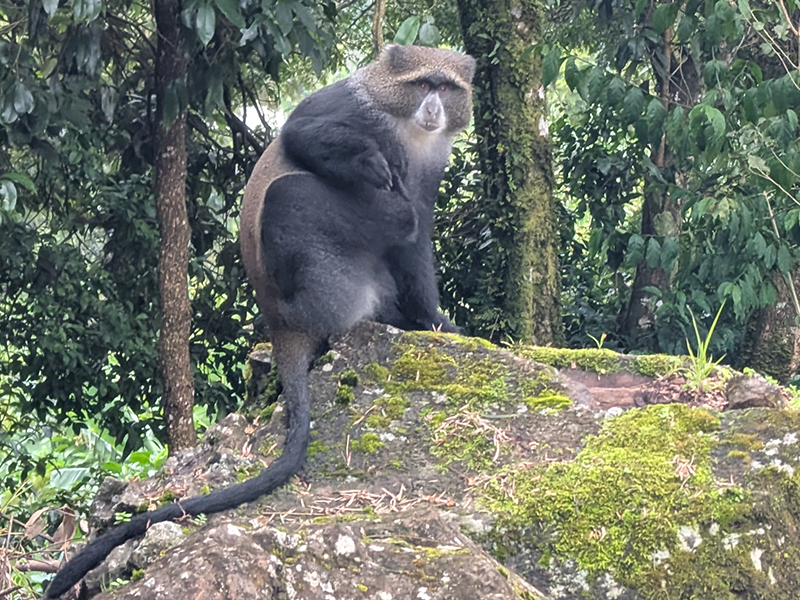
A blue monkey perched on a mossy rock surrounded by green vegetation
A blue monkey on the Marangu Route. Blue monkeys are among the animals climbers may see on the lower trail.

Day 2: Mandara Hut to Horombo Hut

You leave the forest and enter the moorland. The trail opens up, with views toward Mawenzi and the higher slopes of Kibo. This is the first day when the altitude becomes noticeable, and your sleeping altitude rises by about 1,000 m. Walk slowly and drink regularly.

  • Altitude: about 2,720 m to 3,720 m
  • Distance: 11 km
  • Hiking time: 5–6 hours
  • Zone: moorland

Day 3: Acclimatization day at Horombo Hut

This extra day is the main reason to choose 6 days instead of 5. You hike to Zebra Rocks (4,020 m), about 300 m higher than Horombo, stay there for about 45 minutes to an hour, then return to sleep at Horombo again. On this day our guides pay extra attention to each climber’s oxygen saturation and look for signs of acute mountain sickness (AMS).

The day gives your body more time to adjust before the climb to Kibo Hut. It does not guarantee a summit or protect you from altitude illness.

  • Altitude: Horombo Hut (about 3,720 m), hike to Zebra Rocks (4,020 m)
  • Distance: about 3.5 km
  • Time at Zebra Rocks: about 45 minutes to 1 hour
  • Hiking time: 3–4 hours
  • Purpose: acclimatization
Horombo Huts on the Marangu Route with Mawenzi Peak in the background
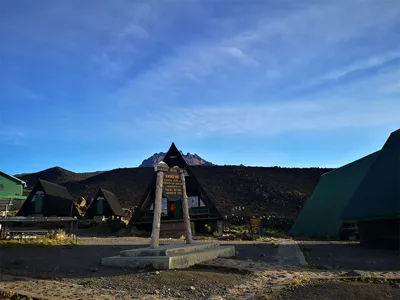
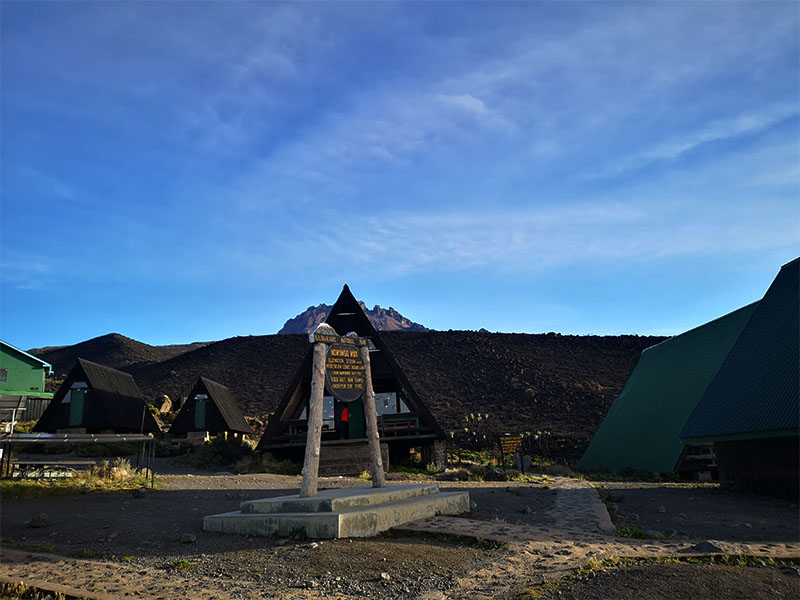
Horombo Huts (about 3,720 m) with Mawenzi Peak in the background. You sleep here twice on the 6-day itinerary.

Day 4: Horombo Hut to Kibo Hut

The route continues through alpine desert toward Kibo Hut, the base for summit night. The landscape becomes drier, colder and more exposed. Your sleeping altitude rises by about 1,000 m again. There is no water at the toilets at Kibo Hut, so bring hand sanitiser and wipes. After dinner we check each climber’s health before everyone goes to bed early.

  • Altitude: about 3,720 m to 4,720 m
  • Distance: 9 km
  • Hiking time: about 5 hours
  • Zone: alpine desert

Day 5: Kibo Hut to Uhuru Peak, then down to Horombo Hut

Summit day is the hardest day on the Marangu Route. We wake at 11:00 pm, have tea, coffee and biscuits at 11:30 pm and leave at midnight. When we wake you for summit night we check your health again, to see that everything is okay and that you are safe to start. Before we leave Kibo Hut, our guides also tell you who will accompany you on the climb. Where a climber needs it, summit porters can assist on summit night, including help with the climber’s backpack. If the path is icy and slippery, our guides fit crampons at Stella Point or lower. We do not supply crampons, so read the crampons note in the packing section before you travel.

The climb goes steeply from Kibo Hut to Gilman’s Point on the crater rim (about 5 hours), then to Stella Point (about 1 hour more) and on to Uhuru Peak (about 1 hour more), roughly 7 hours up in total. Coming back down to Kibo Hut takes about 2.5 to 3 hours. After a rest you continue down to Horombo Hut, so the whole day is 12 to 14 hours.

  • Altitude: about 4,720 m to 5,895 m, then down to about 3,720 m
  • Hiking time: 12–14 hours in total
  • Summit: Uhuru Peak
  • Night: Horombo Hut
Gilman's Point summit sign on Mount Kilimanjaro with rocky terrain and blue sky
Gilman’s Point (about 5,680 m) on the crater rim, the first summit point on the Marangu Route.

Day 6: Horombo Hut to Marangu Gate

The last day descends through moorland and rainforest back to Marangu Gate. After you sign out, climbers who reached the summit receive their Kilimanjaro summit certificate before the transfer to Moshi or Arusha.

  • Altitude: about 3,720 m to 1,843 m
  • Hiking time: 5–6 hours
  • Zone: moorland to rainforest

Marangu Altitude Profile: Why Pacing Matters

The Marangu Route is not technically difficult. Its challenge is how quickly the sleeping altitude rises. The table shows where you sleep each night on the 6-day itinerary.

NightSleeping altitude (approximate)Change from the night before
1: Mandara Hut2,720 mStart
2: Horombo Hut3,720 m+1,000 m
3: Horombo Hut3,720 m0 m (6-day itinerary only)
4: Kibo Hut4,720 m+1,000 m

The CDC’s travel guidance advises that above 3,000 m, your sleeping altitude should rise by no more than about 500 m per night, with an extra night for every 1,000 m gained. It also says its advice can be too fast for some travellers and too slow for others. Marangu’s two 1,000 m nights are above that guideline, even on 6 days. The CDC adds that training and physical fitness do not affect your risk of altitude illness. For symptoms and what to do about them, read our guide to altitude sickness on Kilimanjaro.

Is the Marangu Route easy?

Not automatically. Marangu is not a technical climb, and you do not need ropes or climbing skills on the standard route. But altitude, a 12 to 14 hour summit day and cold nights make it a demanding mountain trek rather than an easy hike. The huts make the nights more comfortable, but they do not change how fast you gain altitude. For a fuller picture of what makes Kilimanjaro hard, read how hard it is to climb Kilimanjaro.

5 days or 6 days?

Choose 6 days if you can. The sixth day adds a second night at Horombo and the hike to Zebra Rocks before the climb to Kibo Hut. It gives your body more time to adjust, but no route or itinerary guarantees a summit.

Kili Quests keeps no summit-success records, so we do not publish a percentage for Marangu. One published study followed 312 Marangu trekkers on 4- and 5-day schedules. Of the 181 complete records, 111 (61%) reached the summit and 139 (77%) developed AMS, with similar results on both schedules. That study did not cover the 6-day itinerary, so it cannot tell us how much the extra day changes the odds. Our success rate by route page explains what the studies do and do not show.

How we monitor climbers on Marangu

We check oxygen saturation routinely twice a day, in the morning and after dinner, with extra checks if someone feels unwell. On Marangu we pay closer attention at two points: on the acclimatization day at Horombo, when we also watch for AMS signs, and at Kibo Hut, after dinner and again when we wake for summit night. We carry a first aid kit and an oxygen cylinder on every climb.

An oxygen reading alone cannot show that someone is safe to continue. Guides also consider symptoms. A climber with altitude illness symptoms should not go higher, and descent is the priority over the summit.

Marangu Huts: What to Expect

Marangu is the only main route with permanent huts, at Mandara, Horombo and Kibo. They are simple mountain huts, not hotels. Mandara sits in the rainforest, where you may see blue monkeys and colobus monkeys, and a tree hyrax, a small nocturnal mammal, may also be around. Sightings are never guaranteed. Horombo sits in the moorland with Mawenzi Peak in view, and on clear nights you may see the lights of Moshi in the distance.

  • Rooms: from 3 to 6 beds per room, with a mattress on each bed. Rooms are shared with other groups.
  • Sleeping bag: bring your own. Sleeping bags are not included in the price, and you can rent one before the climb.
  • Meals: three meals a day, in a shared dining area where climbers from different companies sit together.
  • Washing and toilets: the toilets at Mandara and Horombo have water. The toilets at Kibo Hut do not. Toilets are shared, and there is no private toilet on this route. Warm water is brought for washing.
  • Luxury rooms: available as an extra. Message us well in advance. We check availability with Kilimanjaro National Park authority (KINAPA) first, then confirm the price and details.

If you want your own tent and a private toilet instead, a camping route such as Machame is a better match.

How Much Does the Marangu Route Cost?

Kili Quests’ Marangu climb costs US$1,800 to 2,000 per person, in US dollars (indicative, November 2026). The 5-day itinerary is US$1,800. Message us your dates and group size and we will confirm the price for your climb.

Marangu is usually less expensive than camping routes partly because it uses mountain huts rather than a full camping arrangement. On camping routes, operators must provide and transport tents, mattresses, dining facilities and extra camping equipment. The final price still depends on itinerary length, crew arrangements and group size. A typical Kili Quests Marangu crew is one cook, one guide and five to six porters.

Included in the priceNot included
  • All park fees (entry fees and rescue fees)
  • All equipment for the climb
  • Oxygen cylinder, pulse oximeter and blood pressure machine
  • All meals for clients and porters for the whole climb
  • Wages for porters, guides and cooks at authority-recommended rates
  • All transport costs for organizing the climb, including costs related to porters and food
  • Transfers between hotels or airport and the park gate
  • 2 hotel nights (1 before and 1 after the climb)
  • Tips for guides, porters and cooks
  • Visa
  • Personal trekking gear such as sleeping bag, hiking boots and clothes (available to rent)
  • Travel insurance and personal expenses such as laundry, phone and drinks
  • Flights to Kilimanjaro, or overland transfers to Kilimanjaro International Airport or Arusha if you come from Nairobi
  • Hotel nights beyond the two included

Tips are not included in the price. We recommend 20% of the package price per person, which is US$360 to 400 on Marangu. For a full breakdown of what affects the price of any Kilimanjaro climb, read our Kilimanjaro climb cost guide.

Do not choose Marangu only because it costs less. A lower price is not good value if the itinerary is rushed or the operator cuts corners on safety, food, guides or porter care.

Best Time to Climb the Marangu Route

The drier months, January to early March and June to October, usually give better trail conditions and clearer views. Huts are more comfortable than tents in wet weather, but rain still makes the lower forest muddy and reduces visibility. For a month-by-month breakdown, read best time to climb Kilimanjaro.

SeasonWhat to expect
January to early MarchWarmer conditions, good visibility and fewer crowds than peak season.
June to OctoberDrier weather and clearer skies, with colder nights and busier trails.
April to MayLong rains, muddy trails and lower visibility. Usually not recommended.
NovemberShort rains and less predictable conditions.

What to Pack for the Marangu Route

Huts do not mean you can pack casually. The route crosses rainforest, moorland, alpine desert and the cold summit zone, so your clothing must handle rain, wind and freezing nights.

  • A warm sleeping bag (required on Marangu, and you can rent one)
  • Warm layers, waterproof clothing, gloves and a warm hat
  • Broken-in hiking boots and trekking poles
  • A headlamp for summit night
  • A daypack of about 5 to 7 kg with 3 to 4 litres of water, snacks, medication, rain gear and sunscreen

Crampons: Kili Quests does not supply crampons, and they are not part of a normal climb. Icy, slippery conditions are most likely from around 15 January to March and can continue through the rain seasons. When the path is icy and slippery, our guides fit crampons at Stella Point or lower. If you want a pair for those conditions, bring your own or rent one in Moshi before the climb. Use our Kilimanjaro packing list for the full kit.

Frequently Asked Questions About the Marangu Route

Is the Marangu Route good for beginners?

Yes, if you strongly prefer huts and choose the 6-day itinerary. Marangu has a clear trail and hut accommodation, but your sleeping altitude rises about 1,000 m on two nights, and no route guarantees a summit. If you are comfortable camping, we suggest 7-day Machame for a first climb. If you have little altitude experience, we usually suggest Lemosho or 7-day Rongai.

Should I choose the 5-day or 6-day Marangu Route?

Choose 6 days if you can. The extra night at Horombo Hut (about 3,720 m) and the hike to Zebra Rocks (4,020 m) give your body more time to adjust before Kibo Hut. It does not guarantee a summit. The 5-day itinerary costs US$1,800 and the 6-day itinerary falls within our US$1,800 to 2,000 range (indicative, November 2026).

Do I need to bring a sleeping bag on the Marangu Route?

Yes. Bring a warm sleeping bag, because sleeping bags are not included in the price. You can rent one before the climb. Hut rooms have from 3 to 6 beds and are shared with other groups, and the dining area is shared too.

How much does the Marangu Route cost with Kili Quests?

US$1,800 to 2,000 per person (indicative, November 2026), with the 5-day itinerary at US$1,800. The price includes park fees, meals, equipment, crew wages, transfers and 2 hotel nights. It does not include tips, visa, personal gear, insurance or flights. Message us your dates and group size for the exact price.

Which summit points do climbers reach on the Marangu Route?

Climbers reach Gilman’s Point on the crater rim first, then Stella Point, then Uhuru Peak (5,895 m), the highest point in Africa. From Kibo Hut it takes about 5 hours to Gilman’s Point, about 1 hour more to Stella Point and about 1 hour more to Uhuru Peak.

Plan your Marangu climb with Kili Quests

Tell us your dates, group size and any hiking or altitude experience. We will tell you whether the 5-day or 6-day Marangu Route, or another route, fits you best. You can also see the Marangu trek itinerary.

WhatsApp us: +255 (762) 187 967

Read traveller reviews of Kili Quests on Tripadvisor.

Descending Kilimanjaro: What Happens After the Summit

Questions before you book? WhatsApp us: +255 (762) 187 967

Quick answer: what happens after you reach Uhuru Peak?

After a short stop at the top, often 15 to 30 minutes, you walk down the trail your route uses. On Machame, Lemosho, Shira and Umbwe you rest at Barafu, sleep at Mweka Camp and exit at Mweka Gate the next morning. On Marangu and Rongai you rest at Kibo Hut, sleep at Horombo Hut and exit at Marangu Gate. Northern Circuit itineraries and some others differ, so ask which camp and gate yours uses. From the midnight start, summit day lasts about 12 to 15 hours if you sleep at Millennium Camp and 15 to 18 hours if you sleep at Mweka Camp.

Trekkers near Stella Point on the Kilimanjaro summit route
Stella Point on the crater rim. Most climbers begin the descent from here or from Uhuru Peak.

Reaching Uhuru Peak at 5,895 m (19,341 ft) is the highlight of a Kilimanjaro climb, but it is the halfway point of summit day, not the end. Most of the hardest walking on your legs is still ahead, and most climbers have questions they did not think to ask: how long is the way down, where do I sleep, what happens at the gate, and how will my body feel?

This guide follows the whole journey in order, from the first steps below the summit to the hotel shower and the days that follow. For preparation before summit night, read our Kilimanjaro summit night tips.

What happens right after Uhuru Peak

The summit is cold, windy and short on oxygen, so climbers rarely stay long. Expect a group photo at the sign, a few quiet minutes and then your guide turning you around. Many climbers reach Stella Point or Gilman’s Point first and walk along the crater rim to Uhuru Peak, so the way back down starts with that same rim.

Uhuru Peak sign at the summit of Mount Kilimanjaro
Uhuru Peak, 5,895 m. The stop here is deliberately short.

Your descent begins at once because the longer you stay high, the longer your body runs on thin air after a night with little sleep. Going down is also when the day’s fatigue catches up with you, so your guide keeps the group together and sets a steady pace.

Which route do you use to descend Kilimanjaro?

Four things can differ from route to route: the camp you start summit night from, the trail you come down, the camp where you sleep afterwards and the gate where you exit. Do not assume they match. Our Kilimanjaro routes comparison shows each route side by side.

The Mweka descent: Machame, Lemosho, Shira and Umbwe

Climbers on these routes start summit night from Barafu Camp, reach the crater rim at Stella Point and return to Barafu after the summit. After a rest there, the group continues down to Mweka Camp for the night, or on some itineraries to Millennium Camp, about 2 hours below Barafu. The next morning you walk through rainforest to Mweka Gate. Our 7-day Machame itinerary gives the day-by-day detail. The Northern Circuit reaches the summit from a different side and its camps differ, so ask us for the plan that applies to your dates.

Barafu Camp, the high camp used for summit day on the southern Kilimanjaro routes
Barafu Camp, where climbers rest after summiting on the Mweka descent.
Kili Quests map of the Lemosho route on Mount Kilimanjaro
Route map: the Lemosho route summits from Barafu and finishes on the Mweka descent.

The Marangu descent: Marangu and Rongai

Both routes summit from Kibo Hut. After the summit you return to Kibo Hut for a meal and a short break, then continue to Horombo Hut for the night. The next day you walk down to Marangu Gate. Marangu is the only route with huts instead of tents, and it uses the same trail up and down. Rongai approaches from the north, then joins the Marangu trail for the descent.

How long does it take to descend Kilimanjaro?

From the summit to the gate takes two days. The times below come from our guiding experience and are approximate. Your pace, the weather and the trail conditions change them.

Mweka descent: approximate times from the midnight start at Barafu
StageWhat happensTypical time
Uhuru PeakPhotos, a short stop, then turn backAbout 15 to 30 minutes
Uhuru Peak to Barafu Camp (about 4,670 m)Rim walk and scree, then food and rest3 to 4 hours down, then 1 to 2 hours of rest
Barafu Camp to Millennium Camp (about 3,820 m)Downhill to the night camp on itineraries that use itAbout 2 hours (about 4 km)
Barafu Camp to Mweka Camp (about 3,100 m)Long downhill to the night campAbout 5 hours (about 12 km)
Whole summit dayFrom the midnight start to the night camp12 to 15 hours to Millennium Camp; 15 to 18 hours to Mweka Camp, rest included
Mweka Camp to Mweka Gate (about 1,640 m)Rainforest trail, sign-outAbout 3 to 4 hours (next day)
Marangu descent (Marangu and Rongai): approximate times from Kibo Hut
StageWhat happensTypical time
Kibo Hut to Uhuru PeakThe summit climb, for comparisonAbout 7 hours
Uhuru Peak to Kibo HutDescent, then a meal and a short breakAbout 2.5 to 3 hours
Whole summit dayKibo Hut to Uhuru Peak, back to Kibo, then on to Horombo Hut12 to 14 hours
Horombo Hut to Marangu GateMoorland and forest trail, sign-outAbout 5 to 7 hours (next day)

Treat these as planning ranges, not promises. Your guide confirms the schedule for your itinerary, and extra stops or a slower pace add to the day.

What the descent feels like

Knees and thighs

Many climbers find going down harder than going up. Your thigh muscles act as brakes for thousands of metres of descent, and they are already tired from summit night. Short, controlled steps and trekking poles take load off the knees. Our 6-week training plan includes hill and stair training for this reason.

Loose scree

Below Stella Point and Gilman’s Point the path is loose volcanic gravel. Plant your poles slightly ahead, keep your knees soft and let your guide set the line. Slow is better than fast on scree.

Cold, tiredness and altitude

You start the descent in freezing wind and end it in forest warmth, so you take layers off in stages. Tiredness and a low appetite are common after summit night. A headache that is severe or getting worse is not normal tiredness, so tell your guide. For what is normal and what is not, read our guide to altitude sickness on Kilimanjaro.

How Kili Quests guides support climbers on the way down

Summit day does not end at the summit, and neither does the guides’ attention to how you are doing. On our climbs this includes:

  • Health checks: our guides check each climber’s oxygen saturation twice a day, in the morning and after dinner, with extra checks if someone feels unwell.
  • Observation: guides watch how you walk, talk and respond. A pulse oximeter reading is one piece of information, never the whole picture.
  • Pace and rest stops: your guide sets the pace for the group and decides when to pause.
  • Food and water: the cooks prepare your meals at camp, and a waiter brings drinking and washing water.
  • Equipment: we carry a first aid kit and an oxygen cylinder on every climb.

Oxygen equipment and monitoring devices do not make a climb risk-free. They support, and never replace, a guide’s judgment, proper medical assessment and going down.

If you feel unwell during the descent

Tiredness, sore legs and a low appetite are expected after summit night. Serious altitude illness is different. Tell your guide at once about confusion, trouble walking in a straight line, a severe or worsening headache, breathlessness at rest, a wet cough or repeated vomiting. Do not wait to see whether these pass. Descent is the first response to serious altitude illness, alongside urgent medical care, and your guide decides what else is needed, which may include supplementary oxygen, an assisted descent or an evacuation.

Who goes down with you

If one climber has to leave the mountain, the rest of the team stays with the group. On a descent on foot, one Kili Quests guide and two porters go down with the climber. A stretcher evacuation takes one guide and six porters. When a helicopter is used, one guide accompanies the climber, and our office team meets them at the landing site and escorts them to hospital.

Given Minja’s Marangu evacuation

On a Marangu climb, a client’s oxygen readings were getting low when we arrived at Kibo Hut. After the evening check we asked her to eat and sleep. When she woke for the summit attempt I checked her again, gave her oxygen and started the descent to Horombo Hut the same midnight. We reached Horombo about 5:00 am and called a rescue car, which arrived about 8:00 am. She said she felt fine on the drive, but I insisted she go to hospital. I tell this story because feeling better after going down is not a reason to skip a medical check.

This is general information, not medical advice. See a doctor before you climb, especially if you have a heart, lung or circulation condition.

What happens at the exit gate?

You reach Mweka Gate or Marangu Gate, depending on your descent, and sign out with your guide. Summit certificates are issued according to the highest point you reached. Uhuru Peak earns the gold certificate. Sources commonly say that Stella Point and Gilman’s Point earn a green one, but they do not agree on every detail, so ask your guide what is issued on your date. On our Mweka itineraries you collect your certificate at the gate.

The crew often says goodbye with a song and photos. Tipping for guides, cooks and porters is customary, but it is not a park fee and no amount is compulsory. Agree a sensible guideline with your operator before the climb. A vehicle then takes you to your hotel in Moshi or Arusha.

Back at the hotel and the days after

Expect a hot shower, a proper meal and a long sleep. Your legs will probably be stiff, and stairs can feel hard. Recovery varies from person to person, so keep the next day or two easy.

  • Muscles and knees: soreness after long downhill walking is common. Gentle walking and stretching help.
  • Tiredness: sleep and energy can take some days to settle, and the time differs for each climber.
  • Swelling: some climbers notice puffy hands or feet. Do not assume swelling is harmless if it is new, marked or in one leg only.

Seek urgent medical help for pain or swelling in one leg, chest pain, breathlessness, confusion or a headache that is getting worse.

Can you fly home straight after climbing Kilimanjaro?

There is no single waiting time that suits every climber. The CDC says anyone travelling more than four hours, by air, car or bus, can be at risk of blood clots in the legs (deep vein thrombosis), and tired, swollen legs after a trek are a reason for care. Walk around every hour or two on long journeys, wear loose clothing and talk to a doctor before flying if you have leg pain or swelling, a history of clots or other clotting risk factors. No single measure removes the risk.

Many climbers add a few quieter days in Tanzania before flying. A safari or a few days on Zanzibar gives your legs a break while you see more of the country.

Frequently asked questions about descending Kilimanjaro

How long does it take to descend Kilimanjaro after the summit?

The descent takes two days. On our Mweka itineraries summit day lasts about 15 to 18 hours from the midnight start to Mweka Camp, or about 12 to 15 hours to Millennium Camp, rest included. The next morning you walk about 3 to 4 hours to Mweka Gate. On Marangu and Rongai summit day takes about 12 to 14 hours, and the walk from Horombo Hut to Marangu Gate takes about 5 to 7 hours the next day.

Where do climbers sleep after summit day?

It depends on the route. On Machame, Lemosho, Shira and Umbwe it is usually Mweka Camp, or Millennium Camp on some itineraries. On Marangu and Rongai it is Horombo Hut. Northern Circuit camps differ, so confirm yours before you book.

Is descending Kilimanjaro harder than climbing up?

For the legs, often yes. Long downhill sections stress knees, thighs and ankles after summit night, although breathing gets easier as you lose height. Poles, short steps and a steady pace help a lot.

What happens if someone becomes exhausted or ill during the descent?

The guides slow the pace and stay with the climber. If symptoms point to altitude illness or the climber cannot walk safely, descent comes first and the team arranges extra support, an assisted descent or an evacuation. On our climbs a guide and two porters go down with a climber on foot, while the rest of the team stays with the group. Tell your guide early.

Can I fly home straight after climbing Kilimanjaro?

There is no universal waiting time. Long journeys of more than four hours raise the risk of blood clots, so move regularly and speak to a doctor first if you have leg pain, swelling or clotting risk factors. Many climbers add a safari or a few days on Zanzibar before flying.

Planning your Kilimanjaro climb?

Share your dates, the route you have in mind, your hiking experience and how your knees cope with long descents, and we will help you choose a route and plan the descent, the exit and your time afterwards. No operator can guarantee a summit.

WhatsApp us: +255 (762) 187 967

Read traveller reviews of Kili Quests on Tripadvisor.

About the author

Given Minja is a Kilimanjaro guide at Kili Quests in Moshi, Tanzania, with more than eight years of guiding experience. Given Minja and fellow guide Daniel Munuo each completed Sentinel Outdoor Institute’s 80-hour Wilderness First Responder course and a Sentinel Outdoor Institute CPR course. Kili Quests co-founder Allen Minja has more than 30 years of experience on the mountain. Learn more about Kili Quests and the team.

Sources

Descent times and the post-summit schedule come from Kili Quests guiding experience and are approximate. This article gives general information, not individual medical advice. Consult a qualified healthcare professional before high-altitude travel and before flying if you have leg symptoms or a clotting risk.

Keep planning your climb
Kilimanjaro Summit Night Essentials: Gear & Packing Tips

Prepare for Summit Day the Right Way

The right gear and preparation can make the difference between reaching the summit and turning back.At Kili Quests, we help you plan your climb with:

Plan Your Kilimanjaro Climb

Preparation goes beyond gear , understand the full climb:

OUR CATEGORIES

Kilimanjaro Summit Day Gear Guide: What to Pack for the Final Push

Summit day on Mount Kilimanjaro is the toughest  and most unforgettable  part of your trek. You’ll start in the middle of the night, climb through freezing temperatures, and push toward Uhuru Peak as the sun rises over Africa.The difference between success and turning back often comes down to one thing: proper preparation.
 
In this guide, you’ll learn exactly what gear you need for summit night, how to stay warm, and how to manage the physical and mental challenge of reaching the top.
 
Before packing, make sure you have the full checklist: Kilimanjaro Packing List: What to Bring 
 
Trekkers resting at Stella Point on Mount Kilimanjaro above the clouds
Reached Stella Point — 5,756m above sea level!

Table of Contents

What Makes Summit Day So Challenging?

Summit day is not just another hiking day it’s the most demanding part of the climb.
  • You’ll start around midnight
  • Temperatures can drop well below freezing
  • Oxygen levels are significantly lower
  • The terrain becomes steep, slow, and exhausting
This combination of cold, altitude, and fatigue is what makes summit day the hardest part of Kilimanjaro.Want to understand the difficulty in detail?How Hard is Kilimanjaro? 

Summit Day Essentials: What to Pack

You’ll need gear that keeps you warm, visible, hydrated, and energized for 6–10 hours of climbing in extreme conditions.They are especially helpful during the descent on loose scree.

Layered Clothing System

A proper layering system is critical for staying warm without overheating.
  • Base Layer: Moisture-wicking top and bottom (synthetic or merino wool)
  • Mid Layer: Fleece or insulated jacket
  • Outer Shell: Waterproof and windproof jacket and pants
Accessories:
  • Insulated gloves
  • Warm hat or beanie
  • Neck gaiter or buff
Temperatures drop significantly during summit night. How Cold Are Nights on Kilimanjaro?

Proper Footwear

You’ll be trekking over loose rock, scree, and sometimes snow.
  • Waterproof hiking boots (well broken-in)
  • Warm socks (merino wool recommended)
  • Optional gaiters
Uncomfortable or wet feet can end your summit attempt early.

Headlamp + Extra Batteries

You’ll be climbing in complete darkness for several hours.
  • High-quality headlamp
  • Spare batteries (cold drains power faster)
A reliable headlamp is non-negotiable for summit day.

Water & Hydration System

Even in freezing temperatures, hydration is critical for performance and safety.
  • Water bottles or insulated hydration system
  • Electrolyte tablets
Pro tip: Keep bottles upside down or inside your jacket to prevent freezing.
 
Proper hydration also reduces the risk of altitude sickness. Altitude Sickness on Kilimanjaro Guide 

Sun Protection

As soon as the sun rises, UV exposure becomes intense at high altitude.
  • Sunscreen
  • UV-protection sunglasses
Snow and altitude can amplify sunlight, increasing the risk of sunburn.

Snacks & Energy

Your body burns a significant amount of energy during summit day.
  • Energy bars
  • Chocolate
  • Trail mix
  • Energy gels
Choose foods that are easy to eat even when you’re tired or wearing gloves.

Trekking Poles

Trekking poles are highly recommended for both ascent and descent.
  • Improve balance
  • Reduce strain on knees
  • Help maintain a steady rhythm
They are especially helpful during the descent on loose scree.
Arriving at Stella Point — the summit is within reach!

Summit Day Tips for Success

Pace Yourself

Summit day is not about speed  it’s about consistency. The altitude and terrain will naturally slow you down, so trying to go too fast can quickly drain your energy. Focus on taking small, steady steps and maintaining a rhythm that you can sustain for several hours. Most successful climbers follow a slow pace known as “pole pole” (slowly, slowly).

Pace Yourself

Reaching the summit is as much a mental challenge as it is physical. The darkness, cold, and fatigue can make the climb feel overwhelming. Instead of thinking about the entire distance, break the climb into smaller goals  such as reaching Stella Point or the next rest stop. This approach keeps you motivated and focused.

Listen to Your Body

At high altitude, your body gives important warning signs. Symptoms like headache, dizziness, nausea, or unusual fatigue can indicate altitude sickness. Never ignore these signs. Communicate openly with your guide  they are trained to monitor your condition and make the right decisions for your safety.
 
If you want to understand altitude risks in detail:Altitude Sickness on Kilimanjaro Guide 

Manage Your Layers

Temperature changes throughout the night and early morning can be extreme. While climbing, your body generates heat, but during rest stops, you can cool down quickly. Adjust your layers frequently to avoid sweating, as moisture can make you dangerously cold later in the climb.

Fuel and Hydrate Regularly

Even if you don’t feel hungry, your body needs energy to keep moving at altitude. Eat small snacks regularly and drink water consistently throughout the climb. Dehydration and low energy are common reasons climbers struggle during summit day.

Focus on the Descent Too

Reaching the summit is only halfway — the descent is physically demanding and often overlooked. Loose scree and fatigue increase the risk of slipping or injury. Use trekking poles, stay focused, and conserve some energy for the way down.
 
Your route and acclimatization strategy also affect summit success: Kilimanjaro Routes Guide 

Keep Your Devices Powered

Cold temperatures drain batteries quickly.
  • Bring a power bank
  • Keep electronics warm inside your jacket
Read our article about: Charging Devices on Kilimanjaro 

Quick Summit Day Checklist

 
Before you leave camp, make sure you have:
  • Headlamp + spare batteries
  • Warm layered clothing
  • Gloves, hat, and neck protection
  • Water + electrolytes
  • Snacks
  • Sunglasses
This quick check can prevent small mistakes that could affect your summit attempt.

Frequently Asked Questions About Kilimanjaro Summit Day Gear

What should I wear on Kilimanjaro summit day?

On summit night of Mount Kilimanjaro you should wear a layered clothing system to handle freezing temperatures and strong winds. This usually includes a moisture-wicking base layer, an insulating mid-layer such as fleece or down, and a waterproof outer shell. Accessories like insulated gloves, a warm hat, and a neck gaiter are also essential.

How cold does it get on Kilimanjaro summit night?

Temperatures near the summit can drop to –10°C to –15°C (14°F to 5°F) or even colder with wind chill. Climbers heading toward Uhuru Peak often start around midnight, so proper insulation and windproof gear are critical for staying warm.

Do I need a headlamp for the Kilimanjaro summit climb?

Yes. Summit attempts begin in total darkness, usually around midnight. A reliable headlamp with spare batteries is essential for safely navigating rocky trails and scree slopes on the way to points like Stella Point.

What food should you bring for Kilimanjaro summit day?

High-energy, easy-to-eat snacks are best. Many climbers carry items like chocolate, energy bars, trail mix, or energy gels to stay fueled during the long ascent to Uhuru Peak.

Why are trekking poles important on Kilimanjaro summit day?

Trekking poles improve balance and reduce pressure on the knees, especially on steep volcanic scree near the summit. They are particularly helpful during both the climb and descent from the crater rim of Mount Kilimanjaro.

How much water should you drink on Kilimanjaro summit day?

Trekkers should aim to drink 3–4 liters of water per day, including summit day. Even in freezing temperatures, staying hydrated helps your body cope with altitude and maintain energy during the climb.

 Ready for the Top?

Summit day is the ultimate moment of your Kilimanjaro trek. With the right gear and mindset, you’ll be prepared to face the cold, the altitude, and the challenge  and stand proudly on Africa’s highest point.At Kili Quests, we help you gear up, pace smart, and summit strong.
 
 Contact us to plan your trek and get expert advice from our team

Related Articles