
Questions before you book? WhatsApp us: +255 (762) 187 967
Quick answer: what does a Kilimanjaro climb cost?
With Kili Quests, a guided Kilimanjaro climb costs about USD 1,800 to 3,500 per person, depending on the route and number of days: Marangu USD 1,800 to 2,000, Machame USD 2,200 to 2,400, Rongai and Umbwe about USD 2,400, Shira about USD 2,600, Lemosho USD 2,700 to 3,000, and the Northern Circuit USD 3,000 to 3,500 (indicative prices, November 2026). Group size can lower the price per person, so send us your group size for a group quote. The price includes all park fees, camping equipment, meals for climbers and crew, crew wages, an oxygen cylinder, a pulse oximeter, a private portable flush toilet, transfers to the park gate and two hotel nights. It does not include flights, your visa, travel insurance, personal gear or tips. For tips, we advise 20 percent of the package price per person. See the price table and our tipping guidance.
Kilimanjaro is not a cheap trip, and the prices you see online are hard to compare. One operator’s quote may include park fees, hotel nights and a toilet tent, and another’s may not. This guide shows what we charge, what is inside that price, what you pay on top, and which questions to ask any operator before you send a deposit.
It is written by Given Minja and draws on guiding observations from Allen Minja, Kili Quests co-founder and Kilimanjaro guide with more than 30 years of mountain experience. The prices are ours, so they describe how Kili Quests works, not every operator. For the routes themselves, see our Kilimanjaro routes comparison.
Kili Quests prices by route
These are indicative prices in US dollars per person for 2026, and we confirm the exact price when you tell us your dates and group size. The route and the number of days on the mountain are the biggest things that move the price.
| Route | Price per person (USD) | What to know |
|---|---|---|
| Marangu | 1,800 to 2,000 | Less expensive partly because it uses mountain huts rather than a full camping arrangement. The final price still depends on the itinerary length, crew arrangements and group size. |
| Machame | 2,200 to 2,400 | USD 2,400 per person, and for groups of 5 to 8 climbers we offer prices starting from USD 2,200. Camping route. About 1 to 2 hours by road from a Moshi hotel to Machame Gate. |
| Rongai | About 2,400 | Camping route, and one of the quieter routes. |
| Umbwe | About 2,400 | Camping route. |
| Shira | About 2,600 | Camping route. |
| Lemosho | 2,700 to 3,000 | Camping route for 7 or 8 days. About 3 to 4 hours by road from a Moshi hotel to the start, plus a bigger crew for more days and more food. |
| Northern Circuit | 3,000 to 3,500 | The longest route, and one of the quieter routes. |
Group size can change the price per person. For example, Machame is USD 2,400 per person, and for groups of 5 to 8 climbers we start offering from USD 2,200 per person. To get the price for your group, send us a message with your group size and dates, and we will reply with the cost for your group. For route detail, read our guides to the Machame route and the Lemosho route.
Comparing prices. Published prices for Kilimanjaro climbs vary a lot, and a price is only useful if you know what it includes. That is why the next sections list exactly what we include.
What affects the cost of climbing Kilimanjaro?
Several things shape the price of a climb. These are the main ones, and each of them is part of what a package has to cover.
- Route and days. More days mean more park fees, more food and more crew time.
- Park fees. Conservation, camping or hut, and rescue fees are charged by TANAPA and add up with every day and night on the mountain.
- Food. Our price covers all meals for clients and for the porters for the whole climb. A longer climb and a bigger crew mean more food to buy, carry and cook, and a cook to prepare it. This is one reason Lemosho costs more than Machame. Every climber needs adequate meals on every route, including Marangu.
- Mountain crew. Guides, porters and cooks are paid wages for every day of the climb. We use 3 porters per climber on a standard camping climb, and a luxury climb with a bed, a big tent and a daily hot-water shower uses 5 porters per climber.
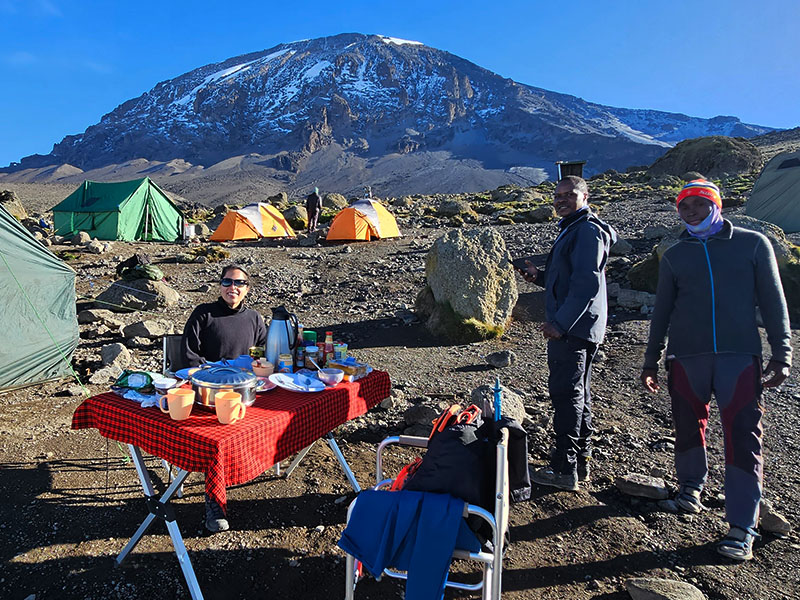
- Camping equipment. Tents, client mattresses, a mess tent, a cooking tent, chairs, tables, plates, cooking gas and lamps all have to be provided, carried and kept in good condition. Marangu is hut-based, so on camping routes operators must provide and transport tents, mattresses and dining facilities that a hut route does not need. We do not carry tents, a dining table or chairs on Marangu.
- Transport and hotel nights. Lemosho starts about 3 to 4 hours by road from a Moshi hotel, while Machame Gate is about 1 to 2 hours. Our price also covers transfers to the park gate and two hotel nights, one before and one after the climb.
- Group size. Park fees are charged per person, but crew and transport costs are shared across the group, so the number of people climbing together can change the cost per person. On Machame, for example, groups of 5 to 8 climbers can start from USD 2,200 per person.
- Comfort level. Private toilet, bed, shower and menu all change the cost.
- Safety equipment. An oxygen cylinder, a pulse oximeter, a blood pressure machine and a first aid kit are a cost to the operator, so ask what is included.
For a view of how season changes crowding on these routes, see our guide to the best time to climb Kilimanjaro.
Kilimanjaro park fees explained
Park fees are the largest single cost on most climbs, and they are set by Tanzania National Parks (TANAPA), not by the operator, so they cannot be negotiated. The tariff for 1 July 2026 to 30 June 2027 lists the fees below in Tanzanian shillings (TZS) for a non-resident adult aged 16 or over on Kilimanjaro. We also show each fee in US dollars (USD). The shilling amounts equal the older 2023/24 dollar tariff at about TZS 2,555 per US dollar, which is our own calculation, so in dollars the fees have not changed.
| Fee | TZS | USD | How it is charged |
|---|---|---|---|
| Conservation (park entry) fee | 178,850 | 70 | Per person, per 24 hours on the mountain |
| Camping fee (public campsites) | 127,750 | 50 | Per person, per night |
| Hut fee (Marangu route) | 153,300 | 60 | Per person, per night |
| Upper Barafu campsite | 255,500 | 100 | Per person, per night |
| Rescue fee | 51,100 | 20 | Per person, per trip |
The tariff also lists small charges for the crew: TZS 3,500 for a mountain guide and TZS 5,000 for a porter or a cook, which is about USD 1.40 and USD 2. These are separate from the visitor fees above, and the operator pays them.
Here is what the visitor fees add up to on a camping climb. The totals are our own arithmetic from the table above, and they leave out the crew charges and any route-specific charges.
| Climb | Conservation | Camping | Rescue | Total |
|---|---|---|---|---|
| 7 days (7 park days, 6 nights) | TZS 1,251,950 (USD 490) | TZS 766,500 (USD 300) | TZS 51,100 (USD 20) | TZS 2,069,550 (USD 810) |
| 8 days (8 park days, 7 nights) | TZS 1,430,800 (USD 560) | TZS 894,250 (USD 350) | TZS 51,100 (USD 20) | TZS 2,376,150 (USD 930) |
TANAPA’s public tariff page still shows the 2023/24 financial year, so check the current figures on the Tanzania National Parks (TANAPA) website or with us before you plan around them. The tariff information says its fees are inclusive of 18 percent VAT where applicable, so we have not added VAT to these totals. Some operators add 18 percent on top of the published amounts, so ask how any quote treats VAT. At Kili Quests, all park fees are inside the package price. When you compare quotes, ask whether park fees are in them.
Guide, porter and cook costs
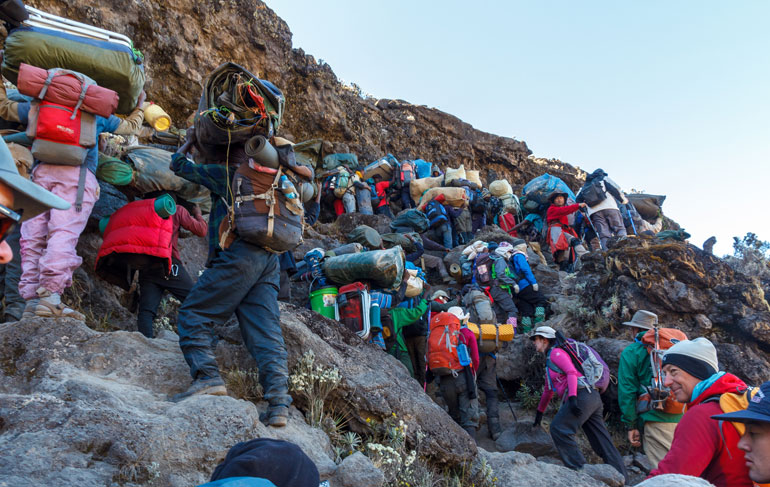
Crew wages are the second big cost. We pay guides, porters and cooks at the rates the authorities recommend, and those wages are inside our package price. The daily porter rate KINAPA has established for the mountain is TSh 25,000. Our daily wages by role are:
| Crew role | Daily wage (TSh) |
|---|---|
| Porter | 25,000 |
| Assistant cook | 30,000 |
| Waiter | 30,000 |
| Cook | 35,000 |
| Guide | 50,000 |
Our crew set-up on a standard camping climb looks like this:
- Porters: 3 per climber. You carry only a daypack of about 5 to 7 kg, and the porters carry your duffel bag, tents, food and camp equipment. For more on loads, read how many porters you need on Kilimanjaro.
- Cooks: 1 cook for up to 8 climbers, 2 for 9 to 15 climbers and 3 for 16 to 25 climbers.
- Toilet: a private portable flush toilet with a dedicated toilet porter.
- Safety: an oxygen cylinder and a first aid kit on every climb, with pulse oximeter checks twice a day.
What our price includes and does not include
| Included in the price | Not included |
|---|---|
| All park fees: entry, camping and rescue fees | Tips for guides, porters and cooks |
| Camping equipment: tents, chairs, tables, mess tent, cooking tent, client mattresses, plates, forks, knives, cooking gas and lamps | Your visa |
| Oxygen cylinder, pulse oximeter and blood pressure machine | Personal trekking gear such as sleeping bag, boots and clothing (available to rent) |
| All meals for clients and porters for the whole climb | Travel insurance and personal expenses such as laundry, phone and drinks |
| Wages for porters, guides and cooks at the rates the authorities recommend | Flights, and overland transfers to Kilimanjaro International Airport or Arusha if you arrive from Nairobi |
| All transport costs to organize the climb, including preparation, porters and food | Hotel nights beyond the two included nights |
| Transfers from your hotel or the airport to the park gate | |
| Private portable flush toilet | |
| Two hotel nights: one before and one after the climb |
The camping equipment applies to our camping routes. On Marangu you sleep in huts. Our Kilimanjaro climb package page explains each inclusion in more detail.
Extra costs to budget for
These costs sit outside any operator’s climb price, so add them to your plan.
| Cost | What to expect |
|---|---|
| Tips | We advise 20 percent of the package price per person. See the next section. |
| Tanzania visa | Fees depend on your nationality and visa type. The official ordinary single-entry visa fee is USD 50 and the multiple-entry visa is USD 100, and US citizens are required to apply for the multiple-entry visa. Apply through the official Tanzania Immigration e-visa portal and check the requirements for your passport before you pay. |
| Flights | Depend on where you fly from and the season. Check current fares to Kilimanjaro International Airport, Dar es Salaam or Nairobi. |
| Travel insurance | Choose a policy that covers trekking to the summit at 5,895 m and helicopter evacuation, and read what altitude it allows. |
| Personal gear | Sleeping bag, boots, clothing and similar items can be rented. Use our Kilimanjaro packing list to decide what to buy and what to rent, and our gear rental guide for what to rent in Moshi and Arusha. |
| Extra hotel nights | Two nights are included. Any additional night is extra. |
How much to tip on Kilimanjaro: Kili Quests guidance
Tips are not part of our package price. Our guidance is that clients tip 20 percent of the climb package price per person, for the guides, porters and cooks who looked after the group. Here is why we suggest it.
Climbing crews do hard work to make a client’s Kilimanjaro dream come true, and many of them depend on this job. When the low season arrives and there are no trips, some go back to farming, and they need capital for that, along with things like insurance for their families. Tips earned in the season are what they draw on, so they can say they saved while they were working.
Here is what that looks like in dollars at the ends of each Kili Quests price range. The amounts are our own arithmetic from the guidance.
| Route | Package price | Tip at 20 percent |
|---|---|---|
| Marangu | 1,800 to 2,000 | 360 to 400 |
| Machame | 2,200 to 2,400 | 440 to 480 |
| Rongai | about 2,400 | 480 |
| Umbwe | about 2,400 | 480 |
| Shira | about 2,600 | 520 |
| Lemosho | 2,700 to 3,000 | 540 to 600 |
| Northern Circuit | 3,000 to 3,500 | 600 to 700 |
This is Kili Quests’ own guidance. If you have questions about tipping before your climb, message us on WhatsApp, or read our Kilimanjaro tipping guide.
Budget, standard and luxury climbs
Quotes fall into broad levels of service. Here is how we separate two of them.
| Level | Porters per climber | What changes |
|---|---|---|
| Standard | 3 | Camping with tents, a mess tent, mattresses, meals, a private portable flush toilet and safety equipment, as listed above. |
| Luxury | 5 | Adds a bed, a big tent and hot water for a shower every day. These comforts need extra crew to carry. |
Luxury prices depend on your route and what you want to add, so message us on WhatsApp for a quote.
Why Kilimanjaro prices differ between operators
A lower price is not automatically a problem. When you compare lower-priced packages, check carefully what is included, because differences can relate to accommodation, equipment, crew arrangements, transport, meals and other services. Before you pay anyone, ask:
- Are all park fees, including rescue fees, in the price, and how is VAT treated?
- How many porters per climber, and what wage do they receive?
- Is there an oxygen cylinder and a first aid kit on every climb, and who carries them?
- Are pulse oximeter checks done every day?
- How many climbers share one guide and one cook?
- Is a toilet provided, and who carries it?
- Are airport transfers and hotel nights included, and how many?
- How many days is the itinerary, and where do you sleep each night?
- What do breakfast and dinner look like, and what tents and mattresses are supplied?
Food and tents deserve a close look. Appetite can change at altitude, so a well-run kitchen plans enough food, with alternatives for a climber who does not feel like the meal on offer, especially before summit night. A tent that lets rain in makes it harder to sleep and recover before the next day.
Marangu: why our itinerary is six days. Marangu is the hut route, so you sleep in mountain huts and not in tents. Allen Minja has seen the cheaper Marangu packages that other operators sell. Our Marangu itinerary is six days long, with one extra day for acclimatization, so your body has more time to adjust to the altitude.
This extra day makes Marangu with Kili Quests an option for beginners who prefer huts to tents. It does not remove the risk of altitude illness, so prepare well and follow your guide’s advice.
What not to cut from your budget
Some savings cost you more than they save.
- Acclimatization days. The CDC advises that above 3,000 m you should not increase your sleeping altitude by more than 500 m per night, and that you should add a rest night for every 1,000 m gained. Fitness does not change that risk. Our acclimatization guide explains how our itineraries handle it, and our guide to altitude sickness symptoms and causes explains what to watch for.
- Emergency oxygen and first aid. Ask for them in writing.
- Proper meals and rest for the crew. Ask how the crew is fed and housed on the mountain.
- Good boots and warm clothing. Rent what you do not own rather than skipping it.
- Insurance. Buy a policy that covers the altitude and evacuation.
Example budgets using Kili Quests prices
Here is one way to add up a first-time budget for a US traveler, using the package price, our tipping guidance and the USD 100 US visa fee. The totals are our own arithmetic and do not include flights, insurance, personal gear or extra hotel nights.
| Route | Package | Tips (20%) | US visa | Total |
|---|---|---|---|---|
| Machame | 2,200 to 2,400 | 440 to 480 | 100 | 2,740 to 2,980 |
| Lemosho | 2,700 to 3,000 | 540 to 600 | 100 | 3,340 to 3,700 |
Is climbing Kilimanjaro worth the cost?
Your price pays for park fees, a mountain crew, food, camping equipment, transport and safety equipment. What matters is knowing exactly what each quote covers, so you can compare like with like.
Given Minja: “Our work is to deliver for every client who climbs with us. We make sure their expectations are met and then go beyond them. The best thing that can happen to us is when a client tells a friend: ‘Go with Allen. He is the right person for you.’”
Allen Minja does not only guide. He makes sure he understands each client and uses all of his skill to meet their expectations and give them a better experience on the mountain.
Frequently asked questions about Kilimanjaro costs
How much does it cost to climb Kilimanjaro with Kili Quests?
Our indicative prices in November 2026 range from about USD 1,800 per person for Marangu to USD 3,500 for the Northern Circuit, depending on the route. Every route is listed in the price table above. Group size can lower the price per person: on Machame, for example, the price is USD 2,400 per person and groups of 5 to 8 climbers can start from USD 2,200. Send us a message with your group size and dates and we will reply with the cost for your group.
Are park fees included in the price?
Yes. At Kili Quests, the price includes all park fees: entry, camping and rescue fees. The amounts depend on the route, the number of days and the current TANAPA tariff, so see the park fees section above and confirm current rates with TANAPA. Ask any other operator to confirm in writing that park fees are included.
How much should I tip on Kilimanjaro?
We advise 20 percent of the package price per person, for the guides, porters and cooks. On a Machame climb at USD 2,200 to 2,400, that is about USD 440 to 480. Tips are not included in the package price.
Why do Kilimanjaro prices vary so much between operators?
Park fees are set by TANAPA, so differences can relate to crew arrangements, food, equipment, group size, itinerary length and what the price includes. Ask each operator what is in the price, how many porters you get per climber, and whether oxygen, a first aid kit and pulse oximeter checks are provided.
What other costs should I budget for besides the climb?
Flights, your visa (the official fee is USD 50 for an ordinary single-entry visa and USD 100 for a multiple-entry visa, depending on nationality and visa type), travel insurance, personal trekking gear or rental, tips, personal expenses, and any hotel nights beyond the two we include.
Want an exact price for your dates?
Share your dates, group size and hiking experience and we will recommend a route and send you a price. No operator can guarantee a summit.
- When would you like to climb?
- How many people will be joining?
- Which route are you considering, or would you like us to suggest one?
- Do you want a standard or luxury climb?
About the author
Given Minja is a Kilimanjaro guide at Kili Quests in Moshi, Tanzania, with more than eight years of guiding experience. Given Minja and fellow guide Daniel Munuo each completed Sentinel Outdoor Institute’s 80-hour Wilderness First Responder course and a Sentinel Outdoor Institute CPR course. Allen Minja, Kili Quests co-founder and Kilimanjaro guide with more than 30 years of mountain experience, is the source of the guiding observations in this article. Learn more about Kili Quests and the team.
Sources
- Tanzania National Parks, Tariffs 2023/2024 and quick reference guide (both for 1 July 2023 to 30 June 2024: conservation, camping, hut and rescue fees)
- Tanzania National Parks tariff figures for 1 July 2026 to 30 June 2027, in Tanzanian shillings (to be confirmed with TANAPA)
- CDC Yellow Book, High-Altitude Travel and Altitude Illness
- Daily News Tanzania, How tourism has transformed lives, industries in Tanzania (2025 daily porter rate)
- Tanzania Immigration Department, visa fees and visa guidelines
- Tanzania National Parks, park tariffs page
Kili Quests prices, inclusions, crew numbers and tipping guidance come from Kili Quests itineraries and operations. Prices are indicative, in US dollars per person, and can change. Park fees, visa fees and wages change over time, so confirm current figures before you book. This article gives general information, not individual medical or financial advice.
Keep planning your climb