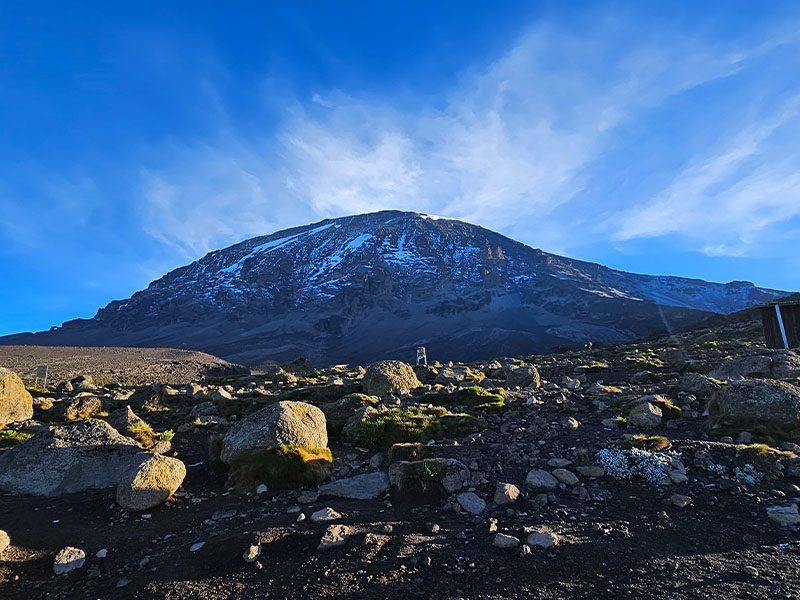
Shira Route Kilimanjaro: Scenic & Remote Trek Guide

Shira Route on Kilimanjaro: Remote Trail with Open Views

Why Choose the Shira Route?

Due to this high starting point, it’s best suited for experienced high-altitude hikers or those who’ve already acclimatized. If you’re looking for a less crowded adventure with expansive views and dramatic landscapes, Shira is worth considering.Check out other Kilimanjaro routes comparison.Each route has its pros and cons—see our Kilimanjaro Route Comparison to choose the best fit
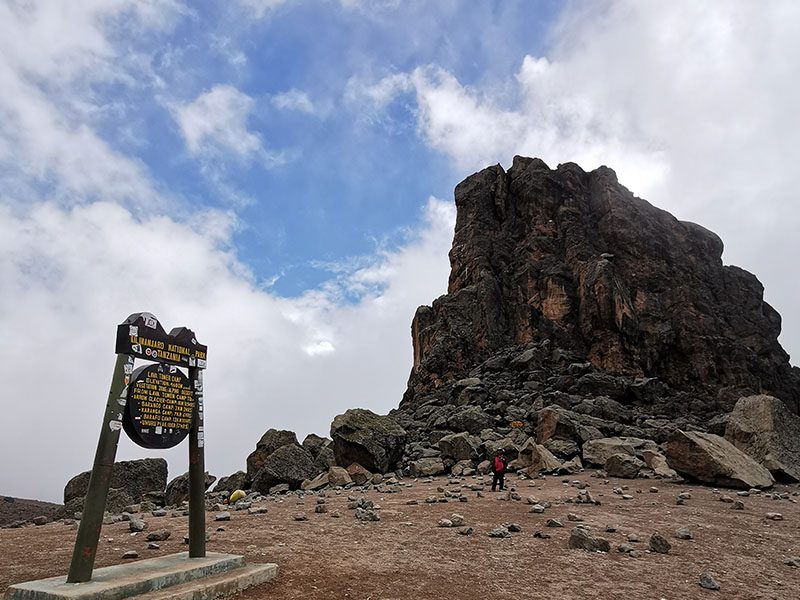
Lava Tower rising steeply at 4,630m on Mount Kilimanjaro’s Shira Route, with the trail sign and a trekker standing beneath the massive volcanic rock | Kili Quests
Lava Tower is a surreal landmark on the Shira Route, often used as an acclimatization stop before descending to Barranco Camp. A must-see on the mountain.

Table of Contents

Shira Route Overview

 Feature Details
Route Length                  –       7 days
Distance                           –       ~56 km (35 miles)
Start Point                       –        Shira Gate (Western Kilimanjaro)
Highest Point                  –        Uhuru Peak (5,895 m / 19,341 ft)
Difficulty                          –        Challenging due to fast altitude gain
Best For                            –         Experienced trekkers, scenic lovers, fewer crowds
Success Rate                   –         85% on the 7-day version

Shira Route Days and Elevation Profile

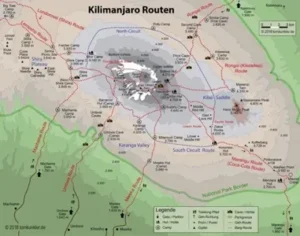
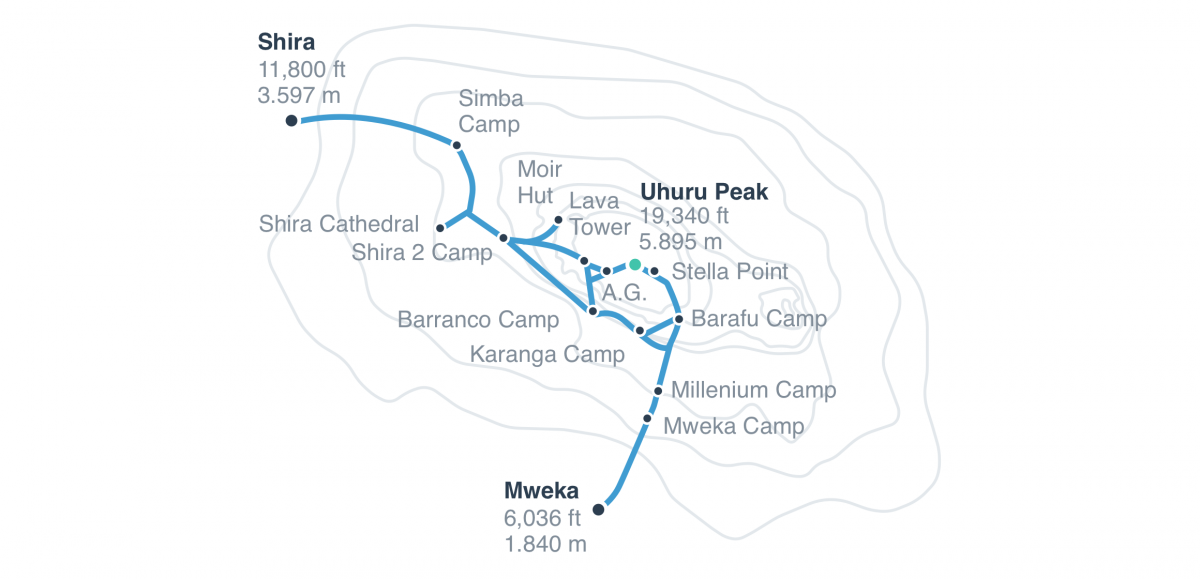
Shira Route map on Mount Kilimanjaro showing trail path from Shira Plateau to Uhuru Peak via Barranco and Barafu Camps
Begins at high altitude on the Shira Plateau and joins the Lemosho-Machame trail to the summit.

Day-by-Day Itinerary (7-Day Itinerary)

Day 1: Shira Gate to Shira 1 Camp

  • Altitude: 3,600 m to 3,610 m
  • Hike Time: 1–2 hours
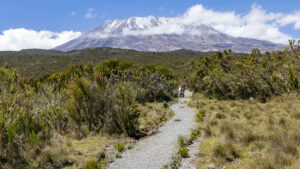
  • Start high and trek across the Shira Plateau with expansive views.
Day 2: Shira 1 to Shira 2 Camp
  • Altitude: 3,610 m to 3,850 m
  • Hike Time: 4–5 hours
  • Gentle ascent across open alpine meadows.
Day 3: Shira 2 to Barranco Camp (via Lava Tower)
  • Altitude: 3,850 m to 4,640 m (up) → 3,960 m (down)
  • Hike Time: 6–7 hours
  • High-altitude acclimatization day via Lava Tower before descending.
Day 4: Barranco to Karanga Camp
  • Altitude: 3,960 m to 4,035 m
  • Hike Time: 4–5 hours
  • Climb the iconic Barranco Wall, then continue to Karanga Valley.
Day 5: Karanga to Barafu Camp
  • Altitude: 4,035 m to 4,673 m
  • Hike Time: 3–4 hours
  • Short hike to the base camp. Rest and prep for summit.
Day 6: Summit Day – Barafu to Uhuru Peak & down to Mweka Camp
  • Altitude: 4,673 m to 5,895 m (summit), descend to 3,100 m
  • Hike Time: 12–14 hours
  • Early morning push to the summit followed by a long descent.
Day 7: Mweka Camp to Mweka Gate
  • Altitude: 3,100 m to 1,640 m
  • Hike Time: 3–4 hours
  • Final walk through the rainforest. Receive your summit certificate!

Shira Route Difficulty and Acclimatization

 The Shira Route is considered more difficult than Lemosho Route  because it starts high — at 3,600 meters. This gives less time for your body to adjust gradually, which increases the risk of altitude sickness. However, the route merges with Lemosho after Day 1, providing good acclimatization afterward.
Best for:
  • Experienced hikers with prior altitude exposure
  • Climbers acclimatized from a previous trek
  • Those wanting a quieter, scenic route
The Lemosho Route is our most scenic trail and has a 98% success rate
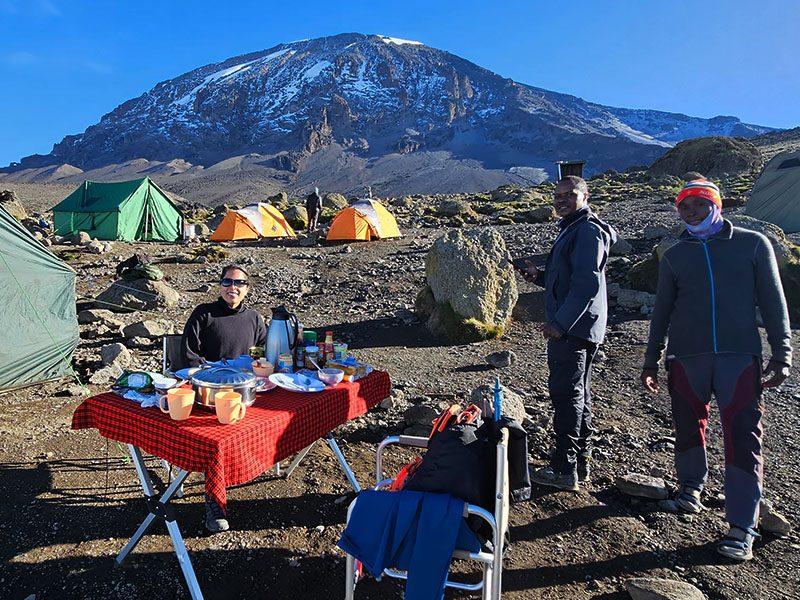
Trekkers enjoying breakfast at Karanga Camp on the Shira Route of Mount Kilimanjaro, with colorful tents and Kibo Peak in the background | Kili Quests
Karanga Camp (3,995m) offers a peaceful stop on the Shira Route, with hot breakfast, scenic campsites, and stunning views of Kibo’s icy slopes.

Best Time to Climb the Shira Route

  • January to early March: Warm with occasional clouds
  • June to October: Clear skies and dry conditions
  • Avoid:
  • Mid-March to May (long rains)
  • November (short rains)

What Makes Shira Route Unique?

  • Starts high on the Shira Plateau (jeep-accessible trailhead)
  • Stunning views from Day 1 onward
  • Less used and less crowded
  • Joins the Lemosho trail from Day 2
  • Passes iconic landmarks like Lava Tower and Barranco Wall

Wondering what’s included in your trek? See exactly what you get with our all-inclusive climbs in the Climb Package Guide — from airport pickup to summit support.

Is the Shira Route Right for You?

  • Are already acclimatized or experienced at high altitude
  • Want to avoid crowds and enjoy peaceful landscapes
  • Prefer a shorter itinerary with similar views to Lemosho route
Sweeping view of Mount Kilimanjaro’s Kibo Peak from Karanga Camp on the Shira Route, with rocky alpine terrain under a bright morning sky | Kili Quests
From Karanga Camp, Shira Route trekkers enjoy this dramatic view of Kibo — a reminder of the summit that awaits beyond Barafu Camp.

Frequently Asked Questions About the Shira Route

Where does the Shira Route start on Kilimanjaro?

The Shira Route begins at Shira Gate on the western side of Mount Kilimanjaro, starting at a high elevation on the Shira Plateau.

Why is the Shira Route considered challenging?

The Shira Route starts at about 3,600 meters, which means climbers gain altitude quickly. This rapid ascent can increase the risk of altitude sickness compared to routes that begin at lower elevations.

How many days does the Shira Route take?

Most climbers complete the Shira Route in 7 days, following a route that later joins the Lemosho Route before reaching the summit.

Is the Shira Route good for beginners?

The Shira Route is generally recommended for experienced trekkers or climbers who have already acclimatized, because of its high starting altitude.

What summit point do Shira Route climbers reach?

Climbers on the Shira Route eventually reach the crater rim near Stella Point before continuing to Uhuru Peak, the highest point in Africa.

What makes the Shira Route unique?

The Shira Route offers wide open landscapes across the Shira Plateau, dramatic volcanic formations like Lava Tower, and fewer crowds compared to other Kilimanjaro routes.

Climb Kilimanjaro with Kili Quests via the Shira Route

At Kili Quests, we offer expertly guided Shira Route climbs for adventurers who want something scenic yet off the beaten path. Our professional mountain teams ensure you’re safe, well-supported, and prepared for the summit — even on this high-starting route.
 Ready to explore Kilimanjaro’s remote western side.Planning your trek? Make sure you understand the official Kilimanjaro trekking rules — from park permits to group size, safety requirements, and porter regulations.
 
[Contact us today] to start planning your Shira Route adventure with Kili Quests.

Related Articles

Mount Kilimanjaro Guide: Facts, Location & Overview

Mount Kilimanjaro, Africa’s highest peak, stands tall at 5,895 meters (19,341 feet) above sea level. Located in northern Tanzania, this iconic free-standing volcano draws thousands of trekkers each year. Whether you’re planning your first summit or comparing routes, this comprehensive guide covers everything you need to know—from choosing the best route to preparing for altitude and understanding what to expect on the mountain.
Read More »

Umbwe Route Kilimanjaro: The Steepest Climb Guide

Plan Your Umbwe Route Climb

The Umbwe Route is steep, direct, and built for experienced climbers.
Get expert advice and a personalized plan for your climb.

Kilimanjaro Planning Guides

Make the right decision before your climb:
Compare all Kilimanjaro routes

OUR CATEGORIES

Umbwe Route on Kilimanjaro: Steep, Short, and Challenging

Why Choose the Umbwe Route?

The Umbwe Route is widely considered the most challenging trail on Mount Kilimanjaro. Known for its steep, direct ascent and fast elevation gain, it offers very little time for acclimatization — making it best suited for experienced climbers.Despite its difficulty, Umbwe is one of the most scenic and least crowded routes on the mountain. It begins in dense rainforest and quickly climbs along a narrow ridge, offering dramatic views and a raw, adventurous feel.If you’re looking for a direct challenge and have prior high-altitude experience, the Umbwe Route can be an unforgettable climb.

Still comparing routes? See our [Kilimanjaro routes comparison guide] or explore alternatives like the [Machame Route Kilimanjaro guide] and [Lemosho Route Kilimanjaro guide] for better acclimatization and higher success rates.
A climber stands on snow-covered terrain near Stella Point on Mount Kilimanjaro, holding a cup and trekking pole while overlooking the crater rim.
A trekker pauses to take in the spectacular view near Stella Point, where Kilimanjaro’s crater rim opens up into a vast, icy alpine landscape.

Table of Contents

Why the Umbwe Route Is Unique

The Umbwe Route is the most direct path up Kilimanjaro, ascending quickly through the southern slopes before joining the southern circuit near Barranco Camp.Unlike longer routes, Umbwe prioritizes speed over gradual acclimatization. This creates a more intense trekking experience, with fewer crowds and a strong sense of wilderness.However, the fast ascent makes it one of the riskiest routes in terms of altitude adaptation.

Umbwe Route Overview

Feature Details
Route Length                –        6 days
Distance                          –       ~53 km (33 miles)
Start Point                      –         Umbwe Gate (Southern Kilimanjaro)
Highest Point                  –        Uhuru Peak (5,895 m / 19,341 ft)
Difficulty                           –        Very challenging
Best For                             –        Experienced climbers, fast ascent, less traffic
Success Rate                     –       75% on the 6-day version
 
Not sure if Umbwe is the right choice? Compare all options in our [complete Kilimanjaro routes guide] to find the best route for your experience level.

Umbwe Route Days and Elevation Profile

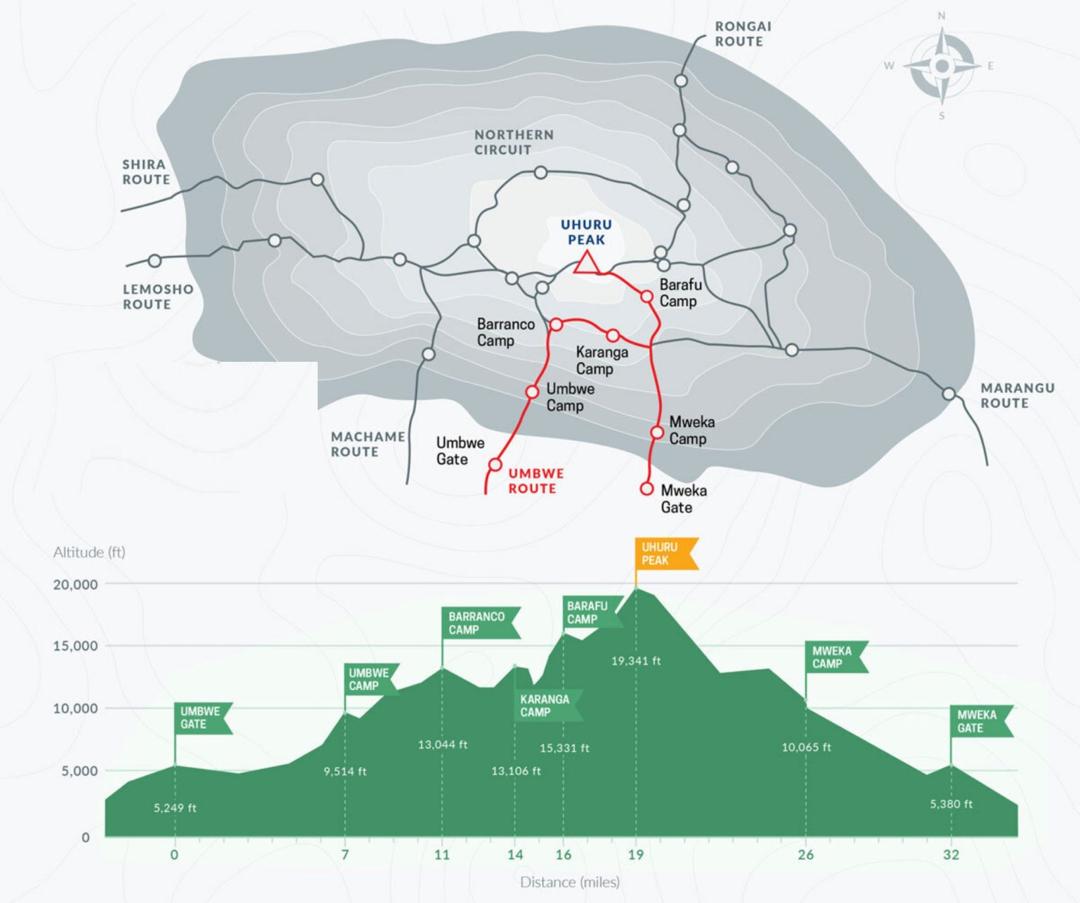
Umbwe Route map on Mount Kilimanjaro showing trail path, elevation chart, and key camps to Uhuru Peak
Kilimanjaro’s steepest and most direct route, ascending via Barranco and Karanga Camps.

Day-by-Day Itinerary (6-Day Version)

Day 1: Umbwe Gate to Umbwe Cave Camp

  • Altitude: 1,800 m to 2,850 m
  • Hike Time: 5–6 hours
  • Steep rainforest ascent through a narrow ridge.
The climb begins at Umbwe Gate, entering a dense rainforest zone. The trail is steep from the start, climbing along a narrow ridge with minimal flat sections.This is one of the most physically demanding first days on any Kilimanjaro route, so pacing is important. You’ll reach Umbwe Cave Camp surrounded by thick forest and rich vegetation.

Day 2: Umbwe Cave to Barranco Camp

  • Altitude: 2,850 m to 3,900 m
  • Hike Time: 5–6 hours
  • Trek through moorland to meet the Machame/Lemosho trails.
The trail continues steeply as you leave the forest and enter the moorland zone. Views begin to open up as you approach Barranco Camp.Here, the Umbwe Route joins the Machame and Lemosho trails, becoming part of the southern circuit.

Day 3: Barranco to Karanga Camp

  • Altitude: 3,900 m to 3,995 m
  • Hike Time: 4–5 hours
  • Climb the Barranco Wall and descend into Karanga Valley.
The day begins with the famous Barranco Wall  a steep but manageable climb that rewards you with incredible views.After crossing ridges and valleys, you’ll descend into Karanga Valley, a key stop before moving higher.

Day 4: Karanga to Barafu Camp

  • Altitude: 4,035 m to 4,650 m
  • Hike Time: 3–4 hours
  • Short but steep climb to base camp for summit prep.
A short but steep climb leads to Barafu Camp, your base for the summit attempt. The environment becomes harsh and exposed, with little vegetation.You’ll rest early and prepare for the midnight summit push.

Day 5: Summit Day – Barafu to Uhuru Peak & down to Mweka Camp

  • Altitude: 4,650 m to 5,895 m (summit), descend to 3,100 m
  • Hike Time: 12–14 hours
  • Early morning summit push, followed by a long descent.
The most demanding day of the climb begins before midnight. You’ll ascend slowly toward Stella Point and continue to Uhuru Peak, the highest point in Africa.After reaching the summit at sunrise, you’ll descend to Barafu briefly before continuing down to Mweka Camp for rest.

Day 6: Mweka Camp to Mweka Gate

  • Altitude: 3,100 m to 1,640 m
  • Hike Time: 3–4 hours
  • Final descent through the forest. Celebrate your summit
The final descent takes you through forest terrain back to Mweka Gate, where you’ll receive your summit certificate and celebrate your achievement.
 
Shorter routes like Umbwe offer less time for acclimatization, which can affect your chances of reaching the summit. Learn more about [Kilimanjaro success rates] and why [Kilimanjaro climb duration] plays a key role.

Umbwe Route Difficulty and Acclimatization

The Umbwe Route is considered the most difficult Kilimanjaro route due to its steep ascent and rapid altitude gain. Unlike longer routes, it provides very little time for your body to adjust to high altitude.This increases the risk of altitude sickness and reduces overall summit success rates. For this reason, Umbwe is only recommended for experienced trekkers with prior high-altitude exposure.

If you’re unsure whether you’re ready, read our full guide on [how difficult Kilimanjaro really is] before choosing this route.
Proper acclimatization is critical — learn how to [acclimatize on Kilimanjaro] to improve your chances of success.
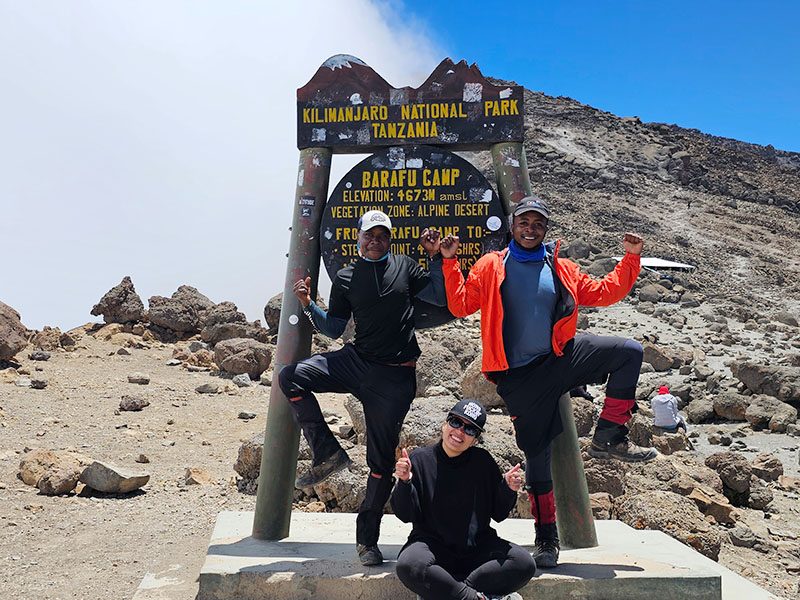
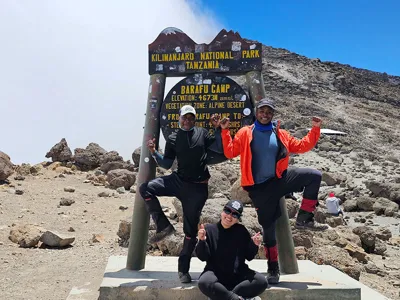
Smiling climbers posing at Barafu Camp (4,673m) on the Umbwe Route, striking fun poses before starting their summit ascent to Uhuru Peak | Kili Quests
A cheerful moment at Barafu Camp, the final staging point on the steep and scenic Umbwe Route before the summit climb begins.

Best Time to Climb the Umbwe Route

  • January to early March: Warmer conditions,fewer climbers
  • June to October: Dry and clear skies
Avoid climbing during:
  • Mid-March to May (long rains)
  • November (short rains)
For a full breakdown of conditions, see our guide on [best time to climb Kilimanjaro].
summit day.

What Makes Umbwe Unique?

  •  Steepest and most direct ascent on Kilimanjaro
  • Remote rainforest trail with few trekkers
  • Joins the southern circuit at Barranco Camp
  • Fast and intense — not a gradual climb
  • Incredible sense of accomplishment if successful

Is the Umbwe Route Right for You?

 Choose Umbwe if you:

  • Have experience trekking at high altitude
  • Want a physical and mental challenge
  • Prefer fewer crowds and raw, natural terrain
  • Are confident in a shorter acclimatization window
Because of its intensity, many climbers choose longer routes instead — compare all options in our [Kilimanjaro routes comparison guide] before deciding.

Umbwe Route Pros and Cons

Pros

  • Very quiet and less crowded
  • Direct and fast ascent
  • Highly adventurous experience
  • Scenic ridge climbing

Cons

  • Highest difficulty level on Kilimanjaro
  • Poor acclimatization profile
  • Lower success rate compared to longer routes
  • Not suitable for beginners
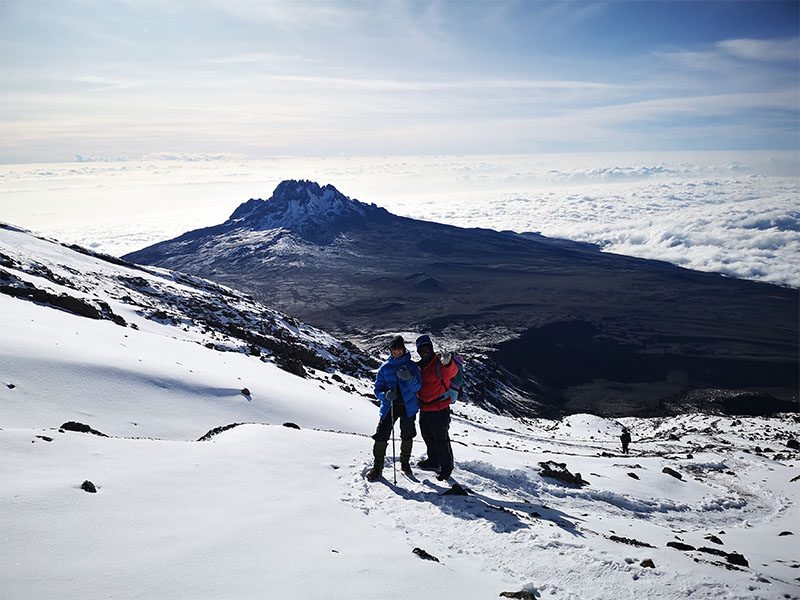
View of Mawenzi Peak rising above the clouds as seen from Stella Point on Mount Kilimanjaro
Nearing Stella Point on the Umbwe Route — a snowy, high-altitude section with sweeping views of Mawenzi and the expansive volcanic landscape below.

Frequently Asked Questions About the Umbwe Route

How difficult is the Umbwe Route on Kilimanjaro?

The Umbwe Route is considered the most challenging route on Mount Kilimanjaro. Its steep terrain and rapid altitude gain provide little time for acclimatization, making it best suited for experienced climbers.

Why is the Umbwe Route considered the toughest Kilimanjaro route?

The Umbwe Route follows a steep and direct path up the southern slopes of the mountain. Because climbers gain altitude quickly, the risk of altitude sickness is higher compared to longer routes like the Lemosho Route or Northern Circuit Route.

How many days does the Umbwe Route take?

Most climbers complete the Umbwe Route in 6 days, making it one of the shorter routes on Mount Kilimanjaro.

Is the Umbwe Route good for beginners?

The Umbwe Route is generally not recommended for beginners due to its steep ascent and limited acclimatization time.

What summit point do Umbwe climbers reach?

Climbers ascending the Umbwe Route usually reach the crater rim near Stella Point before continuing to Uhuru Peak, the highest point in Africa.

Does the Umbwe Route join other Kilimanjaro trails?

Yes. After the early steep section, the Umbwe Route joins the southern circuit near Barranco Camp, sharing the trail with routes such as the Machame Route and Lemosho Route.

Climb Kilimanjaro with Kili Quests via the  Umbwe Route

The Umbwe Route is a serious challenge  best suited for experienced climbers seeking a steep and direct path to the summit.At Kili Quests, we ensure your safety with expert guides, proper pacing, and full support throughout the climb.

Contact us today to plan your Umbwe Route adventure.

Related Articles