Train Smart for Kilimanjaro

Not sure if your fitness level is enough for the climb?At Kili Quests, we help you:

Preparing for Kilimanjaro the Right Way

Training is only part  your route, timing, and acclimatization matter. Explore these guides:

OUR CATEGORIES

How to Train for Kilimanjaro: 6-Week Fitness Plan

Kilimanjaro Is Not Technical , But It Is Demanding

Climbing Mount Kilimanjaro does not require ropes, climbing equipment, or mountaineering experience. But that does not mean it is easy. The real challenge is walking for several days at altitude while your body deals with fatigue, thinner air, changing weather, and long summit hours.
 
Most trekking days involve steady walking for 5 to 8 hours. Summit night can take much longer and often becomes the hardest part of the climb. By then, your legs are tired, your sleep may be lighter, and the altitude makes every step feel slower.
 
Training prepares your body for this reality. It helps you build endurance, leg strength, balance, backpack comfort, and recovery ability. The goal is not to become fast. The goal is to move steadily, recover overnight, and repeat the effort for several days.
 
If this is your first high-altitude trek, read Climbing Kilimanjaro for Beginners and How Hard Is Kilimanjaro? before choosing your route.

Quick Answer: How Should You Train for Kilimanjaro?

You should train for Kilimanjaro by building hiking endurance, leg strength, cardio fitness, stair or hill capacity, backpack comfort, and recovery. Most climbers should train for at least 6 to 8 weeks before the climb. If you are starting from a low fitness level, give yourself more time.
Your training should include:
  • Walking or hiking 4 to 5 days per week
  • One longer hike each weekend
  • Hill, stair, or incline treadmill training 1 to 2 times per week
  • Leg and core strength training 2 times per week
  • Practice with hiking boots and a daypack
  • Gradual backpack weight up to about 6 to 8 kg
  • Rest days to avoid injury and arrive fresh
Kilimanjaro training is not about speed. It is about steady movement, long hours on your feet, and the ability to keep going day after day.
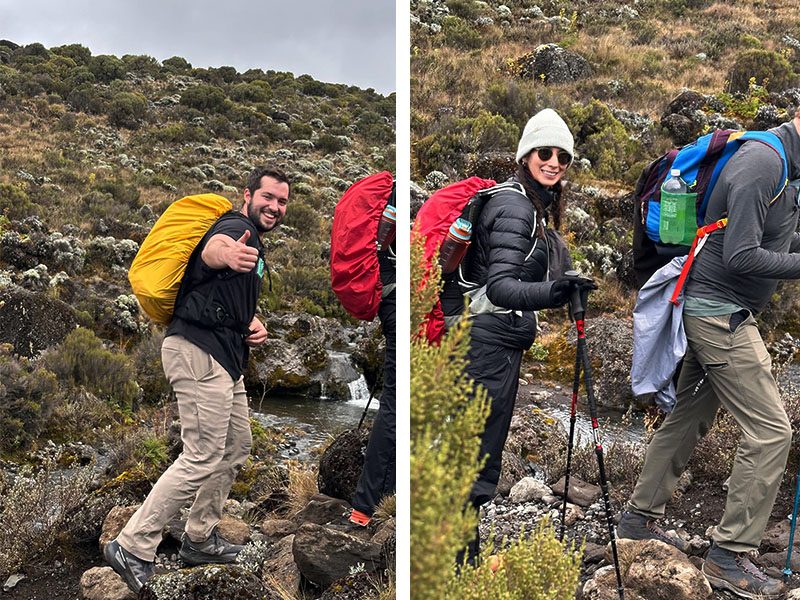
Smiling hiker walking on a trail with trekking gear, building stamina for Kilimanjaro | Kili Quests
With the right training, every step becomes part of your success story.

Table of Contents

What You’re Really Training For

Most people think Kilimanjaro training is about getting “fit.” In reality, it’s about preparing your body for a very specific type of effort.You are not training for speed.
You are training to:
  • Move steadily for long hours
  • Recover overnight and repeat the effort
  • Stay balanced on uneven terrain
  • Keep going when your energy drops
This is why fast runners sometimes struggle, while slower, consistent hikers succeed.Kilimanjaro rewards patience and rhythm  not intensity.
 
Many climbers are surprised by how demanding it is , see our How Hard Is Kilimanjaro? Difficulty Explained.

6-Week Kilimanjaro Training Plan Overview

Week Cardio / Walking Strength Training Hiking Practice Rest
Week 1 3 easy walks, 30–45 minutes 2 light sessions 1 longer walk, 60–90 minutes 1–2 rest days
Week 2 3 walks, 45–60 minutes 2 sessions 1 hike, 1.5–2 hours 1–2 rest days
Week 3 3 walks with hills, stairs, or incline 2 sessions 1 hike, 2–3 hours 1 rest day
Week 4 3–4 sessions with incline or stairs 2 sessions 1 hike, 3–4 hours 1 rest day
Week 5 3 sessions with backpack practice 2 lighter sessions 1 hike, 4–5 hours 1 rest day
Week 6 2–3 moderate sessions 1 light session 1 long hike, then taper 2 rest days

The First Two Weeks: Building a Foundation That Lasts

The beginning of your training should feel almost too easy.That’s intentional.
 
Your goal in the first two weeks is to create consistency. Your body needs to get used to regular movement before it can handle intensity.
 
Go for walks several times a week. Keep a steady pace. You should finish your sessions feeling like you could continue if needed.At the same time, start light strength training. Focus on simple movements like squats, lunges, and planks.
 
These exercises support your joints and improve stability, which is more important than raw strength on the mountain.If you push too hard too early, you risk burnout or injury. If you build slowly, your body adapts naturally.
 
Your training should match your itinerary  see our How Long It Takes to Climb Kilimanjaro.
 

Weeks Three and Four: When Your Body Starts Adapting

By this stage, something changes.Your body is no longer adjusting  it’s improving.
Walks that once felt difficult become manageable. This is where you begin to increase the challenge.
  • Start adding hills to your routes.
  • Use stairs whenever possible.

Extend the duration of your hikes so your body learns to stay active for longer periods.This is also the phase where strength becomes more important.Not for climbing up  but for coming down.

Descending puts significant strain on your legs. Without preparation, this is where fatigue builds quickly. Training your legs to handle that impact will make a big difference during your trek.

Weeks Five and Six: Training for the Reality of the Mountain

Now your training becomes specific.You are no longer just exercising  you are preparing for Kilimanjaro itself.
 
Begin hiking with a backpack. Add weight gradually until you are carrying around 6 to 8 kilograms. This changes your posture, your balance, and how your body uses energy.More importantly, start doing back-to-back hikes.
For example:
  • A long hike on Saturday
  • Another long hike on Sunday
This is one of the most valuable things you can do.Kilimanjaro is not about one difficult day. It’s about showing up again the next morning and continuing, even when your body is tired.That second day teaches your body exactly what the mountain will demand.

Best Strength Exercises for Kilimanjaro Training

Exercise Sets Reps Why It Helps
Squats 3 10–15 Builds leg strength for uphill trekking.
Lunges 3 8–12 each leg Helps with balance and uneven terrain.
Step-ups 3 10 each leg Closely matches uphill hiking movement.
Calf raises 3 15–20 Supports long uphill walking.
Plank 3 30–60 seconds Strengthens your core for balance and backpack comfort.

Cardio Training for Kilimanjaro

Cardio training helps your body handle long trekking days without burning out too early. You do not need to train like a runner, and you do not need high-intensity workouts every day. For Kilimanjaro, steady endurance is more useful than speed.
Good cardio options include:
  • Brisk walking
  • Long hikes
  • Incline treadmill walking
  • Stair climbing
  • Cycling
  • Swimming
  • Slow jogging if you already run comfortably
The key is consistency. Your cardio sessions should build your ability to move for long periods at a controlled pace. Kilimanjaro is climbed slowly, so your training should prepare you for steady effort, not short bursts of speed.

Hiking Practice: The Most Important Kilimanjaro Training

Hiking is the best training for Kilimanjaro because it prepares your body for the exact movement you will repeat on the mountain. Gym workouts help, but they do not fully prepare your feet, knees, balance, joints, and mental patience the way hiking does.
Hiking practice helps you build:
  • Foot comfort
  • Knee and ankle strength
  • Balance on uneven terrain
  • Pacing control
  • Backpack comfort
  • Confidence on long walking days
  • Mental patience when tired

Try to include one longer hike each week. As your training improves, add hills, stairs, uneven trails, or a backpack to make the practice more realistic.

How to Train for Kilimanjaro Without Mountains

You can still prepare well for Kilimanjaro even if you do not live near mountains. The goal is to copy the effort of uphill walking, long time on your feet, and repeated movement over several days.
Use these training options:
  • Stair climbing
  • Incline treadmill walking
  • Step-ups
  • Long city walks
  • Parking garage stairs
  • Walking with a loaded backpack
  • Back-to-back long walks on weekends
If you live in a flat area, stairs and incline treadmill sessions are especially useful. They help your legs adapt to uphill movement and prepare your body for slow, steady climbing.

What to Do in the Final Week Before Kilimanjaro

In the final week before Kilimanjaro, reduce your training intensity. This is not the time to test your limits or start hard new workouts. The goal is to arrive rested, healthy, and ready to climb.
During the final week:
  • Do light walks
  • Stretch gently
  • Sleep well
  • Hydrate regularly
  • Check your gear
  • Avoid heavy leg workouts
  • Avoid long, exhausting hikes
  • Do not try new boots or new training routines

Arriving tired is a mistake. Your final week should help your body recover so you begin the climb fresh.

Kilimanjaro Training Mistakes to Avoid

Many climbers make training harder than it needs to be by focusing on the wrong things. Kilimanjaro rewards consistency, not extreme workouts.

Training Too Hard Too Early

Pushing too hard in the first weeks can cause injury, soreness, and burnout. Build slowly so your body has time to adapt.

Only Running and Not Hiking

Running can help cardio fitness, but it does not fully prepare your feet, knees, backpack comfort, balance, or downhill muscles. Hiking should be part of your training.
Ignoring Descending

Going downhill can be hard on your knees and thighs. Practice descents, step-downs, and controlled walking so your legs are ready for the way down.

Not Testing Boots and Backpack

Do not bring new boots or an untested backpack to Kilimanjaro. Train with the gear you plan to use so you can fix problems before the climb.

Training Without Rest

More training is not always better. Your body improves during recovery. Take rest days so you do not arrive exhausted.

Arriving Tired

Do not destroy yourself in the final week. Reduce intensity, sleep well, hydrate, and arrive fresh.

Altitude Will Be the Hardest Part — No Matter Your Fitness

No training plan can fully prepare you for altitude.You can be very fit and still feel its effects.What training does is give you a stronger base. When altitude slows you down, your body is still capable of continuing.It also helps you control your breathing and maintain a steady pace  both of which are essential at high elevation.
 
 To understand how altitude affects your body, read our Altitude Sickness Guide.
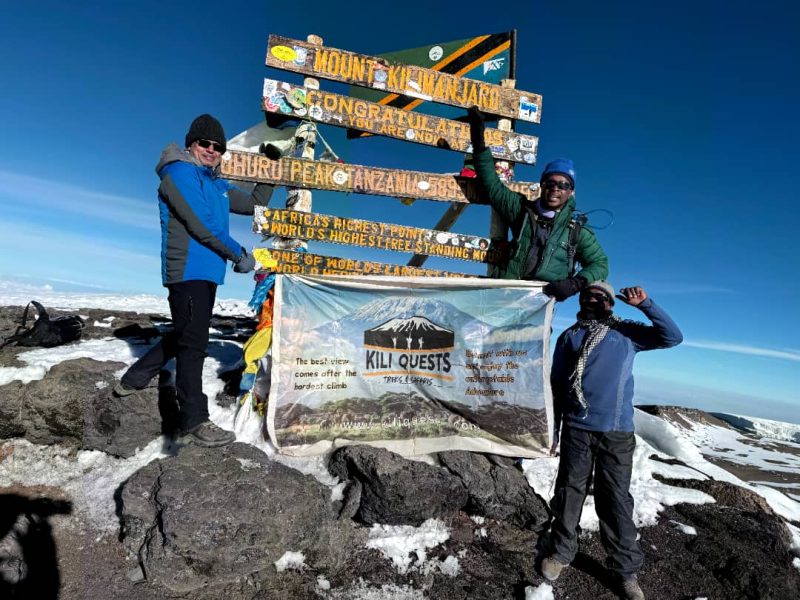
Smiling climber at Uhuru Peak holding a flag or sign after a successful Kilimanjaro ascent | Kili Quests
The reward of every step — with the right training, Kilimanjaro is within reach.

Training With Your Gear Is Part of Preparation

Many climbers make the mistake of bringing new gear to Kilimanjaro without testing it.This creates unnecessary problems.Your boots should already feel comfortable before you arrive. Your backpack should fit properly. Your clothing layers should be familiar.
During training:
  • Wear your actual hiking boots
  • Use your backpack
  • Practice with trekking poles
  • Test your layering system in different conditions

This removes uncertainty and helps you focus on the climb itself.

 Use our Kilimanjaro Packing List to make sure you’re fully prepared.

Recovery Is What Allows You to Improve

Training is only effective if your body has time to recover.Without rest, your body doesn’t adapt  it simply becomes tired.
Make sure you:
  • Sleep at least 7–8 hours per night
  • Take at least one full rest day each week
  • Stretch regularly after workouts
If you feel constantly exhausted, reduce your intensity. Arriving tired is one of the worst ways to start your climb.
 
Choosing the right season also impacts your performance , read our Best Time to Climb Kilimanjaro.

The Real Goal of Training

The goal is not to arrive as the strongest person on the mountain.
The goal is to arrive:
  • Comfortable walking for hours
  • Confident in your pace
  • Mentally prepared for long days
Kilimanjaro is a slow journey. Success comes from consistency, not speed.One step at a time  repeated over days  is what takes you to the summit.

Frequently Asked Questions About Training for Kilimanjaro

How fit do you need to be to climb Mount Kilimanjaro?

You don’t need to be an athlete to climb Kilimanjaro, but you do need a solid level of endurance.The key requirement is not speed or strength  it’s your ability to walk for multiple hours a day, for several days in a row, while carrying a daypack and dealing with altitude. Most trekking days involve steady movement at a slow pace, often on uneven or steep terrain.A good benchmark is this:
  • If you can comfortably complete a 5–6 hour hike and still feel capable the next day, you are on the right track.
Fitness doesn’t eliminate the challenge, but it gives your body the ability to cope with fatigue, recover overnight, and maintain a steady pace  all of which are critical for summit success.

How long should you train before climbing Kilimanjaro?

For most people, 6 to 8 weeks of structured training is enough to prepare for Kilimanjaro  provided that training is consistent.What matters is not just the duration, but progression. Your training should gradually increase:
  • Time spent on your feet
  • Exposure to hills or elevation
  • Ability to recover between sessions

If you already have a good fitness base, you may need less time. If you are starting from a low activity level, giving yourself more time will significantly improve your experience on the mountain.The goal is simple: arrive feeling prepared, not rushed.

Can beginners climb Mount Kilimanjaro?

Yes , and in fact, many successful climbers are beginners.Kilimanjaro is one of the few high-altitude mountains in the world that is accessible to people without technical climbing experience. However, that does not mean it is easy.Beginners who succeed usually do three things well:
  • They follow a structured training plan
  • They choose the right route and itinerary
  • They take acclimatization seriously

With the right preparation and guidance, first-time trekkers regularly reach Uhuru Peak.

What type of exercise is best for Kilimanjaro training?

The most effective training is hiking, because it closely matches the demands of the mountain.However, hiking alone is not enough. A well-rounded training approach should include:
  • Endurance work (long walks, hikes, or cycling)
  • Strength training (especially legs and core)
  • Incline training (hills or stairs)
  • Time-on-feet training (long-duration movement, not intensity)

The goal is to prepare your body for sustained effort not short bursts of performance.If you train in a way that reflects how you will move on the mountain, your body adapts much more effectively.

Should you train with a backpack before climbing Kilimanjaro?

Yes , and it is one of the most important parts of your preparation.On the mountain, you will carry a daypack with water, layers, snacks, and personal items. Even a moderate weight of 6–8 kg changes how your body moves.Training with a backpack helps your body adapt by:
  • Strengthening your shoulders and back
  • Improving balance and posture
  • Teaching your body how to manage energy under load
Climbers who skip this step often feel discomfort early in the trek, even if they are otherwise fit.

Plan Your Kilimanjaro Climb the Right Way

Training gets your body ready, but reaching the summit also depends on the route, pace, acclimatization schedule, guide team, and safety support. The smartest plan combines physical preparation with a realistic itinerary.
 
At Kili Quests, we help climbers choose routes and schedules that match their fitness level, travel dates, and altitude concerns. Our local guides support you with steady pacing, daily health checks, proper acclimatization planning, good mountain meals, and safe summit preparation.
 
If you are preparing for Kilimanjaro, we can help you choose the right route and climb plan before you arrive in Tanzania.
 
Contact Kili Quests today to plan your Kilimanjaro climb with experienced local guides.

Related Articles