
Questions before you book? WhatsApp us: +255 (762) 187 967
Yes. Climbing Kilimanjaro can be dangerous because altitude illness can become life-threatening. The main danger is gaining height faster than your body can adjust. The standard routes to Uhuru Peak (5,895 m) are walked, with no ropes or technical climbing, but people do die on the mountain, mostly from altitude illness, and a fit hiker can still become seriously ill. No reliable official death count is published, so we do not quote one.
Before you book: look at where you will sleep each night, and ask the operator who will go down with you if you need to turn back. Have evacuation insurance that covers up to 6,000 m. On the mountain: tell your guide as soon as you feel unwell, do not sleep higher while you have symptoms, and descend if they get worse. Read the CDC’s altitude guidance.
| Safety question | Short answer |
|---|---|
| Is Kilimanjaro technical? | No. On the main routes it is a high-altitude trek, not a technical mountaineering climb. |
| Do people die on it? | Yes. A two-year hospital review from the region found 21 climbers who died, and altitude illness caused 19 of those deaths. There is no reliable official yearly figure. |
| Main risk | Altitude illness from gaining height faster than the body can adjust. |
| Other risks | Cold, dehydration, exhaustion, injury, stomach issues and poor preparation. |
| Is the Barranco Wall dangerous? | It is a steep rock scramble where you use your hands in places, not a technical climb. Take the Kissing Rock step slowly and follow your guide’s voice. |
| Best safety choice | A longer route, a slow pace, early reporting of symptoms and daily health checks. |
| Beginner-friendly? | Yes, if you train, choose the right route and follow your guide’s instructions. |
On the main routes you walk to the summit. You do not climb vertical rock or ice, so Kilimanjaro is far less demanding in skill than mountains that need ropes, ice axes or glacier travel.
The danger is physiological. Uhuru Peak is 5,895 m (19,341 ft), and your body has to adjust to much thinner air. That is why a mountain with no technical difficulty can still be medically serious.
Yes. A two-year review of hospital records from the region’s main referral hospital, including postmortem referrals, was published in Wilderness & Environmental Medicine in 2021. It included 21 climbers who had died, 17 of them while still climbing. Sixteen deaths were from high-altitude pulmonary edema (HAPE, fluid on the lungs). Three were from HAPE together with high-altitude cerebral edema (HACE, swelling of the brain). One was from trauma and one from a cardiopulmonary cause. In the same review, the vast majority of climbers who reached hospital made a full recovery.
What the review cannot tell you is your personal risk on a particular route. There is no reliable official annual figure either. The UIAA’s mountain medicine page says reliable mortality figures are very difficult to obtain, while citing an unnamed estimate of about 30 deaths a year. Many operator websites say 3 to 10, usually without a source. Because none of these figures can be checked, we do not quote one.
The useful point is the cause. Almost all of the deaths in that review came from altitude illness, which is linked to going up faster than the body can adjust. We take a change in someone’s breathing seriously, even when they can still walk. The rest of this page covers pace, warning signs and what we do when a climber cannot continue.
As you climb, there is less oxygen in each breath, and your body needs time to adjust. This adjustment is called acclimatization, and our guide to acclimatizing on Kilimanjaro explains how routes and pace affect it. The CDC reports that acute mountain sickness affected 75% to 77% of trekkers in recent studies of 4- and 5-day ascents of Kilimanjaro, so mild symptoms are common on short itineraries.
Tell your guide what has changed and when it began. “I have to catch my breath while sitting in the tent” gives us different information from “I breathe harder on the uphill sections.” If a teammate seems confused or is suddenly unsteady, speak up for them.
| What you notice | What to do |
|---|---|
| A new headache after gaining altitude, especially with nausea, dizziness, loss of appetite or unusual fatigue | Tell your guide promptly and have the symptoms assessed. Do not go to a higher sleeping altitude while symptoms are present. Mild symptoms usually start 2 to 12 hours after going higher and typically ease within 12 to 48 hours if you do not climb higher. |
| Symptoms get worse at the same camp despite rest or treatment | Tell your guide immediately and descend. Do not wait for the next scheduled health check. |
| Breathlessness at rest, a cough with chest congestion or difficulty finishing a sentence because of breathlessness (possible HAPE). Confusion, drowsiness or new difficulty walking straight (possible HACE). | Stop ascending and get urgent help. Descent is urgent. With suspected HAPE, keep exertion to a minimum and give oxygen if it is available while arranging the descent. |
The third row covers the two dangerous forms of altitude illness. HAPE is fluid on the lungs: chest congestion, a cough and unusual breathlessness, first on exertion and later at rest. HACE is swelling of the brain: confusion, unsteadiness and drowsiness. Our altitude sickness guide covers the symptoms in more detail.
A prospective study of 1,237 recreational Kilimanjaro hikers (December 2019 to March 2020), published in the Journal of Travel Medicine in 2022, found that 8.6% of them developed severe altitude symptoms and 1.1% were hospitalized. Most climbed higher despite mild or severe symptoms. The only response to mild symptoms linked with fewer severe symptoms was not climbing further. This was an observational study, so it shows an association, not proof. For a climber at camp, the practical rule is to report symptoms before setting out again. Read the study (Croughs and colleagues, 2022).
Medical reviews of high-altitude illness deaths note that the illness is not associated with age or physical conditioning. Fitness helps with the long walking days, but it does not replace time to acclimatize. Pace, number of days and honest reporting matter more.
Kilimanjaro passes through several climate zones. You may start in warm rainforest and reach well below freezing on summit night. Without proper layers, gloves, waterproofs and a warm sleeping system, the cold becomes dangerous. Keep warm gloves, a dry layer and a waterproof jacket in your daypack.
You walk for several days and sleep in tents or huts while your body is adjusting to altitude. Fatigue can make symptoms feel worse and slow your recovery.
Dehydration can make headaches and fatigue worse. The UIAA says cold, dehydration and acute mountain sickness together seem to turn most climbers back. Drink regularly and follow your guide’s advice.
On the way down, tired legs make a slip more likely. A broken bone or a twisted ankle that stops you walking ends the climb, even if you feel well otherwise. If an injury makes it hard to bear weight, stop and tell your guide so the team can assess how to get you down. We treat that as an evacuation, covered below.
Altitude and exhaustion affect judgment. This is why experienced guides matter. A good guide makes safety decisions based on your condition, not your summit emotions.
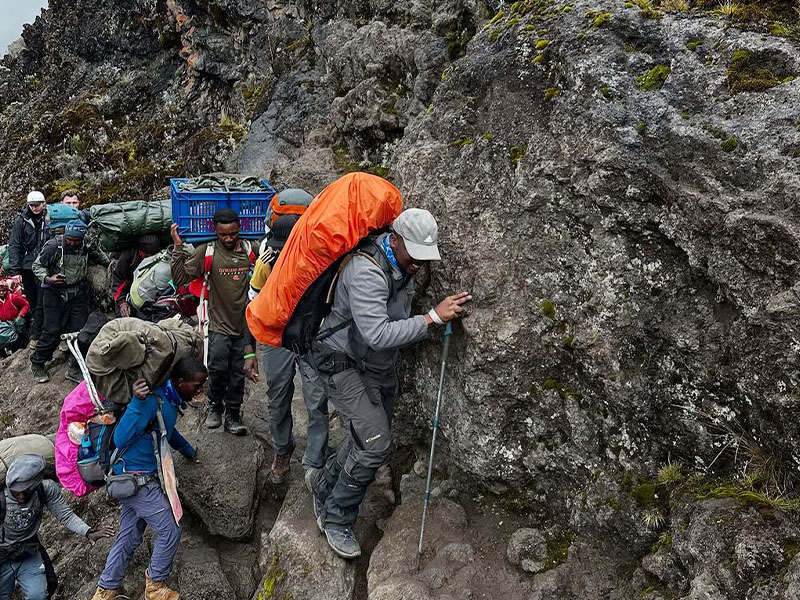
This is one of the questions climbers ask us most, and many worry that crossing the Barranco Wall makes a route dangerous. The Machame and Lemosho routes both cross it, after the night at Barranco. It is a steep rock scramble. You use your hands in places, but you do not need ropes or technical climbing skills. Marangu, Rongai and the Northern Circuit do not cross it. Our guide to technical skills on Kilimanjaro covers the wall in more detail.
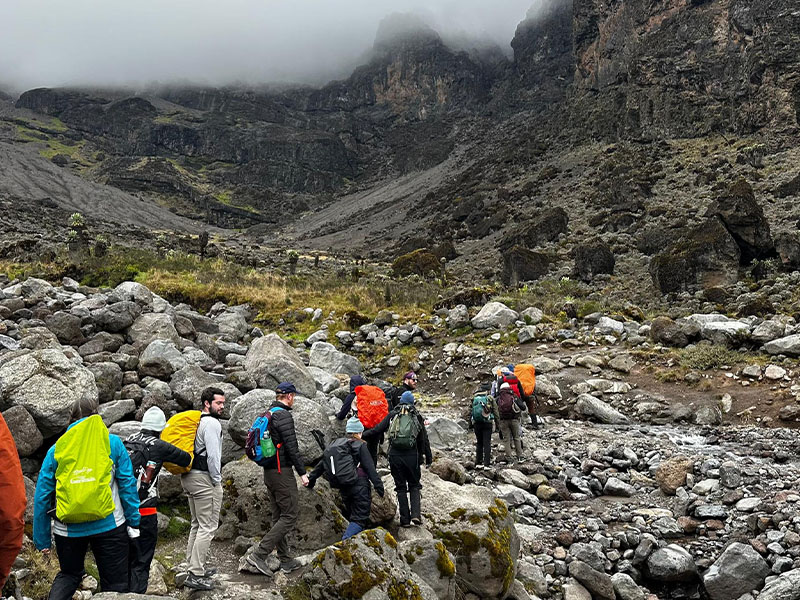
The step people talk about is the Kissing Rock, where the path narrows and you move across with your body close to the rock. At the Kissing Rock, I ask clients to listen to my voice and take their time with the step, even when people are waiting behind them. Your own pace matters more than the group behind you. If heights or scrambling worry you, tell your guide before the wall so they can plan how to help you across.
Altitude illness can affect anyone, including fit climbers. Higher-risk climbers often include people who:
The CDC advises people with coronary artery disease, chronic lung disease, low blood oxygen, sleep apnea or sickle cell trait to see a physician who knows high-altitude medicine before travel, even if the condition is well controlled.
This is how Kili Quests runs its climbs. Other operators do things differently, so ask any company what it checks and how often.
A pulse oximeter gives one piece of information. How you breathe, speak and walk also matters, and a single reading cannot clear someone with warning signs to climb higher.
On 15 July 2018, Allen Minja was guiding a climber on day three of the Machame route, from Shira Cave camp over Lava Tower and down to sleep at Barranco (3,900 m). The climber’s oxygen saturation was 80 in the morning at Shira Cave. After Lava Tower and the descent to Barranco, the evening check was still around 80 to 84.
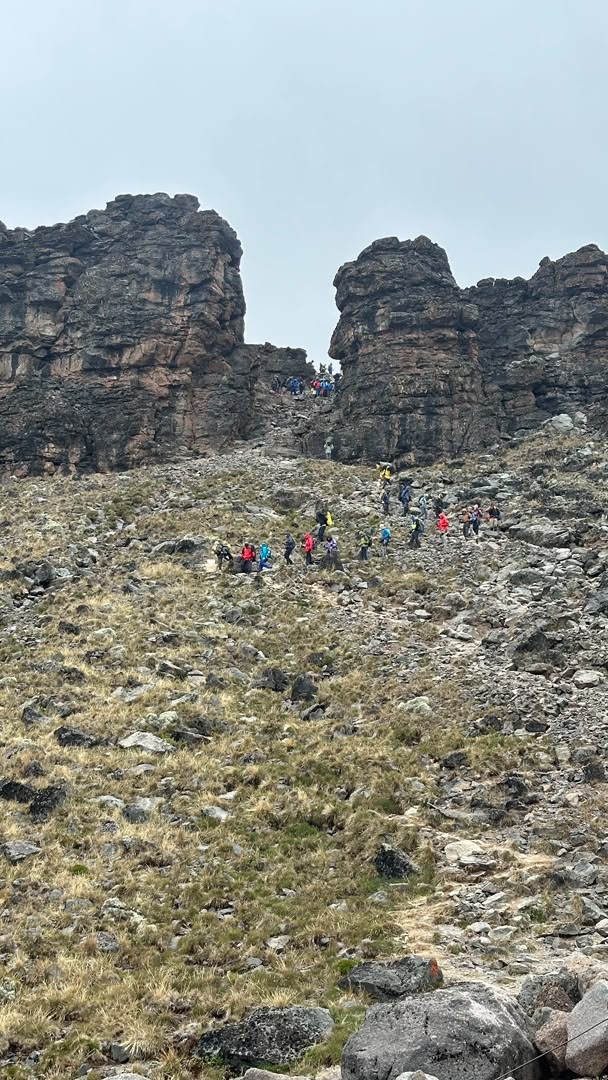
Guides know the body needs time to acclimatize, and many climbers need time to adjust after Lava Tower. That is why the day goes high and then sleeps lower. It is also why we check in the morning and again after dinner: a guide can compare one reading with the next instead of judging a climber from a single number. This climber’s condition got worse near the end of the walk to Karanga the next day, and after the team reached camp they began the descent. The full account is under the Karanga evacuation below.
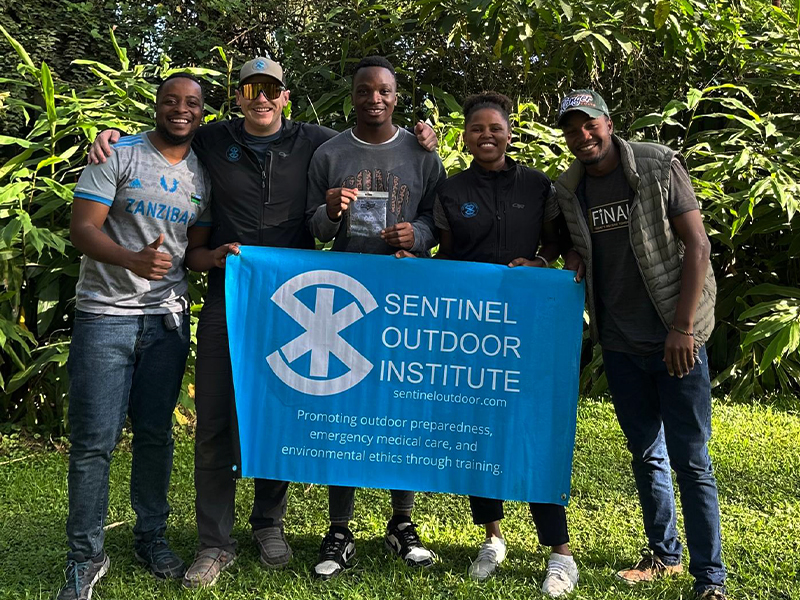
Given Minja, the Kilimanjaro guide who wrote this article, and Daniel Munuo, a Kili Quests guide, each completed Sentinel Outdoor Institute’s 80-hour Wilderness First Responder course and a Sentinel Outdoor Institute CPR course based on American Heart Association Hands-Only CPR guidelines. These are the two guides whose training records we state here.
You can ask any operator this question before paying a deposit. The CDC advises climbers to keep the itinerary flexible and to consider an extra guide who can take anyone who becomes ill back down the mountain. Here is how we handle it.
If someone becomes seriously unwell, we stop climbing and go down. We treat two situations as evacuations: a climber showing symptoms of HAPE or HACE, and an accident, such as a broken bone or a twisted ankle, that leaves the climber unable to walk. If a climber cannot walk, we use a stretcher. The people who go with you depend on the kind of descent:
Before any climb, ask who your guide will be and who will remain with the group if a climber has to descend. Where we descend depends on where the problem happens:
| Where it happens | How we descend | Then |
|---|---|---|
| Karanga or Barafu | Mweka route to the service road | A car takes the climber to KCMC hospital. |
| Barranco | Umbwe route to Umbwe Gate | The climber goes on to hospital. |
| Shira Cave, Shira 1 or Shira 2 | Service road near the Shira plateau to Londorossi Gate | On to Moshi via Sanya Juu and Boma la Ng’ombe. |
This is the same climber Allen Minja was guiding on 15 July 2018, on the Machame route. His oxygen reading was 80 in the morning at Shira Cave and still around 80 to 84 at Barranco that evening. Allen remembers how hard he was breathing, and that he could say only two or three words before coughing. On the walk to Karanga the following day, his condition got worse as the team neared camp.
After the team reached Karanga, they took him down that night by stretcher. They reached town at about 4:00 am and went straight to hospital. After several days under medical supervision, the climber was able to return home.
Breathing this hard, and coughing while trying to speak, are the kind of warning signs in the symptom table above. The CDC says descent is urgent and mandatory in most cases of suspected HAPE, with oxygen given if it is available and as little exertion as possible (CDC guidance). Tell your guide the moment your breathing changes.
Yes, helicopter evacuation is available on Kilimanjaro. When a climber needs one, we contact the helicopter company and give them the climber’s insurance information. The company confirms the emergency evacuation with the insurer. Once that is confirmed, the helicopter goes ahead and comes to carry out the rescue.
If the climber has no insurance, the helicopter is still available, but the climber pays for it directly. We call the helicopter company and they come. Helicopters operate from designated areas.
We recommend that every climber has insurance that covers emergency evacuation for high-altitude trekking up to 6,000 m. Check the altitude limit in your policy. Some policies cover only up to 4,000 m, and Barafu camp is above that, so a policy like that would not cover an evacuation from there. Choosing a policy with a high enough altitude limit saves time sorting out cover when an evacuation is already under way.
A helicopter evacuation is paid for in one of two ways: through your insurance, or by you directly. If you do not have insurance, be prepared to pay for the rescue yourself. Our Kilimanjaro travel insurance guide explains what cover to look for.
Yes, if you train, choose a suitable route and follow your guide’s instructions. You do not need technical climbing skills, but you do need fitness, patience, proper gear and enough days for your body to adjust.
When you compare routes, mark the camp where you sleep each night. That tells you more about the afternoon before summit night than the route name alone. On the 7-day Machame, we sleep at Karanga (3,995 m), and the next morning there are about three to four hours of walking to Barafu, which leaves time to eat and rest before summit night. On the 6-day Machame, climbers cross the Barranco Wall, pass Karanga and reach Barafu the same day.
For fit hikers with little altitude experience, we recommend Lemosho or the 7-day Rongai. Machame suits climbers who are comfortable hiking uphill on consecutive days and have been at altitude before. Fast altitude gain on Marangu can lead to altitude sickness in people who are not used to climbing mountains, so we usually suggest it to experienced climbers. Our Kilimanjaro routes comparison sets the options side by side.
The CDC, citing Wilderness Medical Society guidance, advises raising your sleeping altitude by no more than about 500 m per night once you are above 3,000 m. Its Tanzania guidance adds that extra time helps on routes usually marketed as 4 to 6 days, and advises adding at least 1 to 2 days to the planned ascent. Longer routes spread the climb over more nights, which is the main reason they are usually the better choice.
The most important rule on Kilimanjaro is pole pole, which means slowly in Swahili. Fast climbing increases altitude stress.
Do not hide headaches, nausea, dizziness, vomiting, unusual fatigue or breathing problems. Your guide can only help if you tell them.
You do not need to be an athlete, but you should prepare your legs, lungs and endurance. Practise uphill walking on consecutive days, and try your boots, rain gear and warm layers before you travel. Training helps your legs handle the walking. Previous altitude experience and your sleeping elevations are more useful for discussing altitude risk. Our 6-week Kilimanjaro training plan is a good place to start.
Talk to a doctor who knows high-altitude medicine if you have any condition listed above, and arrange evacuation insurance that covers up to 6,000 m before you travel.
Yes. A 2021 review of hospital records from the region found 21 climbers who had died, and altitude illness (HAPE, with or without HACE) caused 19 of those deaths. There is no reliable official yearly figure, so we do not quote one.
Yes. Medical reviews note that high-altitude illness is not associated with age or physical conditioning. Fitness helps with the long walking days, but fit climbers need the same attention to pace and symptoms as everyone else.
No. Tell your guide when the symptom starts. Describe whether your breathing settles when you stop walking and whether you feel worse than at the previous camp. Anyone struggling to breathe at rest or to speak comfortably needs immediate attention.
Yes. When a climber needs evacuation, we contact the helicopter company and give them the insurance information. The company confirms with the insurer, then goes ahead and flies in. If you have no insurance, you pay the helicopter company yourself, and they come once we call. Helicopters operate from designated areas. Our ground arrangements also include a guide and porters for an accompanied descent or a stretcher evacuation.
Yes. We recommend insurance that covers high-altitude trekking and emergency evacuation up to 6,000 m. Some policies stop at 4,000 m, which is below Barafu camp and falls well short of the summit. Before departure, ask your insurer in writing whether the policy covers trekking to Uhuru Peak at 5,895 m, medically necessary ground and helicopter evacuation, hospital care and any advance-authorisation requirements. Keep the insurer’s emergency number with you. Without insurance, you pay for a helicopter evacuation yourself. A high enough altitude limit also saves time on cover questions during an emergency.
Sources checked on 20 November 2026
Plan a safer Kilimanjaro climb with us
Tell us your dates, how many days you can spend on the mountain and your hiking and altitude experience. We will compare the overnight camps for you and explain how we handle health checks and descent on the route you are considering.
Related articles