

Questions before you book? WhatsApp us: +255 (762) 187 967
Quick answer: what happens after you reach Uhuru Peak?
After a short stop at the top, often 15 to 30 minutes, you walk down the trail your route uses. On Machame, Lemosho, Shira and Umbwe you rest at Barafu, sleep at Mweka Camp and exit at Mweka Gate the next morning. On Marangu and Rongai you rest at Kibo Hut, sleep at Horombo Hut and exit at Marangu Gate. Northern Circuit itineraries and some others differ, so ask which camp and gate yours uses. From the midnight start, summit day lasts about 12 to 15 hours if you sleep at Millennium Camp and 15 to 18 hours if you sleep at Mweka Camp.

Reaching Uhuru Peak at 5,895 m (19,341 ft) is the highlight of a Kilimanjaro climb, but it is the halfway point of summit day, not the end. Most of the hardest walking on your legs is still ahead, and most climbers have questions they did not think to ask: how long is the way down, where do I sleep, what happens at the gate, and how will my body feel?
This guide follows the whole journey in order, from the first steps below the summit to the hotel shower and the days that follow. For preparation before summit night, read our Kilimanjaro summit night tips.
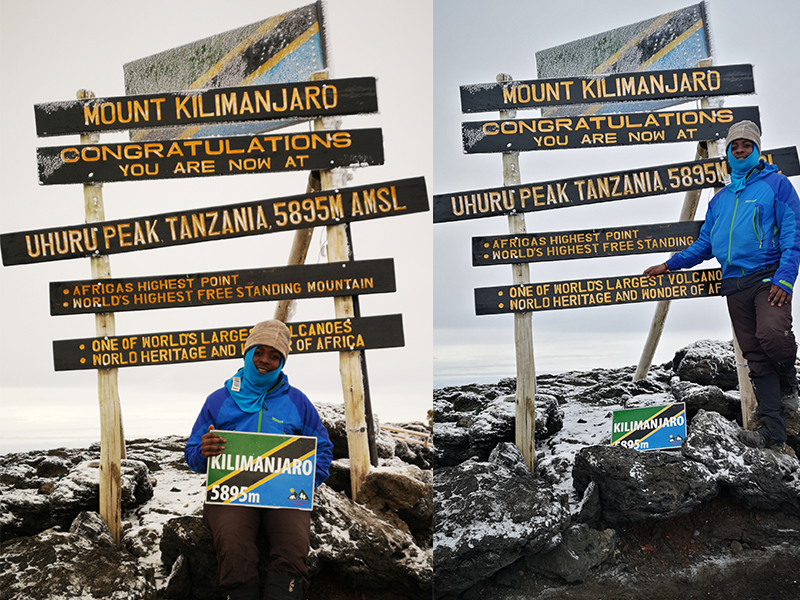
The summit is cold, windy and short on oxygen, so climbers rarely stay long. Expect a group photo at the sign, a few quiet minutes and then your guide turning you around. Many climbers reach Stella Point or Gilman’s Point first and walk along the crater rim to Uhuru Peak, so the way back down starts with that same rim.
Your descent begins at once because the longer you stay high, the longer your body runs on thin air after a night with little sleep. Going down is also when the day’s fatigue catches up with you, so your guide keeps the group together and sets a steady pace.
Four things can differ from route to route: the camp you start summit night from, the trail you come down, the camp where you sleep afterwards and the gate where you exit. Do not assume they match. Our Kilimanjaro routes comparison shows each route side by side.
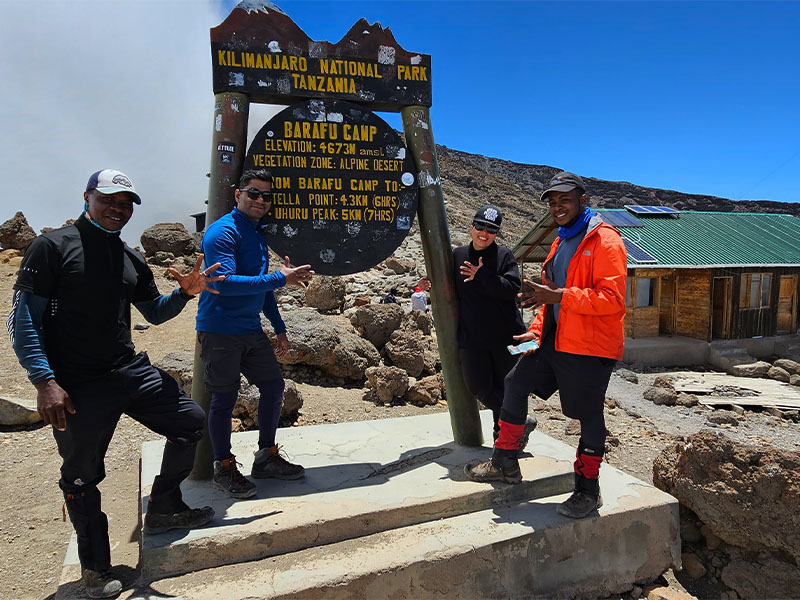
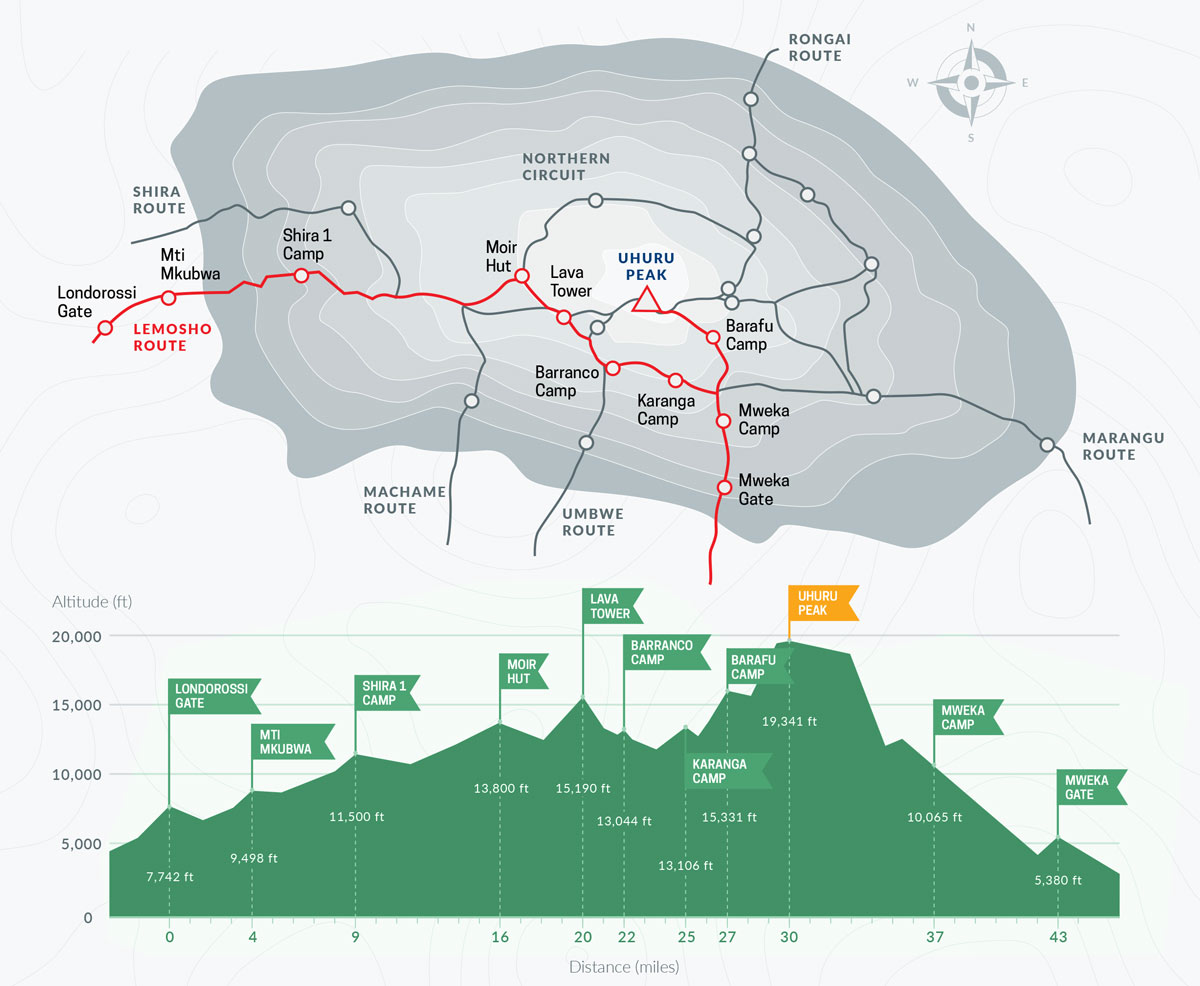
Climbers on these routes start summit night from Barafu Camp, reach the crater rim at Stella Point and return to Barafu after the summit. After a rest there, the group continues down to Mweka Camp for the night, or on some itineraries to Millennium Camp, about 2 hours below Barafu. The next morning you walk through rainforest to Mweka Gate. Our 7-day Machame itinerary gives the day-by-day detail. The Northern Circuit reaches the summit from a different side and its camps differ, so ask us for the plan that applies to your dates.
Both routes summit from Kibo Hut. After the summit you return to Kibo Hut for a meal and a short break, then continue to Horombo Hut for the night. The next day you walk down to Marangu Gate. Marangu is the only route with huts instead of tents, and it uses the same trail up and down. Rongai approaches from the north, then joins the Marangu trail for the descent.
From the summit to the gate takes two days. The times below come from our guiding experience and are approximate. Your pace, the weather and the trail conditions change them.
| Stage | What happens | Typical time |
|---|---|---|
| Uhuru Peak | Photos, a short stop, then turn back | About 15 to 30 minutes |
| Uhuru Peak to Barafu Camp (about 4,670 m) | Rim walk and scree, then food and rest | 3 to 4 hours down, then 1 to 2 hours of rest |
| Barafu Camp to Millennium Camp (about 3,820 m) | Downhill to the night camp on itineraries that use it | About 2 hours (about 4 km) |
| Barafu Camp to Mweka Camp (about 3,100 m) | Long downhill to the night camp | About 5 hours (about 12 km) |
| Whole summit day | From the midnight start to the night camp | 12 to 15 hours to Millennium Camp; 15 to 18 hours to Mweka Camp, rest included |
| Mweka Camp to Mweka Gate (about 1,640 m) | Rainforest trail, sign-out | About 3 to 4 hours (next day) |
| Stage | What happens | Typical time |
|---|---|---|
| Kibo Hut to Uhuru Peak | The summit climb, for comparison | About 7 hours |
| Uhuru Peak to Kibo Hut | Descent, then a meal and a short break | About 2.5 to 3 hours |
| Whole summit day | Kibo Hut to Uhuru Peak, back to Kibo, then on to Horombo Hut | 12 to 14 hours |
| Horombo Hut to Marangu Gate | Moorland and forest trail, sign-out | About 5 to 7 hours (next day) |
Treat these as planning ranges, not promises. Your guide confirms the schedule for your itinerary, and extra stops or a slower pace add to the day.
Many climbers find going down harder than going up. Your thigh muscles act as brakes for thousands of metres of descent, and they are already tired from summit night. Short, controlled steps and trekking poles take load off the knees. Our 6-week training plan includes hill and stair training for this reason.
Below Stella Point and Gilman’s Point the path is loose volcanic gravel. Plant your poles slightly ahead, keep your knees soft and let your guide set the line. Slow is better than fast on scree.
You start the descent in freezing wind and end it in forest warmth, so you take layers off in stages. Tiredness and a low appetite are common after summit night. A headache that is severe or getting worse is not normal tiredness, so tell your guide. For what is normal and what is not, read our guide to altitude sickness on Kilimanjaro.
Summit day does not end at the summit, and neither does the guides’ attention to how you are doing. On our climbs this includes:
Oxygen equipment and monitoring devices do not make a climb risk-free. They support, and never replace, a guide’s judgment, proper medical assessment and going down.
Tiredness, sore legs and a low appetite are expected after summit night. Serious altitude illness is different. Tell your guide at once about confusion, trouble walking in a straight line, a severe or worsening headache, breathlessness at rest, a wet cough or repeated vomiting. Do not wait to see whether these pass. Descent is the first response to serious altitude illness, alongside urgent medical care, and your guide decides what else is needed, which may include supplementary oxygen, an assisted descent or an evacuation.
If one climber has to leave the mountain, the rest of the team stays with the group. On a descent on foot, one Kili Quests guide and two porters go down with the climber. A stretcher evacuation takes one guide and six porters. When a helicopter is used, one guide accompanies the climber, and our office team meets them at the landing site and escorts them to hospital.
On a Marangu climb, a client’s oxygen readings were getting low when we arrived at Kibo Hut. After the evening check we asked her to eat and sleep. When she woke for the summit attempt I checked her again, gave her oxygen and started the descent to Horombo Hut the same midnight. We reached Horombo about 5:00 am and called a rescue car, which arrived about 8:00 am. She said she felt fine on the drive, but I insisted she go to hospital. I tell this story because feeling better after going down is not a reason to skip a medical check.
This is general information, not medical advice. See a doctor before you climb, especially if you have a heart, lung or circulation condition.
You reach Mweka Gate or Marangu Gate, depending on your descent, and sign out with your guide. Summit certificates are issued according to the highest point you reached. Uhuru Peak earns the gold certificate. Sources commonly say that Stella Point and Gilman’s Point earn a green one, but they do not agree on every detail, so ask your guide what is issued on your date. On our Mweka itineraries you collect your certificate at the gate.
The crew often says goodbye with a song and photos. Tipping for guides, cooks and porters is customary, but it is not a park fee and no amount is compulsory. Agree a sensible guideline with your operator before the climb. A vehicle then takes you to your hotel in Moshi or Arusha.
Expect a hot shower, a proper meal and a long sleep. Your legs will probably be stiff, and stairs can feel hard. Recovery varies from person to person, so keep the next day or two easy.
Seek urgent medical help for pain or swelling in one leg, chest pain, breathlessness, confusion or a headache that is getting worse.
There is no single waiting time that suits every climber. The CDC says anyone travelling more than four hours, by air, car or bus, can be at risk of blood clots in the legs (deep vein thrombosis), and tired, swollen legs after a trek are a reason for care. Walk around every hour or two on long journeys, wear loose clothing and talk to a doctor before flying if you have leg pain or swelling, a history of clots or other clotting risk factors. No single measure removes the risk.
Many climbers add a few quieter days in Tanzania before flying. A safari or a few days on Zanzibar gives your legs a break while you see more of the country.
The descent takes two days. On our Mweka itineraries summit day lasts about 15 to 18 hours from the midnight start to Mweka Camp, or about 12 to 15 hours to Millennium Camp, rest included. The next morning you walk about 3 to 4 hours to Mweka Gate. On Marangu and Rongai summit day takes about 12 to 14 hours, and the walk from Horombo Hut to Marangu Gate takes about 5 to 7 hours the next day.
It depends on the route. On Machame, Lemosho, Shira and Umbwe it is usually Mweka Camp, or Millennium Camp on some itineraries. On Marangu and Rongai it is Horombo Hut. Northern Circuit camps differ, so confirm yours before you book.
For the legs, often yes. Long downhill sections stress knees, thighs and ankles after summit night, although breathing gets easier as you lose height. Poles, short steps and a steady pace help a lot.
The guides slow the pace and stay with the climber. If symptoms point to altitude illness or the climber cannot walk safely, descent comes first and the team arranges extra support, an assisted descent or an evacuation. On our climbs a guide and two porters go down with a climber on foot, while the rest of the team stays with the group. Tell your guide early.
There is no universal waiting time. Long journeys of more than four hours raise the risk of blood clots, so move regularly and speak to a doctor first if you have leg pain, swelling or clotting risk factors. Many climbers add a safari or a few days on Zanzibar before flying.
Planning your Kilimanjaro climb?
Share your dates, the route you have in mind, your hiking experience and how your knees cope with long descents, and we will help you choose a route and plan the descent, the exit and your time afterwards. No operator can guarantee a summit.
About the author
Given Minja is a Kilimanjaro guide at Kili Quests in Moshi, Tanzania, with more than eight years of guiding experience. Given Minja and fellow guide Daniel Munuo each completed Sentinel Outdoor Institute’s 80-hour Wilderness First Responder course and a Sentinel Outdoor Institute CPR course. Kili Quests co-founder Allen Minja has more than 30 years of experience on the mountain. Learn more about Kili Quests and the team.
Descent times and the post-summit schedule come from Kili Quests guiding experience and are approximate. This article gives general information, not individual medical advice. Consult a qualified healthcare professional before high-altitude travel and before flying if you have leg symptoms or a clotting risk.
Keep planning your climb